
How Much Is a $10 Gold Coin Worth? Two Very Different Coins With the Same Face Value
Why the “ten dollars” stamped on a gold coin tells you almost nothing about what it’s worth.

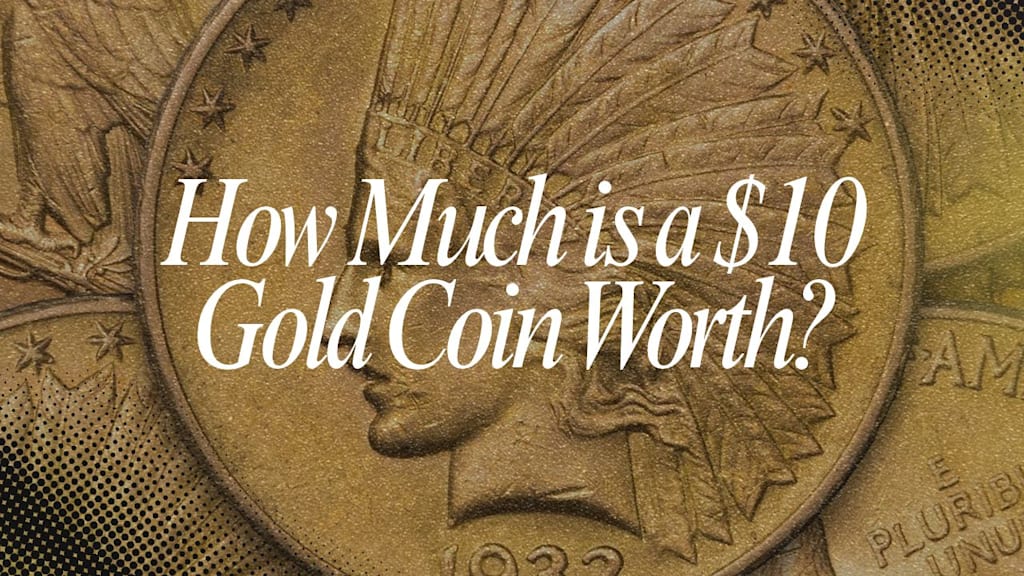
Imagine a man cleaning out his late father’s desk who finds a small gold coin stamped “TEN DOLLARS.” He does the obvious math and assumes it is worth, well, ten dollars. Then a coin dealer tells him it is worth well over a thousand. The man is not being cheated and the dealer is not exaggerating. The face value stamped on a gold coin has almost nothing to do with what it is worth. A $10 gold coin is worth its gold content at the current spot price, plus a premium, and in some cases a collector’s premium on top. Which of those applies depends on which $10 coin you are holding.
Why “Ten Dollars” Is the Wrong Number to Start With
Here is the first thing to understand about gold coins. The face value is a legal tender designation, and it is essentially symbolic. Governments put it on the coin so that the piece qualifies as money, but the gold inside is worth vastly more than the number stamped on it. (If you tried to spend a gold coin at its face value, you would be giving away most of your wealth.)
At least two very different coins carry a $10 face value, and the difference between them is large. The first is the modern one-quarter ounce American Gold Eagle. It contains exactly one quarter of a troy ounce of gold, which is about 7.78 grams. Its total weight is 8.483 grams, because the coin is 22 karat and includes small amounts of silver and copper to make it durable. Its diameter is 22 millimeters.
The second is the pre-1933 $10 Liberty Head or Indian Head eagle, struck from 1838 through 1933. These are heavier: each contains 0.48375 troy ounce of gold, with a total weight of about 16.72 grams, in a 90 percent gold alloy. That is nearly twice the gold of the modern quarter-ounce coin, with the same $10 printed on it.
If you want to compare either one against other gold coins, the weight and gold content of each coin size is the place to match what is stamped on a coin with what is actually inside it. The weight tells you the story the face value does not.
The Three Layers of a $10 Gold Coin’s Price
Once you know which coin you have, the price breaks down into layers.
The bottom layer is melt value: gold content multiplied by the spot price. For illustration only, suppose spot gold were $4,000 per troy ounce. The modern quarter-ounce Eagle would contain $1,000 of gold, and the old $10 Liberty or Indian Head eagle would contain about $1,935 of gold. These are hypothetical figures meant to show the method. Use the live spot price when you do your own calculation, because it changes constantly.
The middle layer is the bullion premium, the amount above melt that a dealer charges to cover minting, distribution and profit. This is the layer that applies to the modern coin. If you are looking at the American Gold Eagles series, the premium is the price of buying a recognizable, government-backed coin that nearly any dealer will take back.
The top layer is the numismatic premium, which applies mainly to the old coins. A pre-1933 $10 eagle is not just gold. It is a piece of American history, and some dates, mint marks and grades are scarce enough that collectors pay far more than melt. A common-date coin in circulated condition may trade close to its bullion value plus a modest premium, while a scarce date in high grade can be worth many multiples of its gold content. That range is wide, and it is the reason you should never price an old coin by weight alone.
A Simple Checklist for Valuing the Coin in Your Hand
When you are trying to find out what a $10 gold coin is worth, the order in which you check things matters.
If the coin says “United States of America” with a Liberty or Indian Head design and a date before 1934, then it is an old eagle, and you should treat it as a possible collectible. Note the date and mint mark, weigh it (it should be close to 16.72 grams), and have it assessed by a reputable dealer or grading service before you decide anything. Do not clean it. Cleaning can destroy numismatic value in seconds.
If the coin says “1/4 oz” or “1/4 OZ FINE GOLD” and carries a modern date, then it is a bullion coin, and its value is gold content plus a bullion premium. The weight should be about 8.48 grams, and the value moves almost entirely with the spot price.
If the coin says $10 but is Canadian, then check carefully. A one-quarter ounce Canadian Gold Maple Leaf carries a $10 face value too, but that is Canadian dollars, and the coin is .9999 fine gold weighing about 7.78 grams. The face value is a hint about the country, not the worth.
If you are unsure what you have, then stop and get a second opinion before you sell or buy anything. This is the habit that separates careful owners from people who learn expensive lessons.
Before you pay a premium, it helps to understand what pushes premiums up or down, because that knowledge is what lets you tell a fair price from an inflated one.
Concerns Buyers and Heirs Often Raise
“What if the premium is too high?” It can be, particularly on small coins and on anything marketed as “rare” or “limited.” Compare the all-in price against melt value, ask the dealer to explain the difference, and walk away from anyone who cannot or will not.
“Is the old coin worth more because it is old?” Only if it is scarce. Age alone does not make a coin valuable. Millions of common-date gold coins survive, and many trade near bullion value. Scarcity, condition and demand are what matter.
“Could the government take it?” This is a reasonable thing to ask, given history. In 1933 an executive order required Americans to turn in most gold coins, though it exempted coins of recognized special value to collectors. That episode is one reason many holders keep records of what they own and why they hold it. It is not a prediction, but it is part of the reason cautious people think carefully about how they own their gold.
There is a larger lesson in the man’s desk drawer. His father kept that coin for a reason. He understood something the Federal Reserve would prefer people forget: Federal Reserve notes lose purchasing power year after year, while a coin with real gold in it keeps its content no matter what number is printed on it. The “ten dollars” on the face was never the point. The gold was.
Gold Content, Not Face Value, Prices a $10 Gold Coin
A $10 gold coin is worth its gold content at the current spot price plus a premium, and the face value has almost nothing to do with it. The modern one-quarter ounce Eagle holds about 7.78 grams of gold. The pre-1933 Liberty or Indian Head eagle holds about 15 grams. Check the date, weigh the coin, identify which one you have, and let the metal, not the label, tell you what it is worth.
About the Creator
Stefan Gleason
Stefan Gleason is President and CEO of Money Metals, the company recently named "Best Overall Online Precious Metals Dealer" by Investopedia. A graduate of the University of Florida, Gleason is a seasoned business leader and investor.
Enjoyed the story? Support the Creator.
Subscribe for free to receive all their stories in your feed.
Comments
There are no comments for this story
Be the first to respond and start the conversation.