
How Building Automation Is Transforming the Future of Smart Infrastructure in the Middle East
Rapid urbanization, smart city investments, sustainability goals, and large-scale construction projects are driving unprecedented growth in the Middle East building automation market.

Across the region, governments are investing billions of dollars into smart cities, mega infrastructure projects, advanced transportation networks, luxury developments, and sustainable urban environments. From futuristic cities rising in the Saudi desert to intelligent skyscrapers reshaping the skylines of Dubai and Doha, technology has become central to how modern buildings are designed, managed, and operated.
At the heart of this transformation is building automation.
What was once considered a luxury feature for premium commercial properties has rapidly evolved into an essential component of modern infrastructure. Building automation systems enable intelligent control of critical building functions such as heating, ventilation, air conditioning, lighting, security, fire protection, and energy management. These technologies help reduce operating costs, improve energy efficiency, enhance occupant comfort, and support sustainability objectives.
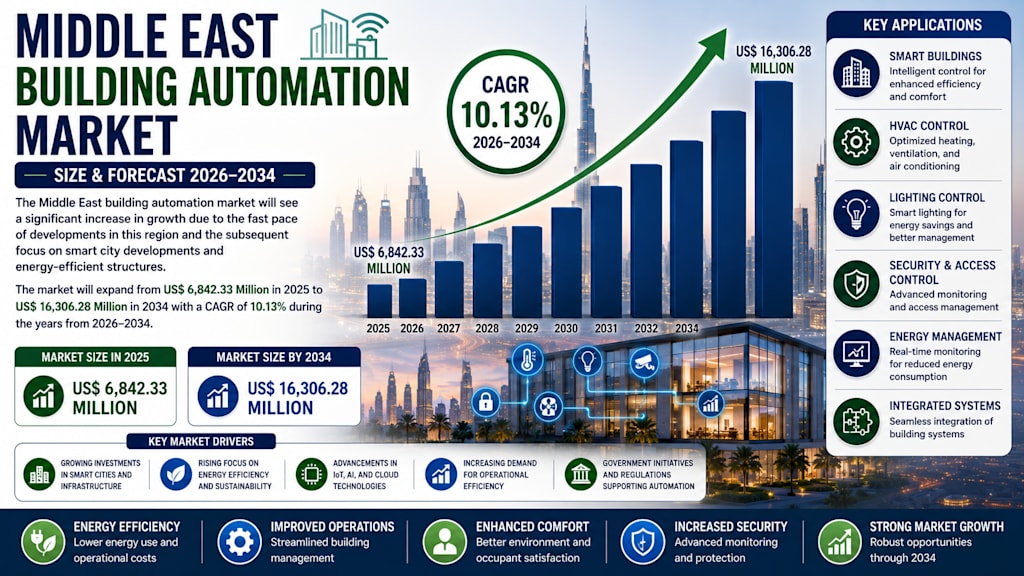
According to Renub Research, the Middle East Building Automation Market is expected to grow from US$ 6,842.33 million in 2025 to US$ 16,306.28 million by 2034, expanding at a compound annual growth rate (CAGR) of 10.13% between 2026 and 2034. The market's rapid growth reflects the region's increasing focus on digital transformation, smart infrastructure, and energy-efficient development.
As urban landscapes continue evolving across the Middle East, building automation is becoming one of the most important technologies shaping the future of construction and facility management.

What Is Building Automation?
Modern buildings are becoming increasingly complex.
Large commercial towers, hotels, hospitals, airports, shopping centers, and residential communities require sophisticated systems to manage daily operations efficiently. Building automation provides a centralized framework that allows these systems to communicate, coordinate, and operate intelligently.
A building automation system integrates sensors, controllers, communication networks, and software platforms to monitor and control essential building functions.
Rather than relying on manual intervention, automated systems can adjust lighting based on occupancy levels, optimize air conditioning according to weather conditions, monitor energy consumption in real time, and trigger security or fire protection responses when necessary.
The result is a smarter building that operates more efficiently while providing a better experience for occupants.
As buildings become larger and more technologically advanced, automation is becoming increasingly necessary rather than optional.
Rapid Urbanization Is Driving Demand
Urban growth remains one of the strongest drivers of the Middle East building automation market.
Countries throughout the Gulf Cooperation Council region are experiencing significant urban expansion fueled by economic diversification, population growth, infrastructure investment, and tourism development.
According to industry estimates, nearly 90% of GCC nationals are expected to live in urban areas by 2050. This dramatic shift is creating unprecedented demand for residential communities, office complexes, hotels, airports, healthcare facilities, educational institutions, and mixed-use developments.
Managing these large and complex structures efficiently requires intelligent systems capable of coordinating multiple building functions simultaneously.
Building automation provides the technological foundation needed to support this growth.
As cities become larger and more densely populated, the ability to monitor and optimize building performance in real time is becoming increasingly valuable.
Mega Projects Are Creating New Opportunities
Few regions in the world are investing in mega projects on the same scale as the Middle East.
Saudi Arabia alone is preparing for several globally significant events over the coming decade, including the AFC Asian Cup, Asian Winter Games, World Expo 2030, FIFA World Cup 2034, and the Asian Games. These events are driving massive investments in hospitality infrastructure, transportation systems, sports venues, and urban development projects.
Projects such as NEOM, Trojena, and numerous smart city developments require advanced building technologies capable of supporting sustainability, operational efficiency, and superior user experiences.
Building automation systems are increasingly incorporated into project designs from the earliest planning stages.
The scale of these developments creates significant opportunities for providers of smart building solutions throughout the region.
Smart City Initiatives Are Accelerating Adoption
Governments across the Middle East are actively promoting smart city development.
Countries such as Saudi Arabia, the United Arab Emirates, and Qatar have launched ambitious programs designed to create more sustainable, efficient, and digitally connected urban environments.
Building automation plays a crucial role within these initiatives.
Smart buildings serve as foundational components of smart cities, providing real-time data, energy optimization, predictive maintenance capabilities, and intelligent environmental controls.
The United Arab Emirates, for example, announced significant investments in smart city solutions aimed at improving public services, enhancing sustainability, and improving quality of life for residents. Such initiatives continue encouraging adoption of advanced building management technologies throughout the region.
As governments pursue long-term sustainability objectives, building automation is becoming a strategic priority rather than a simple operational enhancement.
Energy Efficiency Has Become Essential
Energy consumption represents one of the most important challenges facing building owners in the Middle East.
The region's hot climate creates significant demand for cooling systems, which often account for a large portion of total energy usage. Rising electricity costs and increasing environmental awareness have encouraged organizations to seek more efficient ways of managing energy consumption.
Building automation systems address this challenge directly.
Smart HVAC controls adjust cooling performance based on occupancy, weather conditions, and usage patterns. Automated lighting systems reduce unnecessary electricity consumption, while energy management platforms provide detailed insights into building performance.
These capabilities allow facility managers to identify inefficiencies, reduce waste, and lower operating expenses.
As sustainability goals become increasingly important, energy-efficient building technologies are expected to remain major drivers of market growth.
Improving Occupant Comfort and Experience
Beyond energy savings, building automation significantly enhances occupant comfort.
Modern occupants expect indoor environments that are comfortable, healthy, and responsive to their needs. Whether in office buildings, luxury hotels, residential towers, hospitals, or retail centers, user experience has become a critical consideration.
Automation systems continuously monitor temperature, humidity, lighting, and air quality to maintain optimal indoor conditions.
Instead of relying on static settings, intelligent systems adapt dynamically to changing conditions and occupancy levels.
This not only improves comfort but also supports productivity, health, and overall satisfaction.
In premium real estate developments, superior occupant experiences have become important competitive advantages, further encouraging adoption of smart building technologies.
Fire Protection Systems Are Becoming Smarter
Fire safety remains a critical component of building automation.
The rapid growth of high-rise buildings, large public venues, airports, hotels, and shopping centers has increased demand for advanced fire protection solutions throughout the Middle East.
Modern fire protection systems are increasingly integrated into broader building automation platforms.
This integration enables real-time monitoring, automated alerts, faster emergency response, and coordinated evacuation procedures. Sensors, smoke detectors, suppression systems, and centralized management software work together to improve safety outcomes.
As urban environments become more complex, intelligent fire protection systems are becoming essential elements of modern infrastructure.
The emphasis on safety regulations and risk management is expected to support continued investment in this segment.
Security and Access Control Are Evolving
Security concerns are also driving adoption of building automation technologies.
Organizations increasingly require sophisticated systems capable of protecting people, assets, and critical infrastructure. Traditional access control methods are being replaced by more advanced solutions that offer higher security and greater operational efficiency.
Biometric authentication, RFID systems, smart cards, mobile credentials, and intelligent surveillance platforms are becoming increasingly common.
When integrated with building automation systems, these technologies provide centralized management and real-time visibility across facilities.
Facility managers can monitor activity remotely, receive automated alerts, and respond quickly to potential security incidents.
As smart cities and critical infrastructure projects continue expanding, demand for integrated security solutions is expected to rise substantially.
Commercial Buildings Lead Adoption
Commercial buildings represent one of the largest application segments within the Middle East building automation market.
Office towers, shopping malls, airports, healthcare facilities, educational institutions, and hospitality properties all rely on automation technologies to improve operational performance.
Commercial environments often consume large amounts of energy and accommodate significant numbers of occupants, making efficiency and comfort particularly important.
Automation enables centralized control of lighting, HVAC systems, security functions, and energy consumption, helping reduce costs while improving user experiences.
Hotels and luxury developments have become especially active adopters due to growing expectations regarding convenience, personalization, and sustainability.
As commercial construction activity remains strong throughout the region, this segment is expected to continue driving market growth.
Software Is Becoming the Brain of Smart Buildings
While sensors and hardware remain important, software is increasingly becoming the intelligence behind modern building automation systems.
Cloud-based platforms, artificial intelligence, predictive analytics, and remote monitoring technologies are transforming how buildings are managed.
These systems provide real-time visibility into building performance while enabling automated decision-making and predictive maintenance.
Facility managers can identify potential problems before they result in equipment failures, reducing downtime and maintenance costs.
The integration of software with security systems, fire protection platforms, energy management tools, and IoT devices creates a unified ecosystem that improves overall building performance.
As digital transformation accelerates, software-driven automation solutions are expected to experience particularly strong growth.
Challenges Facing the Industry
Despite strong growth prospects, several challenges remain.
One of the most significant barriers is the high initial investment required to implement comprehensive automation systems. Advanced sensors, software platforms, controllers, communication networks, and integration services can involve substantial upfront costs.
Retrofitting older buildings presents additional complexity and expense.
Another challenge involves workforce availability.
Building automation systems require specialized expertise in networking, software management, engineering, and facility operations. In some parts of the region, shortages of skilled professionals can slow implementation and increase project costs.
Addressing these challenges will be important for sustaining long-term market expansion.
Regional Leaders Driving Innovation
Saudi Arabia remains one of the largest and fastest-growing building automation markets in the region.
Government initiatives such as Vision 2030, combined with large-scale investments in smart cities, airports, healthcare facilities, and commercial developments, continue creating strong demand for intelligent building solutions.
The United Arab Emirates also maintains a leading position due to its focus on smart cities, sustainability, and advanced urban infrastructure. Dubai and Abu Dhabi continue adopting sophisticated automation technologies across residential, commercial, and public sector projects.
Kuwait is gradually increasing adoption as infrastructure development, energy efficiency awareness, and smart building initiatives gain momentum. Growing investment in public and private construction projects is supporting market expansion.
Together, these countries illustrate the region's commitment to building smarter and more sustainable urban environments.
Looking Ahead
The future of building automation in the Middle East appears exceptionally promising.
Continued urbanization, smart city development, sustainability goals, and technological innovation will drive demand for increasingly sophisticated building management solutions. Artificial intelligence, predictive analytics, cloud computing, and Internet of Things technologies are expected to play larger roles in future automation systems.
Building owners will continue seeking solutions that improve operational efficiency, reduce environmental impact, and enhance occupant experiences.
At the same time, governments will increasingly promote smart infrastructure as part of broader economic diversification and sustainability strategies.
These trends position building automation as a key component of the region's future development.
Final Thoughts
The Middle East building automation market is experiencing rapid growth as governments, developers, and businesses invest in smarter, more efficient infrastructure. Driven by urbanization, mega projects, sustainability goals, and technological innovation, automation systems are becoming essential elements of modern building design and operation.
With the market projected to grow from US$ 6.84 billion in 2025 to US$ 16.31 billion by 2034, opportunities for technology providers, construction firms, and facility managers remain substantial. Building automation is no longer simply about convenience; it is becoming a strategic tool for improving energy efficiency, enhancing safety, supporting sustainability, and creating better experiences for occupants.
As the Middle East continues building some of the world's most ambitious cities and infrastructure projects, intelligent building technologies will play a central role in shaping the region's future.
About the Creator
Enjoyed the story? Support the Creator.
Subscribe for free to receive all their stories in your feed.
Comments
There are no comments for this story
Be the first to respond and start the conversation.