
Handheld X-Rays Market Is Reshaping Modern Diagnostics with Portable Imaging Innovation
From dental clinics to emergency care units, handheld X-ray systems are becoming a powerful force in next-generation medical imaging.

Healthcare is entering an era where portability, speed, and accessibility matter more than ever. Traditional imaging systems, while effective, often require large dedicated spaces, expensive infrastructure, and patient movement that may delay urgent diagnosis. This challenge has accelerated interest in compact medical imaging solutions — and handheld X-ray systems are now at the center of that transformation.
The global handheld X-rays market is witnessing remarkable growth as hospitals, dental clinics, emergency response teams, veterinary centers, and remote healthcare providers increasingly adopt portable diagnostic technologies. These lightweight devices allow clinicians to perform imaging at the point of care, improving efficiency and patient outcomes while reducing operational barriers.
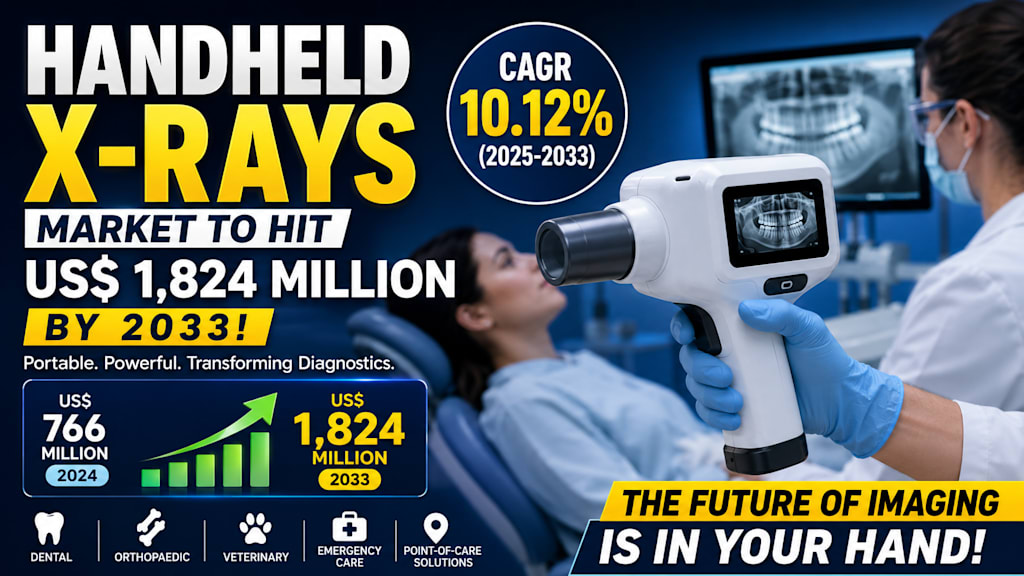
According to Renub Research, the global Handheld X-rays Market is projected to grow from US$ 766 million in 2024 to US$ 1,824 million by 2033, expanding at a CAGR of 10.12% between 2025 and 2033. The rapid adoption of mobile healthcare solutions, rising demand for point-of-care diagnostics, and continuous advancements in imaging technologies are fueling this impressive market trajectory.
Why Handheld X-Ray Systems Are Gaining Global Attention
Medical professionals across the world are prioritizing faster and more convenient diagnostic tools. Handheld X-ray devices address multiple challenges faced by healthcare providers, especially in emergency medicine, dentistry, orthopedic care, and rural healthcare services.
Unlike traditional radiology equipment, portable X-ray systems are compact, battery-powered, and easy to transport. Clinicians can use them directly beside patients, eliminating delays caused by patient transportation and room scheduling.
This advantage became particularly important after global healthcare systems experienced increased pressure for decentralized and rapid medical care. Portable imaging is now considered a critical component of modern healthcare infrastructure.
Healthcare facilities are also investing in technologies that improve workflow efficiency. Handheld systems reduce setup times and streamline diagnostic procedures, enabling providers to handle larger patient volumes without compromising care quality.
Dental Clinics Are Driving Significant Market Demand
Among all applications, dentistry remains one of the strongest contributors to handheld X-ray adoption.
Dental professionals increasingly prefer portable intraoral imaging devices because they simplify the patient experience while improving clinical efficiency. Chairside imaging minimizes patient movement and speeds up diagnosis, allowing dentists to provide faster treatment recommendations.
Portable dental X-rays are especially beneficial for:
Pediatric dentistry
Elderly patients
Patients with mobility limitations
Mobile dental services
Rural outreach programs
In the United States alone, dental visitation rates continue to remain high, creating sustained demand for portable imaging systems. Clinics are also seeking lightweight devices with lower radiation exposure and enhanced digital imaging capabilities.
As cosmetic dentistry and preventive dental care continue expanding worldwide, demand for compact imaging equipment is expected to grow steadily.
Point-of-Care Diagnostics Are Transforming Healthcare Delivery
The rise of point-of-care diagnostics is another major factor boosting the handheld X-rays market.
Healthcare providers increasingly require diagnostic solutions that deliver immediate results without relying on centralized imaging departments. Handheld X-ray systems help clinicians perform imaging exactly where patients receive treatment.
This capability proves valuable in several situations:
Emergency trauma care
Intensive care units
Ambulance services
Military field operations
Disaster relief programs
Rural health missions
In remote regions where access to large hospitals is limited, handheld imaging devices can significantly improve diagnostic access. Portable systems help healthcare workers detect fractures, infections, and dental complications rapidly, enabling quicker intervention.
Governments and healthcare organizations are also promoting mobile healthcare initiatives to expand medical access in underserved communities. This trend is expected to create long-term growth opportunities for handheld imaging manufacturers.
Technology Innovations Are Strengthening Market Expansion
Modern handheld X-ray devices are no longer basic portable imaging tools. Today’s systems incorporate advanced digital technologies that dramatically improve imaging performance and operational usability.
Manufacturers are focusing heavily on:
Artificial intelligence integration
Enhanced image resolution
Lightweight materials
Extended battery performance
Cloud-based diagnostics
Wireless connectivity
Radiation dose reduction
Artificial intelligence is becoming particularly important in image enhancement and automated diagnostic assistance. AI-supported imaging improves diagnostic precision while reducing interpretation time for clinicians.
Cloud integration is another growing trend. Portable X-ray systems can now connect directly with hospital databases and telemedicine platforms, allowing specialists to review scans remotely in real time.
These innovations are helping handheld X-rays become more reliable and clinically effective across multiple healthcare environments.
Veterinary Medicine Is Emerging as a Strong Opportunity
Veterinary healthcare is becoming another important growth segment for portable X-ray systems.
Animal imaging often presents unique logistical challenges because many animals are difficult to position for traditional radiology procedures. Portable X-ray devices allow veterinarians to perform imaging directly in clinics, farms, shelters, and field environments.
Large-animal veterinarians especially benefit from mobile imaging systems because transporting animals to specialized facilities can be difficult and expensive.
The growing global focus on pet healthcare and livestock management is expected to further accelerate demand for veterinary handheld X-ray equipment during the coming years.
Asia-Pacific Is Becoming a High-Growth Regional Market
North America currently holds a dominant share of the global handheld X-rays market due to advanced healthcare infrastructure and rapid adoption of innovative medical technologies.
However, Asia-Pacific is emerging as the fastest-growing regional market.
Several factors are contributing to this rapid expansion:
Rising healthcare investments
Growing awareness of early disease diagnosis
Expanding healthcare access
Increasing rural healthcare initiatives
Rapid urbanization
Rising dental care demand
Countries such as China and India are investing heavily in healthcare modernization. Portable diagnostic tools are becoming essential for reaching large rural populations where traditional imaging infrastructure remains limited.
China, in particular, is witnessing strong demand due to its aging population and increasing chronic disease burden. Portable imaging solutions are helping healthcare providers improve diagnostic access across both urban and rural regions.
Challenges Still Exist for the Industry
Despite strong growth potential, the handheld X-rays market still faces several operational and technological challenges.
Battery Limitations
Most handheld devices rely on rechargeable batteries, which may require frequent charging in high-demand environments. In busy clinics or remote locations with unstable electricity access, limited battery life can disrupt workflow efficiency.
Manufacturers are actively developing higher-capacity and replaceable battery solutions to address this issue.
Image Quality Constraints
Although handheld systems have improved significantly, some devices still struggle to match the image quality of full-sized radiology systems in highly complex diagnostic applications.
Detailed orthopedic imaging, chest examinations, and deep tissue analysis sometimes require higher imaging precision than certain portable systems can currently provide.
However, ongoing advancements in sensor technology and digital processing are steadily narrowing this gap.
Regulatory and Safety Concerns
Radiation safety remains a critical concern for portable imaging devices. Regulatory approvals from organizations such as the FDA and CE authorities play an important role in ensuring product safety and quality standards.
Healthcare providers also require proper operator training to ensure safe and effective device usage.
Competition Is Intensifying Across the Industry
The global handheld X-rays market features growing competition as manufacturers race to develop lighter, smarter, and more efficient imaging systems.
Leading companies are focusing on partnerships, product launches, and technological innovation to strengthen market presence.
Key players include:
Dental Imaging Technologies Corporation
REMEDI Co. Ltd
Genoray
OXOS Medical
Digital Doc LLC
EVIDENT
Carestream Dental LLC
MaxRayCocoon.com
Companies are increasingly investing in AI-enabled diagnostics, cloud-based imaging platforms, and ergonomic device designs to gain a competitive edge.
10 Recent Developments in the Handheld X-Rays Industry
1. OXOS Medical Received FDA Clearance for MC2 Device
In January 2024, OXOS Medical secured FDA approval for its ultraportable MC2 X-ray system featuring digital radiography and fluoroscopy capabilities.
2. Turner Imaging Systems Introduced Enduro DR
In July 2024, Turner Imaging Systems launched the Enduro DR portable digital X-ray solution designed for multiple clinical environments.
3. Mid America Dental Sales Released X4 Handheld
The company introduced the lightweight X4 Handheld device featuring Carbon Nano Tube technology and the ability to capture nearly 800 images on a single charge.
4. AI Integration Became a Key Industry Trend
Manufacturers increasingly incorporated artificial intelligence into portable imaging platforms to improve diagnostic accuracy and image enhancement.
5. Cloud-Based Imaging Adoption Expanded
Healthcare providers accelerated integration of cloud-connected handheld imaging systems for remote diagnostics and telemedicine support.
6. Portable Imaging Demand Increased in Rural Healthcare
Government-backed rural healthcare initiatives boosted adoption of handheld imaging systems across underserved regions.
7. Dental Clinics Accelerated Chairside Imaging Adoption
Dental providers increasingly shifted toward portable chairside imaging solutions to improve patient comfort and operational efficiency.
8. Veterinary Applications Expanded Globally
Veterinary clinics and livestock healthcare providers adopted portable X-ray systems for onsite animal diagnostics.
9. Emergency Care Providers Increased Portable Imaging Investments
Emergency response teams prioritized lightweight imaging systems capable of delivering rapid bedside diagnostics.
10. Battery and Radiation Safety Innovations Continued
Manufacturers focused heavily on improving battery performance and reducing radiation exposure in next-generation devices.
The Future of Portable Imaging Looks Strong
The handheld X-rays market is evolving from a niche healthcare segment into a mainstream diagnostic solution with applications across multiple industries.
As healthcare systems continue prioritizing mobility, rapid diagnosis, and decentralized care delivery, portable imaging technologies are expected to become increasingly essential.
Advancements in artificial intelligence, wireless connectivity, digital imaging, and battery efficiency will likely redefine what portable diagnostic systems can achieve in the coming decade.
For healthcare providers, handheld X-ray systems offer more than convenience — they represent a practical path toward faster, smarter, and more accessible patient care.
Final Thoughts
The future of medical imaging is becoming more mobile, connected, and patient-focused. Handheld X-ray systems perfectly reflect this transformation by delivering diagnostic capabilities directly where they are needed most.
From dental offices and emergency rooms to rural healthcare missions and veterinary clinics, these compact devices are helping bridge healthcare accessibility gaps worldwide.
As innovation accelerates and adoption continues rising, the handheld X-rays market is positioned to play a critical role in shaping the next generation of diagnostic healthcare technologies.
About the Creator
Enjoyed the story? Support the Creator.
Subscribe for free to receive all their stories in your feed.
Comments
There are no comments for this story
Be the first to respond and start the conversation.