
Gold Broke $3,900. Central Banks Kept Buying. That Gap Matters More Than the Drop.
A liquidity squeeze, a 23-tonne purchase, and a packed Shenzhen market point to different time horizons, not one verdict on gold.
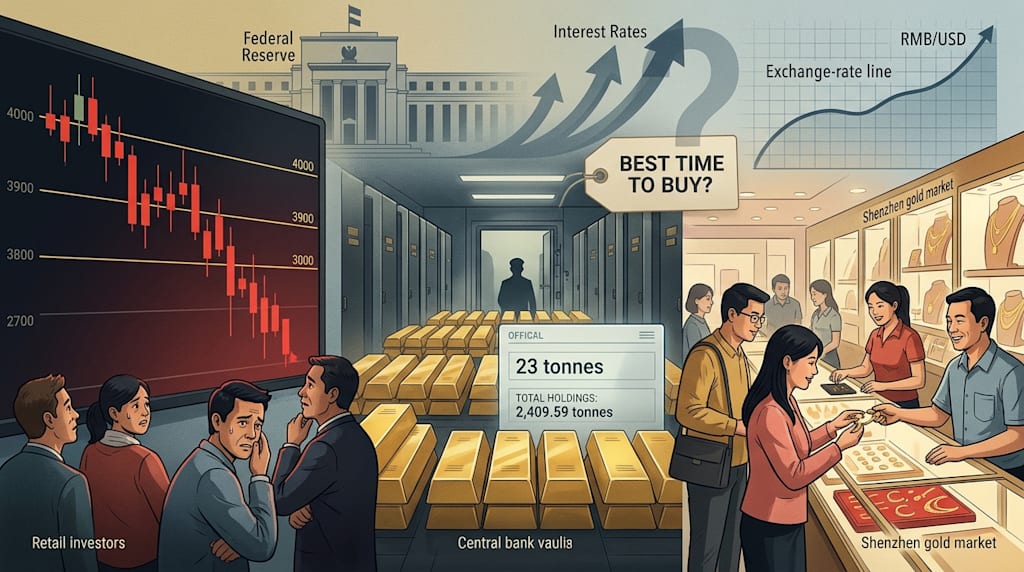
On October 30, New York gold futures fell below $4,000 in early trading and lost $3,900 in the afternoon. Spot gold touched $3,891.23, a year-to-date low. Two round numbers broke in one session, and technical selling followed.
The same day, weekend foot traffic at Shenzhen’s Shuibei gold market was “packed,” according to merchants. One merchant said October sales rose about 30% from September and that “whenever gold prices fall, foot traffic rises noticeably.”
Earlier, China’s central bank bought about 23 tonnes of gold in September. Reserves reached about 2,409.59 tonnes. That was the 23rd straight month of purchases and the largest monthly increase since October 2023.
Three facts sit side by side: prices are falling, the central bank is buying, and physical buyers are rushing in. “Is gold still any good?” cannot capture that split.
1. The breakdown is real. The cause is liquidity, not a failed safe-haven story.
When gold lost $4,000 and $3,900, ordinary investors saw support lines break. Professional investors saw the liquidity structure.
U.S. technology stocks sold off hard in October. The Philadelphia Semiconductor Index fell 11.4% in one week. The S&P 500 technology sector had its worst month since March 2025. Falling risk assets forced deleveraging and margin calls. Institutions needed cash. Gold is liquid and easy to sell, so it became an early source of cash.
That is a liquidity-driven selloff. The world did not stop needing gold. Cash got tight, and gold was sold first. The distinction shapes how you read the drop.
2. The central bank and Shuibei are on different clocks.
The central bank’s 23 straight months of buying, including about 23 tonnes in September, is not a trading signal. It looks at reserve structure, currency credibility, and longer-cycle hedging. It does not forecast next week’s price. It does put money behind a strategic view.
Shuibei runs on another logic. Late October weekends were crowded. Merchant sales rose about 30% month on month. Some consumers treat a decline as a buying opportunity. That does not prove a bottom. It does show physical demand has not vanished.
Different clocks, same direction: when prices fall, reserve and physical demand remain.
3. “Rescue, inflation, gold takes off” skips the policy step.
Over time, hard-landing pressure, government rescue pressure, and sovereign currency risk support gold. That chain holds.
Long-term logic is not a short-term buy signal.
The near-term pressure on gold comes from tighter policy expectations. The Federal Reserve held rates at its October 29 meeting. Rate futures priced about an 80% chance of a 25-basis-point hike in December. The market is pricing a possible hike, not imminent easing.
“Rescue is coming” is a direction. It leaves open when, in what form, and how early the market prices it. Policy timing and liquidity conditions sit in between. “Now is the best time to buy” compresses that gap.
4. RMB appreciation shrinks the multiplier for Chinese gold.
The RMB has been rising against the dollar. The onshore rate touched 6.6696, up about 4.6% this year. Some argue capital will flow into China and Chinese gold will rise more than U.S. gold.
The direction needs a correction.
Domestic gold prices roughly follow: domestic price ≈ international dollar price × RMB exchange rate. When the RMB rises, the multiplier falls. For the same dollar gain in gold, RMB-denominated gold rises less. That relationship implies Shanghai gold may underperform London gold when the RMB rises.
“Capital flows into China, so Chinese gold rises more” needs a condition: RMB demand must be strong enough to offset the currency drag. Without that, RMB appreciation weakens the domestic gain.
5. Is now the best time to buy?
For long-term allocation, gold still has a role. Central banks keep buying. The global monetary credibility system faces stress. Geopolitical risks remain. For ordinary investors, treating gold as part of a portfolio and buying in batches is more prudent than short-term speculation.
For short-term trading, this is not a confirmed bottom for indiscriminate buying. If support near $3,886 breaks, downside may open. Liquidity pressure and rate-hike expectations still weigh on prices. Professional investors keeping cash on hand shows the short-term bottom is not confirmed.
The gap is not “ordinary people are pessimistic, professionals are optimistic.” Ordinary people see price. Professional investors see liquidity structure. Ordinary people ask whether to buy. Professional investors ask at what price, with what instrument, and with what position size.
Gold has a long-term floor. That floor is not one day’s price. It comes from central banks, Federal Reserve policy, and global liquidity. In the short run, the downtrend can remain strong. The bottom is hard to pin down.
Conclusion: keep long-term belief and short-term discipline separate.
Central bank buying and Shuibei crowds give long-term investors confidence. The price breakdown and liquidity squeeze demand caution from short-term traders.
The same candlestick tells different stories. Investors should separate them. Long-term allocation can be gradual and patient. Short-term buying needs signals, position sizing, and stop-loss rules.
Gold is not worthless. “Now is the best time to buy” still deserves a question mark. Opportunity rarely goes to the most pessimistic or the most aggressive. It goes to people who understand the long-term logic and respect short-term risk.
About the Creator
Jin
Writer of reamstories
https://reamstories.com/jin
Enjoyed the story? Support the Creator.
Subscribe for free to receive all their stories in your feed. You could also become a paid subscriber, letting them know you appreciate their work.
Comments
There are no comments for this story
Be the first to respond and start the conversation.