
Global Vision Care Market Expands as Digital Eye Strain, Aging Populations, and Vision Disorders Drive Demand
The global vision care industry is witnessing strong long-term growth as increasing screen exposure, rising vision disorders, and advancements in eye care technologies reshape consumer healthcare habits worldwide.

Market Overview
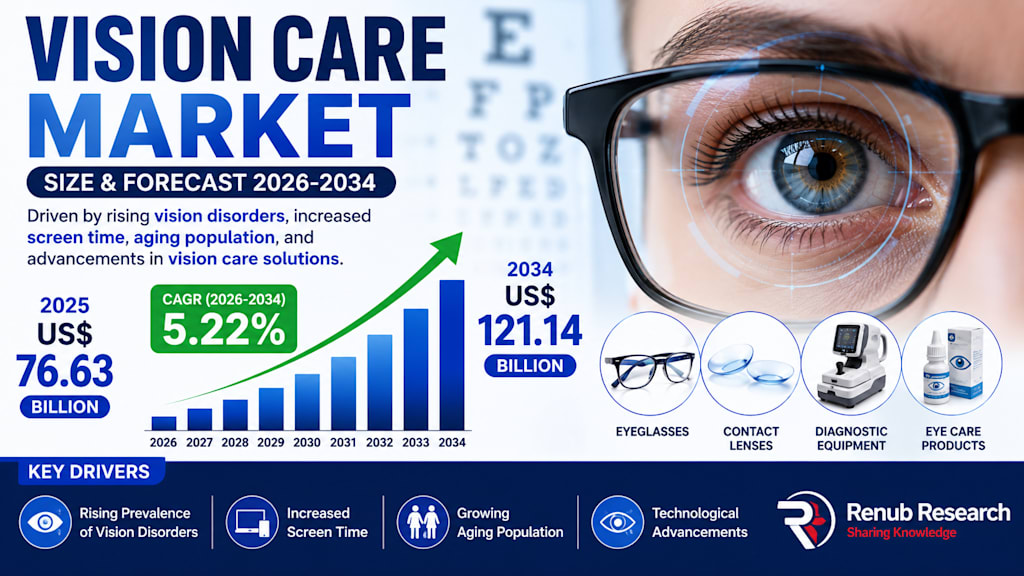
The global Vision Care market is projected to grow from US$ 76.63 Billion in 2025 to US$ 121.14 Billion by 2034, registering a Compound Annual Growth Rate (CAGR) of 5.22% between 2026 and 2034. Rising prevalence of vision disorders, growing digital screen exposure, increasing awareness regarding eye health, and advancements in vision correction technologies are driving market expansion globally.
Vision care has become an essential part of preventive healthcare as millions of people worldwide experience eye strain, refractive disorders, dry eye syndrome, and age-related vision complications. Increasing dependence on smartphones, laptops, tablets, and digital screens is accelerating the need for vision correction products and eye care services across all age groups.
At the same time, technological innovation in contact lenses, eyeglasses, laser therapies, and diagnostic equipment is transforming how vision disorders are diagnosed and managed.
Understanding the Vision Care Industry
Vision care involves the prevention, diagnosis, treatment, and management of eye-related conditions to preserve healthy vision and overall eye function.
The industry includes:
- Eye examinations
- Prescription eyeglasses
- Contact lenses
- Vision correction procedures
- Dry eye treatments
- Diagnostic equipment
- Surgical eye care services
Vision care products and services are widely used to manage conditions such as:
- Myopia
- Hyperopia
- Astigmatism
- Presbyopia
- Cataracts
- Macular degeneration
- Dry eye syndrome
Regular eye check-ups are becoming increasingly important because they allow early detection of vision problems before complications become severe.
Vision Disorders Are Increasing Worldwide
One of the strongest growth drivers in the vision care market is the rising prevalence of vision impairment globally.
According to the source material, at least 2.2 billion people worldwide live with near or distance vision impairment, and approximately 1 billion of these cases could either have been prevented or remain untreated.
Major causes of global vision impairment include:
- Cataracts
- Refractive errors
- Age-related macular degeneration
- Glaucoma
- Diabetic retinopathy
- Presbyopia
The increasing number of people experiencing these conditions is driving strong demand for corrective lenses, diagnostic services, surgical procedures, and preventive eye care solutions.
Aging Populations Are Supporting Long-Term Demand
The aging global population is another major factor fueling growth in the vision care industry.
As people age, the risk of developing vision-related disorders rises significantly because of natural physiological changes in the eyes. Conditions such as cataracts, presbyopia, glaucoma, and macular degeneration are especially common among older adults.
The growing elderly population worldwide is therefore increasing demand for:
- Eyeglasses
- Contact lenses
- Cataract surgery
- Vision correction procedures
- Diagnostic monitoring
- Specialized ophthalmic treatments
Healthcare providers are also increasingly promoting preventive eye examinations for aging populations to improve early diagnosis and long-term vision management.
Digital Lifestyles Are Increasing Eye Strain
One of the most important modern drivers of the vision care market is the growing use of digital devices.
Extended exposure to smartphones, computers, tablets, and televisions is contributing to widespread digital eye strain, dryness, blurred vision, headaches, and irritation.
The report notes that average American workers spend approximately seven hours daily using computers, significantly increasing susceptibility to Computer Vision Syndrome (CVS).
Reduced blinking during screen use contributes heavily to eye dryness and fatigue, particularly among:
- Office professionals
- Students
- Remote workers
- Gamers
- Content creators
This growing issue has increased demand for:
- Blue light filtering lenses
- Artificial tears
- Specialized eyewear
- Regular eye exams
- Digital eye protection products
Employers and healthcare professionals are also encouraging preventive eye care practices to reduce long-term digital vision problems.
Technological Innovation Is Transforming Vision Care
Technology has become a major catalyst for innovation within the vision care market.
Advancements in materials, coatings, diagnostics, and surgical systems are significantly improving patient comfort and treatment outcomes.
Modern contact lenses now offer:
- Extended wear capability
- Better moisture retention
- Higher oxygen permeability
- Improved comfort
Eyeglass lenses have also evolved with features such as:
- Anti-reflective coatings
- Scratch-resistant layers
- Blue light filters
- Lightweight materials
Meanwhile, digital diagnostic equipment is enabling more accurate eye examinations and earlier disease detection.
Laser vision correction technologies like LASIK and PRK are also becoming safer, faster, and more precise, expanding long-term vision correction options for patients.
The report highlights that ZEISS Vision Care introduced recyclable lens wipe sachets in January 2026 as part of its environmentally responsible product innovation efforts.
Cost Remains a Major Barrier for Many Consumers
Despite rapid technological progress, affordability remains one of the biggest challenges in the vision care market.
Advanced eyeglasses, premium contact lenses, laser surgeries, and specialized lens coatings can be expensive, limiting accessibility for low- and middle-income populations.
Laser vision correction procedures are particularly costly and are often not fully covered by insurance systems.
In many countries, lack of insurance coverage for routine eye care services also discourages regular eye examinations and timely treatment.
This affordability gap continues creating disparities in access to quality vision care worldwide.
Limited Infrastructure Challenges Developing Regions
Access to vision care remains uneven across many developing and rural regions.
Several areas still face shortages of:
- Eye care specialists
- Diagnostic equipment
- Optical stores
- Ophthalmic infrastructure
- Affordable vision correction products
Lack of awareness regarding preventive eye care also contributes to underdiagnosis and delayed treatment.
Governments and healthcare organizations are increasingly addressing these issues through:
- Mobile eye care units
- Public awareness campaigns
- Rural outreach programs
- Expanded healthcare investment
However, infrastructure limitations remain a major challenge for long-term market development.
Glass Lenses Continue Holding an Important Market Position
Glass lenses remain an important segment within the vision care market because of their excellent optical clarity, durability, and scratch resistance.
These lenses are often preferred by individuals with stronger prescriptions and specialized vision correction requirements.
Technological improvements have also made modern glass lenses lighter and more comfortable while enhancing functionality through advanced coatings.
The increasing prevalence of refractive disorders such as myopia and astigmatism continues supporting demand within this segment.
Contact Lenses Market Expands Rapidly
The contact lenses market is witnessing strong growth globally because consumers increasingly prefer discreet and convenient alternatives to traditional eyeglasses.
Contact lenses are widely used for correcting:
- Myopia
- Hyperopia
- Astigmatism
Innovations such as soft lenses, daily disposable lenses, and moisture-retaining materials are significantly improving comfort and reducing irritation risks.
Cosmetic and colored contact lenses are also becoming increasingly popular, especially among younger consumers.
The growing availability of contact lenses through online platforms and retail optical chains is further increasing accessibility worldwide.
Laser Therapy Gains Popularity
Laser-based vision correction therapies are becoming increasingly accepted because they offer long-term alternatives to eyeglasses and contact lenses.
Procedures such as:
- LASIK
- PRK
reshape the cornea to improve vision and reduce dependency on corrective lenses.
Technological advancements have improved the safety and precision of these procedures, encouraging greater patient adoption.
Laser therapies are also being used for conditions such as glaucoma and retinal disorders, broadening their role within ophthalmology.
Vision Care Surgery Market Continues Growing
Surgical vision care procedures are also witnessing strong global demand.
Common surgeries include:
- Cataract surgery
- Retinal surgery
- Refractive surgery
Minimally invasive surgical techniques have improved recovery times and treatment accuracy, making surgical solutions more accessible and effective.
Government healthcare programs and insurance coverage in many countries are also improving patient access to advanced eye surgeries.
Hospitals Play a Central Role in Vision Care Services
Hospitals remain one of the most important end-users within the vision care industry.
Modern hospitals provide:
- Comprehensive eye examinations
- Cataract surgery
- Laser therapy
- Emergency ophthalmic care
- Specialized diagnostics
Healthcare investment and the development of specialized ophthalmology departments continue strengthening hospital-based vision care services worldwide.
United States Leads the Global Market
The United States remains one of the largest vision care markets globally because of its advanced healthcare infrastructure, high awareness regarding eye health, and widespread use of digital devices.
Myopia, presbyopia, and digital eye strain are highly prevalent in the country, driving strong demand for corrective products and ophthalmic treatments.
The report highlights that Alcon announced U.S. commercial availability of TRYPTYR for Dry Eye Disease treatment in July 2025.
Strong insurance systems, technological innovation, and large optical retail networks continue supporting market expansion in the United States.
India Emerges as a Fast-Growing Market
India’s vision care market is expanding rapidly because of its large population, increasing screen exposure, urbanization, and rising awareness regarding eye health.
Government eye care programs and increasing availability of hospitals, optical stores, and affordable treatments are improving accessibility across both urban and rural regions.
Growing middle-class incomes are also encouraging consumers to invest more in eyeglasses, contact lenses, and advanced eye treatments.
Saudi Arabia Invests in Eye Care Expansion
Saudi Arabia’s vision care market is steadily growing because of rising healthcare investment, environmental conditions, and increasing awareness regarding eye health.
Dust exposure, intense sunlight, and dry climate conditions contribute significantly to eye irritation and vision problems within the region.
The report notes that Alcon opened its Alcon Experience Center in Jeddah in March 2025 to support ophthalmology education and innovation in the region.
Key Industry Players
Major companies operating in the global vision care market include:
- Essilor International
- Johnson & Johnson Services, Inc.
- Bausch Health Companies, Inc.
- Novartis International AG
- Grand Vision
- Carl Zeiss
- Valeant Pharmaceuticals
- Paragon Vision Science
- Menicon
These companies continue investing heavily in lens innovation, surgical technologies, digital diagnostics, and advanced ophthalmic treatments.
Final Thoughts
The global vision care market is evolving rapidly as digital lifestyles, aging populations, and rising vision disorders increase demand for preventive and corrective eye care solutions. Advances in contact lenses, surgical technologies, diagnostics, and eye health awareness are creating strong long-term opportunities across the industry.
However, affordability and limited access to care in developing regions remain important barriers that healthcare systems and industry players must continue addressing.
As screen exposure and visual demands continue rising globally, vision care is expected to become an even more essential component of everyday healthcare and preventive wellness.
About the Creator
Enjoyed the story? Support the Creator.
Subscribe for free to receive all their stories in your feed.
Comments
There are no comments for this story
Be the first to respond and start the conversation.