
Global Ultrasound Devices Market Set for Strong Growth as Demand for Non-Invasive Diagnostics Accelerates
Advancements in imaging technology, growing chronic disease prevalence, and expanding healthcare infrastructure are driving the next phase of growth in the global ultrasound devices industry.

Introduction: Ultrasound Technology Becomes a Cornerstone of Modern Healthcare
Medical imaging has become one of the most important pillars of modern healthcare, enabling physicians to diagnose diseases earlier, monitor patient conditions more effectively, and make faster treatment decisions. Among the various imaging technologies available today, ultrasound continues to stand out because of its safety, affordability, accessibility, and versatility.
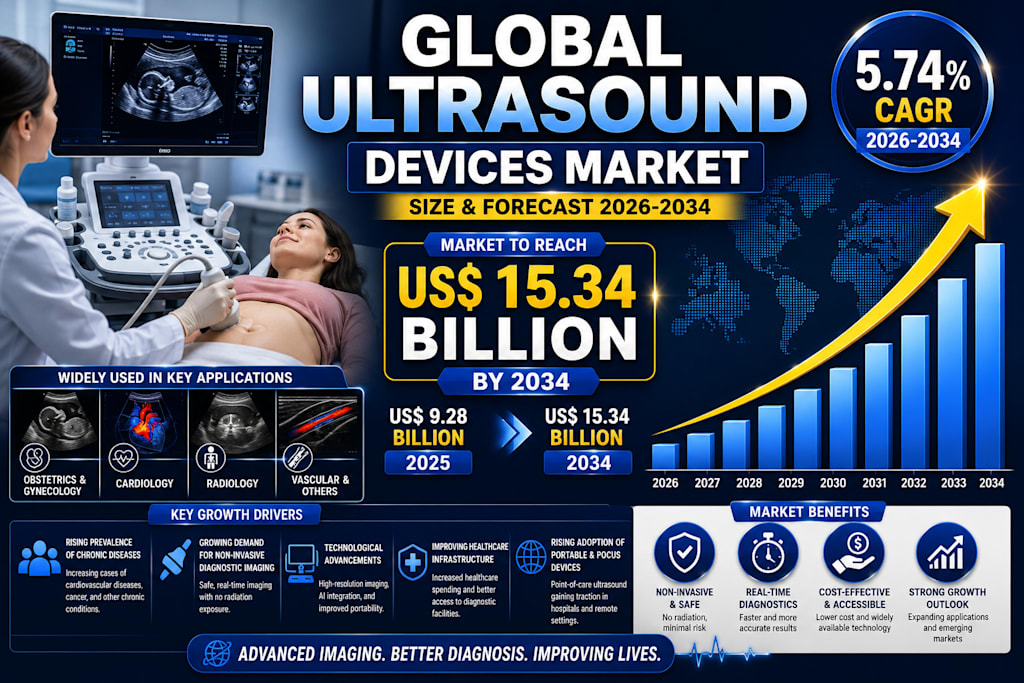
According to Renub Research, the Global Ultrasound Devices Market is expected to grow from US$ 9.28 billion in 2025 to US$ 15.34 billion by 2034, registering a compound annual growth rate (CAGR) of 5.74% between 2026 and 2034. Rising demand for non-invasive diagnostic imaging, increasing prevalence of chronic diseases, growing applications across multiple medical specialties, and rapid technological advancements are among the key factors supporting market growth.
As healthcare systems around the world prioritize early diagnosis, preventive care, and patient safety, ultrasound technology is becoming an increasingly essential tool across hospitals, clinics, diagnostic centers, and emergency care settings.
Understanding Ultrasound Devices and Their Importance
Ultrasound devices use high-frequency sound waves to create images of internal organs, tissues, blood vessels, and blood flow within the body. Unlike imaging methods that rely on ionizing radiation, ultrasound provides a safer alternative for many diagnostic applications.
The technology is widely used in obstetrics to monitor fetal development during pregnancy, in cardiology to evaluate heart function, in radiology to examine organs and tissues, and in emergency medicine to support rapid clinical decisions. Ultrasound imaging also plays a crucial role in diagnosing liver disease, kidney disorders, tumors, vascular conditions, and musculoskeletal injuries.
Because ultrasound procedures are non-invasive, painless, and relatively affordable, they have become one of the most commonly used diagnostic tools worldwide.
Growing Demand for Non-Invasive Imaging Is Driving Market Expansion
One of the strongest drivers behind the growth of the ultrasound devices market is the increasing preference for non-invasive diagnostic procedures.
Patients and healthcare providers alike are seeking safer diagnostic methods that minimize discomfort while avoiding exposure to harmful radiation. Ultrasound technology addresses these concerns by allowing physicians to visualize internal structures without surgical intervention or radiation-based imaging.
This capability has made ultrasound a preferred diagnostic option for numerous applications, including pregnancy monitoring, abdominal imaging, musculoskeletal assessments, cardiovascular evaluations, and preventive health screenings.
Healthcare providers also value ultrasound because it delivers real-time imaging. Immediate visualization of organs, tissues, and blood flow enables faster clinical decision-making and improves diagnostic accuracy. As healthcare systems increasingly emphasize early disease detection and preventive medicine, demand for ultrasound imaging is expected to continue growing steadily.
Technological Innovation Is Transforming Ultrasound Imaging
Technology continues to play a major role in shaping the future of ultrasound devices.
Modern ultrasound systems offer significantly higher image quality, greater diagnostic precision, and more advanced analytical capabilities than earlier generations of equipment. Innovations in imaging technology have introduced sophisticated 3D and 4D imaging capabilities, allowing healthcare professionals to capture highly detailed anatomical views.
Artificial intelligence is also becoming increasingly integrated into ultrasound systems. AI-powered solutions can assist clinicians with image interpretation, workflow optimization, automated measurements, and diagnostic support.
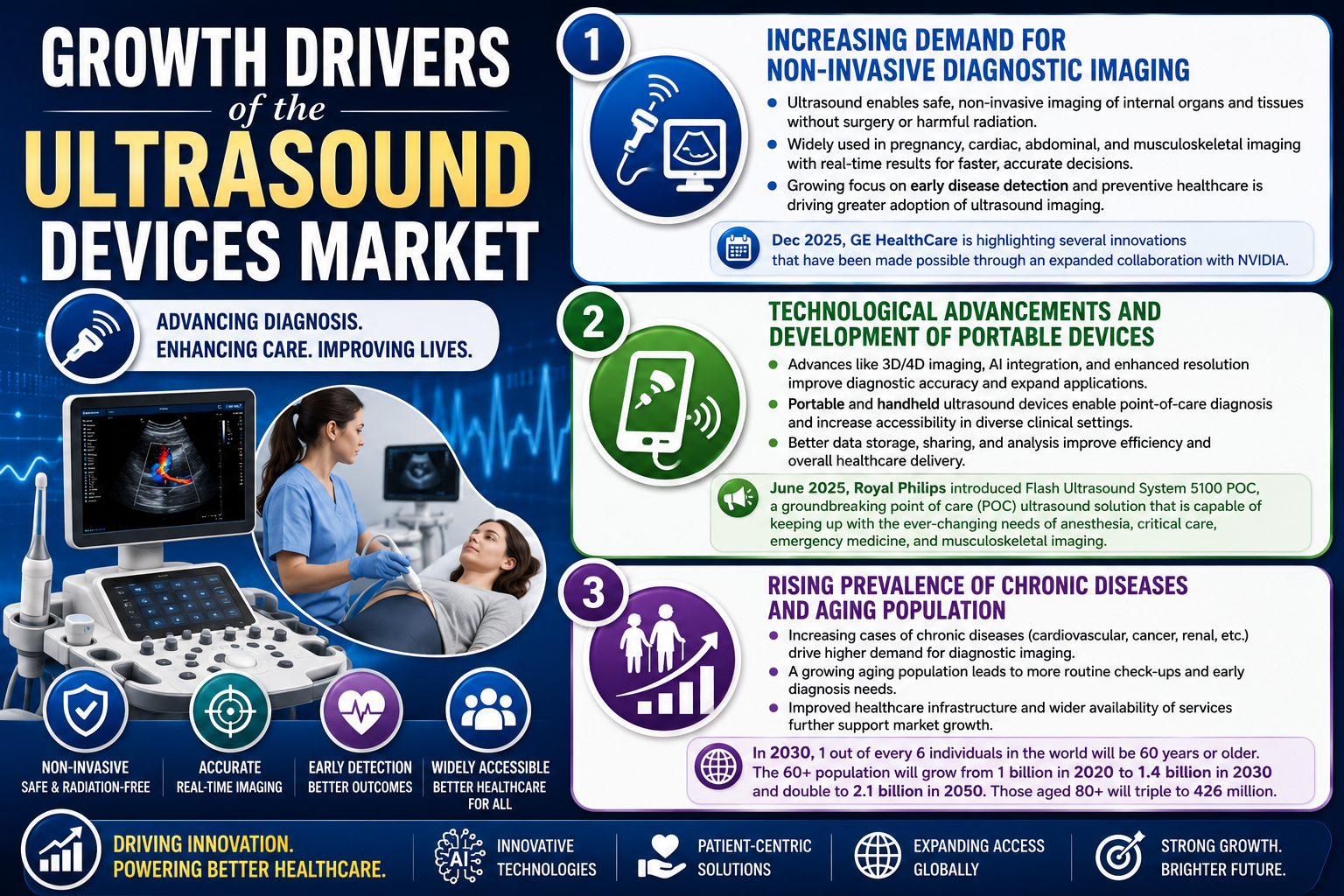
The report highlights recent innovations from leading industry participants, including GE HealthCare's collaboration with NVIDIA to advance imaging technologies and Royal Philips' launch of the Flash Ultrasound System 5100 POC, designed to support point-of-care imaging across multiple clinical settings.
These developments are helping make ultrasound imaging faster, smarter, and more accessible across healthcare environments.
Portable and Handheld Devices Are Expanding Access
One of the most exciting developments in the ultrasound market is the rapid growth of portable and handheld devices.
Traditionally, ultrasound systems were large machines primarily located in hospital imaging departments. Today, compact and handheld devices allow clinicians to perform diagnostic imaging at the patient's bedside, in emergency rooms, rural clinics, ambulances, and even remote healthcare settings.
Portable ultrasound systems offer several advantages, including improved mobility, faster diagnosis, lower infrastructure requirements, and broader access to imaging services.
For healthcare providers operating in underserved regions, portable ultrasound devices provide an opportunity to deliver advanced diagnostic capabilities without requiring expensive imaging centers. As technology continues to improve, portable systems are expected to become increasingly sophisticated while maintaining affordability and ease of use.
Chronic Diseases Continue to Fuel Demand
The rising prevalence of chronic diseases is another major factor driving growth within the ultrasound devices market.
Conditions such as cardiovascular disease, cancer, kidney disorders, liver disease, and vascular abnormalities require regular diagnostic imaging for detection, monitoring, and treatment planning. Ultrasound plays an important role in identifying these conditions early and tracking patient progress over time.
Cardiovascular disease remains one of the leading causes of death globally, increasing demand for echocardiography and vascular imaging systems. Similarly, rising cancer rates and growing awareness of preventive healthcare are encouraging more frequent use of diagnostic imaging technologies.
Healthcare providers increasingly rely on ultrasound because it provides rapid, repeatable, and cost-effective assessments without exposing patients to radiation.
As chronic disease rates continue to rise worldwide, demand for ultrasound-based diagnostic services is expected to remain strong.
Aging Populations Create Long-Term Opportunities
Global demographic trends are creating additional growth opportunities for the ultrasound devices industry.
The report notes that by 2030, one out of every six people worldwide will be aged 60 years or older. The population of individuals aged 60 and above is expected to increase from 1 billion in 2020 to 1.4 billion by 2030 and reach approximately 2.1 billion by 2050. Furthermore, the number of individuals aged 80 and older is expected to triple during the same period.
Older populations generally require more diagnostic imaging due to increased susceptibility to chronic diseases and age-related health conditions. Routine medical evaluations, cardiovascular monitoring, organ assessments, and preventive screenings all contribute to higher demand for ultrasound technology.
As healthcare systems adapt to aging populations, ultrasound imaging is expected to play an increasingly important role in ongoing patient care.
Diagnostic Ultrasound Remains the Largest Segment
Diagnostic ultrasound systems continue to represent the largest segment of the market.
These systems are used extensively for evaluating internal organs, tissues, blood vessels, and pregnancy-related conditions. Physicians rely on diagnostic ultrasound because it provides immediate, real-time images that support accurate medical decision-making.
Applications include detecting tumors, monitoring fetal development, evaluating kidney and liver function, assessing blood circulation, and identifying various abnormalities throughout the body.
Growing awareness of preventive healthcare and the increasing importance of early diagnosis are expected to support continued growth within this segment.
Cardiology Applications Are Becoming Increasingly Important
Cardiology remains one of the most significant application areas for ultrasound technology.
Echocardiography systems enable physicians to examine heart structure, blood flow, valve performance, and overall cardiac function. These systems play a critical role in diagnosing heart failure, valve disorders, congenital heart defects, and other cardiovascular conditions.
The increasing prevalence of cardiovascular disease worldwide continues to drive demand for cardiology-focused ultrasound systems. Real-time imaging capabilities help clinicians evaluate heart function quickly and accurately, supporting improved treatment planning and patient outcomes.
As awareness of heart health grows, demand for advanced cardiac imaging technologies is expected to rise further.
Color Ultrasound Technology Enhances Diagnostic Accuracy
Color ultrasound systems represent another important growth segment within the market.
Unlike traditional black-and-white imaging, color ultrasound systems visualize blood flow and tissue movement using color-coded displays. This capability allows healthcare professionals to detect abnormalities more effectively and evaluate vascular conditions with greater precision.
Color Doppler ultrasound technology is widely used in cardiology, vascular imaging, obstetrics, and emergency medicine. The ability to observe blood flow in real time significantly enhances diagnostic confidence and improves clinical outcomes.
As healthcare providers continue seeking greater diagnostic accuracy, demand for color ultrasound devices is expected to increase steadily.
Hospitals Remain the Largest End Users
Hospitals continue to represent the largest end-user segment within the ultrasound devices market.
Healthcare facilities rely heavily on ultrasound imaging for diagnosis, treatment planning, and patient monitoring. High patient volumes, increasing demand for imaging services, and investments in advanced medical technologies continue to drive adoption across hospitals worldwide.
Hospitals also benefit from access to trained specialists and comprehensive diagnostic infrastructure, making them ideal environments for advanced ultrasound systems.
As healthcare investments increase globally, hospitals are expected to remain the primary purchasers of ultrasound equipment.
Regional Markets Present Significant Growth Potential
United States
The United States remains one of the largest ultrasound device markets globally. Advanced healthcare infrastructure, high healthcare spending, strong innovation capabilities, and widespread adoption of diagnostic imaging technologies continue to support market growth. Rising rates of chronic disease and increasing demand for preventive healthcare further strengthen the outlook.
United Kingdom
The United Kingdom's ultrasound market benefits from strong healthcare accessibility through the National Health Service (NHS). Increasing demand for prenatal care, cardiovascular imaging, and early disease detection continues to drive adoption of ultrasound technologies throughout the country.
India
India represents one of the fastest-growing opportunities within the global market. Expanding healthcare infrastructure, rising health awareness, government healthcare initiatives, and increasing access to diagnostic services are driving demand for ultrasound equipment across both urban and rural regions.
Saudi Arabia
Saudi Arabia is investing heavily in healthcare modernization and diagnostic technology. Rising healthcare expenditures, increasing chronic disease prevalence, and growing adoption of portable imaging solutions are contributing to market expansion throughout the Kingdom.
Challenges Facing the Industry
Despite its strong growth prospects, the ultrasound devices market faces several challenges.
One major concern is the high cost associated with advanced ultrasound systems. Technologies such as 3D imaging, 4D imaging, digital connectivity, and high-resolution displays can require significant investment for purchase, installation, maintenance, and training. These costs may limit adoption in resource-constrained healthcare environments.
Another challenge is the shortage of trained professionals. Ultrasound imaging requires skilled sonographers and healthcare providers capable of accurately interpreting diagnostic images. Insufficient training can lead to misdiagnosis and limit the effectiveness of advanced imaging systems. Continued investment in education and workforce development will be critical for long-term market growth.
Competitive Landscape and Industry Leaders
The ultrasound devices market remains highly competitive, with major medical technology companies investing heavily in innovation, product development, and global expansion.
Leading companies highlighted in the report include GE Healthcare, Siemens Healthcare, Philips, Canon Inc., Fujifilm Holdings Corporation, Samsung Medison, and Hitachi Ltd. These organizations continue to develop next-generation imaging solutions that improve diagnostic accuracy, workflow efficiency, and patient outcomes.
As competition intensifies, technological differentiation and artificial intelligence integration are expected to become increasingly important competitive advantages.
Final Thoughts
The global ultrasound devices market is entering a period of sustained expansion driven by growing demand for non-invasive diagnostics, rising chronic disease prevalence, technological innovation, and expanding healthcare infrastructure.
With the market projected to increase from US$ 9.28 billion in 2025 to US$ 15.34 billion by 2034, ultrasound technology is becoming an even more critical component of modern healthcare delivery. Its ability to provide safe, real-time, cost-effective diagnostic imaging positions it as one of the most valuable tools available to healthcare professionals.
As healthcare systems continue prioritizing early diagnosis, preventive medicine, and patient-centered care, ultrasound devices are expected to remain at the forefront of medical imaging innovation. The coming decade will likely bring further advances in portability, artificial intelligence, image quality, and accessibility, creating significant opportunities for manufacturers, healthcare providers, and patients worldwide
About the Creator
Enjoyed the story? Support the Creator.
Subscribe for free to receive all their stories in your feed.
Comments
There are no comments for this story
Be the first to respond and start the conversation.