
Global Telemedicine Market Surges as Virtual Healthcare, Remote Monitoring, and Digital Health Technologies Transform Patient Care
Growing demand for accessible healthcare, rapid advancements in digital health infrastructure, and increasing adoption of remote patient services are driving explosive growth across the global telemedicine industry.

The healthcare industry is experiencing a digital revolution unlike anything seen before. What once required in-person appointments, lengthy travel times, and crowded waiting rooms can now often be accomplished through a smartphone, tablet, or computer. Telemedicine has emerged as one of the most transformative healthcare innovations of the modern era, fundamentally changing how patients access medical care and how providers deliver services.
From routine consultations and mental health support to chronic disease management and specialist care, telemedicine is making healthcare more accessible, convenient, and efficient. The widespread adoption of digital communication technologies, combined with growing patient expectations for on-demand services, has accelerated the shift toward virtual healthcare solutions across the globe.
While the COVID-19 pandemic significantly accelerated telemedicine adoption, the industry’s growth has continued long after the crisis, driven by technological innovation, healthcare modernization, and increasing demand for patient-centered care models.
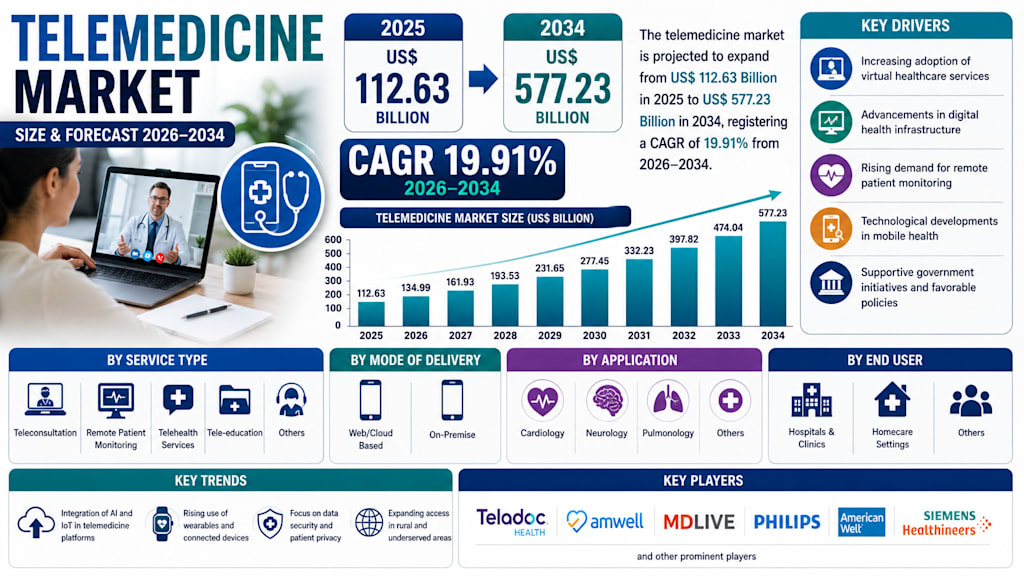
According to Renub Research, the Global Telemedicine Market is projected to grow from US$112.63 billion in 2025 to US$577.23 billion by 2034, registering a remarkable compound annual growth rate (CAGR) of 19.91% between 2026 and 2034. Rising adoption of virtual healthcare services, advancements in digital health infrastructure, and increasing demand for remote patient monitoring are expected to fuel long-term market expansion.

Telemedicine Is Redefining Healthcare Delivery
Telemedicine refers to the delivery of healthcare services through digital communication technologies such as video conferencing, mobile applications, remote monitoring systems, and online healthcare platforms.
The technology enables patients to consult physicians, receive diagnoses, access treatment recommendations, and manage chronic conditions without physically visiting healthcare facilities.
Telemedicine applications span numerous medical specialties, including family medicine, psychiatry, dermatology, cardiology, radiology, pathology, and chronic disease management.
By reducing geographical barriers and increasing convenience, telemedicine helps improve access to healthcare while lowering costs for both patients and providers.
Its ability to connect patients with healthcare professionals regardless of location has made telemedicine one of the fastest-growing segments within the healthcare industry.
Demand for Accessible Healthcare Continues to Rise
One of the most significant drivers behind telemedicine's rapid growth is the increasing demand for accessible and convenient healthcare services.
Modern consumers expect healthcare experiences that match the convenience offered by other digital services.
Patients increasingly prefer solutions that reduce travel time, eliminate long waiting periods, and provide immediate access to healthcare professionals.
Telemedicine addresses these needs effectively by allowing patients to receive care from the comfort of their homes.
This is particularly beneficial for elderly individuals, patients with mobility limitations, people living in rural communities, and individuals managing chronic health conditions.
Healthcare providers also benefit from improved appointment management, reduced operational costs, and enhanced patient engagement.
As healthcare systems continue emphasizing convenience and efficiency, telemedicine adoption is expected to accelerate further.
Digital Health Technologies Are Accelerating Market Growth
Rapid advancements in digital health technology have become a major catalyst for telemedicine expansion.
Improved internet connectivity, cloud computing, smartphone adoption, and video communication platforms have dramatically enhanced the quality and reliability of virtual healthcare services.
Modern telemedicine solutions increasingly integrate with electronic health records (EHRs), wearable devices, remote monitoring systems, and artificial intelligence platforms.
These technologies allow healthcare providers to access real-time patient information, improve diagnostic accuracy, and deliver more personalized treatment plans.
Artificial intelligence is also supporting virtual triage, predictive analytics, and clinical decision-making processes.
As digital health ecosystems continue evolving, telemedicine platforms are becoming more sophisticated and capable of supporting complex healthcare needs.
Remote Patient Monitoring Creates New Opportunities
Remote patient monitoring has emerged as one of the most valuable applications within the telemedicine market.
Patients with chronic conditions such as diabetes, hypertension, cardiovascular disease, and respiratory disorders increasingly use connected devices that transmit health data directly to healthcare providers.
These technologies allow clinicians to monitor patient conditions continuously without requiring frequent office visits.
Early identification of potential health issues improves outcomes while reducing hospital admissions and emergency interventions.
Remote monitoring also empowers patients to take a more active role in managing their own health.
As wearable technologies become more advanced and affordable, demand for remote patient monitoring solutions is expected to grow substantially.
Government Support Is Strengthening Adoption
Government initiatives and healthcare reforms have played a major role in supporting telemedicine growth worldwide.
Many countries have introduced favorable reimbursement policies, funding programs, and regulatory frameworks designed to encourage digital healthcare adoption.
During and after the COVID-19 pandemic, governments increasingly recognized telemedicine as a critical component of healthcare delivery systems.
These policies have helped reduce barriers to adoption while improving provider confidence in virtual care models.
Telemedicine also aligns with broader healthcare objectives, including reducing costs, expanding access, improving preventive care, and alleviating pressure on hospitals and clinics.
Continued policy support is expected to remain a significant growth driver for the industry.
Healthcare Providers Are Investing in Digital Transformation
Healthcare organizations increasingly view telemedicine as a strategic investment rather than a temporary solution.
Hospitals, clinics, specialty practices, and healthcare networks continue integrating virtual care capabilities into their service offerings.
In January 2025, Teladoc Health partnered with Amazon to improve access to chronic condition management programs covering diabetes, hypertension, pre-diabetes, and weight management through Amazon Health Benefits Connector.
Such collaborations demonstrate how major healthcare and technology companies are working together to expand digital healthcare accessibility and improve patient outcomes.
Teleconsultation Remains the Largest Market Segment
Teleconsultation represents one of the fastest-growing and most widely adopted segments within the telemedicine industry.
Through video calls, voice communication, and messaging platforms, patients can consult healthcare professionals regarding symptoms, diagnoses, treatment plans, and follow-up care.
Teleconsultation reduces travel requirements, lowers healthcare costs, and improves access to medical expertise.
The service is especially valuable in primary care, psychiatry, dermatology, and chronic disease management.
Increasing smartphone penetration and improved internet access continue supporting widespread adoption of teleconsultation services across global markets.
Telecardiology Is Improving Cardiovascular Care
Telecardiology has become an increasingly important component of remote healthcare services.
Cardiovascular diseases remain among the leading causes of mortality worldwide, creating strong demand for remote cardiac monitoring solutions.
Telecardiology systems allow healthcare providers to monitor heart rate, blood pressure, electrocardiogram (ECG) readings, and other cardiovascular indicators remotely.
Wearable technologies and cloud-based analytics platforms support continuous patient monitoring and early detection of potential complications.
These capabilities improve patient outcomes while reducing hospital readmissions and healthcare costs.
As chronic cardiovascular conditions become more prevalent, telecardiology is expected to remain a major growth area within the telemedicine market.
Telesurgery Represents the Future of Remote Care
Telesurgery is one of the most advanced segments within telemedicine.
Using robotic surgical systems, high-speed communication networks, and advanced imaging technologies, surgeons can perform procedures remotely.
Although adoption remains limited due to cost and infrastructure requirements, telesurgery offers significant potential for expanding access to specialized surgical expertise.
The technology is particularly valuable for remote regions, emergency situations, and medical education purposes.
As communication networks become faster and robotic systems become more sophisticated, telesurgery is expected to play an increasingly important role in future healthcare delivery.
Telemedicine Diagnostic Centers Expand Access
Telemedicine diagnostic centers are helping bridge gaps in healthcare accessibility.
These facilities provide remote diagnostic services including radiology, pathology, laboratory testing, and medical imaging interpretation.
Specialists can review diagnostic data remotely, improving turnaround times and expanding access to expert medical opinions.
Tele-radiology and tele-pathology have become especially valuable in underserved regions where specialist availability may be limited.
Growing investment in digital imaging technologies and diagnostic infrastructure continues supporting expansion within this segment.
Mental Health Services Benefit from Virtual Care
Mental healthcare has become one of telemedicine's most successful applications.
Virtual counseling, therapy sessions, psychiatric consultations, and behavioral health services have gained widespread acceptance among patients and providers alike.
Telemedicine helps reduce barriers related to stigma, travel, scheduling, and specialist shortages.
Patients often appreciate the privacy and convenience of accessing mental health services remotely.
As awareness of mental health issues continues increasing, virtual behavioral healthcare is expected to remain a major contributor to market growth.
Hospitals Remain the Largest End Users
Hospitals continue to represent the largest end-user segment within the telemedicine market.
Healthcare institutions increasingly use telemedicine platforms for consultations, patient monitoring, specialist referrals, discharge management, and chronic disease care.
Telemedicine helps hospitals improve efficiency while expanding service capacity and reducing unnecessary admissions.
Many hospitals are adopting hybrid care models that combine virtual and in-person services to optimize patient experiences.
As healthcare systems continue modernizing, hospital investment in telemedicine infrastructure is expected to remain strong.
Data Privacy and Cybersecurity Remain Critical Challenges
Despite strong growth prospects, telemedicine faces several important challenges.
One of the most significant concerns involves data privacy and cybersecurity.
Telemedicine platforms handle sensitive patient information, making them attractive targets for cybercriminals.
Healthcare providers must comply with strict regulations such as HIPAA in the United States and GDPR in Europe.
According to a February 2025 report cited in the market study, the U.S. Department of Health and Human Services received reports of 729 healthcare data breaches in 2024, affecting approximately 185.8 million individuals.
These risks highlight the importance of strong cybersecurity frameworks and regulatory compliance.
Digital Access Inequality Limits Adoption
Limited digital access remains another significant challenge.
Many rural and underserved regions continue facing obstacles related to internet connectivity, smartphone availability, and digital literacy.
Older patients may also struggle with technology adoption and virtual healthcare platforms.
Additionally, certain medical conditions still require physical examinations, diagnostic testing, or in-person interventions.
Addressing these barriers will be essential for maximizing telemedicine's long-term impact and ensuring equitable access to healthcare services worldwide.
United States Leads Global Telemedicine Adoption
The United States remains one of the most advanced telemedicine markets globally.
Strong digital infrastructure, widespread smartphone use, robust healthcare spending, and extensive EHR adoption continue supporting rapid market growth.
Teleconsultation, mental health services, chronic disease management, and remote monitoring represent key application areas.
Continued investment in artificial intelligence, digital health platforms, and connected healthcare technologies strengthens the country's leadership position.
Healthcare workforce shortages and rising medical costs further encourage adoption of telemedicine solutions throughout the United States.
United Kingdom Integrates Telemedicine into the NHS
The United Kingdom continues integrating telemedicine services throughout the National Health Service (NHS).
Teleconsultations, telemonitoring, and teletriage services have become increasingly common, particularly within primary care and mental health settings.
Government-backed digital health initiatives and infrastructure investments support continued adoption.
Telemedicine also helps address workforce shortages and regional disparities in specialist healthcare access.
As healthcare demand continues rising, virtual care solutions are expected to play an increasingly important role within the UK's healthcare system.
India Emerges as a High-Growth Telemedicine Market
India's telemedicine market is expanding rapidly due to increasing smartphone penetration, internet accessibility, and healthcare infrastructure development.
Telemedicine plays a vital role in connecting rural populations with healthcare specialists typically concentrated in urban centers.
Government initiatives and private-sector investments continue driving adoption.
In January 2025, SS Innovations International successfully completed the world's first two robotic cardiac telesurgeries using the SSi Mantra 3 Surgical Robotic System in India.
Such achievements highlight India's growing influence within the global digital healthcare landscape.
Saudi Arabia Accelerates Healthcare Modernization
Saudi Arabia's telemedicine market is benefiting from substantial investments in healthcare modernization and digital transformation initiatives.
The government continues promoting teleconsultation, remote monitoring, and specialty care services to improve healthcare access across the Kingdom.
In December 2024, PaxeraHealth partnered with Saudi German Health to launch an AI-powered teleradiology initiative aimed at improving diagnostic speed and accuracy.
These developments reflect Saudi Arabia's commitment to leveraging digital technologies to enhance healthcare outcomes.
Final Thoughts
The global telemedicine market is entering a period of extraordinary growth driven by digital transformation, patient demand for convenience, technological innovation, and expanding healthcare accessibility.
As healthcare systems increasingly embrace virtual care, telemedicine is becoming an essential component of modern medical delivery rather than an alternative option.
With the market projected to grow from US$112.63 billion in 2025 to US$577.23 billion by 2034, substantial opportunities exist for healthcare providers, technology companies, investors, and policymakers worldwide.
While challenges related to cybersecurity, regulatory compliance, and digital access remain important considerations, continued innovation and supportive government policies provide a powerful foundation for future expansion.
As healthcare becomes more connected, data-driven, and patient-centric, telemedicine is poised to redefine how medical services are delivered across the globe.
About the Creator
Enjoyed the story? Support the Creator.
Subscribe for free to receive all their stories in your feed.
Comments
There are no comments for this story
Be the first to respond and start the conversation.