
Global Surgical Robots Market to Reach US$15.89 Billion by 2034 as Robotic-Assisted Procedures Transform Modern Healthcare
Growing demand for minimally invasive surgery, rapid advances in robotics and artificial intelligence, and increasing healthcare investments are accelerating the adoption of surgical robots worldwide.

Surgical Robotics Is Revolutionizing the Future of Healthcare
Healthcare has entered an era where advanced technology is enhancing the precision, safety, and efficiency of complex surgical procedures. Among the most significant innovations is robotic-assisted surgery, a technology that allows surgeons to perform delicate operations with exceptional accuracy while minimizing trauma to patients.
Unlike autonomous machines, surgical robots remain under the complete control of trained surgeons. These sophisticated systems translate a surgeon's hand movements into highly precise actions using robotic arms, high-definition 3D imaging, and advanced computer consoles. The result is greater control, smaller incisions, reduced blood loss, fewer complications, and significantly faster recovery times.
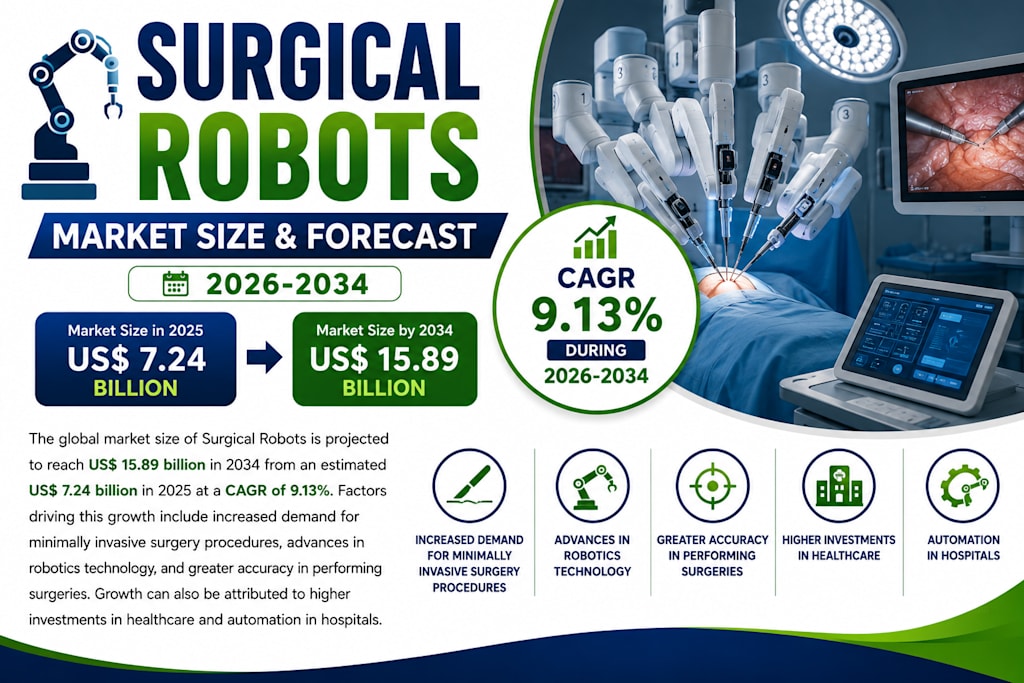
According to the latest market outlook, the Global Surgical Robots Market is expected to grow from US$7.24 billion in 2025 to US$15.89 billion by 2034, registering a compound annual growth rate (CAGR) of 9.13% during 2026–2034. Growing adoption of minimally invasive procedures, continuous technological innovation, and increasing healthcare investments are expected to drive this steady expansion.
Understanding Surgical Robots
Surgical robots are advanced medical systems designed to assist surgeons rather than replace them.
A typical robotic surgical system consists of robotic arms, a surgeon's control console, high-definition three-dimensional imaging, and specialized surgical instruments capable of performing extremely precise movements.
These systems enhance dexterity while filtering hand tremors, allowing surgeons to complete complex procedures with greater confidence and accuracy.
Robotic-assisted surgery is now widely used across multiple specialties, including urology, gynecology, orthopedics, cardiology, neurosurgery, and general surgery.
As healthcare providers continue emphasizing patient safety and improved outcomes, robotic technology has become an increasingly valuable component of modern operating rooms.
Minimally Invasive Surgery Continues to Drive Demand
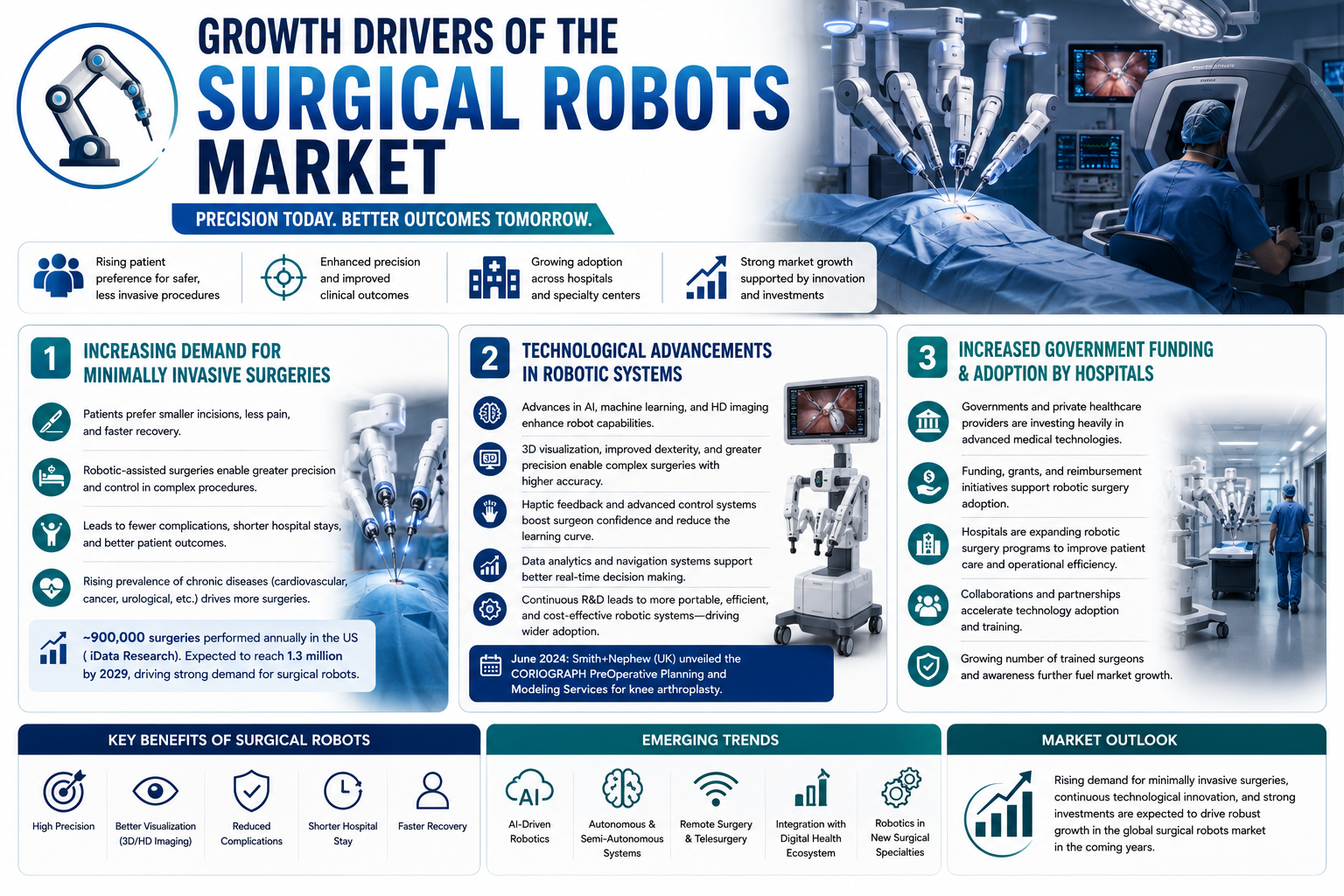
One of the strongest growth drivers for surgical robotics is the increasing preference for minimally invasive surgery.
Patients today seek procedures that involve smaller incisions, reduced pain, minimal scarring, shorter hospital stays, and quicker recovery.
Robotic systems make these procedures possible by providing exceptional precision during delicate surgical operations that would otherwise be difficult using conventional techniques.
Hospitals also benefit through reduced complication rates, improved patient satisfaction, and greater operating efficiency.
As chronic diseases requiring surgical intervention continue increasing worldwide, demand for robotic-assisted procedures is expected to rise steadily.
Artificial Intelligence Is Enhancing Surgical Precision
Artificial intelligence has become a major contributor to the evolution of robotic surgery.
Modern systems combine AI algorithms with high-definition imaging, machine learning, navigation technologies, and real-time analytics to provide surgeons with greater situational awareness during procedures.
Advanced visualization systems allow surgeons to view highly detailed anatomical structures while robotic instruments perform movements with remarkable stability.
Continuous improvements in haptic feedback, intelligent navigation, and imaging technologies are making robotic surgery increasingly accurate and easier for surgeons to master.
These innovations continue expanding the range of procedures suitable for robotic assistance.
Healthcare Investments Continue Rising
Governments and private healthcare providers are investing heavily in advanced medical technologies designed to improve patient care.
Many hospitals now prioritize modernization projects that include robotic operating rooms, digital imaging technologies, and integrated surgical platforms.
Growing medical tourism in emerging economies has also encouraged healthcare organizations to adopt world-class surgical technologies capable of attracting international patients.
In some countries, reimbursement policies supporting robotic-assisted surgery have further accelerated market adoption by improving patient access to advanced procedures.
These investments are expected to remain an important catalyst for long-term market growth.
Surgical Systems Form the Core of the Market
Robotic surgical systems represent the largest component of the market.
These integrated platforms combine robotic arms, surgeon consoles, advanced visualization equipment, and intelligent software to perform highly specialized procedures.
Continuous innovation has improved flexibility, precision, and compatibility with artificial intelligence and digital imaging technologies.
Manufacturers continue developing more compact, efficient, and user-friendly systems capable of supporting increasingly complex operations across multiple surgical specialties.
Accessories Create Recurring Market Opportunities
Beyond the robotic systems themselves, accessories represent an important and rapidly growing segment.
Robotic instruments, sensors, disposable surgical tools, imaging devices, and specialized accessories require regular replacement or upgrades to maintain performance and sterility.
Because many components are single-use or have limited operating lifespans, hospitals generate recurring demand for replacement products.
Manufacturers therefore continue focusing on improving durability while reducing costs to increase affordability for healthcare providers.
Gynecological Surgery Leads Adoption
Gynecological procedures have become one of the largest application areas for robotic surgery.
Operations including hysterectomies, myomectomies, and endometriosis treatment benefit significantly from enhanced precision and minimally invasive techniques.
Patients typically experience reduced blood loss, less postoperative pain, shorter hospitalization, and faster recovery compared with traditional open surgery.
Increasing awareness among both physicians and patients continues supporting wider adoption of robotic technologies within women's healthcare.
Cardiovascular Robotics Continue Advancing
Cardiovascular surgery represents another important growth area.
Complex procedures involving heart valves and coronary artery bypass operations require exceptional precision, making robotic assistance increasingly valuable.
Robotic systems allow surgeons to perform intricate interventions through smaller incisions while reducing surgical trauma and shortening recovery periods.
As cardiovascular disease remains one of the world's leading causes of mortality, demand for advanced robotic solutions is expected to continue expanding.
Robotic Laparoscopy Is Becoming Standard
Laparoscopic robotic surgery has gained significant momentum across numerous medical specialties.
General surgery, gastroenterology, and urology increasingly rely on robotic assistance for procedures involving gallbladder disease, hernias, obesity-related conditions, and digestive disorders.
Enhanced visualization, greater instrument flexibility, and improved precision enable surgeons to perform technically demanding operations with greater confidence.
Patients benefit from reduced pain, minimal scarring, lower complication rates, and faster return to normal activities.
Technological Innovation Is Accelerating
Leading medical technology companies continue investing heavily in research and development.
Recent innovations include improved preoperative planning software, fluorescence imaging systems, enhanced visualization technologies, and AI-assisted navigation tools.
Advanced imaging solutions provide surgeons with better visibility of blood flow, tissue structures, and anatomical landmarks during procedures.
These innovations continue improving surgical accuracy while reducing operating time and enhancing patient outcomes.
High Costs Remain a Challenge
Despite significant clinical advantages, surgical robots remain expensive investments.
Hospitals must purchase sophisticated robotic platforms while also covering installation costs, maintenance, software updates, staff training, and specialized surgical instruments.
Robotic procedures may also require additional disposable accessories that increase overall treatment costs.
For many healthcare facilities, particularly those operating with limited budgets, these financial barriers continue slowing adoption.
As technology matures and competition increases, manufacturers are expected to focus on developing more affordable robotic systems.
Skilled Professionals Are Essential
Successful robotic surgery depends not only on advanced equipment but also on highly trained medical professionals.
Surgeons require specialized education and extensive practical experience before performing robotic-assisted procedures independently.
Healthcare organizations must therefore invest continuously in physician training, certification programs, and technical support.
Keeping surgical teams updated as new technologies emerge remains essential for ensuring safe and effective patient care.
Expanding education programs will play a crucial role in accelerating future market adoption.
Regional Markets Continue Expanding
The United States remains the global leader in robotic surgery thanks to advanced healthcare infrastructure, high technology adoption, and strong investment from leading manufacturers.
France continues expanding robotic-assisted procedures through government support for healthcare digitalization and increased hospital adoption.
India is rapidly emerging as a promising growth market driven by rising healthcare investment, expanding medical tourism, and growing awareness of minimally invasive surgery.
Brazil also continues strengthening its market through increased healthcare spending and regulatory approvals for advanced robotic surgical systems.
The Future of Surgical Robotics
The future of robotic surgery extends far beyond today's capabilities.
Artificial intelligence, augmented reality, machine learning, remote surgery, advanced imaging, and predictive analytics will continue transforming operating rooms over the coming decade.
Future robotic systems are expected to become more intelligent, more affordable, and capable of assisting surgeons during increasingly complex procedures.
Rather than replacing surgeons, these technologies will continue enhancing human expertise while improving safety, precision, and patient outcomes.
Final Thoughts
The global surgical robots market is entering a period of sustained growth as healthcare systems increasingly prioritize precision medicine, minimally invasive procedures, and advanced medical technologies.
The projected expansion from US$7.24 billion in 2025 to US$15.89 billion by 2034, supported by a 9.13% CAGR, demonstrates the growing confidence hospitals and healthcare providers have in robotic-assisted surgery.
Although high costs and specialized training requirements remain important challenges, continuous innovation, rising healthcare investments, and expanding clinical applications are expected to strengthen market growth for years to come. Surgical robots are no longer considered futuristic technology—they have become an essential component of modern surgical care, helping improve outcomes for both patients and healthcare professionals worldwide.
About the Creator
Enjoyed the story? Support the Creator.
Subscribe for free to receive all their stories in your feed.
Comments
There are no comments for this story
Be the first to respond and start the conversation.