
Global Sugar Market Expands as Packaged Foods, Premium Baking Trends, and Sustainable Innovation Drive Demand
Rising global consumption of bakery products, confectionery, beverages, and packaged foods is accelerating growth across the sugar industry, while sustainability and specialty sugar innovation reshape market dynamics.

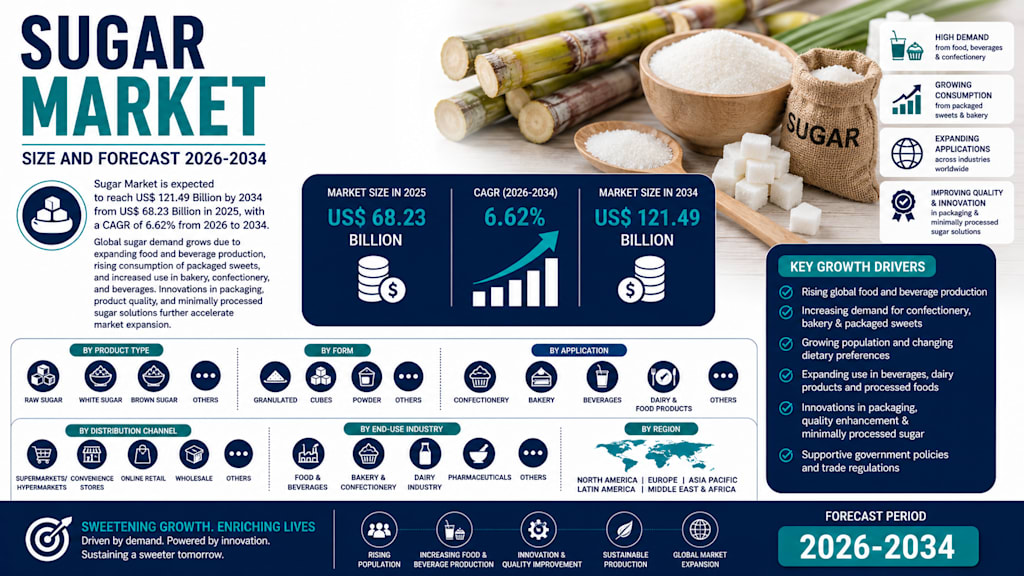
Global sugar market enters a new era of innovation and industrial expansion
The global sugar market is undergoing a significant transformation as rising food processing demand, premium baking trends, and sustainability-focused product innovation continue driving worldwide consumption. According to the latest market analysis, the Sugar Market is projected to grow from US$ 68.23 billion in 2025 to US$ 121.49 billion by 2034, registering a CAGR of 6.62% between 2026 and 2034.
Sugar remains one of the world’s most essential food ingredients, widely used across bakery products, confectionery, beverages, dairy products, pharmaceuticals, and packaged foods. Despite rising health concerns and increasing competition from alternative sweeteners, demand continues expanding because sugar performs multiple functions beyond sweetness—including texture enhancement, preservation, browning, and fermentation.
At the same time, manufacturers are investing heavily in cleaner-label formulations, eco-friendly packaging, premium baking sugars, and minimally processed sugar solutions designed to align with changing consumer expectations. Sustainability, convenience, and specialty applications are increasingly becoming major competitive differentiators in the global sugar industry.
Sugar remains central to the global food industry
Sugar is a crystalline carbohydrate primarily derived from sugarcane and sugar beet. It serves as a foundational ingredient across the global food and beverage ecosystem because of its versatility and functional performance.
Commercial sugar products include:
- White sugar
- Brown sugar
- Liquid sugar
- Granulated sugar
- Powdered sugar
- Syrups
Specialty and ultrafine baking sugars
These products are used extensively in packaged snacks, soft drinks, baked goods, confectionery, dairy products, sauces, pharmaceuticals, and household cooking applications.
The market’s long-term growth is closely linked to rising urbanization, expanding middle-class populations, and increasing demand for processed and ready-to-eat foods worldwide.
Packaged food demand continues driving sugar consumption
One of the strongest growth drivers behind the sugar market is the continued expansion of the global packaged food and beverage industry. Consumers increasingly prefer convenient, ready-to-consume, and shelf-stable products, all of which rely heavily on sugar for taste, preservation, texture, and visual appeal.
Bakery products, confectionery items, flavored beverages, dairy desserts, and snacks remain especially important contributors to industrial sugar demand.
Food manufacturers continue using sugar not only as a sweetener but also because it improves product consistency, moisture retention, browning performance, and fermentation efficiency.
The rapid expansion of foodservice chains, cafés, bakeries, and quick-service restaurants globally is also strengthening commercial sugar consumption.
Packaging innovation is reshaping consumer engagement
Sustainability and convenience are becoming increasingly important purchasing factors within the sugar industry. Manufacturers are redesigning sugar packaging to improve usability, reduce environmental impact, and strengthen brand differentiation.
Consumers increasingly prefer recyclable, refillable, lightweight, and easy-to-store packaging solutions that align with sustainability goals while improving kitchen convenience.
The report highlights a major July 2025 development where Domino Sugar launched its “Easy Baking Tub,” featuring recyclable construction, refillable functionality, tamper-evident lids, and 28% less plastic usage.
Such innovations are helping sugar brands strengthen customer loyalty while encouraging more frequent household purchasing.
As sustainability regulations tighten globally, eco-friendly packaging is expected to become an increasingly important competitive advantage.
Specialty sugars are gaining strong momentum
The growing popularity of home baking, premium desserts, artisanal confectionery, and café culture is accelerating demand for specialty sugars. Consumers and professional bakers increasingly seek high-performance sugar products capable of improving texture, dissolution, browning consistency, and visual presentation.
Ultrafine baking sugars, liquid sugars, and minimally processed sugar variants are becoming especially popular because they support smoother mixing and improved consistency in baked goods and beverages.
The report highlights a March 2025 launch from C&H Sugar involving a new ultrafine granulated baker’s sugar sold in its “Easy Baking Tub” packaging. The product offers Non-GMO and Kosher-certified quality while targeting both retail and professional baking markets.
This reflects a broader industry trend toward premiumization and specialized ingredient functionality.
Industrial food processing remains the market’s foundation
Industrial food manufacturing continues to represent the largest long-term demand pillar for the sugar industry. Large-scale bakery, beverage, confectionery, dairy, and snack manufacturers depend heavily on sugar for production consistency and sensory performance.
As packaged food production expands globally, manufacturers increasingly require refined, liquid, and minimally processed sugar formulations that improve production efficiency while supporting cleaner-label positioning.
A key development occurred in January 2025 when ADM introduced minimally processed liquid sugar solutions designed specifically for bakery and beverage manufacturers. These solutions provide improved color consistency, texture performance, and production efficiency during large-scale manufacturing.
Such innovations are helping food companies balance industrial scalability with evolving consumer expectations regarding ingredient transparency and product quality.
Sustainability is becoming central to market strategy
Sustainability initiatives are increasingly shaping the sugar industry’s future. Producers are investing in regenerative agriculture, environmentally responsible sourcing, recyclable packaging, and cleaner refining methods to improve environmental performance and meet evolving regulatory standards.
The report highlights Florida Crystals’ November 2024 packaging refresh featuring “Regenerative Organic Certified” labeling and compostable paper-based materials.
Such sustainability-focused branding strategies are becoming increasingly important as consumers demand greater transparency regarding farming practices, sourcing standards, and environmental impact.
Sugar producers are also investing in traceability systems and soil-health initiatives to strengthen long-term agricultural resilience and maintain market competitiveness.
Health concerns continue creating industry pressure
Despite strong industrial demand, the sugar market continues facing pressure from rising public health concerns related to obesity, diabetes, and metabolic disorders. Governments worldwide are introducing sugar taxes, stricter labeling regulations, and advertising restrictions aimed at reducing excessive sugar consumption.
Consumers are increasingly exploring low-sugar, sugar-free, and alternative sweetener products featuring stevia, monk fruit, and artificial sweeteners.
These shifts are encouraging food manufacturers to reformulate products and reduce sugar content in beverages, bakery items, and packaged snacks.
As a result, sugar producers are increasingly focusing on:
- Specialty sugars
- Cleaner-label positioning
- Portion-control formats
- Functional sugar applications
- Sustainable sourcing
The industry’s ability to adapt to evolving health expectations will remain critical for long-term competitiveness.
Agricultural volatility remains a major challenge
The sugar industry remains highly vulnerable to agricultural instability and climate-related risks. Sugarcane and sugar beet production depend heavily on weather conditions, water availability, and crop yields.
Extreme weather events, droughts, floods, pest outbreaks, and transportation disruptions can significantly affect supply stability and pricing.
Global sugar markets are also influenced by:
- Trade restrictions
- Export controls
- Government subsidies
- Fuel and fertilizer costs
- Transportation bottlenecks
As climate change intensifies agricultural unpredictability, producers and food manufacturers are increasingly diversifying sourcing strategies and investing in storage capacity to improve resilience.
White sugar remains a dominant segment
White sugar continues to represent one of the most important segments within the global market because of its broad use across households, food processing, and beverage manufacturing.
Demand remains especially strong in premium bakery products, confectionery, dairy processing, and beverage manufacturing where product purity, color consistency, and functionality are critical.
Manufacturers are increasingly promoting sustainably sourced and high-purity white sugar products to strengthen positioning among quality-conscious consumers.
Granulated sugar continues supporting mass-market demand
Granulated sugar remains central to large-scale industrial and retail applications because of its consistent functionality, broad availability, and processing versatility.
It remains widely used across:
- Bakery mixes
- Packaged beverages
- Foodservice operations
- Household cooking
- Quick-service restaurants
Manufacturers continue improving refining efficiency, grain consistency, and sustainable packaging strategies to maintain competitiveness in this high-volume segment.
Sugarcane remains the backbone of global supply
The sugarcane market continues serving as the foundation of global sugar production. Producers are increasingly adopting regenerative farming techniques, mechanized harvesting, and improved cultivation technologies designed to improve efficiency while protecting soil health.
Diversification into molasses, bio-based products, specialty sweeteners, and ethanol production is also helping sugarcane producers improve economic resilience.
Sustainability expectations regarding water usage, traceability, and responsible sourcing are increasingly influencing investment decisions throughout the sugarcane supply chain.
Food and beverage trends continue shaping the market
The food and beverage industry remains the single most influential force shaping sugar demand globally. Sugar continues serving as an essential ingredient for sweetness, preservation, color development, texture enhancement, and fermentation across countless product categories.
As manufacturers expand into premium, convenient, and ready-to-consume product segments, sugar usage patterns continue evolving alongside consumer preferences.
At the same time, food companies are balancing traditional sugar functionality with cleaner-label positioning and reduced-sugar innovation strategies.
United States market driven by beverage and café innovation
The United States sugar market continues growing steadily because of strong consumption across beverages, cafés, bakery products, and packaged foods.
A notable example highlighted in the report occurred in December 2024 when Dunkin’ launched “Sabrina’s Brown Sugar Shakin’ Espresso” in collaboration with singer Sabrina Carpenter.
Such premium beverage innovations continue strengthening retail and foodservice sugar demand while supporting flavor-focused product development.
Germany remains a major European sugar consumer
Germany continues ranking among Europe’s largest sugar-consuming markets because of its strong confectionery, bakery, and processed food industries.
The report references data indicating that Germany remains the world’s second-largest sugar consumer, with average daily consumption reaching 102.9 grams per person.
Traditional bakery culture, premium confectionery production, and a mature foodservice sector continue supporting industrial sugar demand despite increasing health-focused regulation.
India’s market supported by cultural and industrial demand
India’s sugar market remains one of the world’s most dynamic because of strong cultural consumption patterns, expanding packaged food production, and rising demand for sweets and dairy products.
In June 2024, Gujarat Cooperative Milk Marketing Federation expanded its product portfolio with organic sugar and jaggery offerings, reflecting increasing consumer interest in natural and premium sugar formats.
Growth in food processing, dairy manufacturing, and packaged beverage production continues strengthening industrial sugar demand across the country.
Saudi Arabia market driven by modern food consumption
Saudi Arabia’s sugar market is expanding because of rising urbanization, premium food consumption, and growing demand for packaged convenience foods.
The expansion of cafés, bakeries, restaurants, and foodservice operations is also increasing sugar demand across commercial channels.
Investments in food manufacturing and premium sweetened products continue supporting long-term market growth throughout the Kingdom.
Key companies continue intensifying competition
The sugar market remains highly competitive with major global companies investing in product innovation, sustainability initiatives, refining technologies, and industrial ingredient solutions.
Key companies covered in the report include:
- Archer Daniels Midland
- Tate & Lyle
- General Mills, Inc.
- MGP Ingredients Inc.
- Kerry Group
- Südzucker AG
- Tereos
- Cosan SA
Ten major developments shaping the sugar market
- Domino Sugar launched recyclable “Easy Baking Tub” packaging.
- C&H Sugar introduced ultrafine baker’s sugar with premium packaging.
- ADM launched minimally processed liquid sugar solutions.
- Florida Crystals expanded regenerative organic packaging initiatives.
- Incredo introduced its advanced sugar-reduction ingredient Incredo Sugar G2.
- Kodiak launched Apple Brown Sugar Pecan Oatmeal with protein-rich ingredients.
- Sustainability and regenerative agriculture initiatives continue accelerating globally.
- Specialty baking sugar demand is increasing rapidly worldwide.
- Food manufacturers are adopting cleaner-label sugar formulations.
- Industrial packaged food expansion continues strengthening long-term sugar demand.
Final thoughts
The global sugar market is evolving beyond traditional commodity dynamics into a more innovation-driven, sustainability-focused, and premiumized industry. While health concerns and regulatory pressure continue creating challenges, sugar remains deeply embedded within the global food and beverage ecosystem because of its versatility and functional importance.
With the market projected to grow from US$ 68.23 billion in 2025 to US$ 121.49 billion by 2034, manufacturers are expected to intensify focus on specialty products, sustainable sourcing, cleaner-label solutions, and packaging innovation. Companies capable of balancing evolving consumer expectations with industrial-scale efficiency are likely to define the next generation of global sugar market leadership.
About the Creator
Enjoyed the story? Support the Creator.
Subscribe for free to receive all their stories in your feed.
Comments
There are no comments for this story
Be the first to respond and start the conversation.