
Global Steel Market Set to Reach US$ 2.22 Trillion by 2033 as Infrastructure, Manufacturing, and Green Steel Investments Accelerate
Rising Urbanization, EV Production, Smart Infrastructure Projects, and Sustainable Steel Technologies Continue to Shape the Future of the Global Steel Industry

The global steel industry remains one of the most important pillars of modern economic development. From skyscrapers and bridges to automobiles, household appliances, renewable energy projects, and industrial machinery, steel continues to be the backbone of infrastructure and manufacturing worldwide. As nations invest heavily in urban development, transportation networks, renewable energy systems, and advanced manufacturing facilities, demand for steel is expected to remain strong throughout the coming decade.
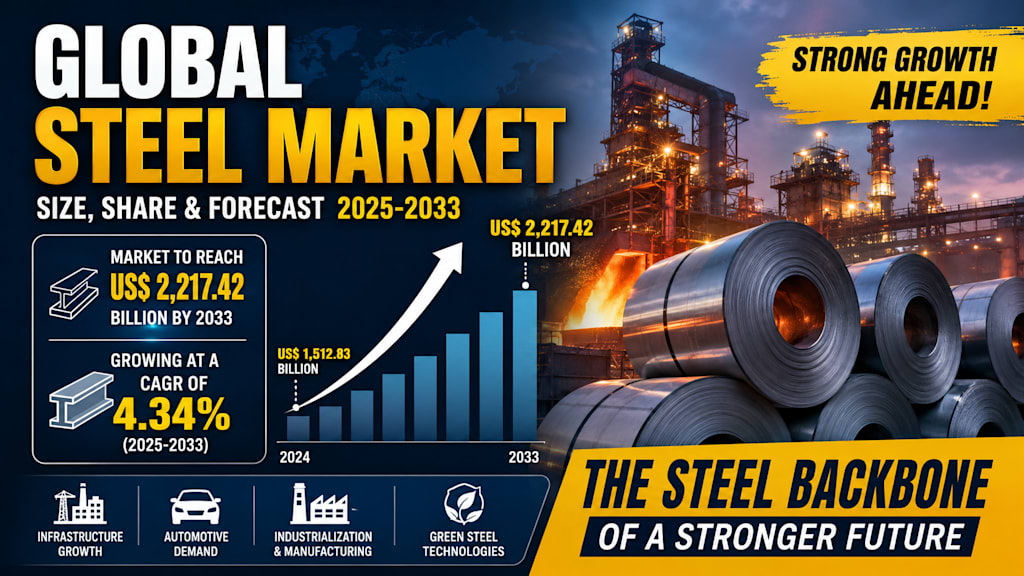
According to Renub Research, the Global Steel Market is projected to grow from US$ 1,512.83 billion in 2024 to US$ 2,217.42 billion by 2033, expanding at a CAGR of 4.34% during 2025–2033. Increasing investments in infrastructure, rapid industrialization, expanding automotive production, and technological advancements in sustainable steel manufacturing are among the primary factors supporting this growth trajectory.
Steel: The Foundation of Modern Civilization
Steel is an alloy primarily composed of iron and carbon, often enhanced with elements such as chromium, manganese, and nickel to improve durability, corrosion resistance, and strength. Its versatility, recyclability, and affordability have made it one of the most widely used materials in human history.
Today, steel is indispensable across numerous industries. Construction firms rely on steel for buildings, bridges, pipelines, airports, and rail networks. Automotive manufacturers use steel extensively in vehicle frames, chassis, engines, and safety components. The energy sector depends on steel for power plants, wind turbines, transmission towers, and oil and gas infrastructure.
The material's ability to be recycled repeatedly without losing quality also supports growing sustainability goals worldwide. As governments and industries pursue circular economy initiatives, steel remains a preferred material because of its long lifecycle and environmental advantages when recycled efficiently.
Infrastructure Development Driving Market Expansion
One of the strongest growth engines for the global steel market is the unprecedented level of infrastructure investment occurring around the world.
Governments are allocating substantial budgets toward highways, metro systems, airports, bridges, smart cities, and public housing projects. Emerging economies, particularly across Asia-Pacific, are investing heavily in urban development to accommodate rapidly growing populations.
Large-scale infrastructure programs require enormous quantities of structural steel, reinforcing bars, beams, and plates. This creates a sustained demand pipeline for steel producers worldwide.
The growing importance of digital infrastructure is also creating new opportunities. In January 2025, OpenAI, SoftBank, and Oracle announced the Stargate initiative, an ambitious project aimed at building advanced AI infrastructure across the United States. The initiative includes significant investments in data centers and related facilities, all of which require substantial amounts of construction-grade steel.
As nations modernize physical and digital infrastructure simultaneously, steel consumption is expected to remain robust throughout the forecast period.
Automotive Industry Continues to Fuel Steel Demand
The automotive sector remains one of the largest consumers of steel globally.
Despite advances in alternative materials, steel continues to dominate vehicle manufacturing due to its strength, affordability, safety performance, and recyclability. High-strength steel grades enable manufacturers to reduce vehicle weight while maintaining structural integrity and passenger safety.
The transition toward electric vehicles is creating additional opportunities for steel producers. EV manufacturers require advanced steel solutions for battery enclosures, chassis structures, crash protection systems, and lightweight vehicle components.
The global automotive landscape is evolving rapidly. In December 2024, Japanese automotive giants Honda and Nissan initiated merger discussions aimed at strengthening their position in the highly competitive electric vehicle market. Such strategic developments highlight the ongoing transformation within transportation industries and their continued reliance on innovative steel products.
In addition to passenger vehicles, growing investments in railways, commercial vehicles, shipbuilding, and aerospace manufacturing continue to support steel consumption worldwide.
Manufacturing Growth and Industrialization Strengthen Market Fundamentals
Rapid industrialization across developing economies remains another critical growth driver.
Countries such as India, Brazil, Indonesia, Vietnam, and several ASEAN nations are expanding manufacturing capabilities to support economic growth and attract foreign direct investment. New factories, industrial parks, logistics hubs, and production facilities require substantial steel inputs for machinery, equipment, and construction.
Steel plays a vital role in manufacturing applications ranging from heavy industrial equipment to consumer goods production. Its cost-effectiveness and adaptability make it indispensable across numerous industrial processes.
The renewable energy sector is also emerging as a major consumer of steel products. Wind turbine towers, solar mounting systems, hydroelectric facilities, and energy transmission infrastructure all require specialized steel components.
In May 2025, ASEAN introduced the Framework of ASEAN Industrial Projects Based Initiative (AIPBI), designed to strengthen regional industrial cooperation and encourage high-impact investments. Such initiatives are expected to support long-term steel demand throughout Southeast Asia.
Green Steel Technologies Reshaping Industry Dynamics
Environmental sustainability has become one of the most important priorities for steel producers globally.
Traditional steelmaking processes are energy-intensive and contribute significantly to carbon emissions. As governments implement stricter environmental regulations and carbon reduction targets, steel manufacturers are investing heavily in cleaner production technologies.
Green steel initiatives include:
Electric Arc Furnace (EAF) technology
Hydrogen-based steelmaking
Carbon capture and storage systems
Renewable energy integration
Increased utilization of recycled steel scrap
These innovations are helping manufacturers reduce environmental impact while maintaining competitiveness in global markets.
Leading steel producers are increasingly positioning sustainability as a strategic advantage, particularly as customers prioritize environmentally responsible supply chains.
Challenges Facing the Global Steel Industry
Raw Material Price Volatility
Steel production relies heavily on raw materials such as iron ore, coking coal, and scrap metal. Fluctuations in commodity prices can significantly affect manufacturing costs and profit margins.
Geopolitical tensions, trade restrictions, transportation disruptions, and supply chain challenges continue to create uncertainty in global raw material markets.
For steelmakers operating in import-dependent regions, sudden price increases can have substantial financial consequences.
Environmental Compliance Costs
The transition toward low-carbon steel production requires significant capital investments.
Many manufacturers must upgrade facilities, adopt cleaner technologies, and improve operational efficiency to meet evolving environmental standards.
While these investments support long-term sustainability, they also increase short-term operational expenses. Companies unable to adapt may face regulatory penalties, reduced export opportunities, and declining competitiveness.
Flat Steel Market Remains a Dominant Segment
Flat steel products, including sheets, coils, strips, and plates, represent one of the most significant segments of the global steel market.
These products are widely used in automotive manufacturing, shipbuilding, appliances, pipelines, storage tanks, and construction projects.
The growing industrialization of Asia-Pacific economies continues to drive flat steel consumption. Additionally, renewable energy infrastructure and transportation projects are generating substantial demand for high-quality flat steel products.
Structural Steel Gains Momentum Worldwide
Structural steel plays a crucial role in modern construction and engineering projects.
Its exceptional strength-to-weight ratio makes it ideal for skyscrapers, bridges, industrial plants, stadiums, and transportation infrastructure.
The increasing popularity of smart city initiatives and sustainable urban development projects is creating favorable conditions for structural steel demand. Renewable energy projects, particularly wind farms, also require large quantities of structural steel components.
Iron and Steel Wire Market Expands Across Industries
Iron and steel wire products are essential in construction, agriculture, automotive manufacturing, telecommunications, and electrical transmission.
Applications include:
Fencing systems
Suspension bridges
Fasteners
Springs
Power transmission cables
Industrial equipment
As infrastructure projects expand globally and agricultural modernization continues, demand for steel wire products is expected to increase steadily.
Construction Industry Remains the Largest Consumer
The building and construction sector continues to account for a substantial share of global steel consumption.
Steel is used extensively in:
Reinforcement bars
Structural beams
Roofing systems
Industrial buildings
Commercial complexes
Residential housing
Rapid urbanization in emerging economies is driving sustained demand. Governments are prioritizing affordable housing programs, transportation networks, and urban redevelopment projects, all of which require significant steel inputs.
Electrical Appliances Industry Creates New Opportunities
Steel remains a fundamental material in household and industrial appliances.
Products such as refrigerators, ovens, washing machines, air conditioners, and industrial machinery rely heavily on steel components due to their durability and corrosion resistance.
Rising disposable incomes, urban lifestyles, and growing adoption of smart home technologies are supporting appliance demand worldwide, creating additional growth opportunities for steel manufacturers.
Regional Market Analysis
United States
The United States steel market is benefiting from substantial infrastructure investments, renewable energy projects, and manufacturing expansion. Federal initiatives supporting transportation modernization and clean energy development are creating strong demand for domestic steel production.
Germany
Germany remains a global leader in specialty steel manufacturing. Strong demand from automotive, engineering, and advanced manufacturing sectors continues to support market growth. The country's focus on sustainable steel production technologies further strengthens its competitive position.
India
India has emerged as one of the world's fastest-growing steel markets. Rapid industrialization, expanding infrastructure development, affordable housing projects, and government initiatives such as Make in India continue to accelerate steel consumption across the country.
Saudi Arabia
Saudi Arabia's Vision 2030 transformation strategy is driving substantial investments in infrastructure, mega-city developments, industrial zones, and energy projects. These initiatives are significantly increasing steel demand throughout the Kingdom.
Competitive Landscape
The global steel market remains highly competitive, with major manufacturers investing in capacity expansion, sustainability initiatives, technological innovation, and strategic partnerships.
Leading companies include:
ArcelorMittal S.A.
Gerdau S.A.
Hyundai Steel Co. Ltd.
JFE Steel Corporation
Jiangsu Shagang Group Co. Ltd.
Nippon Steel Corporation
Nucor Corporation
Shougang Group Co. Ltd.
Tata Steel Ltd.
United States Steel Corporation
10 Recent Developments by Major Steel Companies
1. ArcelorMittal
ArcelorMittal expanded decarbonization projects across Europe, focusing on low-carbon steel production and renewable energy integration.
2. Tata Steel
Tata Steel accelerated investments in green steel technologies and carbon reduction initiatives across its global operations.
3. Nippon Steel
Nippon Steel strengthened advanced steel product development for automotive and electric vehicle manufacturers.
4. Nucor Corporation
Nucor expanded electric arc furnace-based production capacity to improve sustainability and operational efficiency.
5. United States Steel Corporation
U.S. Steel continued modernization initiatives through advanced manufacturing technologies and digital production systems.
6. Hyundai Steel
Hyundai Steel increased production of high-strength automotive steel grades to support growing EV demand.
7. JFE Steel Corporation
JFE Steel advanced hydrogen-based steelmaking research to support future carbon-neutral production goals.
8. Gerdau S.A.
Gerdau expanded recycled steel utilization and circular economy initiatives throughout its operations.
9. Shougang Group
Shougang invested in smart manufacturing technologies to improve productivity and reduce emissions.
10. Jiangsu Shagang Group
Jiangsu Shagang enhanced capacity upgrades and energy-efficiency projects to strengthen long-term competitiveness.
Final Thoughts
Steel continues to serve as the backbone of global industrial progress. Whether powering infrastructure projects, enabling advanced manufacturing, supporting transportation networks, or facilitating renewable energy expansion, steel remains indispensable to economic development worldwide.
With the Global Steel Market projected to reach US$ 2,217.42 billion by 2033, industry participants are entering a period characterized by steady growth, technological innovation, and sustainability-driven transformation. Investments in green steel production, smart manufacturing, infrastructure modernization, and electric vehicle development will likely shape the industry's next chapter.
As governments, businesses, and consumers increasingly prioritize sustainable development, the steel sector's ability to innovate while maintaining affordability and performance will determine its long-term success in the evolving global economy.
About the Creator
Enjoyed the story? Support the Creator.
Subscribe for free to receive all their stories in your feed.
Comments
There are no comments for this story
Be the first to respond and start the conversation.