
Global Smartphone Market Heads Toward a Trillion-Dollar Future as 5G, AI, and Digital Lifestyles Fuel Demand
Expanding mobile connectivity, rapid technological innovation, and growing reliance on smartphones for everyday activities are driving sustained growth across the global smartphone industry.

The smartphone has evolved from a communication device into the most important personal technology product in modern life. For billions of people worldwide, smartphones have become essential tools for communication, entertainment, business, education, healthcare, shopping, banking, navigation, and social interaction.
What began as a simple combination of a mobile phone and a handheld computer has transformed into a powerful digital ecosystem capable of performing tasks that once required multiple devices. Today's smartphones feature advanced processors, professional-grade cameras, artificial intelligence capabilities, cloud connectivity, and access to millions of applications that support nearly every aspect of daily life.
As digital transformation accelerates worldwide, smartphones continue to play a central role in connecting individuals, businesses, and governments. The ongoing expansion of 5G networks, improvements in mobile technology, and growing dependence on digital services are creating strong momentum for the global smartphone market.
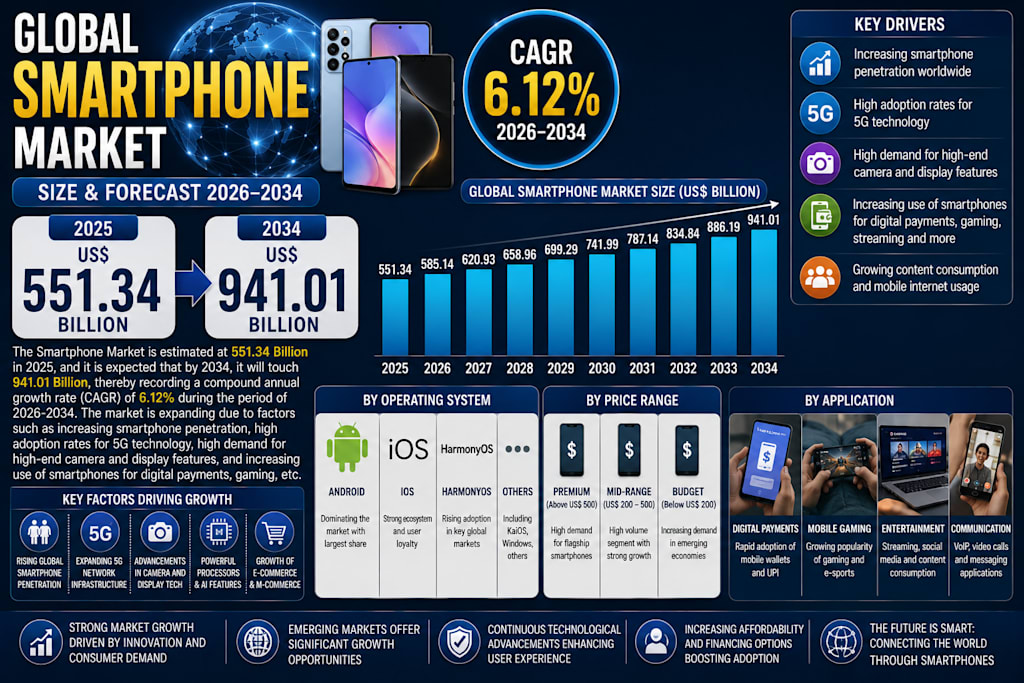
According to Renub Research, the Global Smartphone Market is expected to grow from US$551.34 billion in 2025 to US$941.01 billion by 2034, registering a compound annual growth rate (CAGR) of 6.12% between 2026 and 2034. Rising smartphone penetration, increasing adoption of 5G technology, demand for premium features, and growing use of smartphones for digital payments, gaming, and online services are expected to drive long-term growth.
Smartphones Have Become Essential to Modern Life
Few technologies have influenced society as profoundly as smartphones.
Today, smartphones serve as communication hubs, entertainment centers, productivity tools, navigation systems, payment platforms, health trackers, and educational resources—all within a single device.
Consumers rely on smartphones to make voice and video calls, send messages, browse social media, shop online, access financial services, attend virtual meetings, stream content, and interact with smart home devices.
For many people in developing regions, smartphones represent their primary or only connection to the internet.
This versatility has made smartphones indispensable across virtually every demographic group and geographic region.
As digital ecosystems continue expanding, smartphones remain at the center of modern lifestyles.
5G Expansion Is Driving Upgrade Cycles
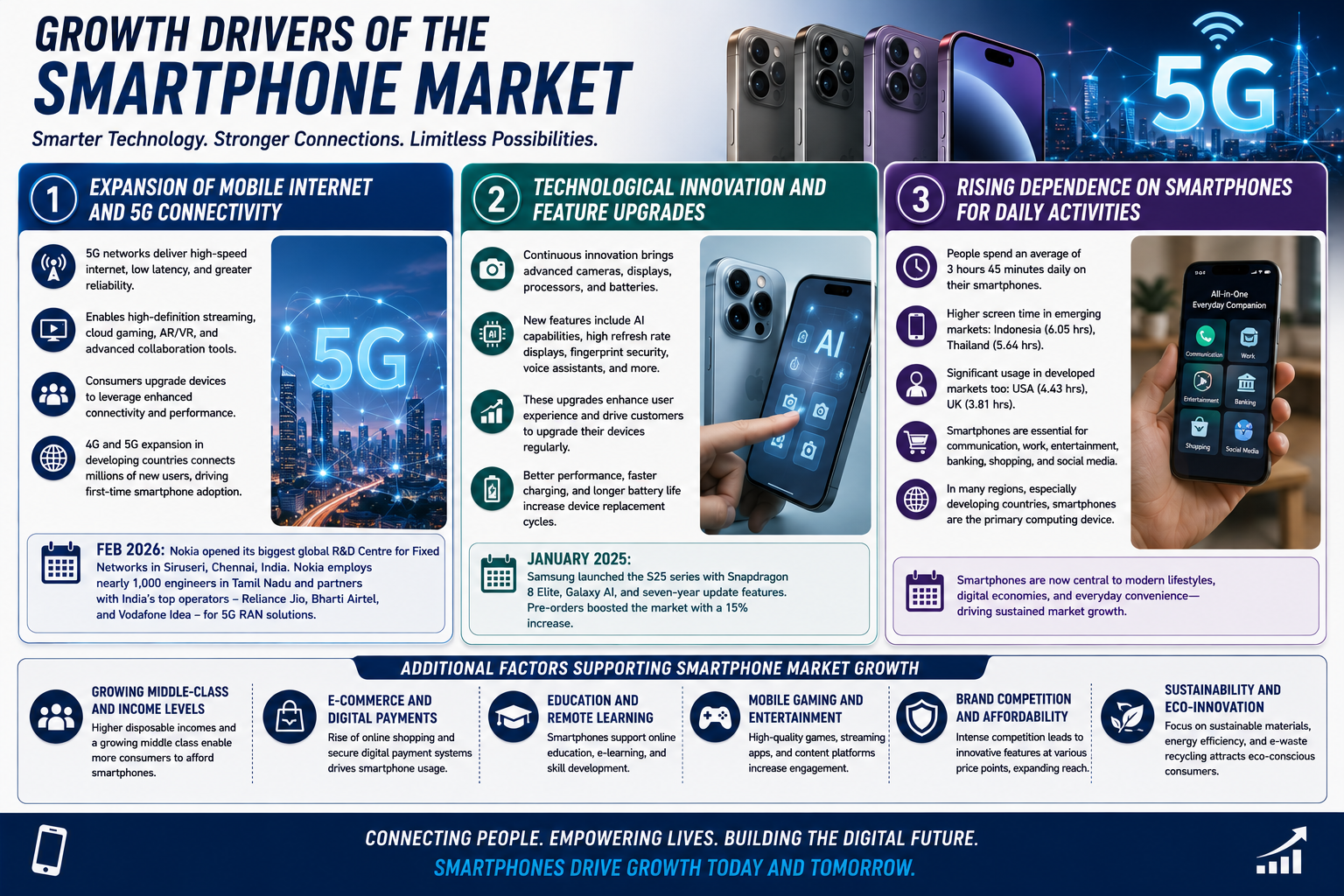
One of the strongest growth drivers for the smartphone market is the global rollout of 5G networks.
Compared with previous generations of mobile connectivity, 5G offers significantly faster download speeds, lower latency, improved reliability, and greater network capacity.
These capabilities enable advanced applications such as ultra-high-definition video streaming, cloud gaming, augmented reality experiences, artificial intelligence services, and real-time collaboration tools.
Consumers increasingly upgrade devices to access the benefits of 5G connectivity.
In emerging markets, expanding mobile infrastructure is introducing millions of new users to high-speed internet services for the first time.
The continued deployment of 5G networks is expected to remain a major catalyst for smartphone demand throughout the forecast period.
Technological Innovation Continues to Attract Consumers
Continuous innovation remains a defining characteristic of the smartphone industry.
Manufacturers regularly introduce improvements in processing power, display quality, battery performance, camera capabilities, security features, and artificial intelligence functionality.
Modern smartphones now feature advanced multi-lens camera systems, AI-powered photography enhancements, ultra-fast charging technologies, high-refresh-rate displays, biometric security systems, and intelligent voice assistants.
Consumers are increasingly motivated to upgrade devices when new technologies provide meaningful improvements to performance and user experience.
In January 2025, Samsung introduced its Galaxy S25 series featuring Snapdragon 8 Elite processors, Galaxy AI capabilities, and seven years of software updates, generating strong market interest and boosting pre-order activity.
Such innovations continue stimulating replacement demand even in mature markets.
Smartphones Are Becoming More Powerful Than Ever
Today's smartphones rival traditional computers in terms of processing capabilities.
Advanced chipsets enable multitasking, gaming, video editing, augmented reality applications, and machine learning functions directly on mobile devices.
Artificial intelligence processors now handle complex tasks such as image recognition, language translation, predictive recommendations, and real-time content optimization.
As mobile hardware continues improving, smartphones increasingly serve as primary productivity tools for professionals, students, and entrepreneurs.
This growing functionality supports demand for higher-end devices across global markets.
Mobile Commerce Is Reshaping Consumer Behavior
The rise of mobile commerce represents another important driver of smartphone adoption.
Consumers increasingly use smartphones to shop online, compare prices, manage subscriptions, and complete purchases through mobile applications.
Digital payment solutions have become particularly important.
Mobile wallets, contactless payments, peer-to-peer transfers, and digital banking services are now integrated into daily routines for millions of users.
Smartphones have effectively become personal financial management tools, enabling convenient access to banking, investment, insurance, and payment services.
As cashless economies continue expanding, smartphone usage is expected to increase further.
Social Media and Entertainment Fuel Daily Usage
Smartphones have fundamentally transformed how people consume content and interact with others.
Social media platforms, video streaming services, music applications, podcasts, and gaming ecosystems generate significant daily engagement.
Research cited in the market study indicates that average smartphone users spend approximately 3 hours and 45 minutes per day on their devices. Usage levels are even higher in countries such as Indonesia and Thailand, while developed markets including the United States and the United Kingdom also report substantial daily screen time.
The growing importance of digital entertainment continues strengthening demand for advanced smartphones capable of delivering immersive experiences.
Artificial Intelligence Is Redefining User Experiences
Artificial intelligence is rapidly becoming one of the most influential technologies within the smartphone industry.
AI enhances photography, voice recognition, battery optimization, predictive text, translation services, personalization, and device security.
Modern smartphones increasingly leverage AI to automate tasks and improve user experiences.
Intelligent assistants can schedule appointments, answer questions, summarize information, and provide context-aware recommendations.
AI-powered camera systems optimize settings automatically to capture professional-quality images under diverse conditions.
As AI capabilities continue advancing, they are expected to become major differentiators among competing smartphone brands.
Foldable Smartphones Create New Growth Opportunities
Foldable smartphones have emerged as one of the most exciting innovations in recent years.
These devices combine the portability of traditional smartphones with larger display areas that enhance productivity, gaming, and entertainment experiences.
Advancements in display materials, hinge mechanisms, and durability have improved consumer confidence in foldable devices.
Manufacturers increasingly view foldable smartphones as a premium growth segment capable of attracting users seeking new form factors and enhanced functionality.
Although still relatively expensive, foldable technology is expected to become more accessible as production scales increase.
Android Continues to Dominate Global Market Share
The Android ecosystem remains the largest segment within the global smartphone industry.
Its open-source structure allows multiple manufacturers to produce devices across a broad range of price points, making smartphones accessible to diverse consumer groups worldwide.
Android devices are available in entry-level, mid-range, premium, and ultra-premium categories.
This flexibility has been particularly important in emerging markets where affordability remains a key consideration.
The platform's extensive application ecosystem, customization options, and compatibility with diverse hardware configurations continue supporting strong global demand.
iOS Maintains Strong Premium Positioning
While Android dominates overall market share, Apple's iOS ecosystem continues to command significant influence within the premium smartphone segment.
Consumers value iPhones for their seamless integration, strong security features, long-term software support, and premium design.
The close integration between iPhones and other Apple products creates a highly cohesive user experience that encourages customer loyalty.
Despite offering fewer device options than Android manufacturers, Apple maintains strong profitability and brand strength across developed markets.
The premium positioning of iOS devices remains a major competitive advantage.
E-Commerce Strengthens Smartphone Distribution
The rapid growth of online retail has transformed smartphone purchasing behavior.
Consumers increasingly research, compare, and purchase devices through e-commerce platforms.
Online channels offer advantages such as broader product selection, competitive pricing, trade-in programs, financing options, and direct-to-consumer purchasing opportunities.
Manufacturers are increasingly investing in digital sales strategies while maintaining physical retail presence.
The combination of online and offline channels provides consumers with greater flexibility and convenience.
OEM Manufacturers Drive Industry Innovation
Original Equipment Manufacturers (OEMs) play a critical role within the smartphone ecosystem.
These companies design, manufacture, and assemble devices for both their own brands and external clients.
OEMs enable economies of scale, rapid product development, and efficient supply chain management.
Their ability to absorb new technologies and respond quickly to market trends helps maintain industry competitiveness.
As demand for diverse device categories continues increasing, OEMs remain essential contributors to global smartphone production.
Market Saturation Challenges Developed Regions
Despite positive growth prospects, the smartphone industry faces several challenges.
One of the most significant concerns is market saturation in developed economies.
Most consumers in North America, Western Europe, Japan, and South Korea already own smartphones.
As a result, market growth increasingly depends on replacement purchases rather than first-time buyers.
Longer device lifespans and incremental feature improvements have extended replacement cycles, reducing upgrade frequency for some consumers.
Manufacturers must continue delivering meaningful innovation to encourage upgrades.
Supply Chain Complexity Remains a Risk
The smartphone industry relies on highly complex global supply chains involving semiconductors, displays, batteries, sensors, and numerous other components.
Geopolitical tensions, trade restrictions, logistics disruptions, and raw material shortages can significantly affect production schedules and costs.
Manufacturers must continuously balance quality, innovation, affordability, and supply chain resilience.
These challenges highlight the importance of strategic sourcing and manufacturing flexibility.
United States Remains a Premium Market Leader
The United States continues to be one of the world's most valuable smartphone markets.
Consumers demonstrate strong purchasing power, high technology adoption rates, and significant demand for premium devices.
Replacement purchases account for much of the market's activity, with users upgrading to access improved cameras, processors, battery performance, and 5G capabilities.
In July 2025, Samsung introduced the Galaxy Z Fold 7, Galaxy Z Flip 7, and Galaxy Z Flip 7 FE, reinforcing competition within the premium foldable smartphone segment.
Strong brand loyalty and accessible financing options further support market growth.
United Kingdom Focuses on Upgrades and Sustainability
The United Kingdom smartphone market remains highly mature and heavily driven by replacement cycles.
Consumers prioritize battery life, camera performance, connectivity, and device longevity.
Sustainability considerations are increasingly influencing purchasing decisions, encouraging manufacturers to emphasize durability and extended software support.
The expansion of 5G networks continues supporting device upgrades throughout the country.
India Emerges as a Global Growth Engine
India remains one of the fastest-growing smartphone markets in the world.
Increasing internet penetration, affordable devices, expanding mobile networks, and rising incomes continue driving adoption.
Smartphones play critical roles in education, digital payments, e-commerce, entertainment, and government services.
In July 2024, TECNO launched the SPARK 20 Pro 5G in India, featuring a 108MP camera, up to 16GB RAM, and advanced connectivity capabilities aimed at value-conscious consumers.
The country's large population and growing digital economy position India as a major contributor to future market expansion.
Saudi Arabia Benefits from Digital Transformation
Saudi Arabia's smartphone market is supported by strong consumer spending, widespread mobile connectivity, and ambitious digital transformation initiatives.
Consumers demonstrate strong interest in premium devices with advanced features and 5G capabilities.
Smartphones play essential roles in mobile payments, e-commerce, government services, and social connectivity.
Growing investment in digital infrastructure continues strengthening demand throughout the Kingdom.
Final Thoughts
The global smartphone market continues to evolve as one of the most influential industries in the digital economy.
Driven by 5G expansion, artificial intelligence, technological innovation, and growing reliance on mobile services, smartphones remain central to communication, commerce, entertainment, and productivity worldwide.
With the market projected to grow from US$551.34 billion in 2025 to US$941.01 billion by 2034, significant opportunities exist for manufacturers, software developers, network providers, retailers, and investors.
Although challenges related to market saturation, supply chain complexity, and pricing pressures remain, continuous innovation ensures that smartphones will remain indispensable tools in modern life.
As connectivity becomes faster, devices become smarter, and digital ecosystems expand, the smartphone industry is poised to remain one of the most dynamic sectors shaping the future of technology.
About the Creator
Enjoyed the story? Support the Creator.
Subscribe for free to receive all their stories in your feed.
Comments
There are no comments for this story
Be the first to respond and start the conversation.