
Global Smart Speaker Market to Reach US$47.81 Billion by 2034 as AI-Powered Voice Assistants Transform Connected Living
The growing popularity of smart homes, advances in artificial intelligence, and rising adoption of voice-controlled digital services are driving the global smart speaker market toward unprecedented expansion.

Voice Technology Is Becoming the New Digital Interface
The way people interact with technology is changing rapidly. Instead of typing commands on keyboards or tapping smartphone screens, millions of consumers are now controlling devices simply by speaking. Whether it's playing music, adjusting home lighting, checking the weather, shopping online, or managing daily schedules, voice-controlled smart speakers have become an increasingly important part of connected lifestyles.
Powered by artificial intelligence, cloud computing, and advanced voice recognition technologies, smart speakers are transforming homes into intelligent ecosystems where multiple devices communicate seamlessly. As consumer demand for convenience and automation continues to rise, manufacturers are introducing increasingly sophisticated products capable of understanding natural conversations, recognizing individual voices, and integrating with a growing range of smart home devices.
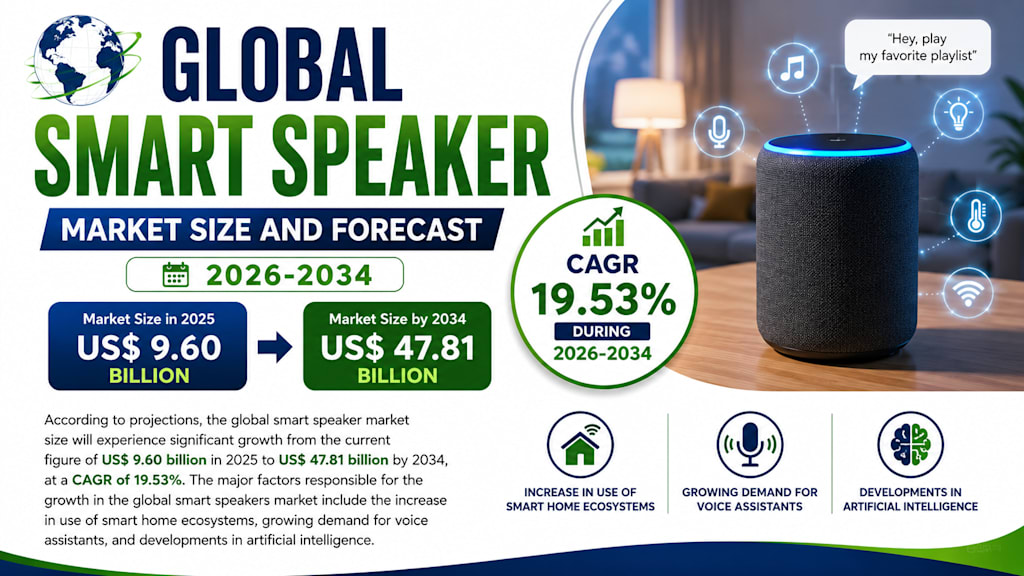
According to the latest market outlook, the Global Smart Speaker Market is expected to grow from US$9.60 billion in 2025 to US$47.81 billion by 2034, registering an impressive compound annual growth rate (CAGR) of 19.53% during 2026–2034. This remarkable growth reflects the increasing role of artificial intelligence in everyday consumer technology.
Understanding Smart Speakers
A smart speaker is much more than a wireless audio device. It is an intelligent, voice-controlled assistant capable of performing numerous digital tasks through artificial intelligence and cloud-based computing.
Modern smart speakers can answer questions, play music, control lighting, operate security systems, provide weather updates, schedule appointments, make shopping recommendations, and interact with thousands of third-party applications.
Popular virtual assistants such as Amazon Alexa, Google Assistant, and Apple Siri have become household names, offering consumers hands-free access to digital services while continuously improving through machine learning and software updates.
As voice recognition technology becomes more accurate, smart speakers are evolving into central control hubs for connected homes.
Smart Home Adoption Is Driving Market Expansion
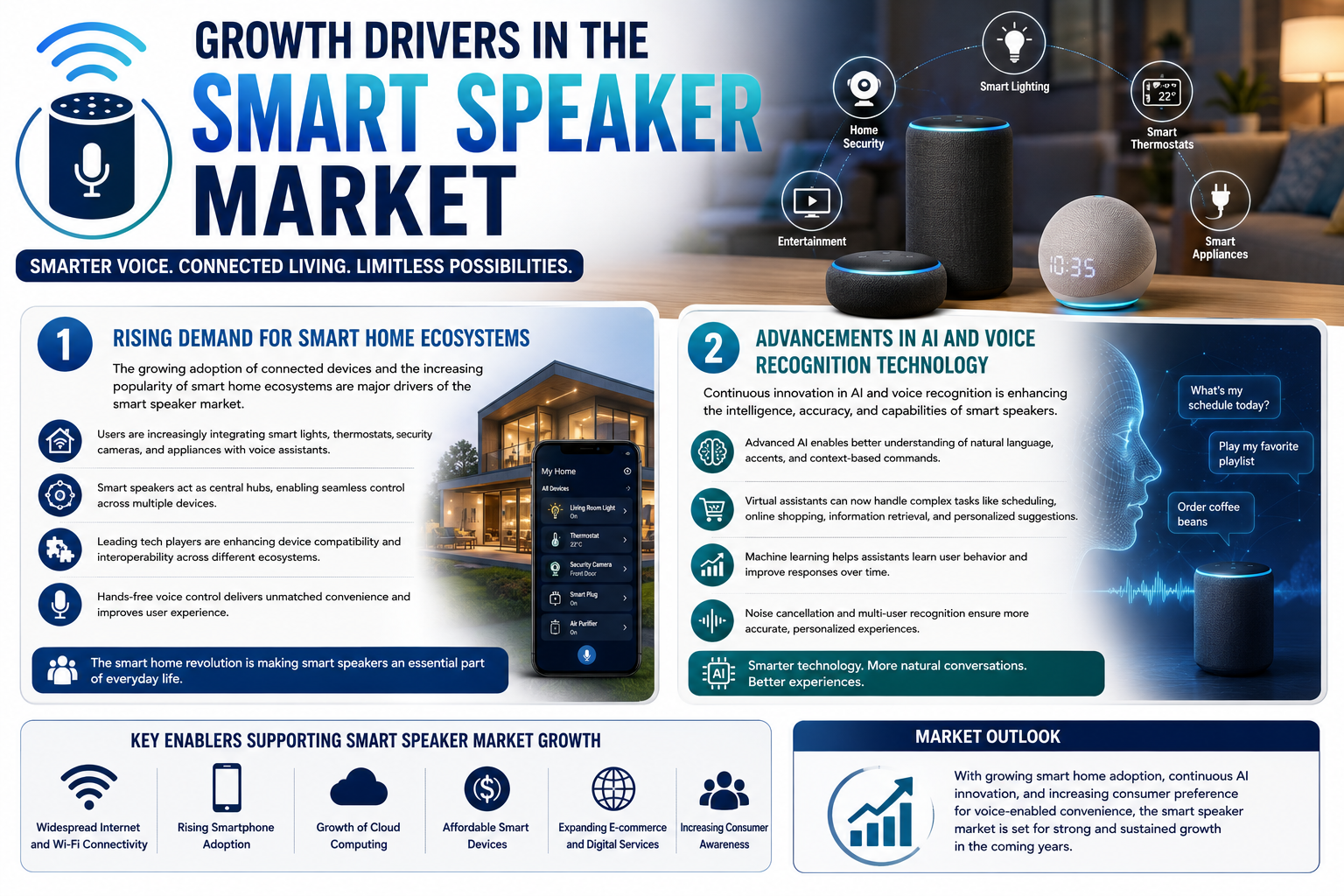
One of the strongest contributors to market growth is the rapid expansion of smart home ecosystems.
Consumers increasingly purchase connected devices including smart lighting, thermostats, surveillance cameras, televisions, kitchen appliances, and home security systems. Smart speakers serve as the central control point that allows users to operate these devices using simple voice commands.
Rather than managing multiple applications individually, homeowners can control an entire connected environment through one intelligent assistant.
Technology companies continue improving interoperability between devices from different manufacturers, making smart homes easier to install and operate than ever before.
Artificial Intelligence Is Making Smart Speakers Smarter
Artificial intelligence has significantly improved the capabilities of modern smart speakers.
Earlier generations could recognize only basic commands, but today's AI-powered virtual assistants understand conversational language, regional accents, contextual questions, and increasingly complex requests.
Machine learning enables these systems to learn user preferences over time, creating personalized experiences based on daily habits and routines.
Advanced technologies including natural language processing (NLP), multi-user recognition, adaptive learning, and intelligent noise cancellation allow smart speakers to respond more naturally even in busy environments.
These innovations continue improving customer satisfaction while expanding practical applications across homes and workplaces.
Voice Commerce Is Becoming Mainstream
Shopping through voice commands has emerged as one of the industry's most exciting developments.
Consumers can now order groceries, purchase household products, schedule food deliveries, and access entertainment services simply by speaking to their virtual assistants.
Voice commerce eliminates many traditional shopping barriers by making purchasing faster and more convenient.
Retailers and ecommerce platforms increasingly optimize their digital services for voice-enabled interactions, allowing consumers to search products, compare prices, track deliveries, and complete transactions without touching a screen.
As digital commerce continues evolving, voice-enabled purchasing is expected to become an increasingly important retail channel.
Software Innovation Is Expanding Device Capabilities
While hardware attracts consumer attention, software remains the true engine behind smart speaker functionality.
Artificial intelligence, cloud computing, speech recognition, and natural language processing enable virtual assistants to understand commands, interpret context, and generate meaningful responses.
Regular software updates continuously introduce new capabilities, improve cybersecurity, enhance multilingual support, and strengthen compatibility with third-party applications.
Predictive intelligence is becoming another important feature, allowing devices to anticipate user needs based on previous interactions and daily routines.
As AI models become increasingly sophisticated, smart speakers are expected to offer even more personalized and proactive assistance.
Hardware Continues to Improve
Manufacturers continue investing heavily in hardware innovation to enhance both performance and user experience.
Modern smart speakers feature improved microphone arrays capable of recognizing commands from across large rooms, even when background noise is present.
Enhanced processors accelerate AI performance while premium audio systems deliver richer sound quality with stronger bass and clearer vocals.
Portable smart speakers are also becoming increasingly popular thanks to longer battery life, compact designs, and improved wireless connectivity.
Many manufacturers now emphasize minimalist aesthetics that blend naturally into modern home interiors.
Amazon Alexa Maintains Strong Market Position
Amazon Alexa remains one of the most influential virtual assistant ecosystems in the global smart speaker market.
Its Echo product family—including Echo Dot, Echo Show, and Echo Studio—offers broad compatibility with thousands of smart home products and third-party applications.
Alexa's integration with Amazon's ecommerce ecosystem further strengthens its competitive advantage by allowing users to place orders, monitor deliveries, and access personalized shopping recommendations through voice commands.
Continuous AI improvements ensure Alexa becomes increasingly conversational and context-aware with every software update.
Apple and Siri Focus on Premium Experiences
Apple approaches the smart speaker market differently by emphasizing premium audio quality, privacy, and seamless integration within its own ecosystem.
HomePod and HomePod Mini synchronize effortlessly with iPhones, iPads, Macs, and other Apple devices, creating a highly connected user experience.
Apple also places significant emphasis on protecting user privacy through secure processing methods and limited cloud dependency.
Although Apple's ecosystem offers fewer third-party integrations than some competitors, its focus on sound quality and security continues attracting loyal customers.
Wi-Fi Connectivity Is Becoming Essential
Wi-Fi has emerged as the preferred connectivity option for modern smart speakers.
Compared with Bluetooth, Wi-Fi provides faster data transmission, higher-quality streaming, cloud connectivity, multi-room synchronization, and continuous software updates.
Consumers increasingly appreciate the ability to stream music simultaneously across multiple rooms while controlling entire smart home ecosystems from a single voice assistant.
Leading brands continue leveraging Wi-Fi to support increasingly advanced AI features and cloud-based services.
Offline Processing Addresses Privacy Concerns
Growing consumer awareness regarding data privacy has accelerated interest in offline smart speaker technologies.
Unlike traditional cloud-dependent devices, offline systems process many voice commands locally without transmitting sensitive information over the internet.
Although these devices currently offer fewer features than cloud-connected alternatives, improvements in edge computing and on-device artificial intelligence continue narrowing this performance gap.
Privacy-focused innovations are expected to become increasingly important as governments introduce stricter data protection regulations.
Regional Markets Continue Expanding
The United States remains the world's largest smart speaker market due to widespread smart home adoption and continuous innovation from leading technology companies.
India represents one of the fastest-growing markets as affordable devices, expanding internet connectivity, and multilingual AI capabilities encourage broader adoption.
France continues strengthening localized voice assistant support for French-speaking users while smart home adoption increases.
Saudi Arabia is also experiencing rapid market growth as digital transformation initiatives and smart city projects encourage wider deployment of AI-powered consumer technologies.
Challenges Still Exist
Despite exceptional market potential, several obstacles continue limiting industry growth.
Privacy and Data Security
Many consumers remain concerned that always-on microphones may unintentionally record private conversations.
Manufacturers must therefore provide stronger encryption, transparent data policies, and greater user control over stored voice recordings.
Compliance with evolving global privacy regulations also requires significant investment in cybersecurity.
Language Compatibility
Although voice assistants perform exceptionally well in major languages, they often struggle with regional dialects, local accents, and less widely spoken languages.
Expanding multilingual capabilities requires extensive AI training, localized content development, and continuous software improvement.
Improving language support remains essential for expanding adoption across emerging markets.
The Future of Smart Speakers
The next generation of smart speakers will become far more intelligent than today's devices.
Advances in generative artificial intelligence, contextual understanding, emotional recognition, and predictive assistance will enable increasingly natural conversations between humans and machines.
Smart speakers will likely become central hubs connecting homes, healthcare systems, vehicles, workplaces, entertainment platforms, and digital commerce ecosystems.
Rather than simply responding to commands, future AI assistants will proactively anticipate user needs and automate many daily activities.
Final Thoughts
The global smart speaker market is entering a period of extraordinary expansion as artificial intelligence reshapes how consumers interact with technology.
The projected increase from US$9.60 billion in 2025 to US$47.81 billion by 2034, supported by a remarkable 19.53% CAGR, demonstrates the growing importance of voice-enabled digital experiences.
Driven by smart home adoption, AI innovation, cloud computing, voice commerce, and continuous improvements in hardware and software, smart speakers are becoming an essential part of connected living. Companies that continue investing in intelligent ecosystems, multilingual capabilities, cybersecurity, and seamless user experiences are expected to lead the next generation of voice-enabled technology.
About the Creator
Enjoyed the story? Support the Creator.
Subscribe for free to receive all their stories in your feed.
Comments
There are no comments for this story
Be the first to respond and start the conversation.