
Global Smart Pills Market Outlook 2026–2034: How Minimally Invasive Diagnostics Are Transforming Modern Healthcare
Rising gastrointestinal disorders, growing demand for non-invasive diagnostic technologies, and rapid advancements in digital healthcare are driving strong growth in the global smart pills market.

The healthcare industry is undergoing a major technological transformation as providers increasingly seek innovative solutions that improve patient comfort, diagnostic accuracy, and treatment efficiency. Among the most promising developments in this evolving landscape is the emergence of smart pills, a revolutionary technology that combines medical diagnostics with advanced electronics.
Smart pills are ingestible medical devices equipped with miniature cameras, sensors, wireless communication systems, and other electronic components capable of monitoring and transmitting valuable health information from inside the human body. Unlike traditional diagnostic methods that often require invasive procedures, smart pills provide a safer, more convenient, and patient-friendly alternative.
The growing prevalence of gastrointestinal disorders, increasing adoption of minimally invasive procedures, and expanding integration of digital healthcare systems are accelerating demand for these advanced diagnostic tools. Healthcare providers are increasingly recognizing the benefits of smart pills for detecting diseases, monitoring patient conditions, and improving clinical outcomes.
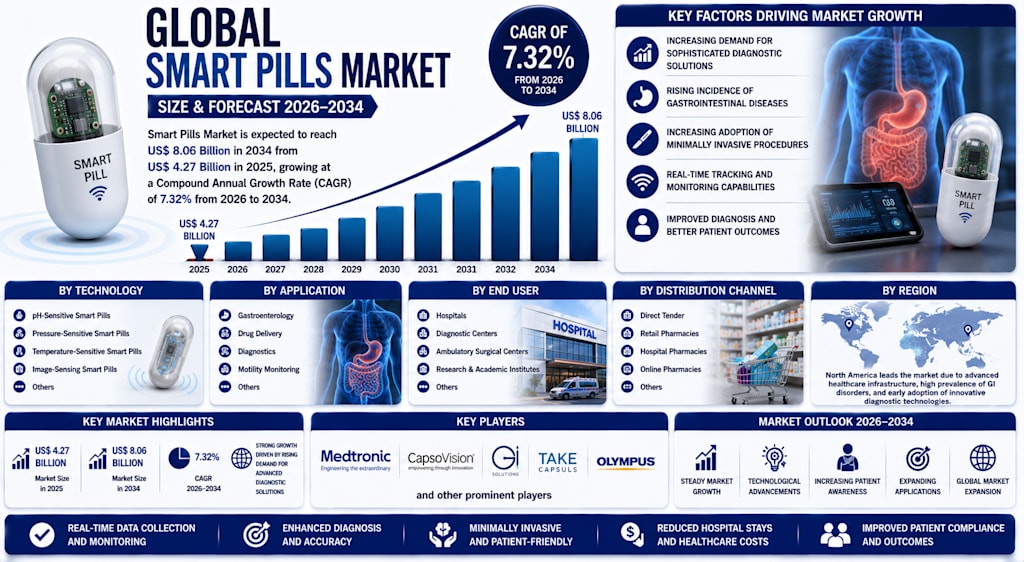
According to Renub Research, the Global Smart Pills Market is projected to grow from US$ 4.27 Billion in 2025 to US$ 8.06 Billion by 2034, registering a Compound Annual Growth Rate (CAGR) of 7.32% from 2026 to 2034. The increasing demand for sophisticated diagnostic solutions, rising incidence of gastrointestinal diseases, and growing adoption of minimally invasive procedures are among the primary factors fueling market expansion.
As healthcare systems continue embracing advanced digital technologies, smart pills are expected to become an increasingly important component of modern diagnostics and patient care.
Understanding Smart Pills
Smart pills are advanced ingestible devices that contain miniature electronic components such as cameras, sensors, batteries, and wireless communication systems.
These devices are swallowed like conventional capsules and travel naturally through the digestive tract while collecting valuable physiological information.
Depending on their design and intended application, smart pills can capture images, measure pH levels, record temperature, monitor pressure, and transmit real-time data to external receivers.
One of the most widely used applications is capsule endoscopy, which allows physicians to examine areas of the gastrointestinal tract that may be difficult to access using conventional diagnostic procedures.
Unlike traditional endoscopy, smart pills typically do not require sedation, invasive instruments, or lengthy recovery periods.
Their ability to provide accurate diagnostic information while minimizing patient discomfort has contributed significantly to growing adoption worldwide.
Rising Gastrointestinal Disorders Are Driving Market Growth
One of the strongest drivers supporting smart pill adoption is the growing prevalence of gastrointestinal disorders globally.
Conditions such as Crohn's disease, colorectal cancer, ulcers, gastrointestinal bleeding, inflammatory bowel disease, and digestive tract abnormalities require accurate diagnosis and continuous monitoring.
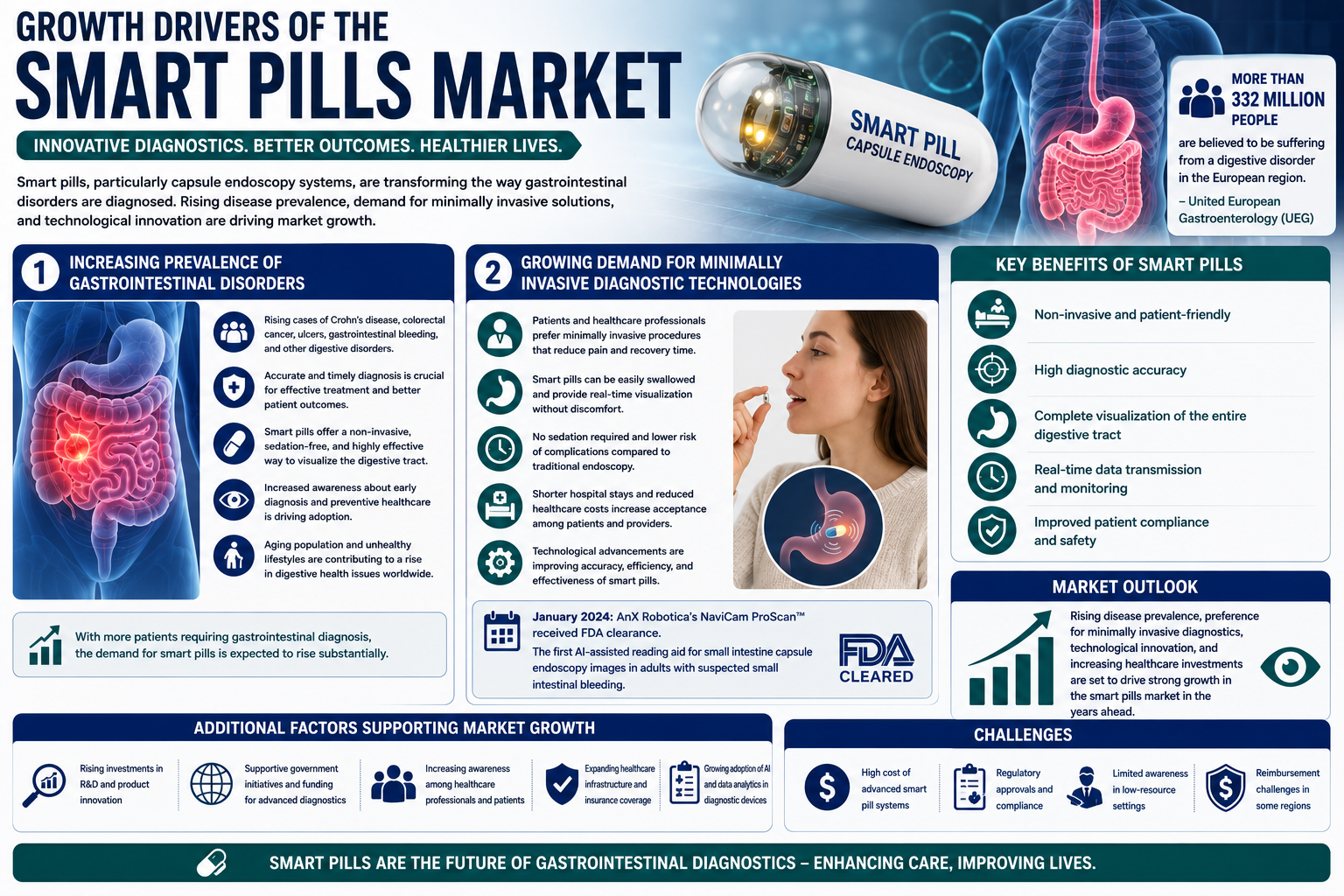
According to the United European Gastroenterology organization, more than 332 million individuals in Europe alone are estimated to be affected by digestive disorders.
Early detection is critical for improving treatment outcomes and preventing disease progression.
Traditional diagnostic methods can often be invasive, uncomfortable, and time-consuming.
Smart pills offer a highly effective alternative by enabling physicians to visualize and assess the digestive system without requiring invasive procedures.
The growing burden of digestive disorders, combined with increasing awareness regarding preventive healthcare, is expected to continue driving strong demand for smart pill technologies.
Demand for Minimally Invasive Procedures Continues Increasing
Healthcare providers and patients alike increasingly prefer minimally invasive diagnostic solutions.
Traditional procedures such as endoscopy often require sedation, hospital visits, and patient preparation that can cause anxiety and discomfort.
Smart pills eliminate many of these concerns by providing a non-invasive diagnostic option that can be completed with minimal disruption to patients' daily activities.
Patients simply swallow the capsule, allowing the device to collect diagnostic information as it moves naturally through the body.
This approach significantly improves patient comfort while reducing procedural risks and recovery times.
Minimally invasive procedures also help reduce healthcare costs by limiting hospitalization requirements and improving operational efficiency.
As healthcare systems continue emphasizing patient-centered care, demand for smart pill technologies is expected to grow steadily.
Technological Innovation Is Transforming Smart Pills
Continuous technological advancement remains one of the most important growth drivers within the smart pills market.
Modern smart pills incorporate high-resolution imaging systems, advanced sensors, improved battery life, and wireless communication technologies that significantly enhance diagnostic capabilities.
These devices can now provide real-time monitoring and transmit data directly to healthcare professionals for analysis.
Artificial intelligence and digital healthcare integration are further expanding their capabilities.
In January 2024, AnX Robotica received FDA clearance for NaviCam ProScan™, the first artificial intelligence-assisted reading aid specifically designed to support analysis of capsule endoscopy images from patients suspected of small intestinal bleeding.
Advances in data analytics and remote monitoring are expected to further improve diagnostic accuracy and patient outcomes.
As technology continues evolving, smart pills are becoming increasingly sophisticated and versatile.
Digital Healthcare Integration Creates New Opportunities
The rapid growth of digital healthcare infrastructure is creating significant opportunities for smart pill adoption.
Healthcare providers increasingly utilize connected technologies, remote monitoring systems, cloud-based data platforms, and artificial intelligence tools to improve patient care.
Smart pills fit naturally within this ecosystem because they generate digital data that can be transmitted, analyzed, and stored electronically.
Real-time monitoring capabilities allow healthcare professionals to track patient conditions more effectively and make informed clinical decisions.
Future applications may extend beyond diagnostics to include personalized drug delivery systems and advanced patient monitoring solutions.
The convergence of smart pills and digital healthcare technologies is expected to create substantial innovation opportunities throughout the forecast period.
Capsule Endoscopy Dominates Market Applications
Capsule endoscopy remains the largest application segment within the smart pills market.
These capsules contain miniature cameras that capture high-resolution images throughout the digestive tract.
Healthcare providers commonly use capsule endoscopy to diagnose gastrointestinal bleeding, Crohn's disease, tumors, ulcers, and other digestive disorders.
Unlike conventional endoscopy procedures, capsule endoscopy requires no tubes, sedation, or invasive instruments.
Patients generally experience greater comfort and convenience while physicians gain access to detailed diagnostic information.
Technological improvements in image quality, battery performance, and wireless data transmission continue enhancing the effectiveness of capsule endoscopy systems.
As awareness regarding early diagnosis continues increasing, demand for capsule endoscopy solutions is expected to remain strong.
Esophagus Smart Pills Are Gaining Importance
The esophagus smart pills segment is growing due to increasing rates of esophageal disorders such as gastroesophageal reflux disease (GERD), Barrett's esophagus, and esophageal cancer.
These specialized devices can measure physiological parameters including pH levels, pressure, and other diagnostic indicators.
Early detection is particularly important for managing esophageal disorders because delayed treatment can result in serious complications.
Smart pills offer a convenient and patient-friendly alternative to conventional diagnostic procedures.
Advancements in sensor technologies and wireless communications have significantly improved device performance and reliability.
As awareness regarding esophageal health continues growing, demand for these specialized diagnostic tools is expected to increase steadily.
Stomach Smart Pills Continue Expanding Applications
The stomach smart pills market is benefiting from growing demand for advanced digestive health monitoring solutions.
These devices help physicians evaluate stomach functions by measuring pH levels, temperature, pressure, and other physiological parameters.
Healthcare providers use these technologies to diagnose conditions such as gastric ulcers, acid reflux disease, and delayed gastric emptying.
Continuous monitoring capabilities allow physicians to gain deeper insights into digestive system performance.
Patients benefit from a non-invasive diagnostic experience that improves comfort and reduces procedural risks.
As awareness regarding digestive health continues increasing, stomach smart pills are expected to become an increasingly important diagnostic tool.
Hospitals Remain the Largest End Users
Hospitals represent one of the most significant end-user segments within the smart pills market.
Modern healthcare facilities increasingly rely on advanced diagnostic technologies to improve patient outcomes and operational efficiency.
Smart pills allow hospitals to obtain accurate diagnostic information while reducing dependence on invasive procedures.
The growing number of patients with gastrointestinal and chronic diseases continues supporting demand for innovative diagnostic solutions.
Hospitals also benefit from improved diagnostic precision, faster decision-making, and enhanced patient satisfaction.
As healthcare institutions continue investing in advanced technologies, smart pill adoption is expected to increase significantly.
Diagnostic Centers Are Expanding Their Role
Diagnostic centers play an increasingly important role in the smart pills market.
These facilities specialize in early disease detection and preventive healthcare services, making them ideal environments for smart pill technologies.
Patients increasingly prefer diagnostic centers because they often provide cost-effective, convenient, and specialized services.
Capsule endoscopy and physiological monitoring solutions are becoming common offerings within advanced diagnostic facilities.
Technological improvements have enabled diagnostic centers to deliver highly accurate results while maintaining operational efficiency.
As preventive healthcare awareness continues rising, diagnostic centers are expected to become major contributors to market growth.
High Costs Remain a Major Challenge
Despite strong growth potential, the smart pills market faces several significant challenges.
One of the most important concerns is the high cost associated with smart pill technologies.
The sophisticated components required for manufacturing—including miniature cameras, sensors, wireless communication systems, and advanced electronics—contribute to elevated production expenses.
These costs are often reflected in final pricing, limiting accessibility for certain patient populations and healthcare facilities.
Additional expenses related to specialized diagnostic equipment and trained medical professionals further increase overall healthcare costs.
Limited insurance coverage in some regions can also restrict adoption.
Addressing affordability concerns will be critical for expanding access and supporting long-term market growth.
Regulatory and Safety Requirements Create Complexity
Regulatory compliance represents another important challenge facing the smart pills industry.
Because smart pills are ingestible medical devices, they must meet rigorous safety and performance standards before receiving regulatory approval.
Manufacturers must complete extensive clinical testing and validation studies to demonstrate device safety and effectiveness.
These processes can be lengthy and expensive, potentially delaying product launches.
There are also concerns regarding capsule retention in patients with certain medical conditions, making safety monitoring particularly important.
Ensuring patient safety and maintaining device reliability remain essential priorities for manufacturers and regulatory authorities alike.
Regional Market Insights
United States
The United States remains one of the largest smart pills markets globally due to advanced healthcare infrastructure, strong research and development activity, and early adoption of innovative medical technologies. In March 2024, researchers at the California Institute of Technology developed a location-aware smart pill capable of using magnetic fields to precisely determine its position within the gastrointestinal tract.
United Kingdom
The United Kingdom market continues growing due to increasing demand for non-invasive diagnostics, rising awareness regarding digestive health, and strong healthcare infrastructure. Investments in healthcare innovation continue supporting adoption of advanced diagnostic technologies.
India
India's smart pills market is expanding rapidly due to improving healthcare infrastructure, rising awareness regarding preventive healthcare, and increasing gastrointestinal disease prevalence. Growing investments in hospitals and diagnostic centers continue supporting market development.
Saudi Arabia
Saudi Arabia continues investing heavily in healthcare modernization and advanced diagnostic technologies. Growing awareness regarding early disease detection and increasing healthcare expenditure are supporting smart pill adoption across the country. In September 2025, King Abdulaziz City for Science and Technology collaborated with the University of California, San Diego, to develop a smart multi-compartment medication capsule.
Competitive Landscape
The global smart pills market remains highly competitive, with major medical technology companies focusing on innovation, product development, and strategic partnerships.
Leading market participants include Check-Cap Ltd., General Electric Company, Fujifilm, Koninklijke Philips N.V., Medtronic plc, Olympus Corporation, Novartis AG, and Otsuka Holdings Co., Ltd.
These companies continue investing in advanced imaging technologies, sensor development, artificial intelligence integration, and digital healthcare solutions to strengthen their market positions.
Research and development activities remain central to expanding smart pill capabilities and improving patient outcomes.
Final Thoughts
The global smart pills market is entering an exciting period of growth as healthcare systems increasingly embrace minimally invasive diagnostics and digital health technologies. Rising gastrointestinal disease prevalence, growing demand for patient-friendly diagnostic solutions, and continuous technological innovation are creating significant opportunities across the industry.
Smart pills offer a unique combination of convenience, accuracy, and real-time monitoring capabilities that align perfectly with the future direction of modern healthcare. Their ability to improve diagnostic outcomes while reducing patient discomfort makes them particularly attractive for both healthcare providers and patients.
With the market expected to grow from US$ 4.27 Billion in 2025 to US$ 8.06 Billion by 2034, smart pills are poised to become a cornerstone of next-generation medical diagnostics. Companies that successfully combine technological innovation, affordability, and regulatory compliance will be best positioned to capitalize on the substantial opportunities emerging within this rapidly evolving market.
About the Creator
Enjoyed the story? Support the Creator.
Subscribe for free to receive all their stories in your feed.
Comments
There are no comments for this story
Be the first to respond and start the conversation.