
Global Rice Market to Reach US$405.50 Billion by 2034 as Rising Food Demand and Agricultural Innovation Strengthen Growth
Growing global population, increasing food consumption, advances in agricultural technology, and expanding international trade are driving the steady growth of the global rice market.

Rice Continues to Feed More Than Half of the World's Population
Rice has remained one of humanity's most important food crops for thousands of years. From Asia and Africa to Latin America and beyond, billions of people rely on rice as their primary source of daily nutrition. Its affordability, versatility, and ability to adapt to diverse climates have made it one of the world's most widely cultivated and consumed grains.
Today, rice is much more than a staple food. It supports global food security, drives international agricultural trade, and provides livelihoods for millions of farmers worldwide. As populations continue expanding and food demand rises, governments and agricultural organizations are investing heavily in improving rice productivity through technological innovation and sustainable farming practices.
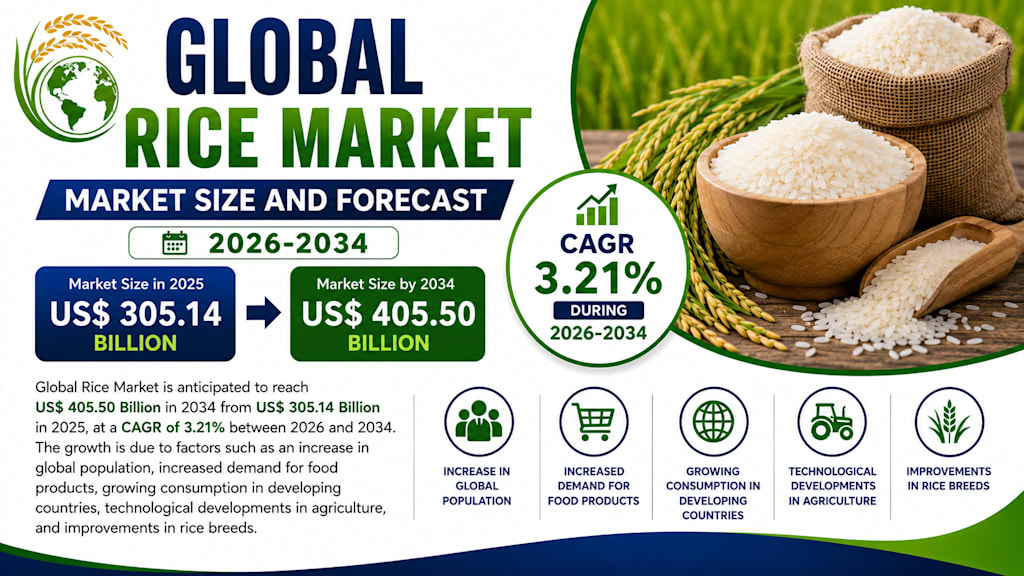
According to the latest market outlook, the Global Rice Market is projected to grow from US$305.14 billion in 2025 to US$405.50 billion by 2034, expanding at a compound annual growth rate (CAGR) of 3.21% during 2026–2034. Increasing population growth, rising food consumption, agricultural modernization, and expanding export opportunities are expected to support long-term market expansion.
Rice Remains a Global Staple Food
Rice is produced from the grains of Oryza sativa and Oryza glaberrima and serves as one of the world's most important cereal crops.
Its versatility allows it to be prepared in countless ways, including steamed, boiled, fried, baked, or processed into flour, beverages, breakfast products, and packaged foods.
Consumers can choose from numerous varieties such as white rice, brown rice, basmati, jasmine, sticky rice, and Arborio rice, each offering unique cooking characteristics and culinary applications.
Because rice is affordable, nutritious, and widely available, it remains essential for maintaining global food security.
Population Growth Continues to Increase Demand
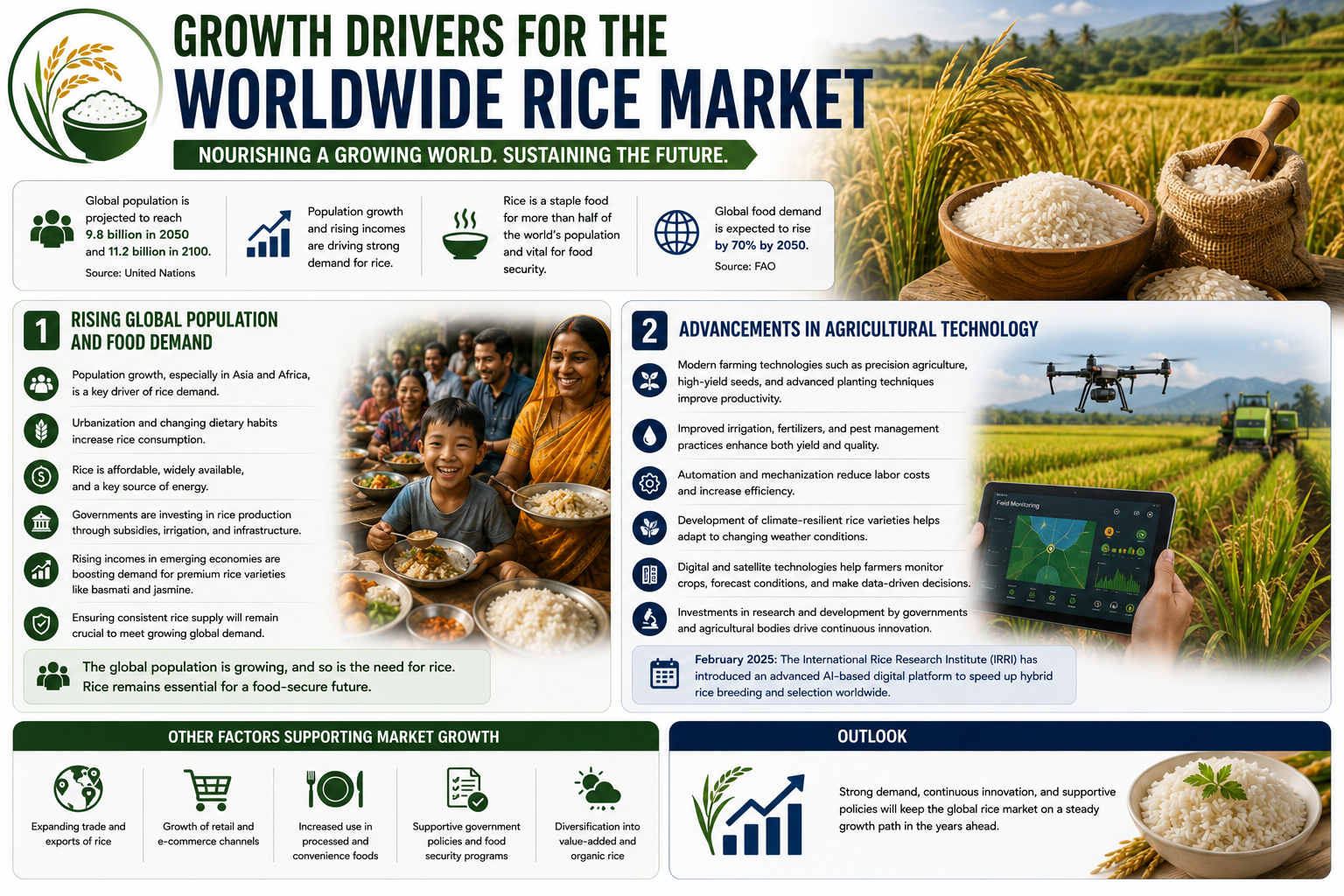
One of the strongest growth drivers for the rice industry is the continuous expansion of the global population.
As billions of additional people require affordable and reliable food supplies, rice consumption continues increasing across both developed and emerging economies.
Rapid population growth throughout Asia and Africa is particularly significant because rice serves as the primary dietary staple in many countries throughout these regions.
Urbanization, rising household incomes, and changing dietary habits have also increased demand for packaged rice products and premium rice varieties.
International organizations continue forecasting substantial growth in global food demand over the coming decades, reinforcing the importance of rice production.
Agricultural Technology Is Improving Productivity
Modern agricultural technologies are transforming rice cultivation worldwide.
Farmers increasingly utilize precision agriculture, satellite monitoring, advanced irrigation systems, automation, improved fertilizers, and high-yield seed varieties to improve productivity.
Researchers are also developing climate-resilient rice varieties capable of withstanding droughts, floods, and changing weather conditions.
Artificial intelligence, digital farming platforms, and remote sensing technologies now help farmers monitor crop health, predict yields, and optimize resource utilization.
These technological advancements are enabling higher production while supporting more sustainable agricultural practices.
Global Trade Expands Market Opportunities
International trade continues creating significant growth opportunities for rice producers.
Leading exporting countries including India, Thailand, Vietnam, and Pakistan supply rice to markets throughout Europe, North America, the Middle East, and Africa.
Demand for premium rice varieties such as basmati, jasmine, and aromatic rice continues increasing as consumers seek higher-quality food products.
Trade agreements, export incentives, and improvements in logistics infrastructure have further strengthened international rice commerce.
Competition within export markets has also encouraged producers to improve quality, packaging, and processing standards.
Conventional Rice Dominates Global Consumption
Conventional white rice continues representing the largest segment of the global market.
Its affordability, long shelf life, ease of preparation, and widespread availability make it the preferred choice for households, restaurants, food manufacturers, and institutional buyers.
Governments frequently support conventional rice production through agricultural subsidies and food security programs to ensure stable domestic supplies.
Although consumer preferences continue evolving, conventional rice remains the foundation of global rice consumption.
Brown Rice Gains Popularity
Health-conscious consumers have significantly increased demand for brown rice.
Unlike white rice, brown rice retains its bran and germ layers, providing higher levels of dietary fiber, vitamins, minerals, and antioxidants.
Consumers increasingly choose brown rice as part of balanced diets focused on weight management, digestive health, and reducing the risk of chronic diseases.
The growing popularity of whole grains, organic foods, and plant-based nutrition has further strengthened this market segment.
Food manufacturers continue expanding product offerings that feature brown rice as a premium health-oriented ingredient.
Arborio Rice Benefits From Culinary Trends
Arborio rice has emerged as a premium niche segment within the global rice market.
Widely recognized for its high starch content and creamy texture, Arborio rice is the preferred ingredient for traditional Italian risotto.
Growing consumer interest in international cuisines and gourmet home cooking has increased demand for specialty rice varieties across global markets.
Restaurants, specialty retailers, and premium grocery stores continue expanding their selection of Arborio rice to meet evolving consumer preferences.
Food Processing Increases Rice Applications
Rice is no longer consumed only as a traditional cooked grain.
Food manufacturers increasingly utilize rice to produce flour, cereals, snacks, beverages, bakery ingredients, infant nutrition products, ready-to-eat meals, and plant-based foods.
Rice-based ingredients also serve important roles in nutraceuticals, pharmaceuticals, and personal care products.
The diversification of rice applications continues creating new commercial opportunities beyond conventional food consumption.
Climate Change Remains a Major Challenge
Climate change represents one of the most significant challenges facing global rice production.
Rice cultivation depends heavily on stable weather conditions and reliable water supplies.
Extreme weather events including droughts, floods, rising temperatures, and unpredictable rainfall patterns can significantly reduce crop yields.
Traditional rice cultivation also contributes to methane emissions, creating additional environmental concerns.
Researchers continue developing climate-resilient rice varieties and sustainable farming methods capable of reducing environmental impact while maintaining productivity.
Price Volatility Continues Affecting Producers
Global rice markets remain sensitive to fluctuations in supply and demand.
Export restrictions, changing government policies, transportation costs, fertilizer prices, labor shortages, and geopolitical developments can all influence international rice prices.
Supply chain disruptions may also increase post-harvest losses while limiting product availability in certain markets.
Improving transportation infrastructure, storage facilities, and logistics networks remains essential for strengthening long-term market stability.
Regional Markets Continue Supporting Growth
India remains one of the world's largest rice producers and exporters, supplying both basmati and non-basmati rice to international markets while supporting substantial domestic consumption.
The United States continues expanding rice production through modern farming practices, improved seed varieties, and increasing demand for healthier rice options including brown rice.
Germany depends largely on imported rice but continues experiencing steady demand driven by multicultural cuisine, premium products, and growing interest in organic food.
The United Arab Emirates remains a major import-dependent market with strong demand for premium rice varieties, particularly basmati rice, reflecting its diverse population and vibrant foodservice industry.
Together, these regional markets continue shaping global production, trade, and consumption trends.
Innovation Is Shaping the Future of Rice Farming
Agricultural innovation continues transforming every stage of rice production.
Artificial intelligence, digital farm management platforms, satellite monitoring, precision irrigation, drone technology, and biotechnology are improving efficiency while reducing production costs.
Governments and agricultural research institutions continue investing heavily in sustainable farming techniques designed to improve productivity without increasing environmental pressure.
These innovations are expected to play a critical role in meeting future food demand.
Final Thoughts
Rice remains one of the world's most important agricultural commodities, supporting food security for billions of people while driving international trade and rural economic development.
The projected growth from US$305.14 billion in 2025 to US$405.50 billion by 2034, supported by a 3.21% CAGR, reflects the continuing importance of rice in feeding a growing global population.
Although climate change, supply chain disruptions, and price volatility present ongoing challenges, technological innovation, expanding export opportunities, and increasing investment in sustainable agriculture position the global rice market for steady long-term growth. As governments, researchers, and farmers continue modernizing production systems, rice will remain an essential pillar of the world's food economy for decades to come.
About the Creator
Enjoyed the story? Support the Creator.
Subscribe for free to receive all their stories in your feed.
Comments
There are no comments for this story
Be the first to respond and start the conversation.