
Global Plywood Market Poised for Strong Growth as Construction and Furniture Industries Drive Demand
Rising urbanization, infrastructure development, and growing demand for sustainable engineered wood products are fueling the next phase of growth in the global plywood market.

The global construction and furniture industries are undergoing significant transformation, creating new opportunities for engineered wood products that combine durability, affordability, and sustainability. Among these materials, plywood continues to stand out as one of the most versatile and widely used products across residential, commercial, and industrial applications.
From modern homes and office buildings to furniture manufacturing and interior design projects, plywood has become a preferred material because of its strength, flexibility, and cost-effectiveness. As urban populations expand and governments invest heavily in infrastructure projects, demand for plywood is increasing across both developed and emerging economies.
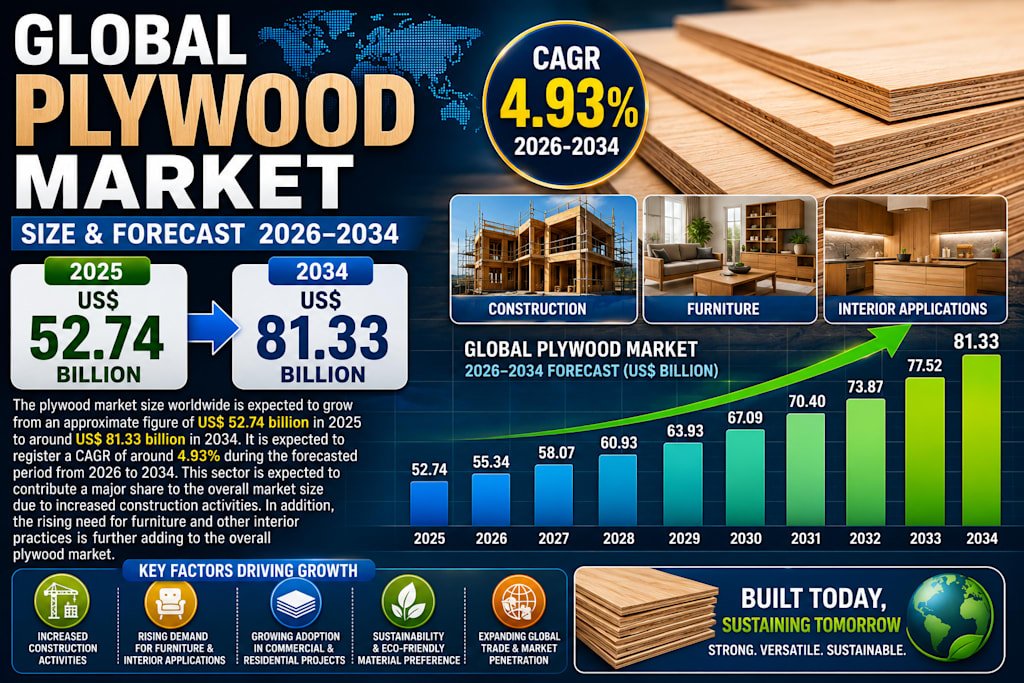
According to Renub Research, the Global Plywood Market is expected to grow from US$52.74 billion in 2025 to US$81.33 billion by 2034, registering a compound annual growth rate (CAGR) of 4.93% from 2026 to 2034. The market's growth is being supported by rising construction activities, expanding furniture production, growing interest in interior design, and increasing preference for sustainable wood-based materials.
Understanding the Importance of Plywood
Plywood is a manufactured wood panel created by bonding together multiple thin layers of wood veneer, known as plies. Each layer is arranged with its grain running perpendicular to adjacent layers, creating a highly stable and durable material.
This cross-grain construction gives plywood superior strength compared to many traditional wood products while reducing the risk of cracking, warping, or shrinking. Because of these qualities, plywood has become a critical material in construction, furniture manufacturing, transportation, packaging, and decorative applications.
The market includes various categories such as hardwood plywood, softwood plywood, marine plywood, moisture-resistant plywood, fire-resistant plywood, and structural-grade plywood, each designed for specific applications and performance requirements.
Its ability to deliver durability, affordability, and versatility has helped plywood maintain its position as one of the most widely used engineered wood products worldwide.
Construction Growth Remains the Biggest Market Driver
One of the most important factors supporting the growth of the global plywood market is the continued expansion of construction activity.
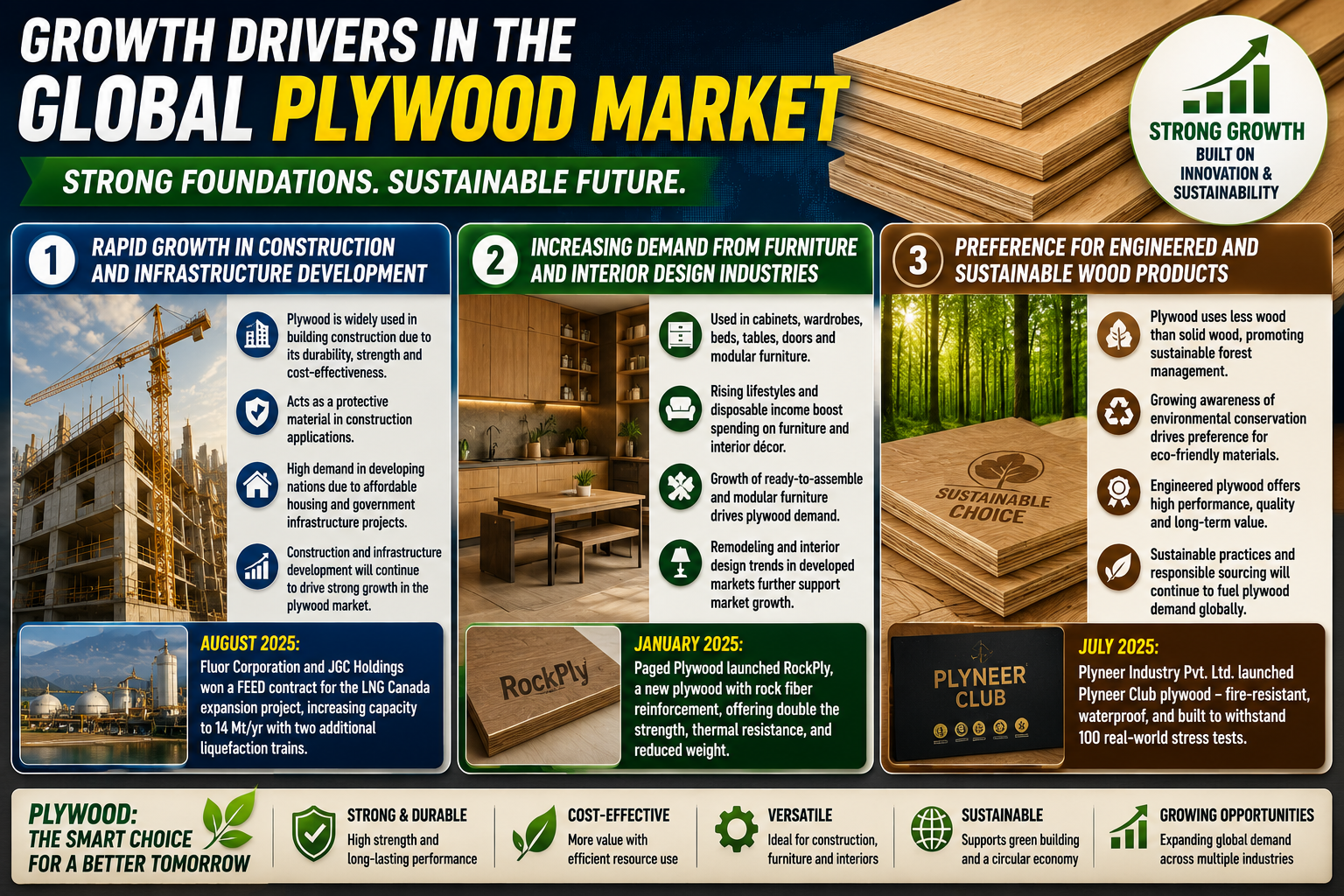
Rapid urbanization, population growth, and economic development are driving demand for residential housing, commercial buildings, industrial facilities, and public infrastructure projects. As cities expand and governments invest in development programs, the need for reliable and cost-effective construction materials continues to rise.
Plywood is extensively used in flooring, roofing, wall sheathing, partitions, formwork, and structural applications due to its strength and versatility. Contractors often prefer plywood because it offers consistent performance while remaining more affordable than many alternative materials.
Developing economies are witnessing especially strong demand as governments prioritize affordable housing projects and infrastructure modernization initiatives.
With global construction activity expected to remain robust throughout the forecast period, plywood demand is likely to continue rising steadily.
Urbanization Is Creating New Opportunities
Urbanization remains one of the most powerful forces shaping global demand for plywood.
Millions of people continue migrating to urban centers in search of employment opportunities and improved living standards. This trend is increasing demand for residential housing, office spaces, retail developments, and public infrastructure.
Modern urban construction often emphasizes efficient use of space, cost-effective materials, and sustainable building practices. Plywood aligns well with these requirements because it offers flexibility, durability, and ease of installation.
As cities continue growing across Asia, Africa, the Middle East, and Latin America, plywood manufacturers are expected to benefit from expanding construction activity and rising material consumption.
Furniture Manufacturing Is Fueling Demand
Beyond construction, the furniture industry represents one of the largest consumers of plywood globally.
Manufacturers use plywood to produce cabinets, wardrobes, beds, tables, shelves, doors, modular furniture, and a wide variety of interior products. Its smooth surface, uniform strength, and ability to accommodate different finishes make it an ideal material for modern furniture production.
Consumer spending on home improvement, interior decoration, and lifestyle products continues to increase, particularly in urban markets where design and functionality are increasingly valued.
The growth of e-commerce has also accelerated demand for ready-to-assemble and modular furniture, both of which rely heavily on plywood as a core material.
As furniture trends continue evolving, plywood remains a preferred choice for manufacturers seeking a balance between aesthetics, durability, and affordability.
Interior Design Trends Support Market Expansion
Interior design has become a major contributor to plywood consumption worldwide.
Homeowners, businesses, and commercial property developers are investing more in customized interiors, decorative wall panels, partitions, ceiling systems, and contemporary furniture solutions.
Plywood's flexibility allows designers to create innovative and visually appealing spaces while maintaining structural integrity and cost efficiency.
The growing popularity of minimalist interiors, modular layouts, and multifunctional furniture has further increased demand for engineered wood products.
As interior design continues to play a larger role in consumer spending decisions, plywood manufacturers are well positioned to benefit from these trends.
Sustainable Building Materials Are Gaining Preference
Environmental sustainability has become a key consideration across the construction and furniture industries.
Consumers, businesses, and governments are increasingly seeking materials that support sustainable development goals and reduce environmental impact.
Plywood offers several sustainability advantages compared to traditional solid wood products. Because it utilizes thin layers of veneer, plywood production generally requires less timber while maximizing resource efficiency.
Many manufacturers are also adopting responsible forestry practices and sourcing wood from certified sustainable forests.
Growing awareness of environmental issues is encouraging greater adoption of engineered wood products, helping drive demand for plywood in both residential and commercial applications.
Technological Innovation Is Enhancing Product Performance
Innovation continues to improve the performance and versatility of plywood products.
Manufacturers are developing advanced plywood solutions that offer enhanced strength, moisture resistance, fire protection, thermal performance, and durability.
Recent product innovations include rock-fiber reinforced plywood, waterproof plywood, fire-resistant panels, and lightweight structural solutions designed for specialized applications.
These advancements allow plywood to compete more effectively with alternative construction materials while expanding its potential use cases.
As technology continues evolving, manufacturers are expected to introduce increasingly sophisticated products that meet changing customer needs and regulatory requirements.
Hardwood Plywood Remains a Premium Segment
Hardwood plywood represents one of the most important segments within the global plywood market.
Manufactured using hardwood veneers, these panels offer exceptional strength, durability, and impact resistance. Hardwood plywood is commonly used in flooring systems, transportation equipment, construction formwork, and premium furniture manufacturing.
Its superior load-bearing capabilities make it particularly valuable in applications where structural performance is critical.
As construction quality standards continue rising globally, demand for hardwood plywood is expected to remain strong.
Fire-Resistant Plywood Gains Importance
Safety considerations are increasingly influencing material selection in construction projects.
Fire-resistant plywood has emerged as a growing market segment due to stricter building regulations and increased awareness of fire safety requirements.
These specialized panels are treated with fire-retardant chemicals that help slow flame spread and improve overall building safety.
They are commonly used in commercial buildings, transportation interiors, public infrastructure, and high-rise residential developments.
As governments continue strengthening fire safety standards, demand for fire-resistant plywood is likely to increase significantly.
Moisture-Resistant Plywood Supports Residential Growth
Moisture-resistant (MR) grade plywood remains highly popular within residential construction and interior applications.
This type of plywood is widely used in kitchen cabinets, wardrobes, wall paneling, partitions, and household furniture because it can withstand occasional exposure to moisture without significant deterioration.
The growing housing market, renovation activity, and demand for modern interiors continue to support strong consumption of MR-grade products.
Its affordability and versatility make it one of the most widely utilized plywood categories globally.
The United States Remains a Major Market
The United States represents one of the largest plywood markets in the world.
Strong demand from residential construction, renovation projects, and furniture manufacturing continues to drive consumption. Plywood plays a vital role in roofing, flooring, sheathing, cabinetry, and structural applications throughout the country.
Growing interest in sustainable building materials has also contributed to increased demand for engineered wood products.
Investments in manufacturing modernization and infrastructure improvements further support market development.
With housing activity and renovation spending remaining strong, the U.S. plywood market is expected to maintain steady growth.
India Emerges as a Fast-Growing Opportunity
India's plywood market is expanding rapidly due to urbanization, rising incomes, and increasing real estate development.
Growing demand for housing, furniture, and interior design solutions is creating substantial opportunities for plywood manufacturers across the country.
The expansion of organized retail, modern housing projects, and commercial construction activities has further strengthened demand.
Manufacturers are investing in new production facilities to meet growing consumption while supporting employment and regional economic development.
India is expected to remain one of the most promising markets for future plywood industry growth.
Saudi Arabia's Construction Boom Supports Demand
Saudi Arabia is experiencing significant construction growth driven by major government investments and long-term development initiatives.
Large-scale housing projects, tourism developments, industrial facilities, and infrastructure investments are increasing demand for construction materials, including plywood.
Programs associated with economic diversification and national development strategies are expected to support continued market expansion.
As construction activity accelerates, plywood consumption is likely to increase across residential, commercial, and industrial sectors.
Challenges Continue to Impact the Industry
Despite strong growth prospects, the plywood market faces several challenges.
One of the most significant concerns is volatility in raw material prices. Timber availability can be affected by environmental regulations, forest conservation measures, and supply chain disruptions.
Price fluctuations create uncertainty for manufacturers and can impact profitability.
The industry also faces competition from alternative materials such as medium-density fiberboard (MDF), particleboard, plastic composites, and engineered construction products.
Additionally, increasingly strict regulations regarding formaldehyde emissions, adhesives, and environmental compliance require ongoing investment in research and development.
Manufacturers must continue innovating to remain competitive while meeting evolving regulatory standards.
Sustainability Will Shape the Future
Sustainability is expected to play an increasingly important role in the future of the plywood market.
Consumers are becoming more environmentally conscious, while governments continue implementing policies that encourage responsible forestry and sustainable construction practices.
Manufacturers that invest in certified wood sourcing, low-emission products, and environmentally friendly production processes will likely gain competitive advantages.
The growing focus on green building certifications and sustainable construction materials is expected to create new opportunities for plywood producers worldwide.
Final Thoughts
The global plywood market continues to demonstrate strong long-term potential as construction activity, urbanization, furniture production, and interior design investments expand across the world.
Its combination of strength, affordability, versatility, and sustainability makes plywood one of the most valuable engineered wood products available today.
With the market projected to grow from US$52.74 billion in 2025 to US$81.33 billion by 2034, manufacturers, suppliers, builders, and investors have significant opportunities to benefit from rising global demand.
While challenges related to raw material availability, regulatory compliance, and competition remain, continued innovation and sustainable production practices are expected to support future growth.
As modern construction and design continue evolving, plywood is likely to remain a foundational material shaping homes, businesses, and infrastructure around the world.
About the Creator
Enjoyed the story? Support the Creator.
Subscribe for free to receive all their stories in your feed.
Comments
There are no comments for this story
Be the first to respond and start the conversation.