
Global Plywood Market Forecast 2026–2034: Construction Growth and Sustainable Materials Drive Industry Expansion
Rising Infrastructure Development, Furniture Demand, and Eco-Friendly Building Trends Are Reshaping the Future of the Global Plywood Industry

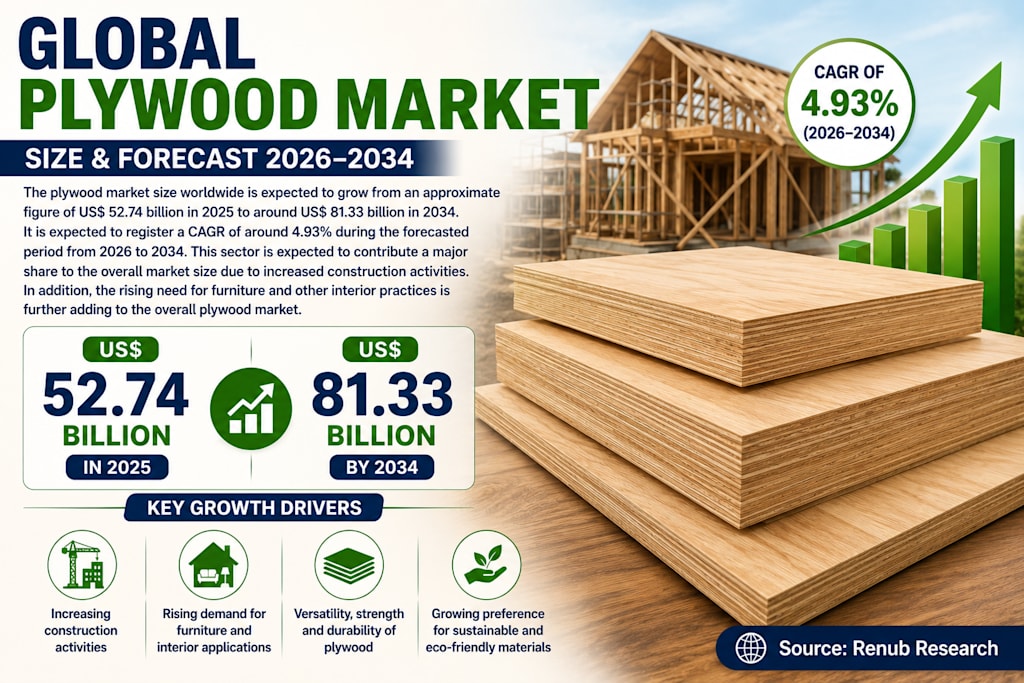
Global Plywood Market Overview
The global plywood market is entering a strong growth phase as construction activity, infrastructure expansion, and modern interior design trends continue to accelerate worldwide. Plywood has evolved from being a basic engineered wood product into a critical material used across residential housing, commercial construction, transportation, furniture manufacturing, and decorative interiors.
According to Renub Research, the global plywood market is projected to grow from approximately US$ 52.74 billion in 2025 to US$ 81.33 billion by 2034, registering a compound annual growth rate (CAGR) of 4.93% from 2026 to 2034.
The market’s growth reflects increasing urbanization, rising investments in infrastructure, expanding real estate development, and the growing preference for engineered and sustainable building materials. As consumers and industries seek durable, cost-effective, and environmentally responsible alternatives to traditional solid wood, plywood continues gaining importance in global manufacturing and construction ecosystems.
From modular furniture and wall paneling to flooring systems and structural applications, plywood is now deeply integrated into modern building and design practices worldwide.
Why Plywood Remains a Preferred Material Worldwide
Plywood is a processed wood product made by bonding together thin layers of wood veneer, known as plies. These layers are arranged with alternating grain directions, which improves structural stability, strength, and resistance to cracking or warping.
This engineered structure gives plywood several advantages over conventional wood products. It offers durability, flexibility, high load-bearing capacity, and better resistance to moisture and environmental stress. Plywood is also relatively affordable, making it attractive across multiple industries.
Different varieties of plywood serve different applications. These include hardwood plywood, softwood plywood, marine plywood, structural plywood, moisture-resistant plywood, and fire-resistant plywood. Each category is designed to meet specific performance requirements in construction, furniture manufacturing, transportation, and decorative applications.
As construction methods become more industrialized and design-focused, plywood’s adaptability continues to strengthen its global demand.
Construction and Infrastructure Development Are Major Growth Drivers
One of the biggest growth drivers in the global plywood market is the rapid expansion of construction and infrastructure activities worldwide.
Plywood is extensively used in residential and commercial construction because of its strength, versatility, and cost-effectiveness. It is commonly used for roofing, flooring, wall sheathing, partitions, formwork systems, and structural support applications.
Developing economies are witnessing large-scale housing projects, urban infrastructure programs, and industrial construction initiatives. Governments across multiple regions are investing heavily in affordable housing, transportation networks, commercial complexes, and smart city projects. These developments are significantly increasing plywood consumption.
The construction sector’s need for durable yet economical materials has positioned plywood as an essential component of modern building systems. As infrastructure investment continues growing globally, plywood demand is expected to remain strong throughout the forecast period.
In August 2025, Fluor Corporation and JGC Holdings secured a front-end engineering and design contract supporting the expansion of LNG Canada facilities in British Columbia. Such large-scale industrial developments indirectly strengthen demand for construction-related materials, including plywood products used in infrastructure and temporary structures.
Furniture and Interior Design Trends Continue to Boost Demand
The global furniture and interior design industries are also playing a major role in expanding plywood consumption.
Plywood is widely used in the production of cabinets, wardrobes, beds, modular furniture, kitchen systems, office interiors, and decorative applications. Manufacturers prefer plywood because it offers consistent strength, easy machinability, smooth finishing, and customization flexibility.
Rising disposable incomes and changing lifestyles are increasing spending on home décor and modern furniture, particularly in urban areas. Consumers increasingly seek aesthetically appealing yet functional interiors, which supports demand for plywood-based furniture and decorative solutions.
The growing popularity of ready-to-assemble and modular furniture is another important trend driving the plywood market. These furniture systems require lightweight, durable, and cost-efficient materials, making plywood an ideal choice.
In developed economies, remodeling and home renovation activities are further contributing to demand. Consumers upgrading kitchens, living spaces, offices, and commercial interiors often choose plywood due to its affordability and design versatility.
In January 2025, Paged Plywood introduced RockPly, a reinforced plywood product featuring rock fiber technology that delivers improved strength, thermal resistance, and reduced weight compared with traditional plywood products.
Innovations like these demonstrate how manufacturers are adapting plywood products to meet changing consumer and construction demands.
Sustainability Trends Are Strengthening Plywood’s Market Position
Environmental sustainability has become one of the most influential factors shaping the future of the plywood market.
Compared with traditional solid wood products, plywood uses wood resources more efficiently during manufacturing. Because plywood is produced using thin wood veneers, less timber is wasted, making it a more sustainable option for construction and furniture applications.
As environmental awareness grows, consumers, builders, and manufacturers are increasingly prioritizing eco-friendly materials and responsible sourcing practices. Sustainable forestry initiatives and green building certifications are encouraging wider adoption of engineered wood products like plywood.
This trend is particularly important in markets where governments and industries are promoting low-carbon construction methods and environmentally responsible manufacturing.
In July 2025, Plyneer Industry Pvt. Ltd. launched a premium plywood range branded as Plyneer Club, featuring waterproof and fire-resistant properties while promoting enhanced durability under real-world stress conditions.
These product innovations reflect the industry’s growing focus on performance, safety, and sustainability simultaneously.
Hardwood Plywood Continues to Gain Importance
Hardwood plywood remains one of the most valuable segments of the global plywood industry because of its superior durability and structural strength.
Produced using hardwood veneers, hardwood plywood is commonly used in flooring systems, heavy-duty furniture, transportation equipment, packaging, and construction formwork. Its ability to withstand high impact and load-bearing applications makes it especially valuable in commercial and industrial environments.
As global construction activity rises, demand for durable wood panels capable of supporting long-term structural applications is increasing. Premium furniture manufacturers also continue favoring hardwood plywood for high-end products requiring strength and longevity.
The expansion of urban infrastructure projects and commercial real estate development is expected to support steady growth in the hardwood plywood segment over the coming years.
Moisture-Resistant and Fire-Resistant Plywood Segments Are Expanding
Specialized plywood categories are also becoming increasingly important as building regulations and consumer expectations evolve.
MR Grade Plywood
MR (Moisture Resistant) Grade plywood is widely used in interior applications exposed to occasional moisture, including cupboards, partitions, wall paneling, and residential furniture.
Urbanization and rising housing renovation activities are significantly boosting demand for MR Grade plywood because it provides an affordable solution for modern interiors while offering better moisture resistance than conventional wood products.
Fire-Resistant Plywood
Fire-resistant plywood is gaining popularity due to stricter fire safety regulations in commercial buildings, transportation interiors, and high-rise residential structures.
This plywood category is chemically treated to slow flame spread and improve fire performance. As construction density increases in urban areas, safety-focused building materials are becoming more important across global markets.
Governments and developers are increasingly emphasizing fire protection standards, creating strong growth opportunities for fire-resistant plywood products.
Furniture and Decorative Plywood Markets Continue Expanding
The global furniture plywood market remains one of the largest application segments for plywood products worldwide.
Residential and commercial furniture manufacturers rely heavily on plywood because it combines strength, smooth finishing, lightweight characteristics, and customization flexibility. Modular furniture trends and evolving interior design preferences continue supporting long-term demand.
Decorative plywood is also experiencing rising popularity in wall coverings, ceilings, partitions, and modern architectural designs. Consumers are increasingly investing in aesthetic living and working spaces, encouraging higher demand for decorative wood materials.
As interior design trends continue evolving globally, decorative plywood products are expected to remain an important growth area within the broader plywood industry.
United States Market Benefits from Construction and Renovation Demand
The United States plywood market remains highly developed and strongly connected to residential construction and renovation activity.
Plywood is widely used in roofing, flooring, wall sheathing, and cabinetry across the U.S. housing sector. Demand is also supported by increasing interest in disaster-resistant housing and sustainable building materials.
The furniture and cabinetry industries remain major consumers of plywood products in the country. Growing awareness of environmentally responsible materials is further strengthening demand for sustainable plywood solutions.
Georgia-Pacific recently announced continued investments in its plywood mill located in Prosperity, South Carolina. The company’s US$ 14 million modernization project includes upgrading an existing boiler system to improve efficiency and environmental performance.
Such investments highlight the industry’s focus on operational modernization and sustainability improvements.
United Kingdom Market Driven by Sustainable Construction
The United Kingdom plywood market is benefiting from steady growth in residential and commercial construction as well as refurbishment activity.
Government initiatives promoting energy-efficient and sustainable buildings are supporting increased adoption of plywood products. Demand is also influenced by furniture manufacturing and modern interior design trends.
The UK market is increasingly influenced by environmental regulations concerning adhesives, emissions, and sustainable sourcing practices. Manufacturers are therefore investing in cleaner production technologies and innovative plywood applications.
In June 2025, the XRoad Transport Expo showcased advanced plywood solutions for transportation applications, including anti-slip plywood and lightweight vehicle flooring systems designed to improve safety and reduce emissions.
India’s Plywood Industry Is Expanding Rapidly
India represents one of the fastest-growing plywood markets globally due to rapid urbanization, housing development, and expanding middle-class consumption.
The country’s booming real estate sector, rising disposable incomes, and increasing interest in interior décor are fueling demand for plywood products across residential and commercial applications.
Furniture manufacturing and modular interior solutions are becoming major growth areas within the Indian market. Plywood’s affordability and adaptability make it especially attractive for large-scale urban housing projects.
In September 2025, Greenply Industries announced the establishment of a major greenfield wood panel manufacturing facility in Odisha with an investment exceeding Rs. 6 billion. The project is expected to create over 1,200 jobs while supporting sustainable agro-based industrial growth.
Saudi Arabia’s Mega Projects Support Long-Term Growth
Saudi Arabia’s plywood market is benefiting from large-scale government investments in housing, tourism, industrial infrastructure, and Vision 2030 development initiatives.
Modern construction projects and growing furniture manufacturing activities are driving demand for plywood products throughout the Kingdom.
In January 2025, NMDC Energy inaugurated a major fabrication yard in Ras Al-Khair with an annual production capacity of 40,000 tons. Such industrial and infrastructure developments are expected to support increased plywood demand in construction and modular applications.
Raw Material Volatility and Regulatory Pressures Remain Challenges
Despite strong growth potential, the plywood industry faces several ongoing challenges.
Raw material availability remains a major concern because plywood manufacturing depends heavily on timber supplies. Deforestation regulations, logging restrictions, and global supply chain disruptions can significantly affect production costs and material availability.
Competition from alternative construction materials also creates pressure on the industry. Manufacturers must continuously innovate to improve product performance, sustainability, and cost competitiveness.
Environmental regulations regarding formaldehyde emissions and adhesive usage are becoming stricter in many countries. Compliance requires investment in cleaner technologies and low-emission production methods, increasing operational costs for manufacturers.
Balancing affordability, sustainability, and regulatory compliance will remain a central challenge for plywood producers over the coming decade.
Final Thoughts
The global plywood market is undergoing a period of sustained expansion driven by construction growth, furniture demand, urbanization, and the global transition toward sustainable building materials.
As industries increasingly prioritize engineered wood products that combine affordability, durability, and environmental responsibility, plywood is expected to maintain a strong position across multiple sectors.
According to Renub Research, the market’s projected rise from US$ 52.74 billion in 2025 to US$ 81.33 billion by 2034 demonstrates the long-term confidence surrounding plywood’s role in modern construction, manufacturing, and interior design.
About the Creator
Enjoyed the story? Support the Creator.
Subscribe for free to receive all their stories in your feed.
Comments
There are no comments for this story
Be the first to respond and start the conversation.