
Global Plant-Based Meat Market Explodes as Health and Sustainability Redefine Food Choices
Rising vegan and flexitarian lifestyles, rapid product innovation, and growing environmental awareness are pushing the plant-based meat industry toward US$ 43 billion by 2034.

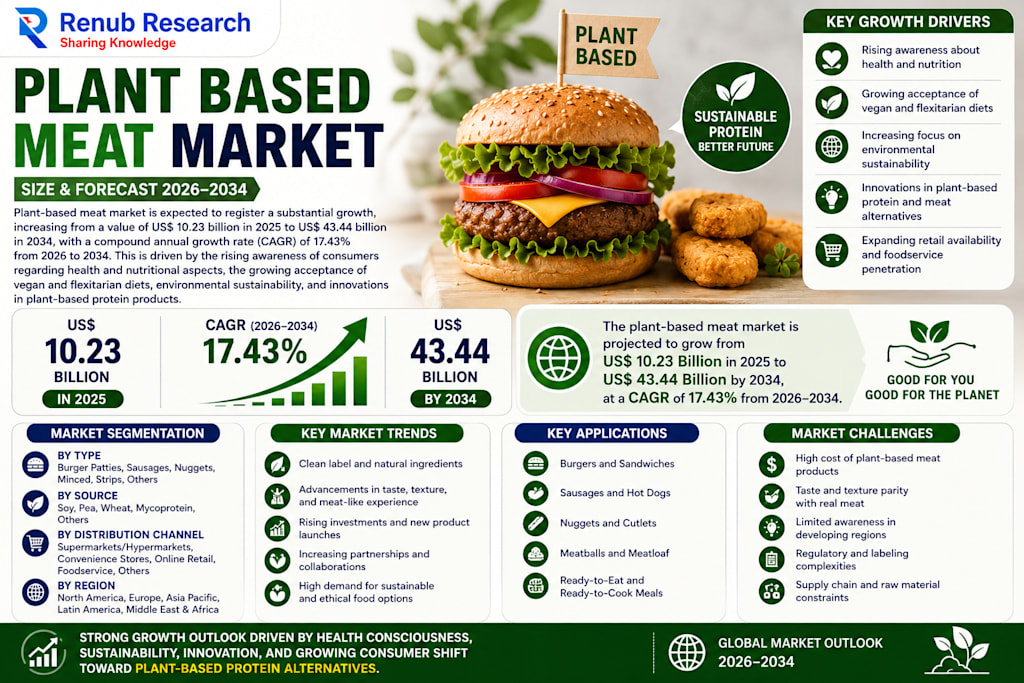
Plant-Based Meat Market Enters a High-Growth Era
The global plant-based meat market is experiencing extraordinary growth as consumers increasingly shift toward healthier, more sustainable, and ethically conscious eating habits. What was once considered a niche vegan category has rapidly evolved into a mainstream global food movement supported by major food companies, restaurants, retailers, and investors.
According to Renub Research, the plant-based meat market is projected to grow from US$ 10.23 billion in 2025 to US$ 43.44 billion by 2034, expanding at a remarkable compound annual growth rate (CAGR) of 17.43% from 2026 to 2034. Growing health awareness, rising environmental concerns, expanding vegan and flexitarian populations, and rapid food technology innovation are driving this impressive market expansion.
Plant-based meat products are designed to imitate the taste, texture, and appearance of traditional animal meat while being produced entirely from plant-derived ingredients such as soy, peas, wheat, beans, and vegetable oils. These products are commonly available in forms including burgers, sausages, nuggets, ground meat, meatballs, and ready-to-eat meals.
As consumers increasingly seek alternatives that combine familiar taste with health and sustainability benefits, plant-based meat is becoming one of the fastest-growing categories within the global food industry.
Health Awareness Is Transforming Consumer Diets
One of the strongest drivers behind the plant-based meat market is the growing consumer focus on health and nutrition. Increasing awareness about the potential health risks associated with excessive consumption of red and processed meat is encouraging many consumers to reduce animal meat intake.
Conditions such as heart disease, obesity, diabetes, and high cholesterol are pushing consumers toward healthier dietary patterns. Plant-based meat products are often promoted as cholesterol-free alternatives with lower saturated fat content compared to conventional meat products.
At the same time, the rise of vegan, vegetarian, and especially flexitarian lifestyles is significantly expanding the customer base for plant-based alternatives. Many consumers are not eliminating meat entirely but are instead seeking balanced diets that reduce meat consumption while maintaining familiar flavors and meal experiences.
This dietary shift is particularly strong among younger generations, urban populations, and health-conscious consumers who are increasingly open to experimenting with alternative protein products.
Sustainability Concerns Are Accelerating Adoption
Environmental sustainability has become another major growth engine for the plant-based meat industry. The livestock sector is widely associated with high greenhouse gas emissions, deforestation, water usage, and land degradation. As awareness of climate change and environmental impact grows, consumers are increasingly searching for more sustainable food options.
Plant-based meat is perceived as a more environmentally friendly alternative because it generally requires fewer natural resources and generates lower emissions than traditional livestock production. Governments, environmental organizations, and advocacy groups are also promoting sustainable food practices, further supporting market adoption.
Food manufacturers are increasingly highlighting sustainability credentials in their marketing campaigns and packaging strategies. The report references Beyond Meat’s launch of updated Beyond Burger and Beyond Beef products emphasizing clean ingredients, lower saturated fat, and sustainability-focused positioning.
As sustainability becomes a more important purchasing factor globally, plant-based meat products are expected to gain even broader consumer acceptance.
Innovation Is Improving Taste and Texture
Technological innovation has played a critical role in making plant-based meat more appealing to mainstream consumers. Early-generation products often faced criticism for poor taste, texture, and overall eating experience. However, significant investment in food science and product development has dramatically improved product quality in recent years.
Advanced extrusion technologies, flavor engineering, fat substitution systems, and protein texturization methods now allow companies to create products that closely resemble traditional meat in appearance, mouthfeel, and taste.
The report highlights Tender Food’s use of fiber-spinning technology, similar to cotton candy production, to create realistic meat alternatives. Such innovations demonstrate how biotechnology and food engineering are reshaping the future of alternative proteins.
The expansion of product categories—including burgers, sausages, nuggets, strips, and ready-to-eat meals—has also made plant-based meat more accessible across different meal occasions and consumer preferences.
Retail and Foodservice Expansion Are Increasing Accessibility
The growing presence of plant-based meat products in supermarkets, quick-service restaurants, food delivery platforms, and fine dining establishments is significantly boosting market visibility and trial rates. Retailers are dedicating more shelf space to alternative proteins as consumer demand continues rising.
Fast food chains and restaurants are increasingly introducing plant-based menu options to attract health-conscious and environmentally aware consumers. This mainstream integration is helping normalize plant-based eating beyond traditional vegan communities.
The rise of private-label products and online retail channels is also improving accessibility while increasing price competition within the market. As distribution networks expand globally, plant-based meat is becoming available to a broader consumer audience.
High Costs Remain a Major Challenge
Despite rapid growth, the plant-based meat industry still faces several important challenges. One of the biggest obstacles is the high production cost associated with advanced plant-based meat manufacturing. Producing realistic meat alternatives requires sophisticated processing technologies such as protein isolation, extrusion, flavor formulation, and texturization systems.
The use of high-quality plant proteins, natural flavors, and specialized ingredients also contributes to elevated production costs. As a result, many plant-based meat products remain more expensive than conventional meat, limiting affordability for price-sensitive consumers.
This pricing gap is particularly challenging in developing economies where affordability strongly influences purchasing decisions. Companies are therefore investing heavily in scaling production and improving manufacturing efficiency to reduce costs over time.
Taste Skepticism Still Influences Consumers
Although product quality has improved substantially, some consumers remain skeptical about whether plant-based meat can fully replicate the taste and experience of traditional meat. Negative first experiences can discourage repeat purchases, making taste perception one of the industry’s most important competitive factors.
There are also concerns among some consumers regarding ingredient processing, artificial additives, and sodium content in certain products. Misinformation and limited understanding about nutritional composition continue affecting adoption among some demographics.
As competition intensifies, companies are focusing increasingly on clean-label formulations, simpler ingredient lists, and improved nutritional profiles to strengthen consumer trust.
Plant-Based Chicken Emerges as a Key Growth Segment
Plant-based chicken products are becoming one of the fastest-growing categories within the market due to strong global demand for chicken alternatives. Products such as nuggets, patties, strips, and fillets are particularly popular because they closely match familiar eating habits and meal formats.
Improvements in flavor and texture technologies have made plant-based chicken increasingly realistic, helping attract flexitarian consumers seeking lower-fat and environmentally friendly protein options.
Health-conscious consumers and younger demographics are especially driving growth within this category.
Plant-Based Sausages Gain Popularity
The plant-based sausage segment is also expanding steadily due to strong demand for flavorful and convenient meat alternatives. Plant-based sausages offer familiar seasoning profiles and versatile usage across breakfast foods, grilling, and prepared meals.
Advances in plant-based casing technologies and fat substitutes are helping manufacturers improve taste and texture further. Easy availability across retail stores and foodservice outlets continues strengthening market adoption.
Refrigerated Products Attract Premium Consumers
The refrigerated plant-based meat market is growing rapidly because many consumers associate refrigerated products with fresher taste, better texture, and cleaner ingredients compared to frozen alternatives.
Premium positioning, improved nutritional value, and clean-label branding are especially attractive to health-conscious consumers. Expansion of cold-chain logistics infrastructure is also supporting wider distribution of refrigerated products globally.
United States Leads the Global Market
The United States remains one of the world’s largest and most advanced plant-based meat markets due to strong consumer awareness, innovation activity, and widespread retail availability. The country has a large flexitarian population seeking alternatives that reduce meat consumption without sacrificing taste and convenience.
Major investments, startup activity, and rapid product innovation continue making the U.S. a global hub for alternative protein development. The report also notes Livekindly Collective’s acquisition of Alpha Foods to expand operations across multiple international markets.
Emerging Markets Continue to Grow
The United Kingdom market is growing steadily due to high awareness of sustainability, ethical consumption, and climate change. Government-backed environmental initiatives and increasing vegetarian populations continue supporting market growth.
India’s market is still developing but shows strong long-term potential due to its large vegetarian population and increasing urban health awareness. Expanding retail availability and localization strategies are helping increase adoption.
Saudi Arabia’s market is also emerging steadily as consumers become more familiar with international food trends and wellness-focused eating habits. The launch of IFFCO Group’s THRYVE™ brand reflects rising regional interest in locally produced plant-based meat products.
Competitive Landscape
The global plant-based meat market includes major players such as Beyond Meat, Conagra Brands, Maple Leaf Foods, Tyson Foods, Kellanova, Archer Daniels Midland, US Foods Holding, and Hormel Foods Corporation.
Competition is increasingly focused on taste improvement, nutritional enhancement, sustainability positioning, and price reduction. Companies investing in food technology, product innovation, and global distribution expansion are expected to shape the future of the industry.
Final Thoughts
The plant-based meat market is rapidly transforming global food consumption patterns as consumers increasingly prioritize health, sustainability, and ethical eating choices. Advances in food technology and wider retail adoption are helping plant-based alternatives move from niche products into mainstream dining habits.
With the market projected to grow from US$ 10.23 billion in 2025 to US$ 43.44 billion by 2034, the future of plant-based meat appears exceptionally strong. Companies that successfully combine affordability, taste, nutrition, and sustainability will likely lead the next generation of global food innovation.
About the Creator
Enjoyed the story? Support the Creator.
Subscribe for free to receive all their stories in your feed.
Comments
There are no comments for this story
Be the first to respond and start the conversation.