
Global Palm Oil Market to Reach US$89.53 Billion by 2034 as Food, Biofuel, and Personal Care Industries Drive Demand
Growing demand for processed foods, renewable fuels, and personal care products is fueling the steady expansion of the global palm oil market despite sustainability challenges.

Palm Oil Remains One of the World's Most Important Vegetable Oils
Palm oil has become an essential ingredient in countless products used every day. From cooking oils and packaged foods to cosmetics, soaps, detergents, and biodiesel, this versatile vegetable oil plays a vital role in global manufacturing and consumer industries.
Its affordability, high productivity, long shelf life, and versatility have made palm oil the preferred choice for manufacturers across multiple sectors. As populations grow, urbanization accelerates, and demand for processed food and renewable energy increases, the global palm oil market continues to expand despite ongoing environmental concerns surrounding its production.
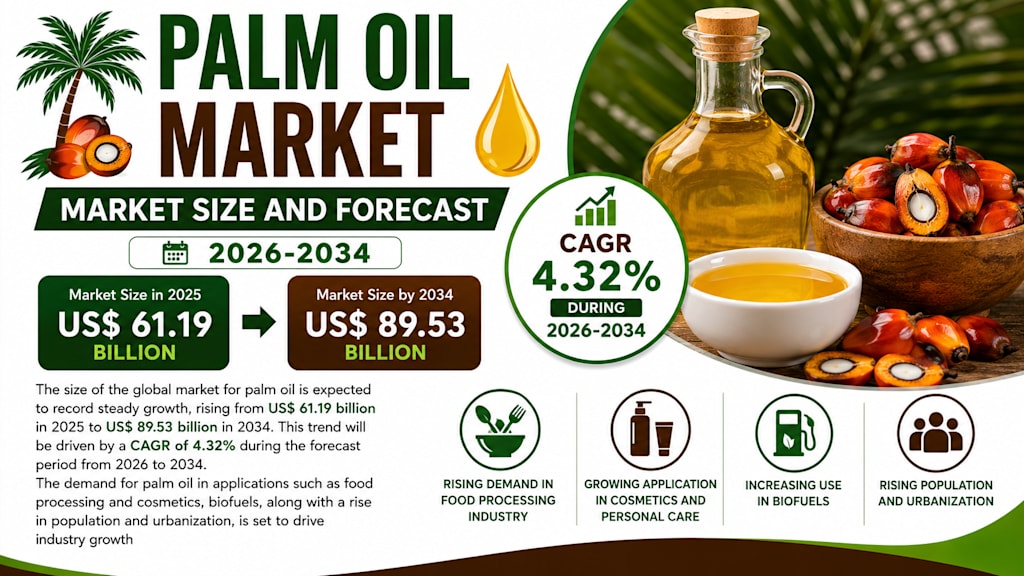
According to the latest market outlook, the Global Palm Oil Market is projected to grow from US$61.19 billion in 2025 to US$89.53 billion by 2034, registering a compound annual growth rate (CAGR) of 4.32% during 2026–2034. Rising applications in food processing, cosmetics, personal care, and biofuel production are expected to support sustained market growth over the coming decade.
Palm Oil Powers Multiple Global Industries
Palm oil is extracted from the fruit of oil palm trees and is recognized for its reddish color due to its natural carotenoid content.
Its semi-solid texture, neutral flavor, oxidation resistance, and excellent stability make it suitable for numerous industrial applications.
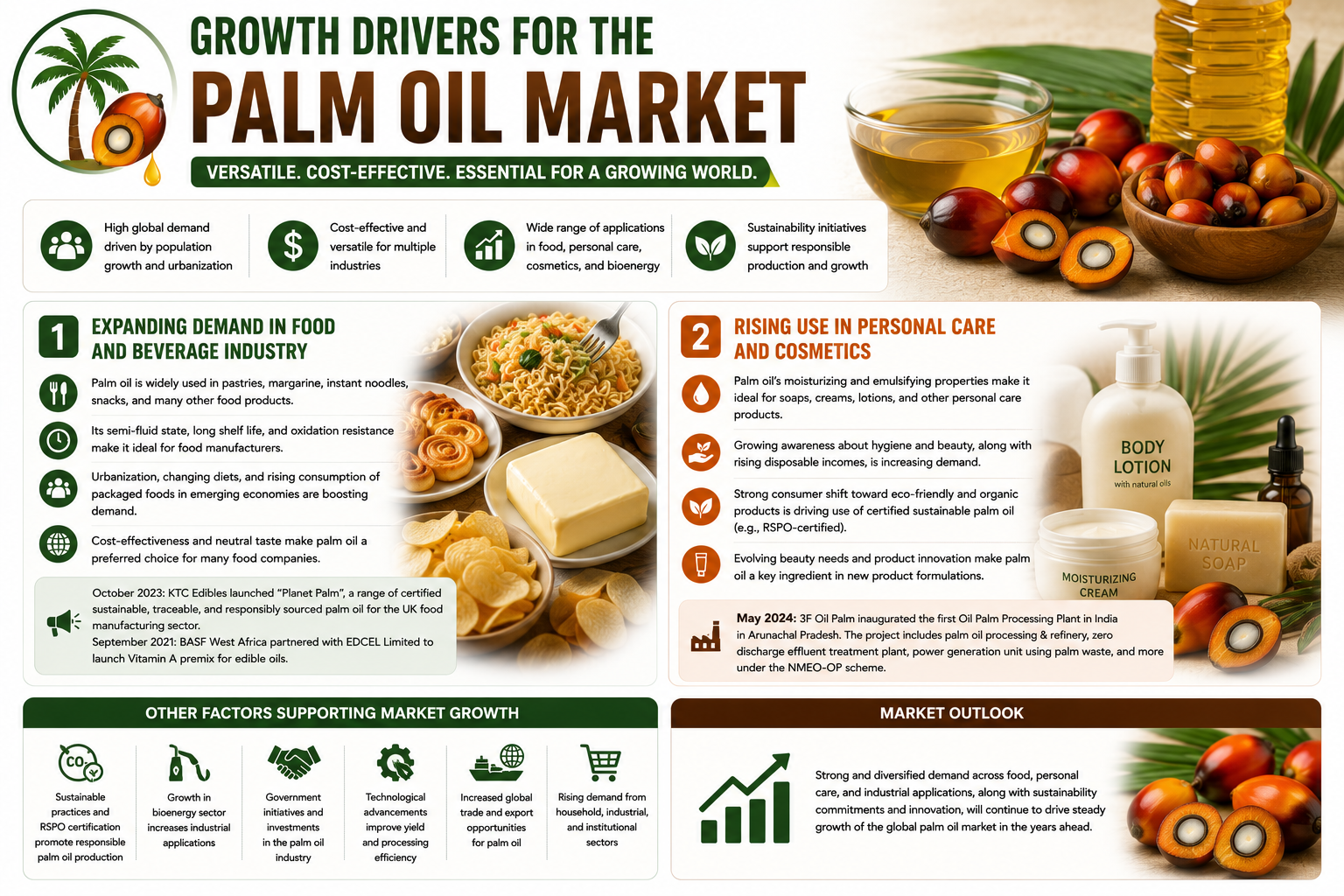
Today, palm oil is widely used in bakery products, confectionery, instant noodles, margarine, cooking oils, processed foods, cosmetics, soaps, detergents, pharmaceuticals, animal feed, and renewable biofuels.
Indonesia and Malaysia remain the world's largest producers, supplying most international markets.
Food Processing Continues Driving Market Growth
The food and beverage industry remains the largest consumer of palm oil worldwide.
Manufacturers value palm oil because it improves product texture, extends shelf life, resists oxidation, and offers cost advantages compared with many alternative vegetable oils.
Palm oil is commonly found in bakery products, snacks, confectionery, margarine, ready-to-eat meals, and instant foods.
Growing urbanization, changing dietary habits, and increasing consumption of packaged foods across emerging economies continue strengthening demand.
As the global population expands, food manufacturers are expected to increase their reliance on affordable and versatile vegetable oils.
Personal Care Industry Expands Consumption
Palm oil has become an essential raw material within the personal care and cosmetics industry.
Its moisturizing properties and emulsifying characteristics make it valuable in soaps, shampoos, lotions, creams, facial cleansers, and skincare products.
Consumers increasingly seek natural ingredients, encouraging manufacturers to utilize sustainably sourced palm oil in premium beauty products.
Growing disposable incomes, rising awareness of personal hygiene, and expanding skincare markets continue supporting demand for palm oil derivatives.
Innovation in beauty and wellness products is expected to create additional opportunities throughout the forecast period.
Biofuel Production Creates New Opportunities
Renewable energy initiatives have significantly increased the use of palm oil in biodiesel production.
Governments worldwide continue encouraging biofuel adoption to reduce greenhouse gas emissions and decrease dependence on fossil fuels.
Palm oil remains one of the most cost-effective feedstocks for biodiesel because of its high yield and efficient production process.
Many countries have introduced blending mandates that require renewable fuels to be mixed with conventional diesel.
Technological improvements in refining processes continue making palm-based biofuels more efficient while supporting long-term energy security goals.
Sustainable Palm Oil Gains Momentum
Environmental awareness has become one of the defining trends within the palm oil industry.
Consumers, retailers, and manufacturers increasingly prefer palm oil certified under sustainability programs such as the Roundtable on Sustainable Palm Oil (RSPO).
Certified sustainable palm oil promotes responsible farming practices while improving traceability throughout global supply chains.
Major food manufacturers and retailers continue expanding their use of sustainably sourced palm oil to strengthen consumer confidence and meet evolving environmental expectations.
This shift is encouraging greater transparency across the industry.
Food and Beverage Applications Lead Demand
Among all applications, food and beverages remain the dominant market segment.
Palm oil's stability, neutral flavor, and cost efficiency make it an ideal ingredient for producing pastries, cakes, confectionery, margarine, cooking oils, instant noodles, and processed foods.
Its ability to maintain product quality over extended storage periods provides significant advantages for food manufacturers operating global distribution networks.
Growing demand for convenience foods continues supporting this segment's long-term expansion.
Animal Feed Industry Supports Growth
Palm oil and palm kernel products also play an important role in animal nutrition.
Livestock, poultry, and aquaculture producers use palm oil ingredients because of their high energy content and digestibility.
Growing global demand for meat, poultry, eggs, and dairy products has encouraged producers to improve feed efficiency through energy-rich feed formulations.
As worldwide protein consumption continues increasing, demand for palm oil within the animal feed industry is expected to remain stable.
Environmental Concerns Remain a Major Challenge
Despite strong market growth, environmental sustainability remains one of the industry's greatest challenges.
Large-scale palm oil cultivation has been associated with deforestation, habitat destruction, biodiversity loss, and greenhouse gas emissions.
Environmental organizations continue encouraging governments and manufacturers to adopt responsible land management, protect forests, and improve traceability.
Many companies now invest heavily in sustainable production methods to reduce environmental impact while maintaining long-term productivity.
Balancing economic growth with environmental responsibility will remain a key priority for the industry.
Price Volatility Affects Global Markets
Palm oil prices remain sensitive to numerous external factors.
Weather conditions, labor shortages, political developments, transportation costs, trade policies, and supply chain disruptions all influence production and international pricing.
Since global production remains concentrated in relatively few countries, regional disruptions can quickly affect worldwide supply.
Manufacturers therefore continue investing in supply chain resilience, improved logistics, and diversified sourcing strategies to minimize operational risks.
Regional Markets Continue Expanding
The United States continues experiencing steady demand for palm oil across food processing, cosmetics, detergents, and biodiesel industries, while many manufacturers increasingly adopt RSPO-certified sustainable palm oil.
The United Kingdom remains an important market where sustainability has become a major purchasing consideration, encouraging retailers to prioritize responsibly sourced palm oil.
India ranks among the world's largest consumers of palm oil due to extensive demand from edible oil, processed food, cosmetics, and renewable energy sectors.
Saudi Arabia also continues expanding palm oil consumption through increasing demand for packaged foods, cooking oils, cosmetics, and industrial applications, relying largely on imports from Southeast Asia.
Together, these regional markets continue shaping global demand patterns.
Innovation Is Supporting Future Growth
Continuous innovation is helping improve palm oil production, processing, and sustainability.
Advanced refining technologies, precision agriculture, digital farm management systems, and traceability platforms are enhancing production efficiency while reducing environmental impact.
Governments and industry organizations continue investing in sustainable cultivation practices, improved processing facilities, and responsible supply chain management.
These innovations are expected to strengthen long-term competitiveness while addressing growing consumer expectations for environmentally responsible products.
Final Thoughts
Palm oil remains one of the world's most versatile and economically important vegetable oils, supporting industries ranging from food manufacturing to renewable energy and personal care.
The projected increase from US$61.19 billion in 2025 to US$89.53 billion by 2034, supported by a 4.32% CAGR, reflects growing demand across multiple industrial sectors.
Although environmental concerns, price volatility, and supply chain disruptions continue presenting challenges, increasing investment in sustainable production, certified sourcing, technological innovation, and renewable energy applications positions the global palm oil market for stable long-term growth. Companies that successfully balance productivity with environmental responsibility are expected to lead the future of this essential global industry.
About the Creator
Enjoyed the story? Support the Creator.
Subscribe for free to receive all their stories in your feed.
Comments
There are no comments for this story
Be the first to respond and start the conversation.