
Global Organic Fertilizers Market Gains Momentum as Sustainable Farming and Organic Food Demand Rise Worldwide
The global agricultural sector is rapidly shifting toward environmentally sustainable practices, and organic fertilizers are becoming one of the most important tools supporting this transition.

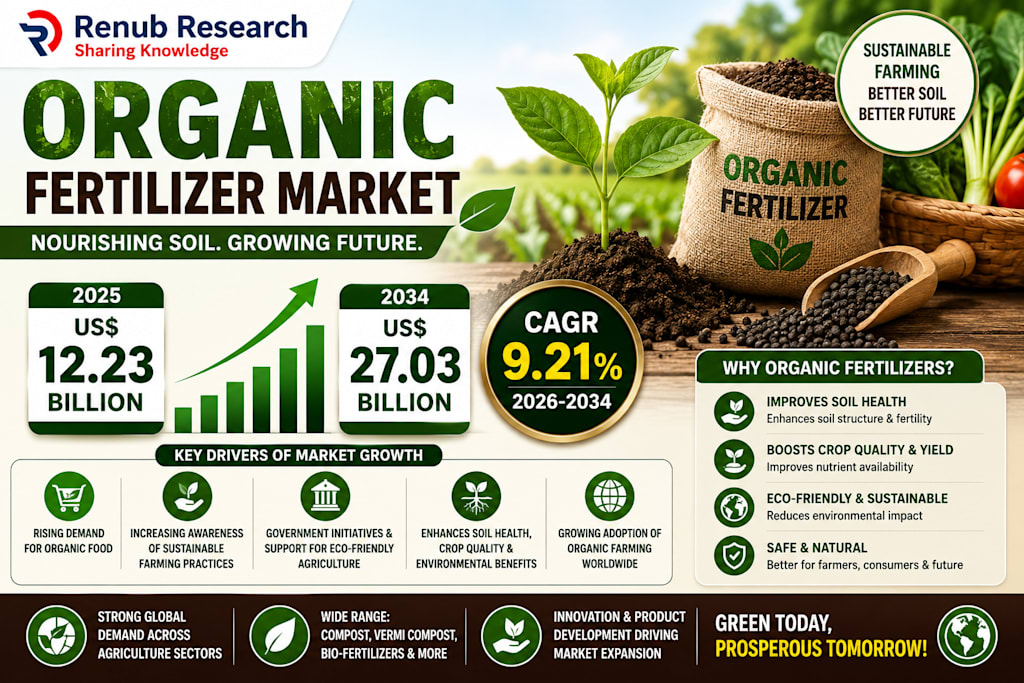
Market Overview
The global organic fertilizers market is witnessing strong growth as farmers, governments, and consumers increasingly prioritize sustainable agriculture, soil health, and chemical-free food production. Organic fertilizers, derived from natural plant, animal, or mineral sources, are becoming a critical part of modern farming systems due to their ability to improve soil fertility while minimizing environmental damage.
Unlike synthetic fertilizers, organic fertilizers work gradually by improving soil structure, microbial activity, nutrient retention, and water-holding capacity. Products such as compost, manure, bone meal, fish emulsion, vermicompost, and biofertilizers are now widely used across organic farming systems worldwide.
As concerns regarding food safety, environmental degradation, and chemical residues continue growing globally, organic fertilizers are emerging as a long-term solution for sustainable agricultural productivity.
Organic Food Demand Is Reshaping Agriculture
One of the biggest drivers of the organic fertilizers market is the rapidly increasing global demand for organic food products.
Consumers today are more conscious about the impact of chemical residues in conventionally grown food. This awareness is encouraging stronger demand for organically cultivated fruits, vegetables, cereals, grains, and packaged food products.
Organic fertilizers play a vital role in organic farming because they provide nutrients naturally without introducing harmful chemicals into the soil. They also improve soil biodiversity and support healthier crop development over the long term.
The report highlights that organic farming expanded by approximately 2.5 million hectares globally, reaching nearly 99 million hectares worldwide.
This rapid growth reflects a major transformation in global agriculture, where sustainability is increasingly becoming a central production priority rather than a niche concept.
Sustainable Agriculture Is Becoming a Global Priority
Environmental concerns surrounding conventional farming practices are also accelerating the adoption of organic fertilizers.
Years of excessive chemical fertilizer usage have contributed to:
- Soil degradation
- Water pollution
- Declining biodiversity
- Reduced microbial activity
- Long-term fertility loss
As a result, governments, environmental organizations, and agricultural institutions are actively promoting sustainable farming systems that preserve soil health and reduce environmental damage.
Organic fertilizers help address these concerns by:
- Improving soil structure
- Increasing organic matter content
- Enhancing microbial activity
- Supporting water retention
- Reducing toxic chemical accumulation
Farmers are increasingly recognizing that maintaining healthy soil directly improves crop quality, long-term productivity, and environmental resilience.
Government Policies Are Accelerating Market Growth
Government support is playing a major role in the expansion of the organic fertilizers industry.
Several countries are introducing subsidies, financial incentives, training programs, and certification support to encourage farmers to adopt organic farming practices.
Governments are particularly focused on reducing the environmental impact of synthetic fertilizers while improving long-term food security.
The source material references India’s Paramparagat Krishi Vikas Yojana (PKVY) and Mission Organic Value Chain Development for North Eastern Region (MOVCDNER) programs, under which farmers receive financial support for organic products including biofertilizers, compost, and organic manure.
Such initiatives are creating favorable conditions for market expansion by reducing the financial burden associated with transitioning to organic farming systems.
Soil Health Is Becoming a Major Agricultural Focus
Modern agriculture is increasingly emphasizing soil health management rather than short-term productivity alone.
Organic fertilizers are highly valued because they improve:
- Soil fertility
- Nutrient retention
- Water-holding capacity
- Root development
- Beneficial microbial activity
Unlike chemical fertilizers, which can gradually damage soil ecosystems when overused, organic fertilizers help regenerate soil structure and biological activity over time.
This shift toward regenerative agriculture is becoming increasingly important as farmers face challenges related to climate change, water scarcity, declining soil productivity, and rising production costs.
The report notes that there are now approximately 4.3 million organic producers worldwide, with India accounting for the largest number of organic producers globally.
Organic Fertilizers Still Face Performance Challenges
Despite strong growth potential, the market also faces several operational and performance-related challenges.
One major limitation is that organic fertilizers generally contain lower nutrient concentrations compared to synthetic fertilizers. They also release nutrients more slowly, which can result in slower crop responses.
For large-scale commercial farmers seeking rapid and highly predictable crop growth, synthetic fertilizers may still appear more efficient in the short term.
Organic fertilizers may also require higher application volumes to achieve nutrient levels comparable to chemical fertilizers. This can increase:
- Transportation costs
- Storage complexity
- Application expenses
Nutrient balancing can also become more difficult in intensive agricultural systems.
As a result, some farmers continue relying partially or fully on conventional chemical fertilizers despite growing environmental concerns.
Supply Chain and Storage Issues Remain Important
The organic fertilizers industry also faces supply chain and consistency challenges.
Because these fertilizers are made from natural raw materials such as animal waste, compost, crop residue, and plant-based materials, product quality and nutrient composition can vary significantly.
Storage and transportation also present difficulties because organic fertilizers generally have shorter shelf lives and may require controlled handling conditions.
In certain regions, limited access to raw materials and insufficient production infrastructure can further restrict market development.
Manufacturers are therefore investing in:
- Improved production technologies
- Better quality control systems
- Distribution network expansion
- Standardized nutrient formulations
to strengthen reliability and market confidence.
Plant-Based Organic Fertilizers Gain Strong Popularity
Plant-based organic fertilizers are becoming one of the fastest-growing product categories within the market.
These fertilizers are derived from materials such as:
- Compost
- Crop residues
- Seaweed
- Plant extracts
and provide important nutrients including nitrogen, potassium, and micronutrients.
Plant-based fertilizers are widely favored in organic farming because they:
- Improve soil fertility naturally
- Support microbial activity
- Enhance moisture retention
- Avoid harmful chemical usage
As environmental awareness grows, more farmers are moving away from synthetic fertilizers and adopting plant-based alternatives that align with organic certification standards and sustainability goals.
Soil Treatment Fertilizers Are Becoming Increasingly Important
Soil treatment organic fertilizers are seeing rising demand because of growing concerns regarding soil degradation and declining land productivity.
These products improve soil quality by increasing organic matter content and stimulating beneficial microbial activity.
They also help:
- Prevent soil erosion
- Improve root development
- Enhance nutrient balance
- Increase plant resistance to stress
Governments and agricultural institutions are actively supporting soil restoration initiatives, creating additional opportunities for this market segment.
Biofertilizers Are Expanding Rapidly
Biofertilizers such as Azospirillum and Azotobacter are gaining popularity because they naturally improve nutrient availability through biological processes.
Azospirillum Fertilizers
Azospirillum fertilizers contain beneficial bacteria that fix atmospheric nitrogen and make it available to plants. These products are widely used in cereals, vegetables, and grasses because they improve root development and crop productivity.
Farmers increasingly prefer these products because they reduce dependence on synthetic nitrogen fertilizers while supporting soil sustainability.
Azotobacter Fertilizers
Azotobacter fertilizers also contain nitrogen-fixing bacteria and are particularly effective for non-legume crops such as fruits, vegetables, and grains.
These fertilizers improve:
- Seed germination
- Plant growth
- Root strength
- Hormone production
while naturally enhancing soil fertility.
Cereals and Grains Segment Drives Strong Demand
Organic fertilizers are widely used in cereals and grain production because these crops require balanced nutrient support for stable yields.
Crops such as:
- Wheat
- Rice
- Corn
- Barley
benefit from improved soil fertility and nutrient retention provided by organic fertilizers.
The growing global population and increasing food demand are creating stronger pressure for sustainable agricultural production systems.
Farmers producing certified organic cereals and grains are particularly dependent on natural fertilizers to comply with organic farming standards.
United States Market Benefits from Strong Organic Farming Culture
The United States organic fertilizers market continues expanding because of high consumer demand for organic food products and strong adoption of sustainable farming practices.
Farmers increasingly use organic fertilizers to meet certification requirements and improve soil health naturally.
The report notes that Hello Nature inaugurated a large bionutrients production plant in Indiana with the capacity to produce 150,000 tons of organic fertilizers and biosolutions sourced primarily from chicken manure.
Strong agricultural infrastructure and distribution systems continue supporting market expansion in the United States.
India Emerges as a Major Growth Market
India’s organic fertilizers market is growing rapidly because of its large agricultural sector and increasing focus on sustainable farming.
Farmers are increasingly adopting organic fertilizers to:
- Improve soil quality
- Reduce chemical input costs
- Meet organic certification standards
- Produce healthier crops
Government subsidies, educational programs, and widespread availability of raw materials such as crop residue and animal waste are supporting domestic production growth.
Saudi Arabia Invests in Sustainable Agriculture
Saudi Arabia’s organic fertilizers market is also expanding steadily because of the country’s efforts to improve food security and agricultural sustainability.
The Kingdom’s harsh climate and limited fertile land make soil health management especially important. Organic fertilizers help improve nutrient retention and support agricultural productivity under difficult environmental conditions.
The report mentions that Saudi dairy giant National Agricultural Development Co. partnered with Municipal Solid Waste Recycling Co. to establish a biowaste recycling plant for fertilizer production.
Such investments highlight the growing importance of sustainable agricultural infrastructure in the region.
Key Industry Players
Major companies operating in the global organic fertilizers market include:
- National Fertilizers
- Madras Fertilizers
- Seek Biotechnology Co. Ltd.
- Coromandel International
- Nagarjuna Fertilizers and Chemicals Ltd.
- T Stanes & Company Limited
- Novozymes
- Kribhco
These companies continue investing in biofertilizer innovation, sustainable production technologies, and distribution expansion.
Final Thoughts
The global organic fertilizers market reflects the growing transformation of agriculture toward sustainability, environmental responsibility, and long-term soil health management. Rising organic food demand, government support, environmental awareness, and regenerative farming practices are creating strong long-term growth opportunities for the industry.
However, challenges related to nutrient efficiency, supply chain consistency, and storage infrastructure remain important barriers that manufacturers and policymakers must address.
As the world continues prioritizing sustainable food systems and environmentally responsible farming, organic fertilizers are expected to become an increasingly essential part of modern agriculture.
About the Creator
Enjoyed the story? Support the Creator.
Subscribe for free to receive all their stories in your feed.
Comments
There are no comments for this story
Be the first to respond and start the conversation.