
Global Organic Fertilizer Market Outlook 2026–2034: How Sustainable Agriculture Is Transforming Modern Farming
Rising demand for organic food, growing environmental awareness, and increasing government support for sustainable farming practices are driving rapid growth in the global organic fertilizer market.

The global agricultural industry is undergoing a profound transformation as farmers, consumers, and governments increasingly prioritize sustainability, environmental protection, and long-term food security. As concerns about soil degradation, chemical contamination, and environmental pollution continue to grow, organic fertilizers are emerging as a crucial solution for creating a more sustainable agricultural future.
Unlike conventional chemical fertilizers, organic fertilizers are derived from natural plant, animal, and mineral sources. These products improve soil fertility, promote healthy plant growth, and enhance agricultural productivity while minimizing environmental damage. Their ability to enrich soil structure and support beneficial microbial activity makes them an essential component of modern sustainable farming practices.
The growing popularity of organic food worldwide has further accelerated the adoption of organic fertilizers. Consumers are becoming increasingly concerned about food quality, chemical residues, and environmental sustainability, encouraging farmers to adopt organic cultivation methods. This shift is creating substantial opportunities for manufacturers and suppliers operating within the organic fertilizer industry.
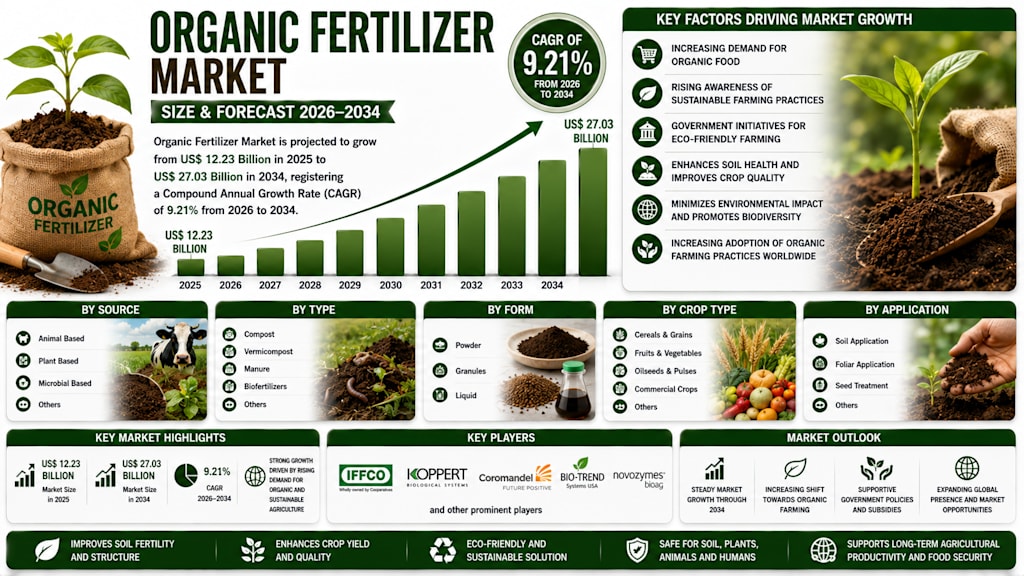
According to Renub Research, the Organic Fertilizer Market is projected to grow from US$ 12.23 Billion in 2025 to US$ 27.03 Billion by 2034, registering a Compound Annual Growth Rate (CAGR) of 9.21% from 2026 to 2034. Rising demand for organic food, increasing awareness of sustainable farming practices, and government initiatives promoting eco-friendly agriculture are among the primary factors driving market expansion.
As agriculture continues evolving toward more environmentally responsible practices, organic fertilizers are expected to play a central role in supporting future food production systems.
Understanding Organic Fertilizers
Organic fertilizers are natural materials derived from plant residues, animal waste, compost, minerals, and biological sources that help improve soil fertility and plant growth.
Common examples include compost, farmyard manure, bone meal, fish emulsion, vermicompost, green manure, and various biofertilizers.
Unlike synthetic fertilizers that provide nutrients immediately, organic fertilizers release nutrients gradually, supporting long-term soil health and sustainable crop production.
These fertilizers improve soil structure, increase microbial activity, enhance water retention capacity, and contribute to overall ecosystem health.
Because they originate from natural sources, organic fertilizers reduce the risk of chemical accumulation in soil and water systems.
As environmental concerns continue growing, farmers worldwide are increasingly recognizing the value of organic fertilizers as a sustainable alternative to conventional chemical products.
Rising Demand for Organic Food Is Driving Market Growth
One of the strongest growth drivers for the organic fertilizer market is the increasing global demand for organic food products.
Consumers are becoming more aware of the potential health risks associated with excessive chemical use in conventional farming.
As a result, demand for organically produced fruits, vegetables, cereals, dairy products, and processed foods has increased significantly.
Organic fertilizers play a critical role in supporting organic farming systems because they provide essential nutrients while complying with organic certification requirements.
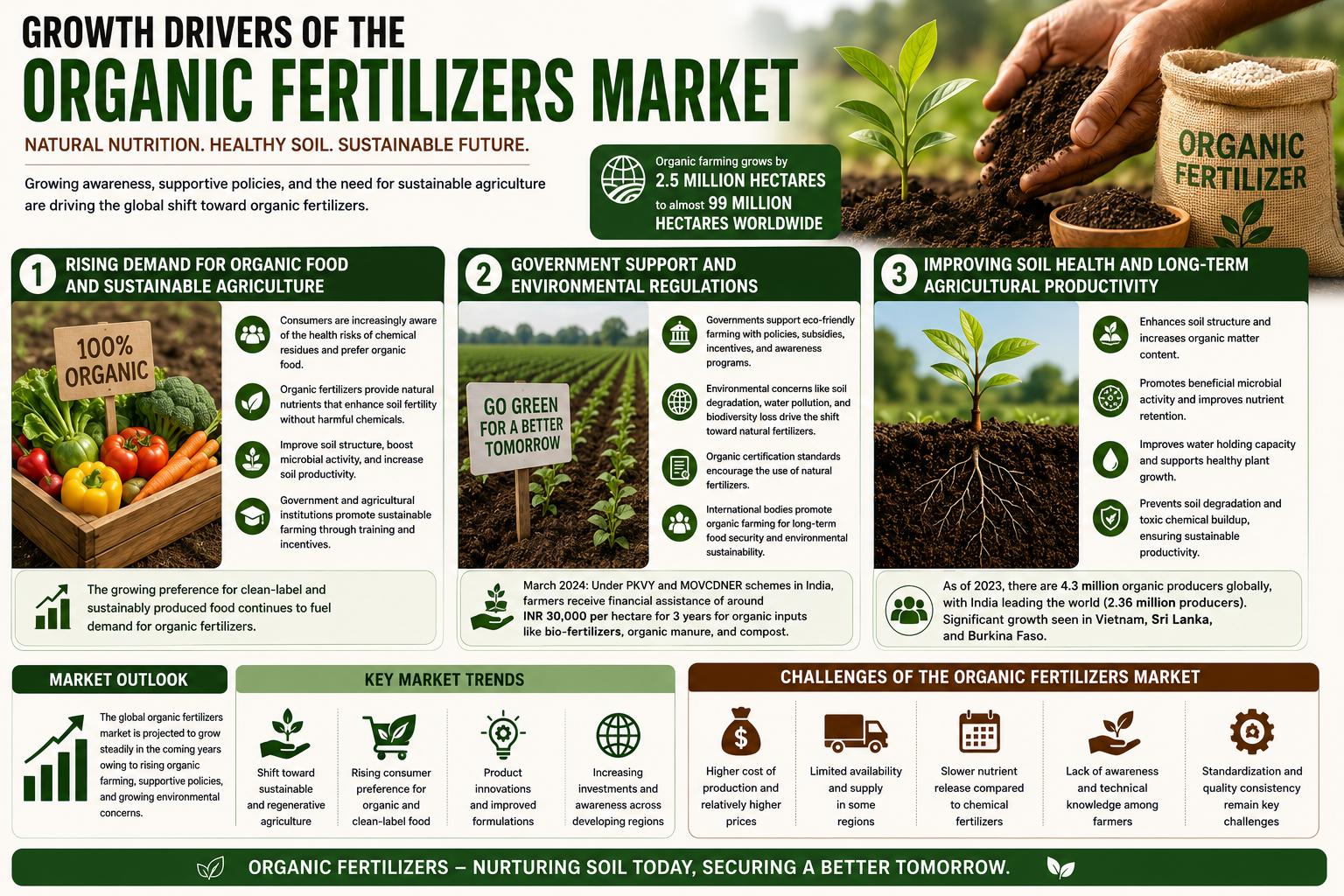
According to industry data, global organic farming expanded by approximately 2.5 million hectares, reaching nearly 99 million hectares worldwide. This growth reflects the increasing commitment to sustainable agriculture across multiple regions.
Farmers are increasingly adopting organic fertilizers not only to meet market demand but also to improve soil quality and long-term productivity.
As organic food consumption continues rising globally, demand for organic fertilizers is expected to expand correspondingly.
Government Support Is Accelerating Adoption
Government initiatives and environmental policies are playing a major role in supporting the growth of the organic fertilizer market.
Many countries have introduced programs designed to reduce dependence on chemical fertilizers and promote sustainable agricultural practices.
Subsidies, grants, farmer training programs, and certification assistance are encouraging growers to transition toward organic cultivation methods.
Environmental concerns such as soil degradation, biodiversity loss, and water pollution have further motivated policymakers to support natural fertilizer solutions.
In March 2024, India's Paramparagat Krishi Vikas Yojana (PKVY) and Mission Organic Value Chain Development for North Eastern Region (MOVCDNER) programs provided financial assistance of approximately INR 30,000 per hectare over three years for organic inputs, including biofertilizers, compost, organic manure, seeds, and botanical extracts.
These supportive policies continue creating favorable conditions for market expansion across both developed and developing economies.
Improving Soil Health Is Becoming a Major Priority
Modern agriculture increasingly recognizes that long-term productivity depends heavily on maintaining healthy soils.
Organic fertilizers contribute significantly to soil improvement by increasing organic matter content, enhancing microbial diversity, and improving nutrient retention.
Healthy soils provide better water infiltration, stronger root development, and improved resistance to environmental stress.
Unlike chemical fertilizers, which may contribute to soil degradation over time when overused, organic fertilizers help restore and maintain natural soil ecosystems.
Farmers are increasingly adopting soil health management strategies that prioritize sustainability and long-term productivity rather than short-term yield gains.
As awareness regarding regenerative agriculture continues growing, organic fertilizers are becoming a key tool for restoring degraded agricultural lands and ensuring future food security.
Global Organic Farming Expansion Supports Demand
The continued expansion of organic agriculture worldwide remains a major contributor to market growth.
According to industry estimates, there are approximately 4.3 million organic producers globally, with India alone accounting for around 2.36 million producers, making it the world's largest organic farming community. Significant increases have also been recorded in countries such as Vietnam, Sri Lanka, and Burkina Faso.
As more farmers transition to organic production systems, demand for certified organic inputs continues increasing.
Organic fertilizers form a foundational component of these systems because they provide nutrients while maintaining compliance with certification standards.
The growth of organic farming is expected to remain one of the strongest long-term drivers of market expansion.
Plant-Based Organic Fertilizers Gain Popularity
Plant-based organic fertilizers represent one of the fastest-growing segments within the market.
These products are produced from materials such as compost, crop residues, seaweed, plant extracts, and agricultural by-products.
They provide essential nutrients including nitrogen, potassium, and micronutrients while improving soil fertility and microbial activity.
Plant-based fertilizers are widely used in organic farming because they offer environmentally friendly nutrient solutions without relying on synthetic chemicals.
Increasing consumer demand for sustainable food production and growing environmental awareness are encouraging broader adoption of plant-derived fertilizers.
Government programs promoting sustainable agriculture are further supporting growth within this segment.
As regenerative farming practices continue expanding, plant-based fertilizers are expected to play an increasingly important role in agricultural production systems.
Soil Treatment Applications Continue Expanding
Soil treatment represents one of the most important application segments for organic fertilizers.
These products are specifically designed to improve soil quality by increasing organic matter content, enhancing microbial activity, and improving nutrient retention capabilities.
Farmers are increasingly using soil treatment fertilizers to address challenges associated with soil degradation caused by years of intensive chemical fertilizer use.
Healthy soils support stronger root systems, improved crop resilience, and more efficient nutrient utilization.
Government initiatives focused on soil restoration and sustainable land management are also contributing to segment growth.
As agricultural sustainability becomes a global priority, soil treatment applications are expected to remain a major driver of market demand.
Biofertilizers Are Revolutionizing Sustainable Agriculture
Biofertilizers have emerged as one of the most innovative categories within the organic fertilizer market.
These products contain beneficial microorganisms that enhance nutrient availability and improve plant growth naturally.
Popular biofertilizers include Azospirillum, Azotobacter, Rhizobium, Cyanobacteria, Azolla, Aulosira, and phosphate-solubilizing bacteria.
These microorganisms support nutrient cycling, improve soil fertility, and reduce dependence on synthetic fertilizers.
As awareness regarding biological farming solutions increases, biofertilizers are becoming an increasingly attractive option for farmers seeking sustainable alternatives.
The growing importance of precision agriculture and environmentally friendly farming methods is expected to further accelerate adoption.
Azospirillum Fertilizers Are Seeing Strong Growth
Azospirillum fertilizers contain beneficial bacteria capable of fixing atmospheric nitrogen and making it available to plants.
These microorganisms establish beneficial relationships with plant roots, enhancing nutrient absorption and overall crop performance.
Azospirillum products are commonly used in cereals, vegetables, grasses, and other agricultural crops.
Farmers appreciate these fertilizers because they reduce dependence on synthetic nitrogen fertilizers while improving crop yields.
Their ability to strengthen root systems and promote healthier plant growth makes them particularly valuable in sustainable farming systems.
Growing awareness regarding biological alternatives is expected to support continued expansion within this segment.
Azotobacter Fertilizers Continue Gaining Attention
Azotobacter fertilizers contain free-living nitrogen-fixing bacteria that improve soil fertility by converting atmospheric nitrogen into plant-available forms.
These products are particularly effective for non-leguminous crops such as fruits, vegetables, and grains.
In addition to nitrogen fixation, Azotobacter microorganisms stimulate plant growth by producing vitamins and growth-promoting substances.
Farmers increasingly value these products because they enhance seed germination, improve root development, and support overall crop productivity.
Growing environmental concerns and increased adoption of sustainable agriculture practices are expected to drive strong future demand for Azotobacter fertilizers.
Cereals and Grains Remain a Key Crop Segment
The cereals and grains segment represents one of the largest application areas for organic fertilizers.
Major crops such as wheat, rice, corn, and barley require balanced nutrient management to achieve optimal yields and maintain soil fertility.
Organic fertilizers help improve soil structure, enhance nutrient availability, and strengthen crop resistance to environmental stress.
The increasing global population and growing demand for staple foods continue driving production requirements for cereals and grains.
At the same time, rising demand for organically certified cereals is encouraging farmers to adopt natural fertilizer solutions.
As sustainable food production becomes increasingly important, organic fertilizers will continue playing a vital role in cereal and grain cultivation worldwide.
Challenges: Lower Nutrient Concentration
Despite strong growth prospects, the organic fertilizer market faces several important challenges.
One of the primary concerns is the relatively lower nutrient concentration compared to synthetic fertilizers.
Organic fertilizers release nutrients slowly, which can result in delayed crop responses and slower plant growth under certain conditions.
Farmers seeking rapid nutrient availability may still prefer conventional fertilizers, particularly in large-scale commercial agriculture.
Additionally, larger application volumes are often required to achieve nutrient levels comparable to chemical fertilizers.
These factors can increase transportation, storage, and application costs for producers and growers.
Addressing these challenges will be important for expanding adoption across diverse agricultural systems.
Supply Chain and Storage Limitations
Supply chain management remains another significant challenge for the organic fertilizer industry.
Organic fertilizers are produced from natural raw materials such as animal waste, compost, and crop residues, which can vary considerably in quality and nutrient composition.
Many organic fertilizers also have shorter shelf lives and require careful storage to maintain effectiveness.
Transportation and bulk handling can present logistical difficulties, particularly in regions with limited infrastructure.
Manufacturers must continue investing in quality control systems, storage technologies, and distribution networks to improve consistency and reliability.
Overcoming these challenges will be essential for supporting long-term market growth.
Regional Market Insights
United States
The United States organic fertilizer market continues expanding due to strong consumer demand for organic food and widespread adoption of sustainable farming practices. In November 2024, Hello Nature inaugurated a new 300,000-square-foot production facility in Indiana with the capacity to produce 150,000 tons of organic fertilizers and biosolutions annually.
United Kingdom
The United Kingdom market benefits from increasing environmental awareness and growing demand for organic food products. In January 2026, SoilWorx announced expansion into mainland UK markets while introducing new organo-mineral fertilizer product ranges.
India
India remains one of the fastest-growing organic fertilizer markets due to its large agricultural base and extensive government support for organic farming. In September 2025, Kumbalangi Panchayat launched a new organic fertilizer product manufactured from organic waste processing systems.
Saudi Arabia
Saudi Arabia is increasingly investing in sustainable agriculture to improve food security and soil productivity. In July 2023, National Agricultural Development Company partnered with Yadoum to establish a biowaste recycling facility focused on fertilizer production.
Competitive Landscape
The global organic fertilizer market features strong competition among established agricultural and biotechnology companies.
Major industry participants include National Fertilizers, Madras Fertilizers, Seek Biotechnology Co. Ltd., Coromandel International, Nagarjuna Fertilizers and Chemicals Ltd., T. Stanes & Company Limited, Novozymes, and Kribhco.
These companies continue investing in product innovation, biofertilizer technologies, research and development, and sustainable agricultural solutions to strengthen their competitive positions.
Strategic partnerships, production expansion, and investments in environmentally friendly technologies are expected to remain important growth strategies throughout the forecast period.
Final Thoughts
The global organic fertilizer market is entering a period of robust growth as agriculture increasingly embraces sustainability, soil health management, and environmentally responsible farming practices. Rising consumer demand for organic food, strong government support, expanding organic farming acreage, and growing awareness regarding soil conservation are creating significant opportunities across the industry.
Organic fertilizers are becoming an essential component of modern agriculture because they improve soil fertility, enhance environmental sustainability, and support long-term agricultural productivity. Although challenges related to nutrient concentration and supply chain management remain, ongoing innovation and policy support are helping overcome these barriers.
With the market projected to grow from US$ 12.23 Billion in 2025 to US$ 27.03 Billion by 2034, organic fertilizers are expected to play an increasingly important role in shaping the future of global agriculture. Farmers, policymakers, and consumers alike are recognizing that sustainable farming begins with healthy soils, making organic fertilizers a critical tool for achieving long-term food security and environmental stewardship.
About the Creator
Enjoyed the story? Support the Creator.
Subscribe for free to receive all their stories in your feed.
Comments
There are no comments for this story
Be the first to respond and start the conversation.