
Global Medical Adhesives Market to Reach US$25.34 Billion by 2034 as Advanced Wound Care and Wearable Healthcare Drive Innovation
Growing demand for minimally invasive surgeries, advanced wound care products, wearable medical devices, and biocompatible bonding technologies is fueling the rapid expansion of the global medical adhesives market.

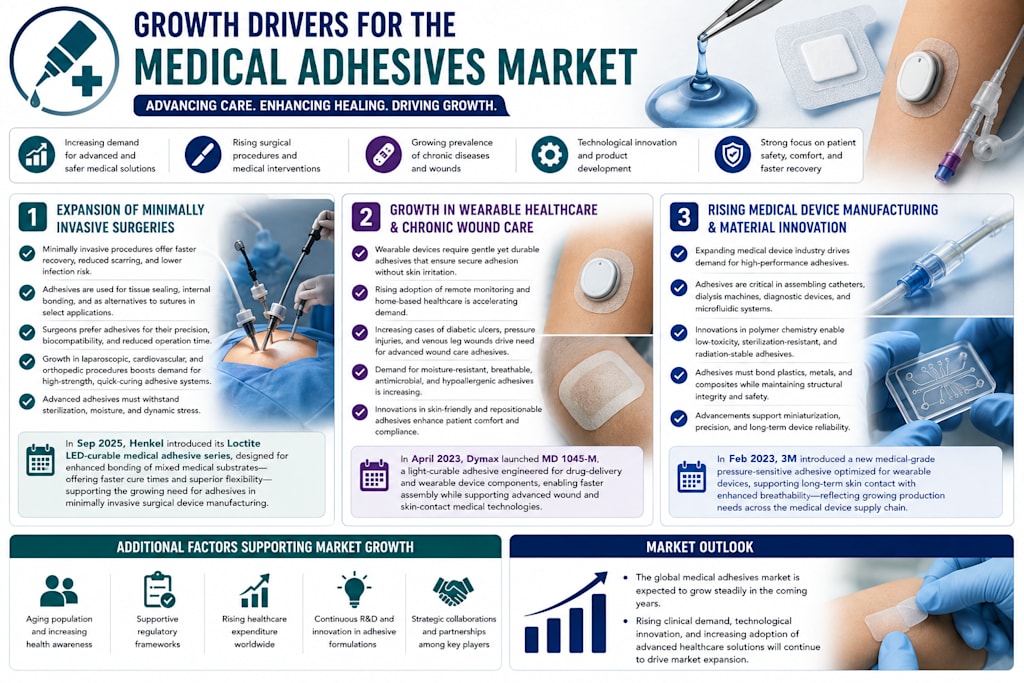
Medical Adhesives Are Transforming Modern Healthcare
Healthcare continues to evolve through innovations that improve patient safety, shorten recovery times, and enhance clinical outcomes. Among these advancements, medical adhesives have become an indispensable component of modern medicine, replacing or complementing traditional methods such as sutures and staples in many medical procedures.
Medical adhesives are now widely used in surgical wound closure, advanced wound dressings, wearable medical devices, diagnostic equipment, dental restorations, and medical device manufacturing. Their ability to provide strong, flexible, and biocompatible bonding while minimizing tissue damage has made them increasingly valuable across healthcare applications.
According to the latest market outlook, the Global Medical Adhesives Market is projected to grow from US$13.25 billion in 2025 to US$25.34 billion by 2034, registering a compound annual growth rate (CAGR) of 7.47% during 2026–2034. Rising demand for minimally invasive procedures, wearable healthcare technologies, chronic wound management, and medical device innovation continues to support long-term market growth.
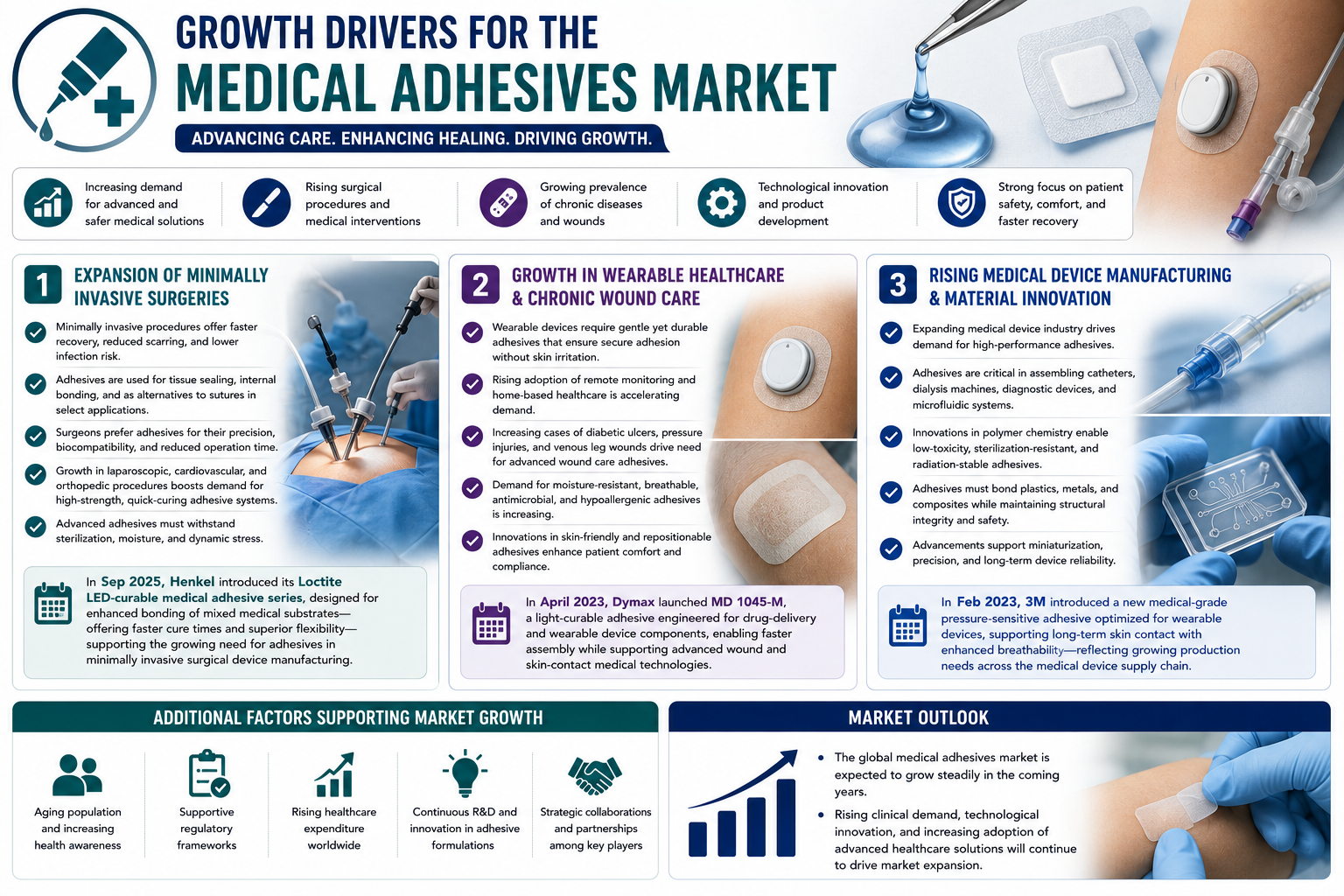
Medical Adhesives Play a Critical Role in Healthcare
Medical adhesives are specialized bonding materials developed specifically for healthcare applications.
Unlike conventional industrial adhesives, these products are designed to meet strict biocompatibility, sterility, flexibility, and safety requirements.
They are widely used to close surgical wounds, secure medical devices, attach wearable health monitors, assemble diagnostic equipment, and support numerous dental and orthopedic procedures.
Medical adhesives reduce infection risks, improve patient comfort, accelerate healing, and simplify many clinical procedures compared with traditional wound closure methods.
As healthcare technology continues advancing, their importance within modern medicine continues to grow.
Minimally Invasive Surgery Continues Driving Market Growth
One of the strongest growth drivers for the medical adhesives market is the rapid adoption of minimally invasive surgical procedures.
Laparoscopic, cardiovascular, orthopedic, neurological, and robotic surgeries increasingly rely on advanced adhesive technologies that provide rapid tissue sealing while minimizing surgical trauma.
Medical adhesives help reduce operating time, decrease postoperative complications, and improve cosmetic outcomes by eliminating or reducing the need for sutures and staples.
Surgeons increasingly prefer fast-curing, highly flexible, and biocompatible adhesive formulations capable of maintaining strong tissue bonding under demanding clinical conditions.
The continued expansion of minimally invasive surgery is expected to remain a major contributor to market growth.
Wearable Healthcare Devices Expand Opportunities
The rapid growth of wearable medical technology has created significant new opportunities for medical adhesive manufacturers.
Devices such as continuous glucose monitors, cardiac monitoring patches, insulin delivery systems, biosensors, and remote patient monitoring equipment require skin-friendly adhesives capable of remaining securely attached for extended periods without causing irritation.
Manufacturers continue developing breathable, hypoallergenic, moisture-resistant, and repositionable adhesive formulations that improve patient comfort while maintaining reliable device performance.
As remote healthcare and home monitoring continue expanding worldwide, demand for advanced medical adhesives is expected to accelerate.
Chronic Wound Care Supports Market Expansion
The increasing prevalence of chronic wounds continues strengthening demand for specialized medical adhesives.
Conditions including diabetes, pressure ulcers, venous leg ulcers, burns, and surgical wounds require advanced wound care products capable of protecting injured tissue while promoting faster healing.
Modern adhesive dressings provide secure fixation, moisture management, antimicrobial protection, and painless removal that improve patient outcomes.
Growing aging populations and increasing chronic disease prevalence continue expanding the need for advanced wound care technologies across hospitals and home healthcare settings.
Medical Device Manufacturing Continues Growing
Medical adhesives have become essential materials in the production of modern medical devices.
Manufacturers utilize specialized adhesives when assembling catheters, syringes, dialysis equipment, diagnostic instruments, infusion pumps, surgical instruments, and microfluidic systems.
Advances in polymer chemistry have enabled adhesives capable of bonding metals, plastics, ceramics, and composite materials while withstanding sterilization processes and maintaining long-term structural integrity.
The rapid expansion of global medical device manufacturing continues supporting strong demand for high-performance adhesive technologies.
Acrylic Adhesives Lead the Market
Acrylic medical adhesives remain among the most widely used product categories.
They offer excellent bonding strength, moisture resistance, durability, and long-term adhesion while remaining suitable for prolonged skin contact.
These adhesives are commonly used in surgical tapes, transdermal drug delivery patches, wound dressings, wearable sensors, and patient monitoring devices.
Manufacturers continue improving acrylic formulations to enhance breathability, repositionability, and skin compatibility while reducing irritation during extended wear.
Dental Adhesives Continue Expanding
Dental applications represent another important segment of the medical adhesives market.
Dental adhesives enable secure bonding of fillings, crowns, veneers, orthodontic brackets, bridges, and restorative materials.
Advances in adhesive dentistry have improved bond strength, moisture resistance, durability, and clinical efficiency.
The increasing popularity of cosmetic dentistry, restorative procedures, and preventive oral healthcare continues driving demand for advanced dental adhesive technologies worldwide.
Water-Based Adhesives Gain Popularity
Water-based medical adhesives are experiencing rapid growth because of their environmentally friendly formulations and excellent patient safety profiles.
These solvent-free products minimize skin irritation while complying with increasingly strict environmental regulations.
Water-based adhesives are widely used in wound dressings, surgical drapes, medical tapes, and disposable healthcare products requiring gentle skin contact.
Continuous innovation has significantly improved their bonding strength, flexibility, and moisture resistance, expanding their applications across healthcare environments.
Regulatory Requirements Present Challenges
Despite strong market growth, regulatory compliance remains one of the industry's most significant challenges.
Medical adhesives must undergo extensive safety evaluations, biocompatibility testing, sterilization validation, and regulatory approval before commercial introduction.
Compliance with regulations established by organizations such as the U.S. Food and Drug Administration (FDA) and the European Medical Device Regulation (MDR) increases development costs while extending product launch timelines.
Manufacturers continue investing heavily in quality assurance and regulatory expertise to maintain global market access.
Technical Performance Remains Critical
Developing medical adhesives that balance strength, flexibility, durability, and patient safety remains technically demanding.
Products must perform consistently under varying temperatures, moisture levels, sterilization conditions, and clinical environments while remaining compatible with different skin types and biological tissues.
Manufacturers also face ongoing challenges related to raw material availability, production costs, and maintaining consistent product quality across increasingly sophisticated healthcare applications.
Continuous research and development remain essential for overcoming these technical limitations.
Regional Markets Continue Supporting Growth
The United States remains one of the world's largest medical adhesives markets, supported by advanced medical device manufacturing, strong regulatory innovation, increasing adoption of wearable healthcare technologies, and growing demand for minimally invasive surgery.
Germany continues leading the European market through its well-established medical technology industry, high surgical procedure volumes, and strong emphasis on advanced wound care and precision healthcare.
China has emerged as one of the fastest-growing markets because of rapid healthcare expansion, increasing surgical procedures, growing domestic medical device production, and substantial government investment in healthcare infrastructure.
Saudi Arabia continues strengthening demand through healthcare modernization under Vision 2030, expanding hospital infrastructure, increasing chronic disease management, and growing adoption of advanced medical devices and wound care technologies.
Together, these regional markets continue driving innovation and worldwide demand for medical adhesives.
Innovation Will Shape the Future of Medical Adhesives
The future of the medical adhesives industry will be driven by continuous advances in biomaterials, polymer chemistry, wearable healthcare, and minimally invasive medicine.
Researchers are developing next-generation adhesives featuring antimicrobial properties, bioresorbable materials, improved moisture resistance, faster curing, and enhanced compatibility with delicate biological tissues.
Artificial intelligence and advanced manufacturing technologies will further accelerate product development while improving quality control and production efficiency.
As personalized healthcare and connected medical devices continue expanding, innovative medical adhesives will become increasingly essential across the global healthcare industry.
Final Thoughts
The global medical adhesives market is entering a period of sustained growth as healthcare systems increasingly prioritize patient comfort, minimally invasive treatment, advanced wound care, and wearable medical technologies.
The projected expansion from US$13.25 billion in 2025 to US$25.34 billion by 2034, supported by a 7.47% CAGR, reflects rising demand for biocompatible adhesive solutions across surgery, medical devices, diagnostics, wound management, and dental care.
Although regulatory complexity, technical performance requirements, and development costs remain important challenges, continuous innovation in biomaterials, polymer science, and medical device manufacturing positions the medical adhesives industry for strong long-term growth. As healthcare technology continues advancing, medical adhesives will remain an indispensable component of safer, more effective, and patient-centered medical care.
About the Creator
Enjoyed the story? Support the Creator.
Subscribe for free to receive all their stories in your feed.
Comments
There are no comments for this story
Be the first to respond and start the conversation.