
Global Insulin Pen Market to Reach US$ 14.78 Billion by 2034 as Smart Diabetes Care and Home Healthcare Expand Worldwide
Rising Diabetes Cases, Smart Insulin Delivery Systems, and Growing Preference for Self-Administration Drive Global Market Growth

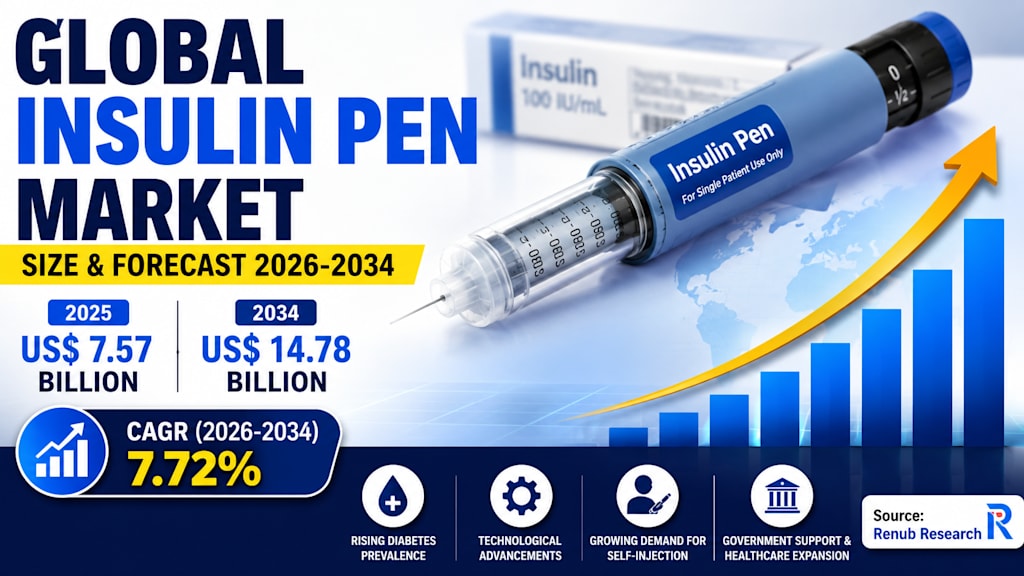
The global insulin pen industry is witnessing strong expansion as rising diabetes prevalence, technological innovation, and increasing demand for convenient self-administration solutions continue transforming diabetes management worldwide. According to Renub Research, the Global Insulin Pen Market is projected to grow from US$ 7.57 billion in 2025 to US$ 14.78 billion by 2034, registering a CAGR of 7.72% from 2026 to 2034.
The market is being driven by the growing diabetic population, rapid advancements in smart insulin delivery technologies, increasing home-based healthcare adoption, and expanding healthcare infrastructure globally. Insulin pens are increasingly replacing traditional syringes because of their convenience, portability, dosing accuracy, and improved patient comfort.
Insulin Pens Are Revolutionizing Diabetes Management
Insulin pens are medical devices designed to help diabetic patients administer insulin injections more accurately, conveniently, and comfortably compared to traditional syringes. These devices resemble writing pens and typically include an insulin cartridge, disposable needle, and dose-adjustment dial.
Over the past decade, insulin pens have become increasingly popular among both healthcare professionals and patients due to their ease of use, portability, and ability to improve treatment adherence.
Modern insulin pens are helping reduce dosing errors, simplify self-administration, and support better long-term glycemic control.
As diabetes cases continue rising globally, insulin pens are becoming essential tools in chronic disease management and home-based healthcare systems.
Rising Global Diabetes Prevalence Is Fueling Market Growth
One of the strongest growth drivers behind the insulin pen market is the rapidly increasing global burden of diabetes.
Lifestyle changes, aging populations, obesity, physical inactivity, and unhealthy dietary habits are contributing to a sharp increase in both Type 1 and Type 2 diabetes worldwide.
According to data from the International Diabetes Federation, approximately 590 million people globally were living with diabetes in 2025, representing around 11.1% of the global population. The number is projected to rise to approximately 853 million by 2050.
This growing diabetic population is significantly increasing demand for efficient insulin-delivery systems.
Insulin pens are particularly preferred because they provide greater convenience, accurate dosing, reduced injection pain, and easier self-administration compared to conventional syringes.
Developing countries such as India and China are witnessing especially strong market growth due to rapid urbanization and increasing diabetes incidence.
Smart Insulin Pens Are Transforming Diabetes Care
Technological innovation is playing a major role in reshaping the insulin pen industry.
Modern “smart insulin pens” now feature memory functions, Bluetooth connectivity, mobile app integration, dose reminders, and digital tracking capabilities that help patients better manage insulin therapy.
These advanced devices reduce the risk of missed or incorrect doses while improving treatment compliance and patient confidence.
Manufacturers are also improving ergonomics, needle comfort, and cartridge systems to enhance user experience.
In February 2026, Medtronic announced the European commercial launch of its MiniMed Go Smart MDI system integrated with the Simplera sensor. The platform combines data from the InPen smart insulin pen and Simplera CGM into a single application for improved diabetes management.
The integration of insulin pens with connected diabetes ecosystems is expected to significantly accelerate future market growth.
Growing Preference for Home Healthcare Is Supporting Adoption
Another major factor driving the insulin pen market is the increasing shift toward home-based healthcare and self-administration.
Patients increasingly prefer treatment solutions that provide independence, flexibility, and convenience without requiring frequent hospital visits.
Insulin pens are especially suitable for home healthcare because they are portable, easy to use, and require minimal training.
The COVID-19 pandemic further accelerated demand for self-administered healthcare products as patients sought to minimize clinical visits and manage chronic diseases from home.
Healthcare providers and insurers are also encouraging home-based treatment models to reduce long-term healthcare costs and improve patient convenience.
In September 2022, Terumo India launched FineGlide Sterile Pen Needles designed for patients requiring regular insulin injections and self-medication.
Reusable Insulin Pens Gain Popularity Through Sustainability and Cost Efficiency
Reusable insulin pens are becoming increasingly popular due to their long-term cost benefits and environmental advantages.
These devices are designed for extended use, requiring only replacement of insulin cartridges instead of complete disposal after each cycle.
Reusable systems are considered more cost-effective for patients requiring daily insulin injections and help reduce medical waste.
As sustainability becomes more important in healthcare, reusable insulin pens are gaining traction among environmentally conscious consumers and healthcare providers.
The affordability advantage is especially important in developing countries where cost-sensitive healthcare systems continue seeking economical diabetes-management solutions.
Disposable Insulin Pens Continue to Witness Strong Demand
Disposable insulin pens remain highly popular due to their convenience and simplicity.
These prefilled devices eliminate the need for cartridge replacement, making them especially suitable for elderly users, first-time insulin users, and patients seeking hassle-free treatment experiences.
Disposable pens also reduce contamination risks and dosing errors while offering portability and ease of use for active lifestyles.
Healthcare professionals often recommend disposable insulin pens for patients requiring straightforward treatment regimens.
Although environmental concerns and higher long-term costs remain challenges, continuous innovation and patient demand for convenience continue driving adoption.
Type 2 Diabetes Segment Dominates Market Expansion
The Type 2 diabetes segment represents a major share of the insulin pen market due to the rapidly growing global incidence of Type 2 diabetes.
Many Type 2 diabetic patients eventually require insulin therapy as the disease progresses, increasing demand for convenient insulin-delivery devices.
Insulin pens are especially beneficial for patients transitioning from oral medications to injectable therapies because they simplify treatment administration and improve adherence.
The increasing elderly and obese population worldwide is further strengthening demand within the Type 2 diabetes segment.
Healthcare professionals increasingly recommend insulin pens to improve treatment compliance and overall disease management.
E-Commerce and Retail Pharmacies Are Expanding Accessibility
Retail pharmacies continue playing a major role in insulin pen distribution by providing easy accessibility and pharmacist support for diabetic patients.
Pharmacists often assist patients with product selection, dosing guidance, and proper usage instructions, helping improve treatment outcomes.
Meanwhile, the e-commerce segment is expanding rapidly as consumers increasingly purchase healthcare products online for convenience and home delivery.
The growth of digital payment systems, logistics networks, and online healthcare platforms has significantly improved product accessibility, especially in remote areas.
The COVID-19 pandemic further accelerated online healthcare purchasing behavior across global markets.
Challenges Continue to Impact the Insulin Pen Market
Despite strong growth prospects, the insulin pen industry still faces several challenges.
High Costs and Affordability Concerns
One of the biggest barriers to adoption is the high cost associated with advanced insulin pens and related consumables.
In addition to the cost of the pen itself, insulin cartridges and disposable needles require regular replacement, creating recurring expenses for patients.
This challenge is especially significant in low- and middle-income countries where healthcare infrastructure and insurance coverage remain limited.
Risk of Improper Usage and Need for Patient Training
Although insulin pens are relatively simple to use, improper dosing techniques, incorrect needle disposal, and insufficient patient education can lead to treatment complications.
Elderly patients and first-time users may struggle to fully understand device operation without adequate guidance.
Healthcare professionals therefore play a critical role in patient education and long-term treatment support.
United States Insulin Pen Market
The United States represents one of the world’s most advanced insulin pen markets due to strong healthcare infrastructure, high diabetes prevalence, and widespread awareness regarding advanced diabetes-management technologies.
Smart insulin pens are witnessing especially strong demand because of favorable reimbursement systems and increasing integration with digital healthcare ecosystems.
In May 2025, GO-Pen ApS announced FDA 510(k) clearance for GO-PEN, a cost-effective user-filled insulin pen designed to improve diabetes care accessibility.
United Kingdom Insulin Pen Market
The United Kingdom insulin pen market benefits from strong National Health Service support and widespread awareness regarding diabetes management.
Healthcare professionals strongly promote insulin pen adoption because of dosing accuracy and patient convenience.
In August 2025, Trividia Health launched its TRUEplus five bevel insulin pen needle line in the UK to provide low-cost needle options for diabetic patients.
India Insulin Pen Market
India’s insulin pen market is experiencing rapid growth due to rising diabetes prevalence, urbanization, and increasing healthcare awareness.
Urban consumers increasingly prefer insulin pens over traditional syringes because of convenience and ease of use.
In July 2025, Biocon Biologics received FDA approval for Kirsty, the first interchangeable biosimilar to NovoLog insulin.
Saudi Arabia Insulin Pen Market
Saudi Arabia’s insulin pen market is growing steadily due to rising diabetes prevalence and strong government investment in healthcare modernization.
Healthcare schemes, insurance support, and increasing patient awareness are improving accessibility to advanced insulin-delivery systems.
In February 2025, Saudi Arabia inaugurated construction of a new insulin manufacturing plant in Sudair Industrial City through Sudair Pharmaceutical Company.
Recent Developments from Major Companies
B. Braun Melsungen AG expanded its diabetes-care portfolio with improved insulin-delivery technologies and patient-focused injection systems.
Eli Lilly and Company continued investing in connected diabetes-management ecosystems and advanced insulin therapies.
Becton, Dickinson (BD) strengthened its insulin pen needle technologies with enhanced comfort and dosing precision features.
Novo Nordisk A/S expanded development of reusable and smart insulin pen technologies integrated with digital healthcare platforms.
Ypsomed AG continued advancing self-injection systems focused on patient convenience and home-based healthcare.
Terumo Corporation launched FineGlide Sterile Pen Needles in India for improved patient comfort during insulin administration.
Sanofi strengthened its connected diabetes-management solutions through integrated insulin-delivery platforms.
Julphar expanded regional diabetes-care initiatives supporting improved insulin accessibility across Middle Eastern markets.
Medtronic commercially launched the MiniMed Go Smart MDI system integrated with Simplera sensor technology across Europe in 2026.
GO-Pen ApS received FDA clearance in May 2025 for its user-filled GO-PEN insulin device designed to improve global diabetes care accessibility.
Product Segmentation Highlights
The insulin pen market includes disposable insulin pens and reusable insulin pens.
Major disease segments include Type 1 diabetes and Type 2 diabetes, while distribution channels span hospitals, homecare settings, retail pharmacies, and e-commerce platforms.
Homecare and digital distribution channels continue witnessing especially strong growth due to increasing self-administration and remote healthcare trends.
Final Thoughts
The global insulin pen market is rapidly evolving as healthcare systems increasingly prioritize patient convenience, digital diabetes management, and home-based treatment solutions.
Rising diabetes prevalence, technological innovation, smart insulin-delivery systems, and growing patient preference for self-administration are creating strong long-term market opportunities worldwide.
The emergence of connected insulin ecosystems, reusable pen technologies, and AI-powered diabetes management tools is reshaping the future of insulin delivery.
As affordability improves and digital healthcare integration expands, insulin pens are expected to remain one of the most important technologies in global diabetes management throughout the coming decade.
About the Creator
Enjoyed the story? Support the Creator.
Subscribe for free to receive all their stories in your feed.
Comments
There are no comments for this story
Be the first to respond and start the conversation.