
Global Game-based Learning Market Set for Explosive Growth as Digital Education and Workforce Upskilling Accelerate Worldwide
Market Expected to Surge from US$ 27.54 Billion in 2025 to US$ 138.62 Billion by 2034, Driven by AI, Cloud Platforms, Gamification, and Interactive Learning Technologies

The global education landscape is undergoing one of the most significant transformations in modern history. Traditional learning methods are increasingly being supplemented—and in many cases replaced—by interactive, technology-driven approaches that place learners at the center of the educational experience. Among these innovations, game-based learning has emerged as one of the fastest-growing and most effective strategies for improving engagement, knowledge retention, and skill development.
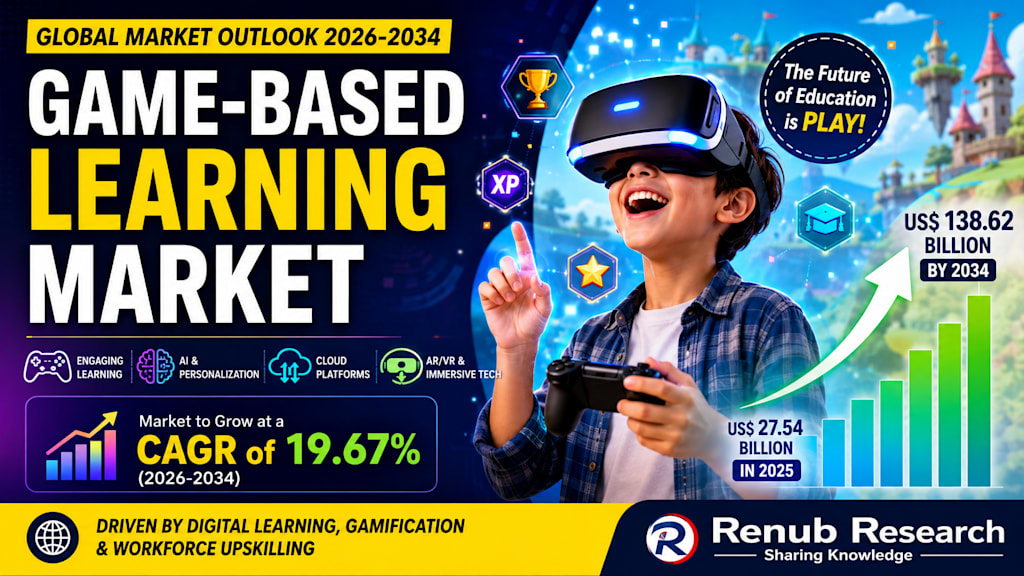
According to Renub Research, the Global Game-based Learning Market is projected to grow from US$ 27.54 billion in 2025 to US$ 138.62 billion by 2034, expanding at a remarkable CAGR of 19.67% during the forecast period 2026–2034. The market's rapid growth reflects increasing demand for personalized learning experiences, expanding corporate training initiatives, and widespread adoption of digital education technologies across developed and emerging economies.
Why Game-based Learning Is Becoming a Mainstream Educational Tool
Game-based learning is an instructional approach that incorporates educational content into game environments, enabling learners to acquire knowledge through participation, experimentation, and problem-solving rather than passive observation.
Unlike conventional learning methods, game-based learning uses elements such as rewards, storytelling, competition, levels, simulations, and instant feedback to create immersive educational experiences. These methods help learners stay motivated while developing practical skills and deeper conceptual understanding.
The approach has gained traction across multiple sectors including K–12 education, higher education, corporate training, government programs, professional certification, and consumer learning applications.
As digital natives become a larger share of the global workforce and student population, organizations are increasingly embracing learning models that align with modern technology habits and user expectations.
Digital Transformation of Education Drives Market Expansion
One of the strongest growth catalysts for the game-based learning market is the ongoing digital transformation of education and workforce development systems worldwide.
Educational institutions are investing heavily in digital infrastructure, cloud learning platforms, virtual classrooms, and mobile learning technologies. These investments create a favorable environment for integrating game-based learning tools into existing educational ecosystems.
Modern learning management systems now routinely incorporate gamified elements such as achievement badges, quizzes, challenges, rankings, and scenario-based simulations. These features improve student engagement while providing educators with valuable performance insights.
Governments are also actively promoting digital education initiatives. In May 2025, the Republic of Congo launched an online learning platform designed to train young people in information technology and communication skills, highlighting the growing emphasis on technology-enabled learning worldwide.
As digital education becomes increasingly accessible, game-based learning is positioned to become a core component of future educational models.
Growing Demand for Personalized and Engaging Learning Experiences
Today's learners expect educational experiences that are interactive, flexible, and tailored to individual needs. Traditional lecture-based instruction often struggles to maintain engagement, particularly among younger learners accustomed to digital environments.
Game-based learning addresses this challenge through adaptive pathways, personalized content recommendations, and real-time performance feedback.
Artificial intelligence is further enhancing personalization capabilities. AI-powered systems can analyze learner behavior, identify strengths and weaknesses, and automatically adjust content difficulty levels.
In July 2025, D2L expanded its Lumi platform with new AI-driven learning capabilities designed to deliver hyper-personalized educational experiences. Such innovations demonstrate how advanced analytics and machine learning are reshaping educational delivery models.
By making learning more engaging and responsive, game-based platforms significantly improve participation rates, knowledge retention, and learning outcomes.
Corporate Upskilling Creates Major Growth Opportunities
The global workforce is experiencing unprecedented technological disruption. Automation, artificial intelligence, and digital transformation are changing job requirements across virtually every industry.
As a result, organizations are investing heavily in employee upskilling and reskilling programs.
Game-based learning has become particularly valuable in corporate environments because it allows employees to practice skills through realistic simulations and decision-making scenarios. Training programs become more engaging, measurable, and effective when gamification elements such as rewards, leaderboards, badges, and achievement systems are incorporated.
Organizations are increasingly using game-based learning for:
Leadership development
Compliance training
Cybersecurity awareness
Sales training
Customer service enhancement
Technical skill development
Employee onboarding
In November 2025, LinkedIn Learning introduced AI-powered corporate training modules capable of creating personalized development pathways for employees, further strengthening the role of advanced learning technologies in workforce development.
The growing need for continuous learning is expected to remain one of the strongest drivers of market expansion throughout the forecast period.
AI Revolutionizing the Future of Learning
Artificial intelligence is rapidly becoming a defining technology within the game-based learning ecosystem.
AI-powered educational platforms can dynamically personalize learning journeys based on learner behavior, preferences, performance history, and skill gaps. This creates highly customized educational experiences that improve learning efficiency and outcomes.
Advanced AI capabilities now support:
Adaptive learning pathways
Intelligent tutoring systems
Automated assessments
Predictive analytics
Personalized content recommendations
Real-time performance feedback
In corporate settings, AI-driven simulations help employees practice complex scenarios while continuously adapting difficulty levels according to performance.
As AI technologies mature, their integration into game-based learning solutions is expected to accelerate significantly, driving innovation and expanding market opportunities.
Cloud-Based Learning Platforms Gain Momentum
Cloud deployment has become one of the most attractive delivery models for game-based learning providers.
Cloud-based platforms offer several advantages compared to traditional on-premise solutions:
Lower infrastructure costs
Rapid scalability
Instant software updates
Global accessibility
Enhanced collaboration
Centralized data management
Improved security and compliance
Educational institutions and enterprises increasingly prefer cloud platforms because they simplify deployment and reduce operational complexity.
Additionally, cloud environments support advanced analytics and integration with existing learning management systems, HR platforms, and collaboration tools.
As organizations continue their digital transformation initiatives, cloud-based game-based learning platforms are expected to capture a growing share of the market.
Online Learning Becomes the Dominant Delivery Model
The normalization of remote learning and hybrid education models has dramatically increased demand for online game-based learning solutions.
Online deployment enables learners to access educational content from virtually any location using computers, tablets, or smartphones.
Benefits of online game-based learning include:
Greater accessibility
Flexible scheduling
Lower training costs
Real-time assessment capabilities
Enhanced learner engagement
Scalability across multiple locations
Educational institutions use online games to reinforce curriculum concepts and assess student understanding. Meanwhile, corporations leverage online platforms for onboarding, compliance, and professional development programs.
The widespread availability of broadband internet and mobile devices continues to support strong growth in this segment globally.
Education Sector Remains the Largest End User
The education sector continues to represent the largest application area for game-based learning technologies.
Schools and universities increasingly use educational games to improve learning outcomes across subjects such as:
Mathematics
Science
History
Geography
Language learning
Computer programming
Interactive learning experiences help students understand complex concepts through exploration, experimentation, and practical application.
Teachers also benefit from real-time analytics that provide insights into student progress and areas requiring additional support.
As educational systems worldwide embrace competency-based learning and student-centered teaching approaches, demand for game-based educational tools is expected to remain robust.
Consumer Learning Segment Experiences Rapid Growth
Outside traditional educational institutions, consumers are increasingly adopting game-based learning applications for personal development and lifelong learning.
Popular consumer-focused learning categories include:
Language learning
Coding education
Financial literacy
Cognitive training
Professional skill development
Personal growth programs
Mobile applications dominate this segment due to their convenience and accessibility.
Features such as achievement systems, social competition, daily challenges, and progress tracking help maintain user engagement and encourage consistent learning behavior.
As lifelong learning becomes increasingly important in modern economies, the consumer learning segment is expected to generate significant growth opportunities.
Market Challenges Remain
Despite its impressive growth prospects, the game-based learning market faces several challenges.
High Development Costs
Creating high-quality educational games requires collaboration among instructional designers, educators, software developers, game designers, and user experience specialists.
Advanced technologies such as AR, VR, and AI further increase development complexity and costs.
For smaller educational institutions and organizations, these investments can create adoption barriers.
Resistance to Adoption
Some educators, trainers, and organizational leaders remain skeptical about the effectiveness of game-based learning compared to traditional instructional methods.
Concerns regarding excessive screen time, implementation complexity, and perceived lack of seriousness can slow adoption rates.
Overcoming these barriers will require continued demonstration of measurable educational outcomes and return on investment.
Regional Market Analysis
United States
The United States remains the world's largest and most technologically advanced game-based learning market.
Strong digital infrastructure, substantial education spending, and extensive corporate training investments continue to support growth.
In June 2025, Arizona State University partnered with Games for Change to advance educational innovation through game-based learning research and microcredential programs.
France
France is steadily expanding its adoption of game-based learning technologies across schools, universities, and enterprises.
Government-backed digital education initiatives and growing awareness of learning effectiveness are supporting market development.
Localized content and alignment with academic standards remain key success factors.
India
India represents one of the fastest-growing game-based learning markets globally.
The country's large youth population, expanding internet penetration, and widespread smartphone adoption create significant opportunities for growth.
Game-based learning is increasingly used for K–12 education, competitive exam preparation, language learning, and workforce development.
Government support for digital education initiatives further strengthens market potential. The Meghalaya government has also introduced game-based learning programs aimed at enhancing educational outcomes among children.
Saudi Arabia
Saudi Arabia is emerging as an important market within the Middle East due to ongoing education modernization initiatives and workforce development programs.
Government-backed digital transformation strategies continue to encourage adoption of innovative learning technologies.
In November 2025, King Salman Science Oasis launched a play-based learning initiative focused on enhancing children's cognitive and creative development through interactive educational experiences.
10 Recent Developments from Leading Companies
Badgeville (CallidusCloud) enhanced enterprise gamification capabilities through deeper workforce analytics integration.
Bunchball (BI WORLDWIDE) expanded employee engagement solutions with AI-powered performance tracking features.
Classcraft Studios Inc. introduced advanced classroom engagement tools supporting hybrid learning environments.
Six Waves Inc. expanded educational gaming content targeting student skill development and retention.
Recurrence, Inc. strengthened adaptive learning capabilities using behavioral analytics and personalized learning engines.
Gametize Pte. Ltd. launched new enterprise gamification modules designed for workforce training programs.
Kuato Studios expanded AI-powered educational content aimed at younger learners and STEM education.
BreakAway Ltd., Inc. enhanced simulation-based learning solutions for leadership and organizational training.
Filament Games introduced curriculum-aligned educational games focused on science and technology education.
LearningWare, Inc. expanded cloud-based learning delivery services with enhanced reporting and learner analytics capabilities.
Competitive Landscape
The global game-based learning market remains highly dynamic, with companies competing on innovation, content quality, user engagement, AI integration, cloud deployment capabilities, and analytics functionality.
Key industry participants are increasingly investing in:
Artificial intelligence
Adaptive learning technologies
AR/VR-based educational experiences
Mobile-first learning platforms
Corporate training solutions
Cloud infrastructure
Learning analytics
Strategic partnerships between educational institutions, technology providers, and corporate learning organizations are expected to further accelerate innovation across the industry.
Final Thoughts
Game-based learning is rapidly evolving from a supplementary educational tool into a mainstream learning methodology embraced by schools, universities, enterprises, governments, and consumers worldwide.
Driven by digital transformation, AI-powered personalization, workforce upskilling needs, cloud adoption, and growing demand for engaging educational experiences, the market is positioned for exceptional growth over the coming decade.
With the global market expected to expand from US$ 27.54 billion in 2025 to US$ 138.62 billion by 2034, game-based learning is set to play a pivotal role in shaping the future of education and professional development. Organizations that invest early in innovative, scalable, and learner-centric game-based solutions will be best positioned to capitalize on one of the most exciting opportunities in the global education technology sector.
About the Creator
Enjoyed the story? Support the Creator.
Subscribe for free to receive all their stories in your feed.
Comments
There are no comments for this story
Be the first to respond and start the conversation.