
Global Fertilizer Market Expands Steadily as Food Security and Modern Farming Drive Agricultural Growth
Rising global food demand, shrinking arable land, and increasing adoption of advanced farming practices are fueling sustained growth in the worldwide fertilizer industry.

Agriculture remains the backbone of global food production, and fertilizers continue to play a crucial role in ensuring that farms can meet the nutritional demands of a growing world population. As countries strive to strengthen food security, improve crop productivity, and maximize agricultural efficiency, fertilizers have become indispensable tools for modern farming systems.
From vast commercial farming operations in North America to smallholder farms across Asia and Africa, fertilizers are helping farmers enhance soil fertility, improve crop yields, and maintain consistent agricultural output. At a time when cultivable land is becoming increasingly limited and climate-related challenges continue to affect farming, efficient nutrient management has never been more important.
The fertilizer industry is evolving alongside these challenges. Manufacturers are developing innovative products, governments are supporting balanced nutrient usage, and farmers are increasingly adopting precision agriculture techniques that optimize fertilizer application while minimizing environmental impact.
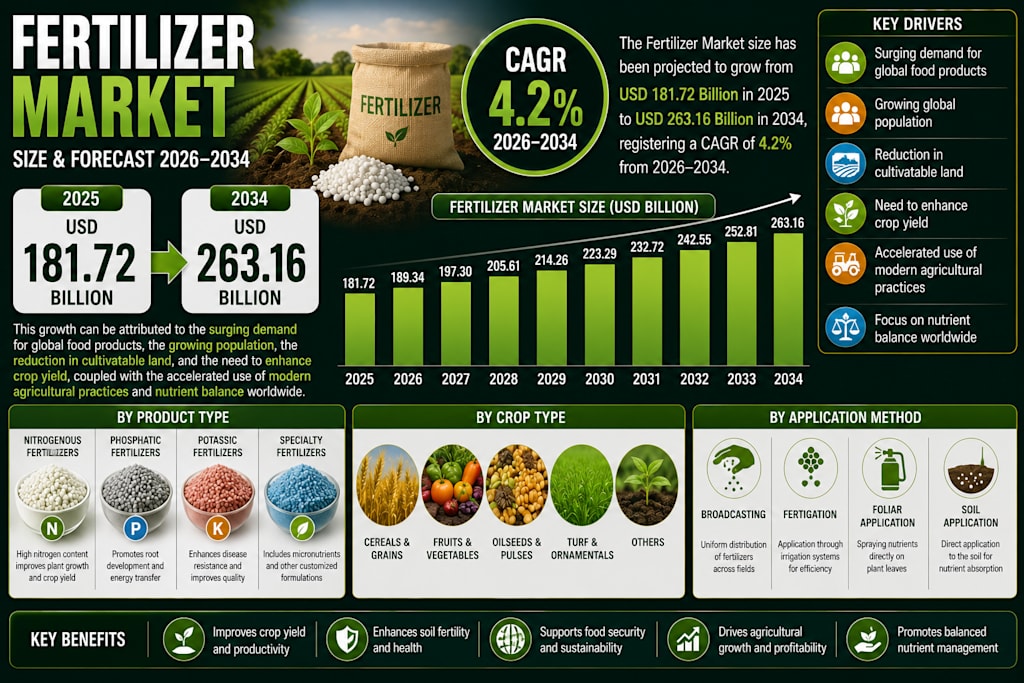
According to Renub Research, the Global Fertilizer Market is projected to grow from USD 181.72 billion in 2025 to USD 263.16 billion by 2034, registering a compound annual growth rate (CAGR) of 4.2% between 2026 and 2034. Rising food demand, population growth, expanding commercial agriculture, and increasing adoption of modern farming practices are expected to support long-term market expansion.
Fertilizers Remain Essential for Modern Agriculture
Fertilizers are natural or synthetic substances applied to soil or plants to provide essential nutrients required for healthy crop growth.
The primary nutrients supplied by fertilizers include nitrogen (N), phosphorus (P), and potassium (K), often referred to as NPK nutrients. Secondary nutrients such as calcium, magnesium, and sulfur, along with micronutrients like zinc, iron, and boron, also play important roles in plant development.
These nutrients help improve soil fertility, promote root development, support photosynthesis, enhance disease resistance, and increase crop productivity.
Without fertilizers, maintaining current levels of agricultural output would be significantly more challenging, especially given the increasing demand for food worldwide.
As a result, fertilizers continue to serve as a cornerstone of global agricultural systems.
Growing Population Is Increasing Food Demand
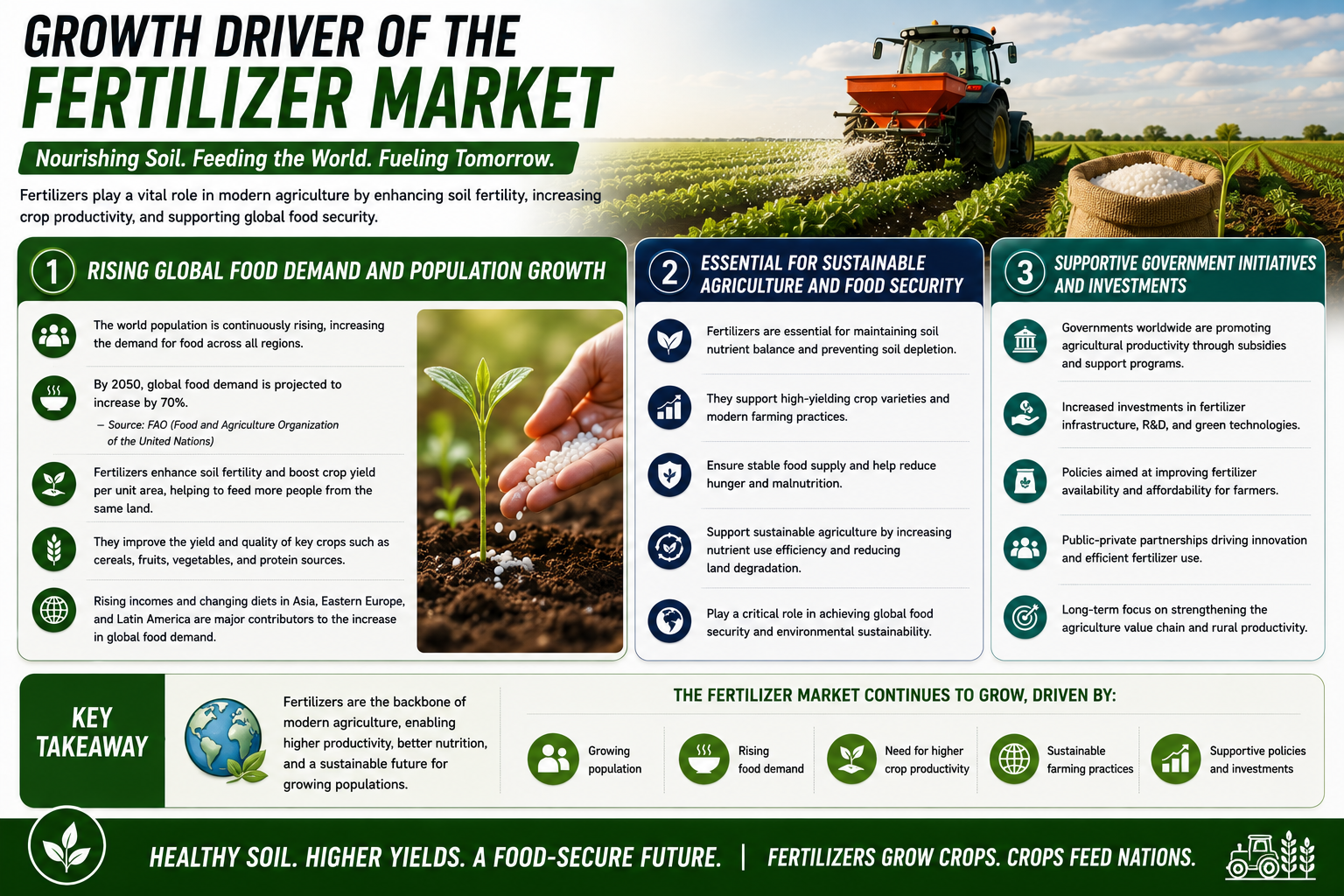
One of the most powerful drivers behind fertilizer market growth is the steady increase in global population.
As the world's population continues expanding, the need for food production is rising accordingly. Farmers face growing pressure to produce more food from existing agricultural land while maintaining crop quality and sustainability.
The Food and Agriculture Organization (FAO) has projected that global food demand could increase by approximately 70% by 2050.
Meeting this demand will require substantial improvements in agricultural productivity.
Fertilizers help achieve these goals by replenishing essential nutrients in soil and enabling crops to reach higher yield potential.
As population growth continues, fertilizer demand is expected to remain closely linked to global food security objectives.
Limited Arable Land Increases Dependence on Fertilizers
While food demand continues rising, the amount of cultivable land available for agriculture is becoming increasingly constrained.
Urbanization, industrial development, infrastructure expansion, and environmental degradation have reduced agricultural land availability in many regions.
This challenge requires farmers to maximize productivity from existing farmland rather than relying on expansion into new areas.
Fertilizers provide an effective solution by improving soil fertility and enabling higher crop yields from limited land resources.
The need to produce more food using less land remains one of the most important factors supporting long-term fertilizer demand.
Commercial Agriculture Is Driving Market Expansion
The growth of commercial agriculture has significantly increased fertilizer consumption worldwide.
Large-scale farming operations prioritize productivity, efficiency, and profitability, making nutrient management a critical component of their success.
Commercial farms often cultivate high-yield crop varieties that require consistent nutrient availability throughout multiple growth stages.
Fertilizers help replenish nutrients removed during harvesting and support intensive farming systems.
As agricultural production becomes increasingly commercialized and export-oriented, fertilizer usage continues expanding across both developed and emerging economies.
Modern Farming Practices Support Higher Adoption
Advancements in agricultural technology are transforming fertilizer application methods.
Farmers increasingly utilize precision agriculture techniques that combine GPS technology, soil testing, satellite imagery, sensors, and digital farm management systems.
These tools enable more accurate nutrient application, reducing waste while improving crop performance.
Precision farming helps farmers apply the right nutrients at the right time and in the correct quantities.
As technology adoption increases globally, fertilizer use is becoming more efficient and environmentally responsible.
This modernization trend continues strengthening demand for both conventional and advanced fertilizer products.
Government Programs Encourage Fertilizer Use
Government support remains a significant contributor to fertilizer market growth.
Many countries provide subsidies, incentives, educational programs, and agricultural development initiatives aimed at improving productivity and food security.
Such policies help make fertilizers more affordable and accessible, particularly for small and medium-sized farmers.
In India, for example, the government approved Nutrient-Based Subsidy (NBS) rates for phosphatic and potassic fertilizers covering the Rabi 2025–26 season.
Programs such as these encourage balanced nutrient usage and support long-term agricultural development.
Government-backed initiatives continue playing an important role in driving fertilizer adoption globally.
Nitrogen Fertilizers Continue to Dominate
Nitrogen fertilizers represent the largest segment within the global fertilizer market.
Nitrogen is essential for plant growth because it supports chlorophyll formation, photosynthesis, and leaf development.
Common nitrogen fertilizers include urea, ammonium nitrate, ammonium sulfate, and urea-ammonium nitrate (UAN) solutions.
These products are widely used across cereal crops, vegetables, oilseeds, and commercial farming operations.
The strong relationship between nitrogen availability and crop productivity ensures continued demand for nitrogen-based fertilizers worldwide.
Although environmental regulations influence usage practices, nitrogen fertilizers remain critical to modern agriculture.
Organic Fertilizers Gain Popularity
The organic fertilizers market is experiencing steady growth as sustainability becomes a higher priority for consumers and farmers.
Organic fertilizers are derived from natural sources such as compost, animal manure, bone meal, and plant residues.
These products improve soil structure, support microbial activity, and enhance long-term soil health.
Growing demand for organic food products is encouraging farmers to adopt organic nutrient management practices.
Although organic fertilizers generally release nutrients more slowly than synthetic alternatives, they offer important environmental benefits.
As interest in sustainable agriculture increases, organic fertilizers are expected to capture a larger share of the overall market.
Dry Fertilizers Remain the Preferred Choice
Dry fertilizers continue to dominate global fertilizer consumption.
Available in granular or powdered forms, dry fertilizers offer advantages including ease of storage, transportation, handling, and long shelf life.
These products are particularly popular in large-scale agricultural operations where cost efficiency and broad application coverage are important considerations.
Dry fertilizers are widely used in traditional farming systems and remain a preferred option in regions with limited irrigation infrastructure.
Despite increasing interest in liquid formulations, dry fertilizers continue maintaining a strong market position.
Agriculture Represents the Largest Application Segment
Agriculture remains the primary application area for fertilizers worldwide.
Fertilizers are essential for cultivating cereals, fruits, vegetables, oilseeds, pulses, sugar crops, and fiber crops.
They help farmers maintain soil fertility while meeting increasing food production requirements.
Population growth, changing dietary preferences, and global food security concerns continue driving fertilizer demand across agricultural sectors.
Government support programs and awareness campaigns further reinforce fertilizer adoption among farming communities.
As agricultural productivity remains a global priority, fertilizers will continue playing a central role in crop production.
Vegetable Production Supports Fertilizer Demand
Vegetable cultivation is another important contributor to fertilizer consumption.
Vegetables require balanced nutrient management to achieve optimal size, appearance, taste, and nutritional value.
Micronutrients and specialty fertilizers are particularly important in vegetable production because quality standards are often higher than for commodity crops.
The growing popularity of fresh produce and increasing demand for nutritious diets continue supporting fertilizer use within vegetable farming operations.
Efficient nutrient management remains essential for maximizing profitability and product quality in this segment.
Sustainability Is Reshaping Industry Strategies
Environmental sustainability is increasingly influencing fertilizer production and application practices.
Excessive fertilizer use has been associated with challenges such as nutrient runoff, water pollution, soil degradation, and greenhouse gas emissions.
As environmental awareness grows, governments and industry stakeholders are promoting more efficient nutrient management strategies.
Manufacturers are investing in technologies that improve nutrient-use efficiency while reducing environmental impact.
Controlled-release fertilizers, precision application systems, and biodegradable coatings are examples of innovations supporting sustainable agriculture.
These developments are helping the industry balance productivity goals with environmental responsibility.
Innovation Continues to Drive Market Evolution
The fertilizer industry is actively investing in research and development to improve product performance and sustainability.
In 2024, ICL Group began shipping products featuring eqo.x technology, a biodegradable coating solution used in controlled-release fertilizers.
Such innovations help optimize nutrient delivery while minimizing losses and environmental impacts.
Technological advancements are expected to play a major role in shaping the future of crop nutrition.
Manufacturers continue focusing on solutions that improve efficiency, reduce waste, and support precision farming practices.
Environmental Regulations Create Challenges
Despite strong growth prospects, environmental concerns remain one of the industry's biggest challenges.
Overapplication of fertilizers can contribute to nutrient runoff, water contamination, and greenhouse gas emissions.
As governments strengthen environmental regulations, producers and farmers face increasing pressure to adopt sustainable practices.
Compliance with environmental standards often increases operational costs while requiring ongoing investment in technology and education.
Balancing productivity with environmental stewardship remains a critical issue for the fertilizer industry.
Raw Material Price Volatility Impacts Profitability
The fertilizer market is highly sensitive to fluctuations in raw material and energy prices.
Key inputs such as natural gas, phosphate rock, and potash significantly influence production costs.
Geopolitical tensions, trade restrictions, transportation disruptions, and supply chain challenges can further affect availability and pricing.
Price volatility creates uncertainty for both producers and farmers, making long-term planning more difficult.
Maintaining stable supply chains and cost structures remains an ongoing priority across the industry.
United States Leads Through Innovation
The United States remains one of the largest fertilizer markets globally.
Strong agricultural output, advanced farming technologies, and widespread adoption of precision agriculture support consistent demand.
Major crops such as corn, soybeans, wheat, fruits, and vegetables require significant fertilizer inputs.
The country also continues investing in domestic fertilizer production capacity.
In March 2023, the U.S. Department of Agriculture announced that more than 350 independent businesses applied for approximately US$3 billion in funding aimed at expanding domestic fertilizer production capabilities.
These investments reflect the strategic importance of fertilizer security and agricultural productivity.
India Remains a Key Growth Market
India is one of the world's largest fertilizer consumers due to its extensive agricultural sector and reliance on farming livelihoods.
Nitrogen-based fertilizers dominate usage, supported by government subsidy programs and strong demand from cereal production.
Growing awareness of soil health and balanced nutrient management is encouraging greater adoption of specialty fertilizers and micronutrients.
In August 2025, India announced the successful development of its first indigenous water-soluble fertilizer technology after seven years of research, potentially reducing import dependence and strengthening domestic production capabilities.
Saudi Arabia Strengthens Its Position
Saudi Arabia plays an important role in both fertilizer production and agricultural development.
Government investments in food security, irrigation infrastructure, greenhouse farming, and modern agricultural systems support fertilizer demand.
In July 2025, Saudi Arabia's state-owned mining company Ma'aden signed a long-term agreement with Indian fertilizer companies to supply 3.1 million metric tons of diammonium phosphate annually for five years.
Such agreements highlight the country's growing influence within the global fertilizer supply chain.
Final Thoughts
The global fertilizer market continues to serve as a cornerstone of agricultural productivity and food security.
Driven by rising population growth, increasing food demand, expanding commercial farming, and technological innovation, fertilizers remain essential for maximizing crop yields and maintaining soil fertility.
With the market projected to grow from USD 181.72 billion in 2025 to USD 263.16 billion by 2034, significant opportunities exist for manufacturers, agricultural suppliers, policymakers, and investors.
Although challenges related to environmental sustainability and raw material price volatility persist, continued innovation and government support provide a strong foundation for future growth.
As the world seeks to feed a growing population while preserving natural resources, fertilizers will continue playing a vital role in supporting sustainable agricultural development and global food production.
About the Creator
Enjoyed the story? Support the Creator.
Subscribe for free to receive all their stories in your feed.
Comments
There are no comments for this story
Be the first to respond and start the conversation.