
Global Epoxy Resin Market Set to Reach US$ 20.84 Billion by 2033 as Demand Accelerates Across Construction, Aerospace, Automotive, and Electronics Industries
Strong Infrastructure Investments, Rising EV Production, and Growing Adoption of High-Performance Materials Continue to Fuel Global Market Expansion

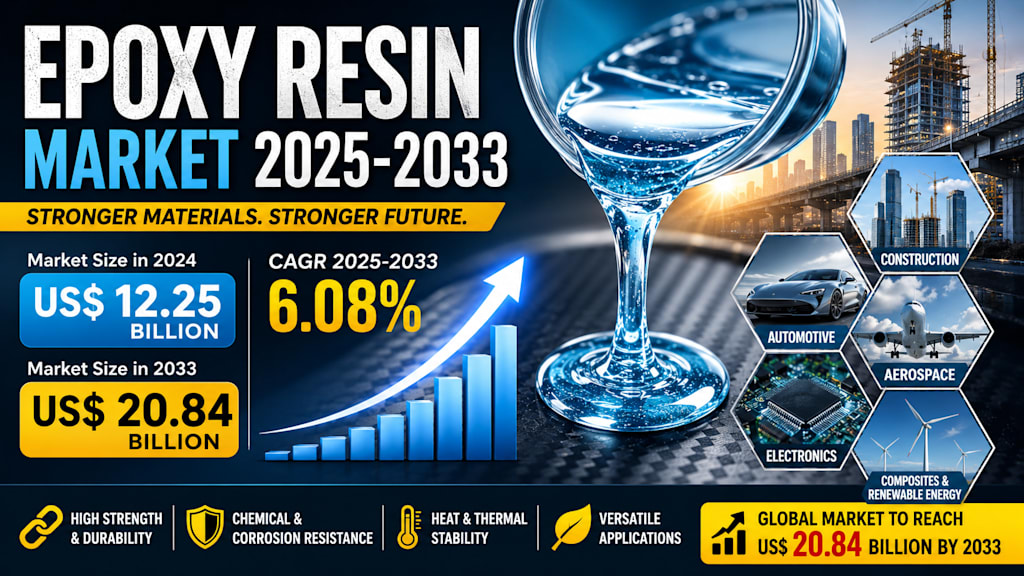
Global Epoxy Resin Market Outlook 2025–2033
The global epoxy resin market is entering a new phase of growth as industries increasingly rely on advanced materials capable of delivering superior durability, chemical resistance, adhesion, and structural strength. According to Renub Research, the worldwide epoxy resin market is projected to increase from US$ 12.25 billion in 2024 to US$ 20.84 billion by 2033, expanding at a CAGR of 6.08% between 2025 and 2033.
The rising adoption of epoxy resin across construction, transportation, aerospace, electronics, renewable energy, and consumer goods sectors continues to reshape the competitive landscape. As manufacturers seek lightweight, durable, and sustainable materials, epoxy resins are becoming indispensable in modern industrial applications.
From skyscrapers and bridges to aircraft structures and electric vehicle components, epoxy resin is increasingly recognized as one of the most versatile engineered materials available today.
Why Epoxy Resin Remains a Critical Industrial Material
Epoxy resin is a thermosetting polymer created through reactions involving epoxide compounds and curing agents. Once cured, the material develops exceptional mechanical strength and resistance to environmental stress.
Its unique properties include:
High adhesive strength
Excellent chemical resistance
Superior electrical insulation
Moisture resistance
Outstanding thermal stability
Long-term durability
These characteristics make epoxy resin a preferred material for coatings, adhesives, sealants, composites, flooring systems, electrical insulation, and protective applications across numerous industries.
The growing emphasis on infrastructure resilience and industrial efficiency is creating substantial opportunities for epoxy resin manufacturers worldwide.
Infrastructure Boom Driving Market Growth
One of the strongest drivers of epoxy resin demand remains the global construction sector.
Rapid urbanization in emerging economies, combined with extensive infrastructure modernization projects in developed nations, is creating a sustained need for high-performance construction materials. Epoxy-based flooring systems, coatings, sealants, and adhesives are increasingly being specified for commercial buildings, industrial facilities, transportation hubs, and public infrastructure projects.
The material's ability to withstand moisture, heavy traffic, chemicals, and harsh environmental conditions makes it particularly valuable in industrial settings.
Major industry innovations continue to emerge. In March 2025, Sika and BASF collaborated on a novel amine building block technology marketed under BASF's Baxxodur® EC 151 brand. The innovation was designed specifically to improve curing performance in flooring systems used within manufacturing facilities, warehouses, assembly plants, and parking structures.
As governments worldwide invest heavily in roads, railways, airports, and smart city projects, epoxy resin demand is expected to remain robust throughout the forecast period.
Automotive and Aerospace Industries Expanding Opportunities
The automotive and aerospace sectors have become major consumers of epoxy resin due to their ongoing pursuit of lightweight and durable materials.
Vehicle manufacturers increasingly utilize epoxy-based composites to reduce vehicle weight while maintaining structural integrity. Lightweight components contribute directly to improved fuel efficiency and extended electric vehicle driving ranges.
In aerospace applications, epoxy composites help manufacturers produce lighter aircraft structures that reduce fuel consumption and operational costs.
The industry continues to witness significant product innovation. During the European Coatings Show 2025, Westlake Epoxy introduced several advanced materials designed to support industries including aerospace, automotive, civil engineering, adhesives, composites, and wind energy.
The push toward electrification and sustainability is expected to further increase epoxy resin consumption across transportation sectors over the next decade.
Electronics Sector Creating New Demand Streams
The rapid evolution of electronics technology represents another major growth catalyst.
Epoxy resins are extensively used in:
Circuit board encapsulation
Semiconductor packaging
Electronic insulation
Component protection
Thermal management systems
The expansion of 5G infrastructure, electric vehicles, smart devices, and industrial automation systems is generating substantial demand for advanced insulation and encapsulation materials.
In February 2024, Elantas introduced a next-generation low-VOC epoxy resin designed for high-speed electric motors. The innovation addresses growing requirements for sustainable and thermally stable insulation systems within the electric vehicle industry.
As electronic devices become increasingly compact and powerful, demand for high-performance epoxy solutions is expected to accelerate further.
Sustainability Challenges Reshaping the Industry
Despite strong growth prospects, the epoxy resin market faces several challenges.
Environmental Concerns
Traditional epoxy resin production often involves chemicals that raise environmental and occupational safety concerns. Volatile organic compound (VOC) emissions and exposure to certain hardeners have attracted increased regulatory scrutiny.
Governments and environmental agencies worldwide are implementing stricter regulations regarding emissions, workplace safety, and chemical usage.
Consequently, manufacturers are investing heavily in:
Bio-based epoxy formulations
Low-VOC technologies
Sustainable curing systems
Green chemistry innovations
These initiatives are expected to transform the industry while creating new competitive advantages for innovators.
Raw Material Price Volatility
Epoxy resin manufacturing relies heavily on petroleum-derived feedstocks, particularly:
Bisphenol-A (BPA)
Epichlorohydrin (ECH)
Fluctuations in crude oil prices, geopolitical disruptions, and supply chain instability can significantly impact production costs.
Price volatility continues to challenge manufacturers attempting to maintain profitability while meeting customer expectations for affordable solutions.
DGBEA Epoxy Resin Continues Market Dominance
Among all product categories, Diglycidyl Ether of Bisphenol A (DGBEA) remains the most widely used epoxy resin type globally.
Its popularity stems from:
Excellent mechanical properties
Strong chemical resistance
Cost-effectiveness
Wide availability
Processing flexibility
DGBEA-based resins are extensively utilized in adhesives, coatings, laminates, and structural composites across automotive, aerospace, electronics, and construction industries.
Their balanced performance profile ensures continued dominance throughout the forecast period.
Novolac Epoxy Resins Gaining Importance in Specialized Applications
Novolac epoxy resins represent an important high-performance segment.
These materials provide:
Superior thermal stability
Enhanced chemical resistance
Exceptional durability under harsh conditions
Industries such as oil and gas, marine, chemical processing, and semiconductor manufacturing increasingly rely on novolac-based systems where conventional epoxy solutions may not perform adequately.
Growing industrial complexity and stricter performance requirements are expected to boost adoption of these specialized resins.
Solid Epoxy Resins Supporting Sustainable Coatings
Solid epoxy resins are becoming increasingly attractive because of their suitability for powder coatings and environmentally conscious applications.
Key advantages include:
Solvent-free formulations
Excellent film formation
High corrosion resistance
Long service life
Infrastructure projects, automotive manufacturing, and industrial equipment production continue to drive strong demand for solid epoxy products worldwide.
The transition toward sustainable coating technologies is expected to strengthen this segment's market position.
Paints and Coatings Remain the Largest Application Segment
Paints and coatings represent one of the largest application categories within the global epoxy resin market.
Industries such as:
Marine
Oil and gas
Infrastructure
Automotive
Manufacturing
depend heavily on epoxy-based coatings to protect assets from corrosion, moisture, abrasion, and chemical exposure.
As industrial operators seek longer asset life and lower maintenance costs, epoxy coatings continue to gain preference over conventional alternatives.
The expansion of offshore energy projects and industrial infrastructure modernization is expected to sustain demand well into the next decade.
Composite Materials Transforming Modern Manufacturing
Composite materials have become one of the most exciting growth areas for epoxy resin producers.
Epoxy-based composites offer exceptional:
Strength-to-weight ratios
Structural rigidity
Fatigue resistance
Design flexibility
These characteristics make them ideal for aerospace components, wind turbine blades, sports equipment, automotive parts, and marine structures.
The global shift toward lightweight engineering solutions continues to accelerate composite adoption, creating significant opportunities for epoxy manufacturers.
Transportation Sector Embracing Lightweight Materials
Transportation industries are increasingly focused on reducing weight while enhancing performance and safety.
Epoxy resins play a central role in achieving these objectives through their use in:
Structural adhesives
Composite panels
Protective coatings
Lightweight assemblies
As electric vehicles gain market share globally, demand for epoxy-based materials is expected to rise substantially.
Manufacturers are prioritizing solutions that improve battery efficiency, extend vehicle range, and support sustainability goals.
Regional Market Analysis
United States
The United States remains one of the world's most important epoxy resin markets.
Strong demand from aerospace, defense, construction, and automotive sectors supports ongoing growth. Investments in infrastructure modernization, renewable energy projects, and advanced manufacturing technologies further strengthen market prospects.
Germany
Germany serves as a key European hub for epoxy resin innovation.
The country's leadership in automotive engineering, industrial manufacturing, and sustainability initiatives continues to drive demand for advanced epoxy materials and environmentally friendly formulations.
India
India is emerging as one of the fastest-growing epoxy resin markets globally.
Government-backed industrialization initiatives, infrastructure expansion, and rising demand from electrical and electronics sectors are accelerating market development. Growing domestic manufacturing capabilities under the "Make in India" initiative further support long-term growth.
Brazil
Brazil's construction, marine, automotive, and oil and gas sectors continue to generate steady demand for epoxy resin products. Urban development projects and industrial investments remain key growth contributors.
Saudi Arabia
Saudi Arabia's ambitious Vision 2030 program is creating substantial opportunities for epoxy resin suppliers. Massive infrastructure developments, industrial diversification efforts, and energy sector investments continue to stimulate demand across multiple applications.
10 Recent Industry Developments Shaping the Epoxy Resin Market
1. BASF and Sika Launch Baxxodur® EC 151 (2025)
A new epoxy curing technology aimed at enhancing industrial flooring performance and durability.
2. Westlake Epoxy Unveils EvoVIVE Portfolio (2025)
Introduction of advanced solutions for aerospace, automotive, construction, and wind energy applications.
3. Elantas Develops Low-VOC EV Motor Resin (2024)
Launch of environmentally friendly insulation resin designed for electric vehicle motors.
4. Hexion Expands Specialty Epoxy Offerings
Focus on advanced composite materials for transportation and industrial applications.
5. Olin Strengthens Global Epoxy Supply Network
Investment initiatives aimed at improving supply reliability and operational efficiency.
6. Covestro Advances Sustainable Resin Technologies
Increased focus on circular economy solutions and low-emission production processes.
7. Kukdo Chemical Expands Electronics Materials Portfolio
New epoxy products targeting semiconductor and high-performance electronics markets.
8. Aditya Birla Chemicals Increases Industrial Resin Capacity
Expansion efforts designed to meet rising demand across Asia-Pacific markets.
9. Atul Ltd. Enhances Specialty Epoxy Product Range
Development of customized formulations for coatings and adhesive applications.
10. DuPont Accelerates High-Performance Electronics Solutions
Continued innovation in advanced encapsulation and insulation technologies.
Competitive Landscape
The global epoxy resin market remains highly competitive, with leading companies focusing on innovation, sustainability, capacity expansion, and strategic partnerships.
Major industry participants include:
Aditya Birla Group
Atul Ltd.
BASF SE
Chang Chun Group
Covestro AG
Daicel Corporation
DuPont de Nemours Inc.
Hexion Holdings Corporation
Kukdo Chemical Co. Ltd.
Olin Corporation
These companies continue investing in R&D, sustainable technologies, and market expansion strategies to maintain competitive advantages.
Final Thoughts
The global epoxy resin market is poised for sustained expansion through 2033, supported by infrastructure development, transportation modernization, renewable energy investments, aerospace innovation, and the rapid evolution of electronics manufacturing.
As industries increasingly prioritize lightweight materials, durability, efficiency, and sustainability, epoxy resin will remain a foundational material across countless applications. While environmental regulations and raw material volatility present ongoing challenges, technological advancements and green chemistry initiatives are creating new opportunities for growth.
With the market expected to reach US$ 20.84 billion by 2033, epoxy resin is positioned to play a pivotal role in shaping the next generation of industrial and infrastructure development worldwide.
About the Creator
Enjoyed the story? Support the Creator.
Subscribe for free to receive all their stories in your feed.
Comments
There are no comments for this story
Be the first to respond and start the conversation.