
Global Drug Abuse Testing Market to Reach US$12.03 Billion by 2034 as Rapid Diagnostics and Workplace Screening Drive Growth
Rising substance abuse cases, stricter workplace drug testing regulations, technological advances in rapid diagnostics, and expanding public health initiatives are accelerating growth in the global drug abuse testing market.

Drug Abuse Testing Is Becoming Essential for Public Health and Workplace Safety
Substance abuse continues to pose a major public health challenge across the world, affecting millions of individuals and placing significant pressure on healthcare systems, workplaces, and law enforcement agencies. The increasing misuse of illicit drugs, prescription medications, and synthetic substances has created a growing need for accurate, rapid, and reliable drug testing solutions.
Drug abuse testing has become an essential tool for hospitals, rehabilitation centers, employers, forensic laboratories, educational institutions, and government agencies. Modern testing technologies help identify substance use quickly, enabling timely medical intervention, workplace safety, legal compliance, and effective rehabilitation programs.
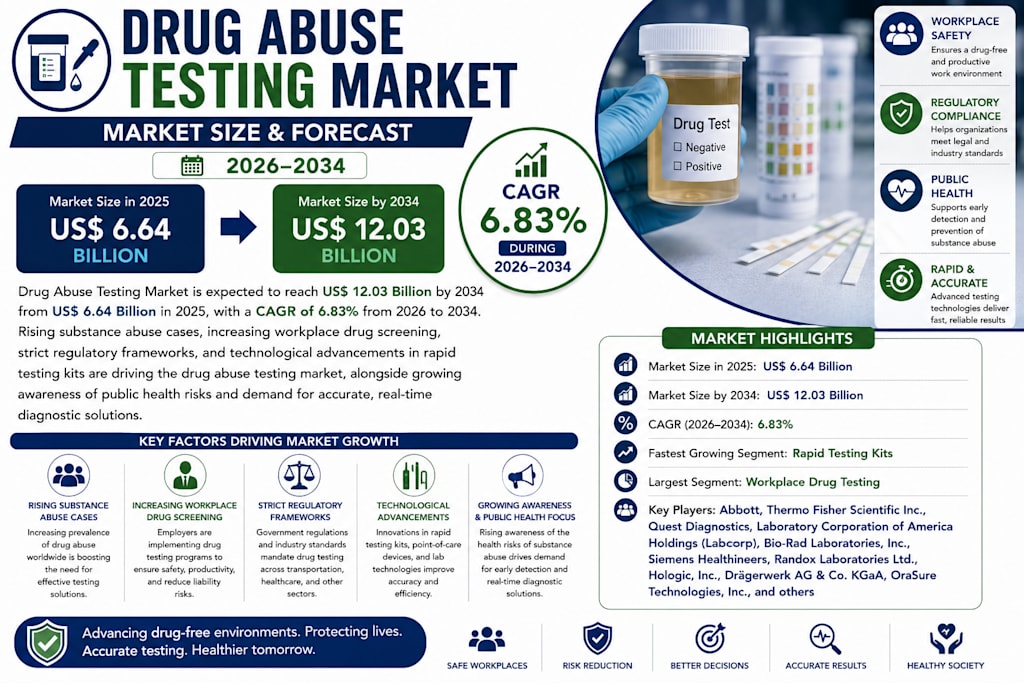
According to the latest market outlook, the Global Drug Abuse Testing Market is projected to grow from US$6.64 billion in 2025 to US$12.03 billion by 2034, registering a compound annual growth rate (CAGR) of 6.83% during 2026–2034. Rising substance abuse prevalence, expanding workplace screening programs, technological innovation, and supportive government regulations continue to drive long-term market growth.
Drug Abuse Testing Plays a Critical Role in Modern Healthcare
Drug abuse testing involves detecting illicit drugs, controlled substances, or the misuse of prescription medications through biological samples including urine, blood, saliva, breath, hair, and sweat.
Testing methods range from rapid immunoassay screening to highly accurate confirmatory laboratory techniques such as gas chromatography-mass spectrometry (GC-MS) and liquid chromatography-mass spectrometry (LC-MS).
These diagnostic tools are widely used to support medical treatment, workplace safety, law enforcement investigations, rehabilitation monitoring, sports integrity, and public health programs.
Advances in diagnostic technology continue improving testing accuracy while reducing turnaround times.
Rising Substance Abuse Continues Driving Market Growth
One of the strongest drivers of the market is the increasing prevalence of substance abuse worldwide.
Growing misuse of opioids, methamphetamine, cocaine, cannabis, synthetic drugs, and prescription medications has created an urgent need for effective screening and monitoring solutions.
Governments and healthcare organizations continue expanding drug testing initiatives to improve public safety, reduce overdose deaths, and strengthen addiction treatment programs.
Earlier detection allows healthcare professionals to intervene promptly while supporting long-term recovery and rehabilitation.
The continued rise in substance use disorders is expected to sustain strong demand for advanced drug testing technologies.
Workplace Drug Screening Expands Worldwide
Workplace drug testing has become increasingly common across both public and private sectors.
Industries including transportation, construction, manufacturing, mining, oil and gas, aviation, and healthcare increasingly require pre-employment, random, post-incident, and return-to-duty drug testing to ensure employee safety.
Substance impairment can significantly increase the risk of workplace accidents, productivity losses, and legal liability.
Employers continue investing in comprehensive drug screening programs to maintain safe working environments while complying with occupational safety regulations.
Growing regulatory requirements continue supporting expansion of workplace testing services.
Rapid Testing Technologies Improve Efficiency
Technological innovation continues transforming the drug abuse testing industry.
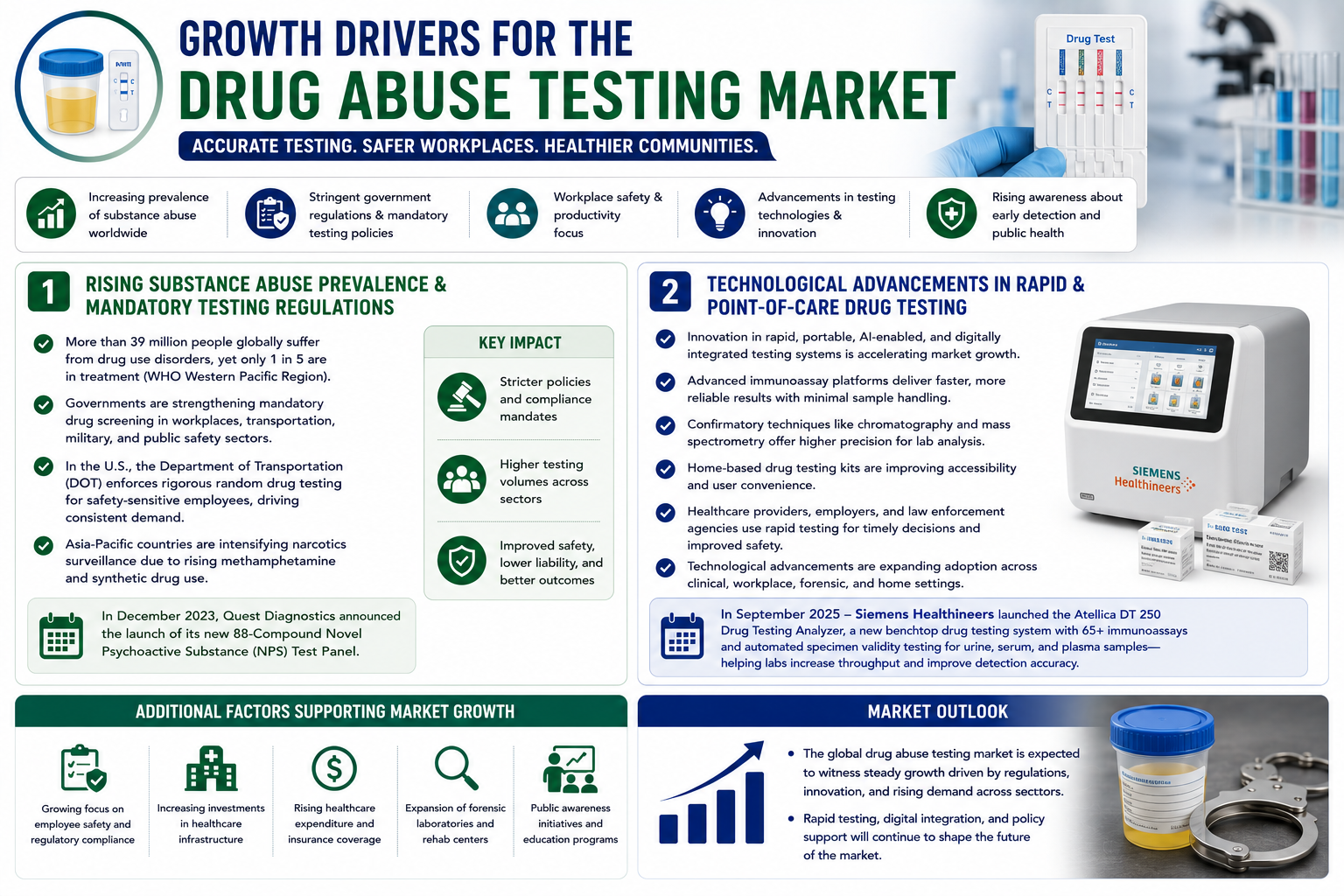
Modern rapid testing kits provide reliable results within minutes using urine, saliva, or oral fluid samples without requiring complex laboratory equipment.
Point-of-care diagnostic devices improve accessibility while allowing healthcare providers, employers, and law enforcement personnel to make faster decisions.
Advances in digital integration, automated analyzers, and artificial intelligence further enhance testing accuracy and operational efficiency.
Portable testing solutions continue expanding into roadside enforcement, emergency medicine, and remote healthcare settings.
Laboratory Diagnostics Continue Advancing
Although rapid testing has become increasingly popular, laboratory-based confirmatory testing remains the gold standard for accuracy.
Advanced chromatography and mass spectrometry technologies provide highly sensitive identification of a broad range of substances while minimizing false-positive and false-negative results.
Clinical laboratories continue investing in automated analyzers capable of processing high sample volumes efficiently.
These sophisticated diagnostic platforms remain essential for legal proceedings, forensic investigations, workplace compliance, and clinical toxicology.
Government Regulations Support Market Expansion
Governments worldwide continue strengthening regulations regarding drug screening in safety-sensitive environments.
Transportation authorities, military organizations, law enforcement agencies, correctional facilities, and healthcare institutions increasingly require mandatory drug testing programs.
Public health initiatives designed to reduce substance abuse and improve rehabilitation outcomes further contribute to growing demand.
Supportive regulatory frameworks encourage wider adoption of standardized testing procedures while improving diagnostic quality across healthcare systems.
Rapid Testing Devices Gain Popularity
Rapid testing devices represent one of the fastest-growing product categories within the market.
These portable kits provide convenient, cost-effective screening using urine, saliva, or oral fluid samples and deliver results within a short period.
Healthcare providers appreciate their ease of use, while employers value their ability to support efficient workplace screening.
Continuous improvements in sensitivity, specificity, and digital connectivity continue increasing confidence in rapid diagnostic technologies.
Oral Fluid Testing Continues Expanding
Oral fluid testing has become increasingly popular because of its non-invasive sample collection and reduced risk of specimen tampering.
Saliva-based testing is widely used for roadside drug screening, workplace compliance, and law enforcement applications.
Collection procedures are straightforward, hygienic, and can often be performed under direct observation without compromising patient privacy.
Advances in oral fluid testing technology continue improving detection accuracy while expanding clinical acceptance.
Drug Testing Laboratories Remain Essential
Drug testing laboratories continue playing a central role within the global market.
These specialized facilities perform confirmatory analysis, forensic toxicology, workplace compliance testing, clinical diagnostics, and rehabilitation monitoring.
Laboratories increasingly utilize automated analyzers, artificial intelligence, and digital laboratory information systems to improve efficiency and reduce reporting times.
Growing outsourcing by hospitals, employers, and government agencies continues supporting demand for laboratory testing services.
High Equipment Costs Present Challenges
Despite significant technological progress, advanced laboratory equipment remains expensive.
Mass spectrometry systems, chromatography analyzers, automated testing platforms, and laboratory infrastructure require substantial investment.
Small healthcare facilities and laboratories may struggle to adopt these technologies because of limited financial resources.
Ongoing maintenance, calibration, quality assurance, and regulatory compliance further increase operational costs.
Reducing testing costs while maintaining high diagnostic accuracy remains an important industry objective.
Privacy and Ethical Concerns Continue
Drug abuse testing also presents legal and ethical considerations.
Employees, students, and patients may express concerns regarding privacy, confidentiality, informed consent, and potential discrimination following positive test results.
Organizations must comply with strict data protection regulations governing sample collection, storage, reporting, and patient information.
False-positive results, sample handling errors, and legal disputes can also create challenges for employers and healthcare providers.
Maintaining transparency, accuracy, and ethical testing practices remains essential for sustaining public trust.
Regional Markets Continue Supporting Growth
The United States remains the world's largest drug abuse testing market due to widespread workplace screening, strong regulatory enforcement, advanced laboratory infrastructure, and increasing investment in substance abuse prevention.
Germany continues expanding its market through strict workplace regulations, growing toxicology services, increasing roadside drug testing, and advanced laboratory technologies.
India is experiencing rapid market growth as rising substance abuse awareness, expanding corporate drug screening programs, and increasing healthcare investment improve testing accessibility.
Saudi Arabia continues strengthening its market through strict anti-drug regulations, mandatory workplace testing, healthcare modernization, and growing investment in advanced laboratory infrastructure.
Together, these regional markets continue driving worldwide adoption of drug abuse testing technologies.
Innovation Will Shape the Future of Drug Abuse Testing
The future of drug abuse testing will be driven by artificial intelligence, digital health integration, advanced biosensors, portable diagnostics, and real-time detection technologies.
Manufacturers continue developing highly accurate handheld analyzers, AI-supported diagnostic systems, next-generation oral fluid testing devices, and integrated laboratory automation platforms.
Future innovations are expected to improve testing speed, expand substance detection capabilities, reduce operational costs, and enhance patient privacy.
As public health systems increasingly prioritize early intervention and substance abuse prevention, technological innovation will remain central to industry growth.
Final Thoughts
The global drug abuse testing market continues expanding as governments, healthcare providers, employers, and law enforcement agencies increasingly prioritize public safety and early detection of substance misuse.
The projected growth from US$6.64 billion in 2025 to US$12.03 billion by 2034, supported by a 6.83% CAGR, reflects rising substance abuse prevalence, stronger workplace regulations, rapid diagnostic innovation, and expanding laboratory capabilities.
Although equipment costs, privacy concerns, and regulatory complexity remain important challenges, continued advances in rapid diagnostics, laboratory automation, digital healthcare, and artificial intelligence position the drug abuse testing industry for sustained long-term growth. As early detection becomes increasingly important for both healthcare and public safety, drug abuse testing will remain an essential component of modern diagnostic and preventive healthcare systems.
About the Creator
Enjoyed the story? Support the Creator.
Subscribe for free to receive all their stories in your feed.
Comments
There are no comments for this story
Be the first to respond and start the conversation.