
Global Defibrillator Market Expands as Rising Cardiac Emergencies and Public Access Programs Strengthen Demand
Growing awareness of sudden cardiac arrest, increasing cardiovascular disease prevalence, and technological advancements in life-saving medical devices are driving steady growth across the global defibrillator industry.

Cardiovascular disease remains one of the leading causes of death worldwide, creating an urgent need for technologies capable of delivering rapid, life-saving intervention during cardiac emergencies. Among the most critical medical devices in emergency care, defibrillators have become indispensable tools for treating life-threatening heart rhythm abnormalities and improving survival rates during sudden cardiac arrest.
From hospitals and ambulances to schools, airports, offices, and sports stadiums, defibrillators are increasingly being deployed across public and private settings. Advances in technology have made these devices more compact, user-friendly, and effective, allowing even non-medical individuals to provide emergency assistance when every second counts.
As governments, healthcare organizations, and communities continue emphasizing emergency preparedness and cardiac health awareness, the global defibrillator market is experiencing sustained growth. Rising investments in healthcare infrastructure, public access defibrillation programs, and innovative cardiac care technologies are expected to support market expansion throughout the coming decade.
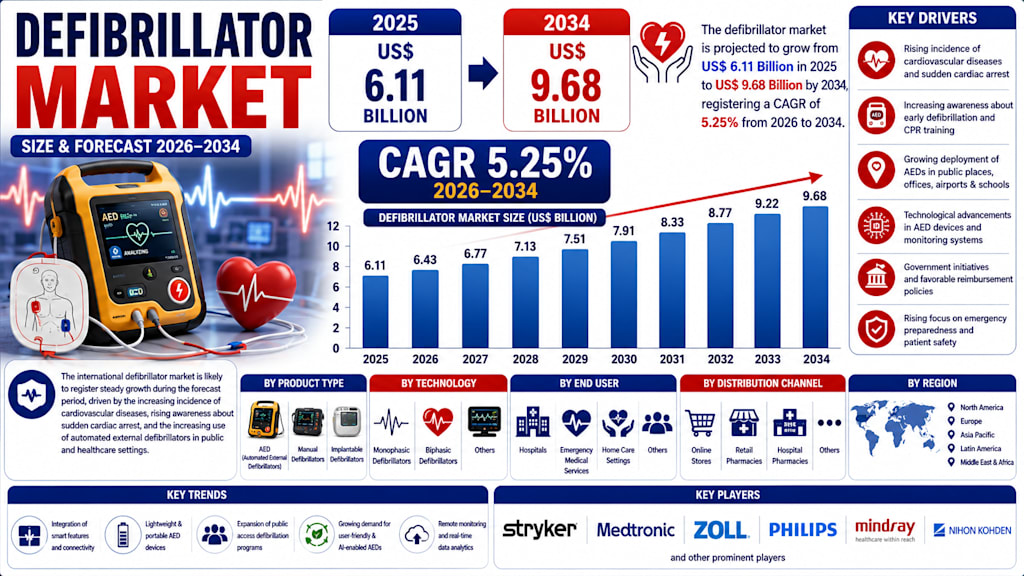
According to Renub Research, the Global Defibrillator Market is projected to grow from US$6.11 billion in 2025 to US$9.68 billion by 2034, registering a compound annual growth rate (CAGR) of 5.25% between 2026 and 2034. Increasing prevalence of cardiovascular diseases, expanding deployment of automated external defibrillators (AEDs), and ongoing technological innovation are expected to drive long-term market growth
Defibrillators Play a Critical Role in Emergency Cardiac Care
A defibrillator is a medical device designed to restore normal heart rhythm during life-threatening cardiac events such as ventricular fibrillation and sudden cardiac arrest.
The device delivers an electrical shock to the heart, helping re-establish a stable rhythm and preventing fatal outcomes.
Defibrillators are widely used in hospitals, emergency medical services, ambulances, and increasingly in public spaces where rapid response is essential.
The market includes several product categories, including implantable cardioverter defibrillators (ICDs), manual defibrillators, and automated external defibrillators (AEDs).
As awareness of sudden cardiac arrest continues increasing globally, defibrillators are becoming recognized as essential life-saving tools in both healthcare and community settings.
Cardiovascular Disease Continues to Drive Demand
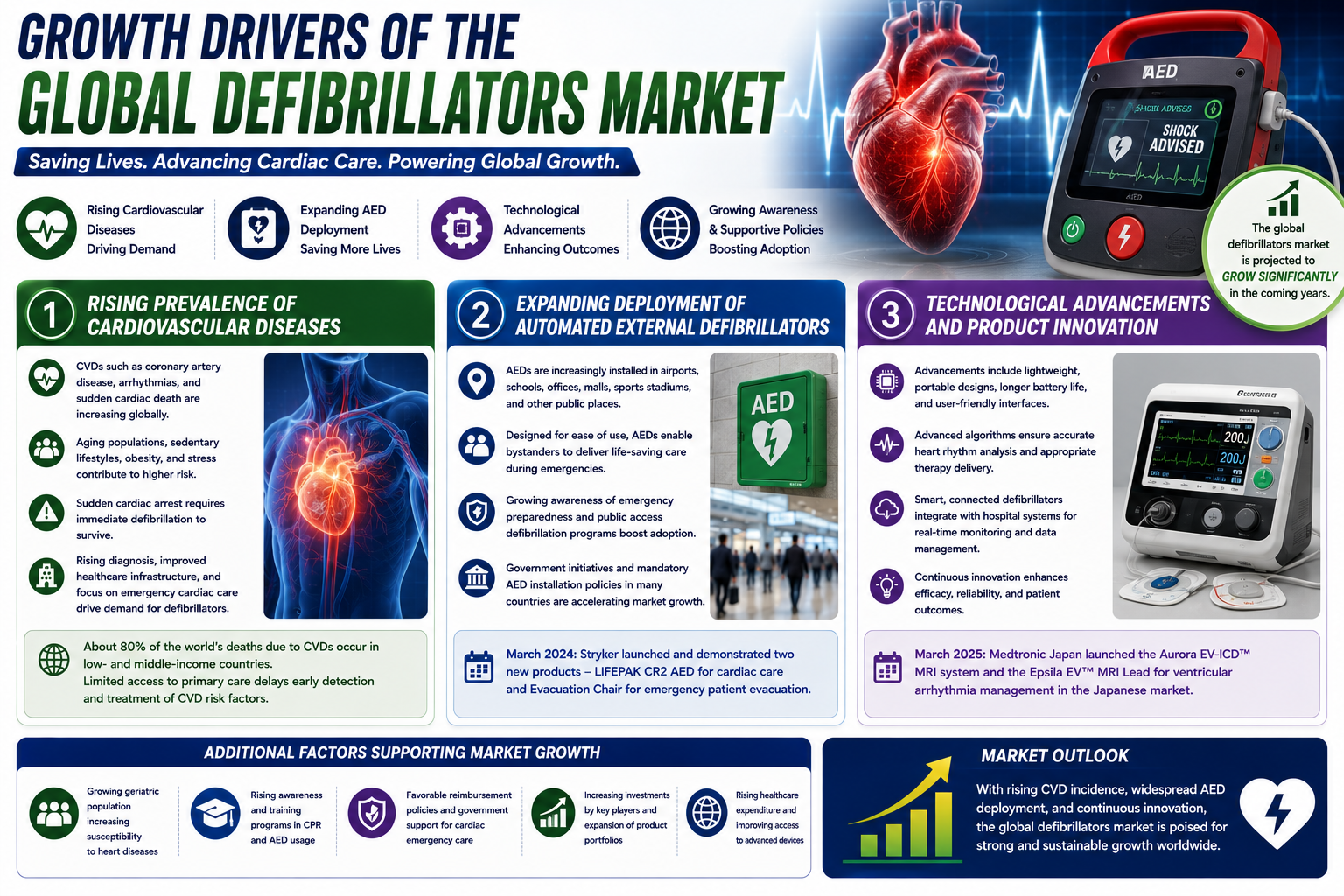
One of the most important growth drivers for the defibrillator market is the increasing prevalence of cardiovascular disease worldwide.
Conditions such as coronary artery disease, arrhythmias, heart failure, and sudden cardiac arrest continue affecting millions of individuals across developed and emerging economies.
Factors including aging populations, sedentary lifestyles, obesity, diabetes, smoking, and chronic stress have contributed to rising cardiovascular health risks.
Patients with severe cardiac conditions often require immediate intervention during emergencies, making defibrillation a critical component of treatment.
As healthcare systems focus on reducing cardiovascular mortality rates and improving emergency response capabilities, demand for advanced defibrillator technologies continues growing steadily.
Aging Populations Are Increasing Cardiac Risk
Population aging represents a major factor contributing to market expansion.
Older adults are more susceptible to cardiovascular diseases, arrhythmias, and heart-related complications that may require emergency cardiac intervention.
As life expectancy rises globally, healthcare providers are encountering larger populations at risk of sudden cardiac events.
This demographic shift is increasing demand for both implantable and external defibrillators across hospitals, specialty clinics, and home healthcare settings.
The growing elderly population is expected to remain one of the most significant contributors to future market growth.
Public Access Defibrillation Programs Are Expanding
The increasing deployment of automated external defibrillators in public locations is transforming emergency response systems worldwide.
Governments, healthcare authorities, and nonprofit organizations continue promoting public access defibrillation initiatives aimed at improving survival rates from sudden cardiac arrest.
AEDs are now commonly installed in airports, schools, shopping malls, office buildings, sports arenas, transportation hubs, and community centers.
Because modern AEDs provide voice instructions and automated guidance, they can be operated by individuals without medical training.
This accessibility has significantly expanded the role of defibrillators beyond traditional healthcare environments.
As public awareness grows, AED deployment is expected to continue accelerating globally.
Emergency Preparedness Is Becoming a Global Priority
Emergency preparedness has become an increasingly important public health objective.
Organizations are investing in emergency response equipment and training programs designed to improve readiness during critical situations.
Defibrillators play a central role in these efforts because survival rates decrease dramatically when cardiac arrest victims do not receive immediate treatment.
Workplaces, educational institutions, sports facilities, and public venues increasingly view AED installation as a vital safety measure.
This trend is creating substantial opportunities for manufacturers and suppliers throughout the market.
Technological Innovation Continues Advancing the Industry
Rapid technological advancement is helping reshape the global defibrillator market.
Modern devices are becoming smaller, lighter, more reliable, and easier to operate.
Innovations in battery technology, connectivity, monitoring capabilities, and diagnostic algorithms have significantly improved device performance.
Many newer systems include real-time monitoring, wireless communication, and integration with electronic health records.
Advanced software can accurately analyze heart rhythms and deliver appropriate therapy while reducing the risk of incorrect shock delivery.
These improvements are enhancing patient outcomes while increasing confidence among healthcare providers and first responders.
Connected Devices Improve Patient Monitoring
Connectivity is becoming an increasingly important feature within the defibrillator market.
Many modern implantable and external defibrillators can transmit patient data directly to healthcare providers.
Remote monitoring capabilities allow clinicians to track cardiac activity, identify potential complications, and adjust treatment plans more effectively.
Connected technologies also improve maintenance and readiness monitoring for publicly deployed AEDs.
As healthcare systems continue embracing digital transformation, connected defibrillator solutions are expected to gain widespread adoption.
Implantable Defibrillators Remain Essential for High-Risk Patients
The implantable defibrillator segment continues to represent a critical area of the market.
Implantable cardioverter defibrillators are surgically placed inside the body to continuously monitor heart rhythm and deliver corrective shocks when dangerous abnormalities occur.
These devices are typically recommended for patients with a history of serious arrhythmias, heart failure, or elevated risk of sudden cardiac death.
Advances in device miniaturization, battery longevity, and sensing technology have improved both patient comfort and clinical outcomes.
As cardiovascular disease prevalence continues rising, demand for implantable defibrillators is expected to remain strong.
External Defibrillators Drive Public Access Growth
External defibrillators, particularly AEDs, represent one of the fastest-growing market segments.
These devices are widely used in hospitals, ambulances, schools, offices, and public spaces.
Modern AEDs are designed for simplicity and can guide users through emergency procedures using visual prompts and voice instructions.
Their portability and ease of use have expanded access to life-saving cardiac care outside traditional healthcare facilities.
The continued growth of public access defibrillation programs is expected to support strong demand for external defibrillator technologies.
Hospitals Remain the Largest End-User Segment
Hospitals continue to represent the largest end-user category within the defibrillator market.
Emergency departments, intensive care units, cardiac care centers, and operating rooms rely heavily on advanced defibrillation technologies.
The increasing number of hospital admissions related to cardiovascular disease continues driving equipment demand.
Healthcare facilities also benefit from integrated systems that connect defibrillators with broader patient monitoring and information management platforms.
As hospitals continue modernizing cardiac care services, investment in advanced defibrillation technologies is expected to remain strong.
Home Healthcare Creates New Opportunities
The home healthcare segment is becoming increasingly important as more cardiac patients receive treatment outside hospital settings.
Portable and wearable defibrillators allow high-risk patients to maintain greater independence while remaining protected against sudden cardiac events.
Continuous monitoring capabilities provide reassurance for both patients and healthcare providers.
The growing preference for home-based healthcare, combined with aging populations and chronic disease management strategies, is expected to support long-term growth in this segment.
High Device Costs Remain a Challenge
Despite strong market potential, affordability remains a major challenge.
Advanced implantable defibrillators and sophisticated external systems require complex manufacturing processes, specialized components, and ongoing maintenance.
These factors contribute to relatively high acquisition and operating costs.
Healthcare facilities in developing regions may face financial barriers when investing in advanced cardiac care technologies.
Public access programs also require funding for device procurement, installation, maintenance, and training.
Improving affordability remains a key priority for industry stakeholders seeking broader adoption.
Public Training Gaps Can Limit Effectiveness
A lack of awareness and training among the general public continues to present challenges.
Although AEDs are designed for use by non-medical individuals, many people remain hesitant to operate them during emergencies.
Concerns about making mistakes, legal liability, or unfamiliarity with the equipment can delay life-saving intervention.
Increasing education, public awareness campaigns, and CPR-AED training programs are essential for maximizing the effectiveness of public access defibrillation initiatives.
Expanding training efforts remains a critical component of future market development.
United States Leads the Global Market
The United States remains one of the largest and most advanced defibrillator markets worldwide.
High cardiovascular disease prevalence, strong healthcare infrastructure, and widespread public access programs support robust demand.
Hospitals, emergency services, educational institutions, and private organizations continue investing heavily in defibrillation technologies.
Favorable reimbursement policies and ongoing technological innovation further strengthen market growth.
The expansion of community-based AED programs continues improving emergency response capabilities across the country.
United Kingdom Expands Public Access Programs
The United Kingdom has made significant progress in expanding public access defibrillation initiatives.
AEDs are increasingly deployed across transportation networks, sports facilities, community centers, and public spaces.
Government-backed awareness campaigns and emergency preparedness programs continue supporting adoption.
Healthcare providers also rely heavily on advanced defibrillators for emergency and critical care services.
These efforts are contributing to steady market growth throughout the UK.
India Emerges as a Growing Market
India's defibrillator market is expanding as awareness of cardiac health and emergency response capabilities improves.
Rising rates of cardiovascular disease, increasing healthcare investments, and expanding hospital infrastructure are supporting demand.
While public access defibrillation remains in its early stages, urban centers are gradually increasing AED deployment.
Government initiatives and healthcare modernization programs are expected to create additional growth opportunities over the coming years.
Saudi Arabia Strengthens Emergency Care Infrastructure
Saudi Arabia continues investing heavily in healthcare modernization and emergency medical services.
Hospitals and specialized healthcare facilities increasingly utilize advanced defibrillation technologies for cardiac care.
Public access programs are gradually expanding across major cities and high-traffic public locations.
Government efforts aimed at improving healthcare quality and emergency preparedness are expected to support sustained market growth throughout the Kingdom.
Recent Industry Developments Highlight Innovation
The defibrillator industry continues witnessing significant innovation and strategic investment.
In March 2024, Stryker introduced new emergency response solutions, including the LIFEPAK CR2 Automated External Defibrillator.
In March 2025, Medtronic Japan launched the Aurora EV-ICD MRI System and Epsila EV MRI Lead for managing ventricular arrhythmias.
Additionally, Medtronic commercially launched the OmniaSecure defibrillation lead in the United States in January 2026.
These developments reflect the industry's ongoing commitment to improving patient outcomes through advanced cardiac care technologies.
Final Thoughts
The global defibrillator market is entering a period of steady growth driven by rising cardiovascular disease prevalence, expanding public access programs, and continuous technological innovation.
As governments, healthcare providers, and communities place greater emphasis on emergency preparedness and cardiac health, defibrillators are becoming increasingly essential across healthcare and public settings.
With the market projected to grow from US$6.11 billion in 2025 to US$9.68 billion by 2034, significant opportunities exist for device manufacturers, healthcare providers, emergency service organizations, and investors.
Although challenges related to affordability, training, and accessibility remain important considerations, ongoing advancements in technology and expanding public awareness provide a strong foundation for future growth.
As global healthcare systems continue prioritizing rapid emergency response and cardiovascular disease management, defibrillators will remain among the most important life-saving technologies available.
About the Creator
Enjoyed the story? Support the Creator.
Subscribe for free to receive all their stories in your feed.
Comments
There are no comments for this story
Be the first to respond and start the conversation.