
Global Cosmetics Market Outlook 2026–2034: How Beauty Innovation, Self-Care Trends, and Digital Influence Are Transforming the Industry
Rising consumer focus on personal grooming, growing demand for premium skincare products, and the influence of social media are driving strong growth in the global cosmetics market.

The global cosmetics industry has evolved far beyond traditional beauty products and has become a powerful force within the consumer goods sector. Today, cosmetics are not only associated with enhancing appearance but are increasingly linked to self-care, confidence, wellness, and personal expression.
Across the world, consumers are becoming more conscious about skincare, haircare, personal grooming, and beauty routines. This shift is being fueled by changing lifestyles, rising disposable incomes, urbanization, and the growing influence of social media platforms. Beauty trends now spread globally within hours, encouraging consumers to explore new products, brands, and skincare regimens.
The industry has also witnessed significant innovation in recent years, with companies investing heavily in research, product development, sustainable packaging, and personalized beauty solutions. Consumers are increasingly seeking products that offer multiple benefits, natural ingredients, and scientifically proven results.
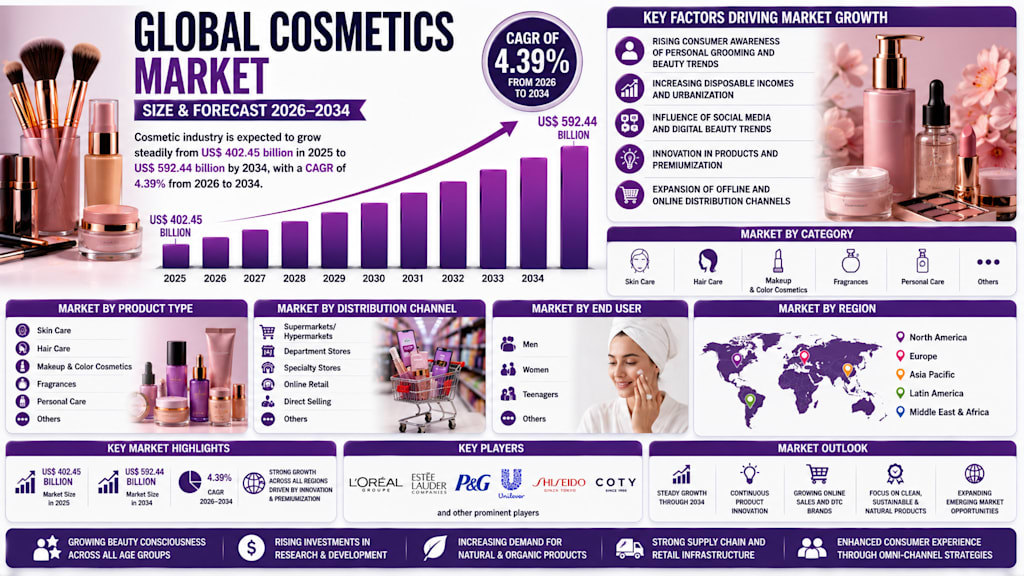
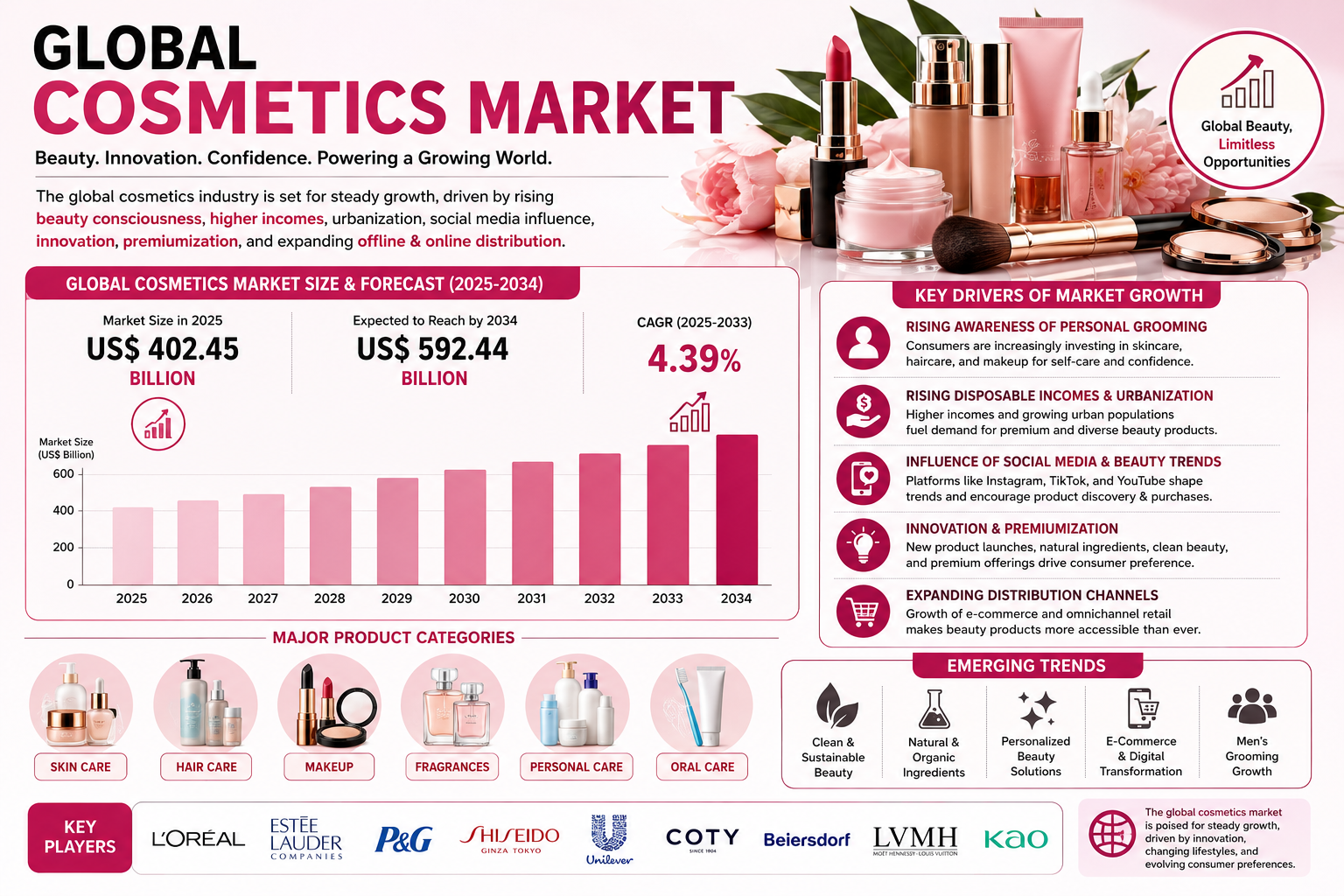
According to Renub Research, the Global Cosmetics Market is expected to grow from US$ 402.45 billion in 2025 to US$ 592.44 billion by 2034, registering a compound annual growth rate (CAGR) of 4.39% during the forecast period. Rising awareness of personal grooming, increasing consumer spending on beauty products, rapid product innovation, premiumization trends, and expanding online and offline distribution channels are among the major factors driving market growth.
As beauty and self-care continue becoming essential aspects of daily life, the cosmetics industry is expected to remain one of the most dynamic and influential consumer markets globally.
Understanding the Modern Cosmetics Industry
Cosmetics are products designed to improve, enhance, protect, and maintain the appearance and health of the skin, hair, face, and body.
The industry encompasses a broad range of products, including skincare solutions, makeup products, haircare items, fragrances, deodorants, and personal care products.
Skincare products include moisturizers, cleansers, serums, sunscreens, anti-aging creams, and treatment products designed to address various skin concerns.
Makeup products such as foundations, lipsticks, mascaras, eyeshadows, and blushes help consumers express personal style and enhance appearance.
Haircare products include shampoos, conditioners, hair masks, oils, and styling products that support hair health and appearance.
Modern cosmetics increasingly combine beauty benefits with wellness, protection, and skincare functionality.
As consumer expectations evolve, cosmetic products are becoming more sophisticated, personalized, and science-driven than ever before.
Rising Focus on Personal Grooming and Self-Care Is Driving Growth
One of the strongest drivers behind the cosmetics market is the growing consumer focus on personal grooming and self-care.
Beauty products are no longer viewed as occasional luxuries but have become part of everyday routines for millions of consumers worldwide.
Individuals increasingly invest in skincare, haircare, and personal wellness products as part of broader self-care practices.
Consumers are also becoming more aware of the effects of pollution, environmental stress, UV exposure, and aging on skin health.
This awareness has increased demand for products such as sunscreens, anti-aging treatments, moisturizers, and protective skincare solutions.
According to a 2024 Health & Beauty Survey, nearly 89% of consumers reported maintaining or increasing spending on beauty and personal care products compared to the previous year, while 94% expected spending to remain stable or increase further in the coming year.
As personal wellness and appearance continue gaining importance, demand for cosmetic products is expected to remain strong.
Social Media Has Become a Powerful Market Force
Social media has fundamentally transformed how consumers discover, evaluate, and purchase cosmetic products.
Platforms such as Instagram, TikTok, YouTube, and Facebook have created unprecedented opportunities for brands to engage directly with consumers.
Beauty influencers, content creators, and makeup artists regularly showcase new products, tutorials, reviews, and skincare routines to global audiences.
Consumers increasingly rely on influencer recommendations and user-generated content when making purchasing decisions.
Viral beauty trends can rapidly drive product demand and introduce emerging brands to millions of potential customers.
In February 2023, self-tanning brand Dolce Glow partnered with singer Miley Cyrus to strengthen brand visibility and consumer engagement through influencer-driven marketing strategies.
As digital engagement continues increasing worldwide, social media is expected to remain one of the most influential drivers of cosmetics industry growth.
Product Innovation Is Transforming Consumer Expectations
Innovation remains at the center of the cosmetics industry's continued expansion.
Consumers increasingly seek products that provide multiple benefits while addressing specific beauty and wellness needs.
Manufacturers are introducing advanced formulations featuring anti-aging properties, hydration benefits, sun protection, skin repair capabilities, and targeted treatment solutions.
Scientific advancements in dermatology, biotechnology, and ingredient research are enabling companies to develop more effective and specialized products.
Personalized beauty products designed for different skin types, tones, and concerns are becoming increasingly popular.
In September 2025, Bausch Health’s European dermatology division launched YUN Probiotherapy ACN, a skincare line featuring probiotic and prebiotic formulations designed for acne-prone skin. The launch reflects growing demand for natural and microbiome-friendly skincare alternatives.
As innovation continues accelerating, brands that successfully combine science, efficacy, and consumer appeal are likely to gain competitive advantages.
Premium Cosmetics Continue Gaining Popularity
Premiumization has emerged as one of the most important trends shaping the cosmetics industry.
Consumers increasingly associate premium products with higher quality, superior performance, advanced formulations, and enhanced brand prestige.
Many consumers are willing to pay higher prices for products that offer visible results, luxury experiences, and trusted ingredients.
Premium skincare products, luxury fragrances, high-end makeup collections, and dermatologist-developed treatments continue attracting strong consumer interest.
This trend is particularly evident among middle-income and affluent consumers who prioritize quality and brand reputation.
Premium beauty brands are also benefiting from growing interest in self-care and wellness-oriented spending.
As disposable incomes rise globally, premium cosmetics are expected to capture an increasing share of industry revenue.
Natural and Organic Beauty Products Are Reshaping the Industry
Consumer preferences are shifting toward products perceived as safer, cleaner, and more environmentally friendly.
Growing concerns regarding synthetic ingredients, chemical exposure, and environmental sustainability have fueled demand for natural and organic cosmetics.
Consumers increasingly seek products containing plant-based ingredients, botanical extracts, essential oils, and naturally derived active compounds.
Brands are responding by developing formulations free from parabens, sulfates, artificial fragrances, and harsh chemicals.
Eco-friendly packaging, cruelty-free certifications, vegan ingredients, and sustainable sourcing practices are also becoming important purchasing factors.
The natural beauty movement has encouraged both established brands and emerging companies to prioritize transparency and sustainability.
As environmental awareness continues rising, demand for clean beauty products is expected to remain strong.
Skin and Sun Care Remain the Largest Market Segment
Skin and sun care products represent one of the largest and fastest-growing categories within the global cosmetics market.
Consumers increasingly prioritize healthy skin and preventive care as part of daily beauty routines.
Popular products include moisturizers, serums, cleansers, sunscreens, anti-aging creams, and specialized treatment solutions.
Growing awareness regarding skin cancer prevention, UV protection, and environmental damage has significantly increased sunscreen usage worldwide.
Consumers also seek multifunctional products that combine skincare, hydration, sun protection, and cosmetic benefits.
Dermatologists, beauty professionals, and social media influencers continue educating consumers about the importance of skincare routines.
As interest in skin health continues growing, skin and sun care products are expected to remain a major contributor to industry growth.
Makeup and Color Cosmetics Continue Evolving
The makeup and color cosmetics segment remains a vital component of the global beauty industry.
Products such as foundations, lipsticks, mascaras, eyeshadows, blushes, and nail products continue enjoying widespread consumer demand.
Consumers increasingly use makeup as a form of self-expression and creativity rather than solely for special occasions.
Manufacturers are expanding shade ranges and developing formulations suitable for diverse skin tones and types.
Long-lasting, waterproof, skin-friendly, and multifunctional products have become increasingly popular.
The growing availability of premium and organic makeup products is also attracting health-conscious consumers.
As beauty trends continue evolving, makeup products remain an important driver of cosmetic market expansion.
Online Beauty Retail Is Revolutionizing Distribution
The rapid growth of e-commerce has significantly transformed cosmetic purchasing behavior.
Consumers now have access to thousands of beauty products through online marketplaces, brand websites, and specialized beauty platforms.
Online shopping provides convenience, product variety, customer reviews, virtual consultations, and personalized recommendations.
Social commerce and influencer marketing further encourage digital purchases by integrating product discovery directly into online content.
Subscription services, loyalty programs, and exclusive online launches are enhancing customer engagement.
Improved logistics and delivery networks have made beauty products more accessible to consumers worldwide.
As digital adoption continues increasing, online retail is expected to become an even more important distribution channel for cosmetics.
Supermarkets and Hypermarkets Continue Supporting Sales
Despite the rise of e-commerce, physical retail stores remain highly important within the cosmetics industry.
Supermarkets and hypermarkets provide consumers with opportunities to compare products, explore brands, and take advantage of promotional offers.
These retail environments offer broad product selections across multiple price points and categories.
Many consumers still prefer in-store shopping when purchasing cosmetics because they can evaluate packaging, textures, colors, and product quality firsthand.
Modern retail infrastructure continues expanding globally, particularly in emerging markets.
As a result, supermarkets and hypermarkets remain a critical component of cosmetic product distribution.
Regulatory Requirements Present Industry Challenges
The cosmetics industry faces strict regulatory oversight regarding product safety, ingredient usage, labeling, packaging, and manufacturing standards.
Governments and regulatory agencies require extensive testing and documentation to ensure consumer safety.
Compliance can significantly increase development costs and delay product launches.
Failure to meet regulatory standards may result in product recalls, legal liabilities, and reputational damage.
Consumer concerns regarding allergens, chemical ingredients, and potential side effects further increase pressure on manufacturers.
Companies must continuously invest in quality assurance, safety testing, and regulatory compliance to maintain market credibility.
Managing these requirements remains one of the industry's most significant challenges.
Intense Competition Is Driving Continuous Innovation
Competition within the cosmetics market is extremely intense.
Global corporations, regional brands, independent beauty companies, celebrity-owned brands, and digital-first startups all compete for consumer attention.
Consumers have access to an unprecedented number of product options across every category and price segment.
Brands must continuously innovate, differentiate, and invest in marketing to maintain relevance.
Price competition is particularly intense within mass-market categories, while premium brands compete through innovation, exclusivity, and customer experience.
Counterfeit products and imitation brands also pose challenges for legitimate manufacturers.
Companies that successfully combine innovation, quality, sustainability, and strong branding are most likely to thrive in this competitive environment.
Regional Market Insights
United States
The United States remains one of the world's largest cosmetics markets, supported by high consumer spending, strong brand innovation, and growing demand for natural, organic, and personalized beauty products. The launch of Maybelline New York’s Fit Me Fresh Tint foundation in 2023 reflects the trend toward multifunctional beauty solutions combining skincare and makeup benefits.
United Kingdom
The UK cosmetics market benefits from strong consumer awareness, premium beauty demand, and growing interest in vegan, cruelty-free, and environmentally sustainable products. Beauty retailers continue expanding product portfolios to address changing consumer preferences.
India
India represents one of the fastest-growing cosmetics markets globally due to rising incomes, urbanization, and increasing beauty awareness among younger consumers. Demand for herbal, Ayurvedic, and natural beauty products continues growing rapidly.
Saudi Arabia
Saudi Arabia's cosmetics market continues expanding due to rising disposable incomes, strong interest in personal grooming, growing social media influence, and demand for halal-certified beauty products. International brands continue strengthening their presence across the Kingdom.
Competitive Landscape
The global cosmetics market remains highly competitive, with leading companies investing heavily in innovation, sustainability, digital marketing, and product diversification.
Major industry participants include Coty Inc., Procter & Gamble, The Estée Lauder Companies Inc., Colgate-Palmolive Company, Johnson & Johnson Services Inc., Revlon Inc., Beiersdorf Group, Kao Corporation, LVMH, and Mary Kay Inc.
These organizations continue developing advanced skincare solutions, premium beauty products, sustainable packaging initiatives, and personalized beauty experiences to strengthen their competitive positions.
Strategic partnerships, acquisitions, and investments in emerging beauty technologies are expected to remain important drivers of future growth.
Final Thoughts
The global cosmetics market continues evolving as beauty, wellness, and self-care become increasingly integrated into everyday life. Consumers are demanding products that not only enhance appearance but also support skin health, sustainability, and personal well-being.
Social media influence, product innovation, premiumization, and the rise of natural beauty products are fundamentally reshaping consumer expectations and industry dynamics. At the same time, expanding online retail channels and growing global awareness of personal grooming continue creating new opportunities for brands worldwide.
With the market projected to grow from US$ 402.45 billion in 2025 to US$ 592.44 billion by 2034, the cosmetics industry is poised for sustained expansion. Companies that successfully combine innovation, quality, sustainability, and digital engagement will be best positioned to capitalize on the next generation of beauty consumers.
About the Creator
Enjoyed the story? Support the Creator.
Subscribe for free to receive all their stories in your feed.
Comments
There are no comments for this story
Be the first to respond and start the conversation.