
Global Cold Chain Packaging Market Set for Massive Growth as Healthcare and Food Industries Demand Better Temperature Control
Rising pharmaceutical shipments, vaccine distribution, online grocery delivery, and sustainable packaging innovations are transforming the future of cold chain logistics worldwide.

In today's interconnected world, maintaining product quality during transportation has become more important than ever. Whether it is a life-saving vaccine traveling across continents, fresh seafood being shipped internationally, or frozen meals delivered directly to consumers' doorsteps, temperature control plays a critical role in ensuring safety and product integrity.
This growing need has placed the cold chain packaging industry at the center of global supply chains. Businesses across healthcare, pharmaceuticals, food and beverage, biotechnology, and chemical industries are investing heavily in advanced packaging solutions that can preserve temperature-sensitive products throughout storage and transportation.
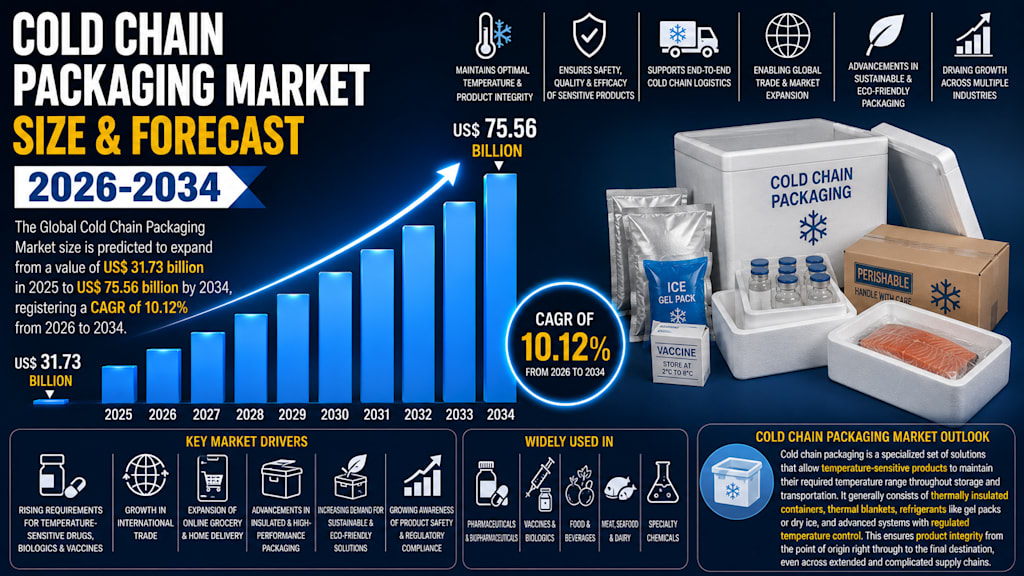
According to Renub Research, the Global Cold Chain Packaging Market is expected to grow from US$ 31.73 billion in 2025 to US$ 75.56 billion by 2034, registering a compound annual growth rate (CAGR) of 10.12% between 2026 and 2034. This impressive growth reflects the increasing importance of reliable temperature-controlled packaging across multiple industries worldwide.
As global trade expands and consumer expectations continue to evolve, cold chain packaging is rapidly becoming one of the most essential components of modern logistics.
Understanding Cold Chain Packaging
Cold chain packaging refers to specialized packaging systems designed to maintain a specific temperature range for sensitive products during transportation and storage.
Many products lose their effectiveness, freshness, or safety if exposed to temperatures outside their recommended range. To prevent this, cold chain packaging uses insulated containers, thermal blankets, refrigerants, gel packs, dry ice, phase-change materials, and advanced monitoring technologies.
These solutions help protect products such as pharmaceuticals, vaccines, biologics, fresh fruits and vegetables, dairy products, seafood, meat, frozen foods, and specialty chemicals.
The primary objective is simple: maintain product quality from the point of origin to the final destination, regardless of distance or environmental conditions.
As supply chains become increasingly globalized, the role of cold chain packaging continues to grow in importance.
Why Demand Is Rising Worldwide
Several powerful trends are driving demand for cold chain packaging solutions across international markets.
The growth of pharmaceutical manufacturing, increasing vaccine distribution, rising consumption of fresh and frozen foods, expanding e-commerce grocery services, and stricter regulatory requirements have collectively created unprecedented opportunities for the industry.
Consumers today expect products to arrive in perfect condition regardless of where they originate. This expectation has forced manufacturers and logistics providers to invest in more sophisticated temperature-controlled solutions.
At the same time, regulatory agencies around the world have strengthened quality and safety requirements for temperature-sensitive goods, creating additional demand for validated cold chain packaging systems.
The Pharmaceutical Industry Is Leading Market Growth
Perhaps the most significant driver of cold chain packaging demand is the rapid expansion of the pharmaceutical and biotechnology sectors.
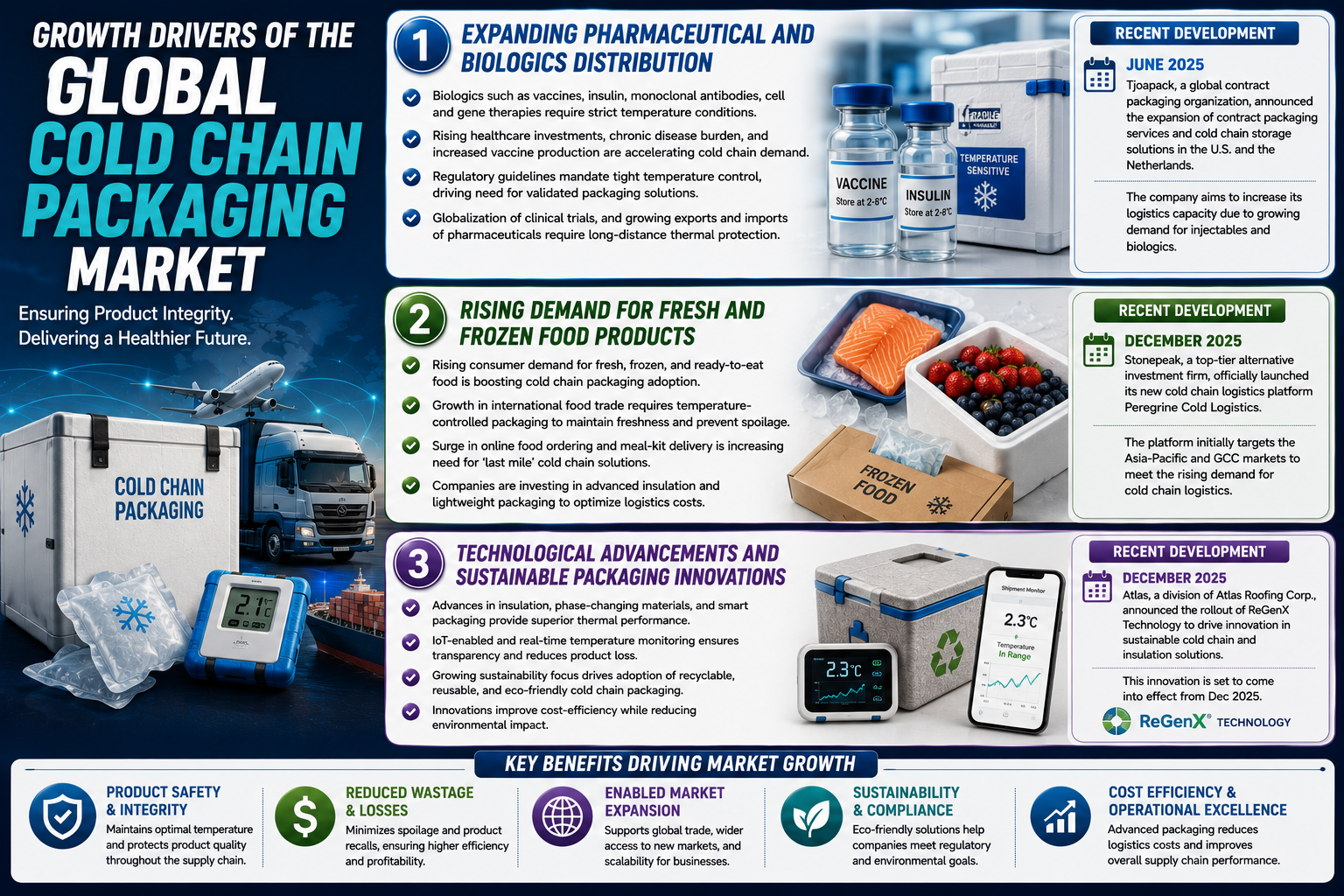
Many modern medicines require precise temperature control throughout their journey from manufacturing facilities to hospitals, pharmacies, and patients. Products such as vaccines, insulin, monoclonal antibodies, cell therapies, gene therapies, and biologics can lose effectiveness if exposed to unsuitable temperatures.
As healthcare spending continues to rise globally, pharmaceutical companies are expanding production and distribution networks to meet growing demand. This expansion requires advanced cold chain infrastructure capable of maintaining product integrity over long distances.
The COVID-19 pandemic highlighted the critical importance of temperature-controlled logistics. The worldwide distribution of vaccines demonstrated how essential cold chain packaging had become for public health systems.
Today, pharmaceutical companies continue to invest heavily in advanced insulated packaging, temperature monitoring systems, and validated transportation solutions.
Recent industry developments reflect this trend. In June 2025, Tjoapack announced the expansion of its cold chain storage and contract packaging capabilities in the United States and the Netherlands to support growing demand for injectables and biologics.
Fresh and Frozen Food Demand Is Creating New Opportunities
The food industry represents another major growth engine for the cold chain packaging market.
Changing consumer lifestyles, urbanization, and rising disposable incomes have significantly increased demand for fresh, frozen, and ready-to-eat food products.
Consumers increasingly purchase seafood, meat, dairy products, frozen meals, fruits, vegetables, and meal kits that require reliable temperature control throughout the supply chain.
International food trade has further amplified demand. Products often travel thousands of miles before reaching consumers, making effective cold chain packaging essential for preserving freshness and preventing spoilage.
Online grocery shopping has added another layer of complexity. Customers now expect fresh products delivered directly to their homes while maintaining strict quality standards.
As a result, food manufacturers and logistics providers are investing heavily in advanced insulation technologies and packaging solutions that can withstand increasingly demanding transportation requirements.
Technology Is Transforming Cold Chain Packaging
Technological innovation continues to reshape the cold chain packaging landscape.
Manufacturers are developing solutions that offer improved temperature stability, longer performance durations, reduced weight, and enhanced sustainability.
Modern cold chain packaging increasingly incorporates phase-change materials, vacuum insulation panels, advanced refrigerants, and real-time monitoring systems.
Smart packaging technologies have become particularly important. These systems provide continuous temperature tracking, allowing companies to monitor shipments throughout transit and quickly identify potential issues.
Real-time visibility not only improves product safety but also helps organizations comply with strict regulatory requirements.
Advanced sensors and connected monitoring platforms are transforming cold chain packaging from a passive protective solution into an active component of supply chain management.
Sustainability Is Becoming a Competitive Advantage
Environmental sustainability is emerging as one of the industry's most important priorities.
Traditional cold chain packaging materials have often faced criticism for generating waste and contributing to environmental concerns. As a result, manufacturers are increasingly focusing on eco-friendly alternatives that balance performance with sustainability.
Paper-based insulation systems, recyclable materials, reusable packaging solutions, and bio-based thermal technologies are gaining popularity across multiple industries.
Organizations are recognizing that sustainable packaging not only reduces environmental impact but also aligns with consumer expectations and corporate sustainability goals.
Innovation in this area continues to accelerate. Companies are developing solutions that reduce waste while maintaining the thermal performance required for sensitive products.
The growing emphasis on environmental responsibility is expected to remain a major influence on future product development.
Expanded Polystyrene Remains an Important Material
Expanded polystyrene, commonly known as EPS, continues to play a significant role in the cold chain packaging market.
Its popularity stems from excellent insulation performance, lightweight characteristics, and cost-effectiveness. EPS packaging is widely used for transporting pharmaceuticals, seafood, dairy products, and other temperature-sensitive goods.
Manufacturers appreciate its ability to maintain stable temperatures while keeping shipping costs manageable.
Although environmental concerns have encouraged exploration of alternative materials, EPS remains widely used because of its proven performance and affordability.
The challenge for the industry is balancing thermal efficiency with sustainability objectives.
Growing Adoption of Paper-Based Solutions
Paper and paperboard packaging solutions are gaining momentum as businesses pursue environmentally friendly alternatives.
These materials are often combined with insulation liners and specialized coatings to improve thermal performance while maintaining recyclability.
The food and beverage sector has become a major adopter of paper-based cold chain packaging, particularly for meal kits, produce deliveries, and last-mile logistics.
Consumers increasingly prefer packaging that aligns with environmental values, encouraging manufacturers to accelerate development of fiber-based insulation technologies.
As sustainability regulations become stricter, paper-based solutions are expected to capture a growing share of the market.
Insulated Containers Continue to Gain Importance
Insulated containers represent one of the fastest-growing segments within cold chain packaging.
These solutions are designed for high-value shipments that require exceptional temperature control over extended periods.
Advanced insulated containers often incorporate polyurethane foam, vacuum insulation panels, and phase-change materials to maximize performance.
Their applications span pharmaceuticals, biotechnology, specialty chemicals, premium food products, and international logistics operations.
Many insulated containers are reusable, providing long-term cost advantages while reducing environmental impact.
As global trade in temperature-sensitive products expands, demand for durable, high-performance insulated containers is expected to increase significantly.
Regional Markets Driving Growth
The United States remains one of the largest and most developed cold chain packaging markets globally.
Strong pharmaceutical manufacturing, extensive food logistics infrastructure, and growing demand for biologics contribute to continued expansion. Online grocery delivery services and meal-kit subscriptions further strengthen market growth.
The United Kingdom is also experiencing steady growth due to increasing pharmaceutical distribution and rising demand for fresh and frozen food products. Sustainability initiatives are particularly influential, driving adoption of recyclable and reusable packaging solutions.
India is emerging as one of the most promising markets. The country's expanding pharmaceutical industry, growing vaccine production capabilities, organized retail development, and rapidly increasing food delivery ecosystem are creating substantial opportunities for cold chain packaging providers.
Government investments aimed at reducing food waste and improving cold chain infrastructure are further supporting market expansion.
Saudi Arabia is another important growth market, driven by pharmaceutical demand, food imports, healthcare investments, and challenging climatic conditions that require advanced temperature-control solutions.
Challenges Facing the Industry
Despite strong growth prospects, the cold chain packaging market faces several important challenges.
One major obstacle is the high cost associated with advanced packaging systems. Insulated containers, monitoring technologies, refrigerants, and validation processes often increase logistics expenses compared to traditional packaging alternatives.
These costs can be particularly challenging for small and medium-sized businesses operating in price-sensitive markets.
Infrastructure limitations also remain a concern in many developing regions. Inadequate cold storage facilities, inconsistent power supplies, limited transportation networks, and shortages of trained personnel can disrupt temperature-controlled supply chains.
Operational complexity presents another challenge. Maintaining temperature consistency across multiple transportation stages requires careful coordination, monitoring, and compliance with diverse regulatory standards.
Addressing these challenges will be essential for unlocking the full potential of the global cold chain packaging market.
Looking Toward the Future
The future of cold chain packaging appears exceptionally promising.
As healthcare innovation accelerates, biologics and advanced therapies become more common, and global food supply chains continue to expand, demand for reliable temperature-controlled packaging will increase substantially.
Technological advancements will further improve efficiency, sustainability, and visibility throughout the cold chain.
Artificial intelligence, predictive analytics, real-time monitoring, reusable packaging systems, and environmentally friendly materials are expected to shape the next generation of cold chain solutions.
Organizations that successfully combine performance, compliance, sustainability, and cost efficiency will be best positioned to capitalize on emerging opportunities.
Final Thoughts
Cold chain packaging has evolved from a specialized logistics function into a critical component of modern global commerce. Whether supporting life-saving pharmaceutical shipments or ensuring fresh food reaches consumers safely, these solutions play a vital role in protecting product quality and public health.
With the market projected to grow from US$ 31.73 billion in 2025 to US$ 75.56 billion by 2034 at a CAGR of 10.12%, the industry is entering a period of significant expansion. Rising pharmaceutical demand, increasing food logistics requirements, technological innovation, and sustainability initiatives are creating powerful growth opportunities worldwide.
As global supply chains become increasingly complex and interconnected, the importance of reliable cold chain packaging will only continue to grow. The companies that invest in innovation, efficiency, and sustainability today are likely to shape the future of temperature-controlled logistics for years to come.a
About the Creator
Enjoyed the story? Support the Creator.
Subscribe for free to receive all their stories in your feed.
Comments
There are no comments for this story
Be the first to respond and start the conversation.