
Global Clinical Trials Market Accelerates as Innovation, AI, and Precision Medicine Redefine Drug Development
Rising pharmaceutical R&D investment, growing chronic disease burden, and decentralized trial technologies are pushing the clinical trials industry toward US$ 158 billion by 2034.

Clinical Trials Industry Enters a New Era of Innovation
The global clinical trials market is undergoing rapid transformation as pharmaceutical companies, biotechnology firms, and healthcare organizations intensify efforts to develop safer, faster, and more effective therapies. Clinical research has become one of the most critical pillars of modern healthcare, driving the discovery of new drugs, vaccines, medical devices, and personalized treatment solutions.
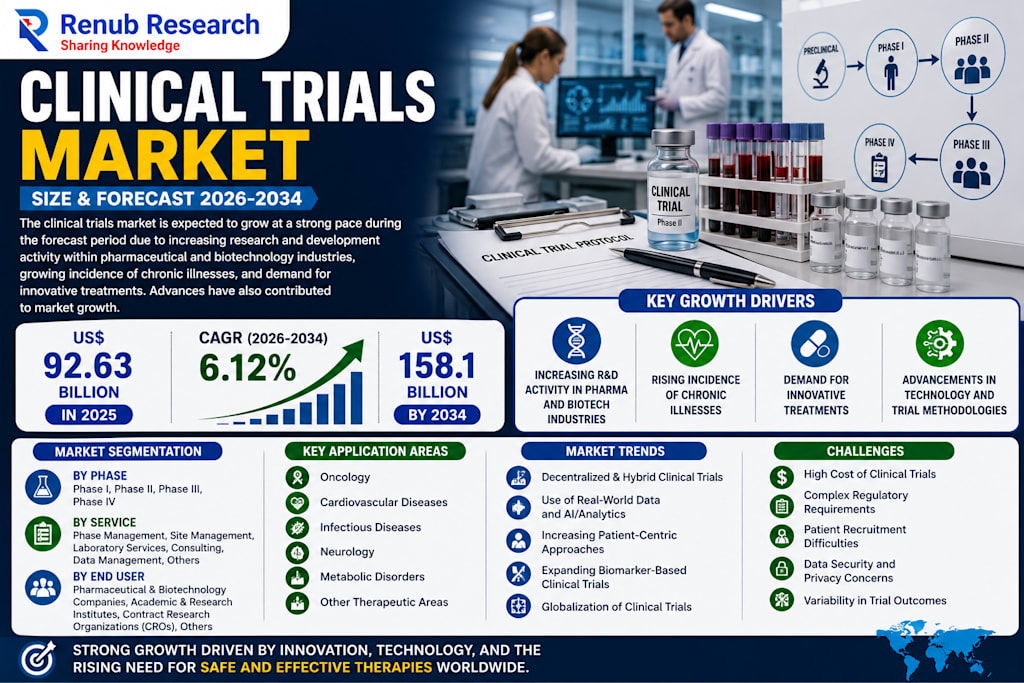
According to Renub Research, the global clinical trials market is projected to grow from US$ 92.63 billion in 2025 to US$ 158.1 billion by 2034, expanding at a compound annual growth rate (CAGR) of 6.12% during 2025–2034. The increasing prevalence of chronic diseases, rising pharmaceutical research spending, and growing adoption of advanced trial technologies are among the primary factors supporting this expansion.
Clinical trials are carefully structured research studies designed to evaluate the safety, efficacy, and effectiveness of new medical treatments in humans. These studies move through multiple phases, beginning with early-stage safety evaluations and progressing toward large-scale assessments of effectiveness and side effects. Clinical trials are essential for regulatory approval and evidence-based healthcare, making them one of the most important components of the global medical innovation system.
As healthcare increasingly shifts toward precision medicine and advanced therapies, the importance of clinical research continues to grow worldwide.
Pharmaceutical and Biotech R&D Spending Is Fueling Growth
One of the strongest drivers behind the clinical trials market is the sharp increase in research and development investment by pharmaceutical and biotechnology companies. Global drug manufacturers are aggressively investing in new therapies to address major healthcare challenges such as cancer, autoimmune disorders, neurological diseases, and rare genetic conditions.
The report notes that major pharmaceutical companies spent enormous amounts on research and development in 2024. Roche invested approximately US$ 15.8 billion, Johnson & Johnson spent around US$ 15.2 billion, and Pfizer allocated roughly US$ 13.9 billion toward R&D activities. These investments are heavily focused on high-value therapeutic areas such as oncology, immunology, and rare diseases, where innovative therapies often command premium pricing.
As competition intensifies within the pharmaceutical sector, companies are relying heavily on clinical trials to demonstrate safety and effectiveness while securing regulatory approval. The increasing complexity of modern therapies, including biologics, gene therapies, and personalized medicines, is also driving demand for specialized clinical research services.
Chronic Diseases Continue to Increase Trial Activity
The growing global burden of chronic and complex diseases is another major factor accelerating the clinical trials market. Conditions such as cancer, cardiovascular diseases, diabetes, obesity, and autoimmune disorders require continuous innovation in treatment development.
The report highlights that chronic diseases are responsible for approximately 73% of global mortalities, demonstrating the enormous healthcare burden associated with non-communicable diseases. In India alone, non-communicable diseases account for 53% of total mortalities and 44% of disability-adjusted life years lost.
An aging global population is also contributing to rising demand for clinical research. Older populations experience higher rates of chronic illnesses, increasing the need for innovative therapies and long-term disease management solutions. In parallel, emerging infectious diseases continue creating urgent demand for vaccine trials and antiviral drug development.
As healthcare systems worldwide struggle to manage growing disease burdens, clinical trials remain essential for bringing next-generation therapies to market.
Technology Is Transforming Clinical Research
Technological innovation is reshaping how clinical trials are conducted. Digital platforms, wearable devices, remote monitoring systems, and decentralized trial models are making clinical research faster, more efficient, and more patient-friendly.
Decentralized and hybrid clinical trials have become especially important because they reduce the burden on patients by allowing certain trial activities to occur remotely. This improves recruitment, increases participation rates, and expands access to more diverse patient populations.
Electronic data capture systems, artificial intelligence, and advanced analytics are also improving trial management and decision-making. These technologies help sponsors monitor patient data in real time, reduce administrative inefficiencies, and shorten development timelines.
The report highlights IQVIA’s launch of One Home for Sites™, a centralized technology platform designed to streamline clinical trial management through single-dashboard access across multiple studies. This reflects the growing emphasis on operational efficiency within the clinical research industry.
Recruitment and Diversity Remain Major Challenges
Despite significant progress, patient recruitment remains one of the biggest obstacles in clinical research. Many studies struggle to enroll enough participants because eligibility criteria are often highly restrictive. Low public awareness about clinical trials further complicates recruitment efforts.
Retention is another challenge. Clinical trials can require long-term commitments, frequent site visits, and complex procedures, making it difficult to keep participants engaged throughout the study duration. Sponsors are increasingly investing in patient-centered trial designs to improve retention and reduce participant burden.
Ensuring diversity in clinical trial populations has also become a major priority. Diverse participant groups are essential for generating results that accurately reflect broader patient populations. However, achieving this diversity adds complexity and cost to clinical trial operations.
Regulatory Complexity and Rising Costs Pressure the Industry
Clinical trials operate within highly regulated environments that vary across countries and regions. Sponsors must comply with strict ethical guidelines, patient privacy laws, and reporting requirements, which significantly increase administrative complexity.
The cost of conducting trials has also risen sharply due to growing staffing requirements, advanced technologies, site management expenses, and extended monitoring obligations. Late-stage trials are particularly expensive because they involve larger patient populations and longer follow-up periods.
Smaller biotechnology firms and emerging sponsors often face financial challenges when navigating these regulatory and operational demands. Balancing innovation with cost control remains one of the industry’s most important long-term challenges.
Phase 2 Trials Play a Critical Role
Phase 2 clinical trials represent one of the most important stages in drug development because they evaluate whether a treatment demonstrates therapeutic benefit after initial safety testing. These studies involve larger patient populations than Phase 1 trials and help determine optimal dosing strategies.
Demand for Phase 2 studies is increasing rapidly, especially in oncology and rare diseases, where pharmaceutical pipelines continue expanding. Sponsors are increasingly adopting adaptive trial designs that allow greater flexibility and more efficient decision-making during development.
Although Phase 2 trials carry high failure risk, they remain essential for identifying promising therapies before advancing into larger and more expensive late-stage studies.
Oncology Remains the Largest Segment
Oncology continues to dominate the clinical trials market due to the global rise in cancer cases and the urgent need for innovative treatments. Cancer trials account for some of the most complex and technologically advanced studies in the healthcare industry.
These trials increasingly focus on targeted therapies, immunotherapies, gene therapies, and biomarker-driven personalized treatments. Precision oncology has become a major research priority because it allows therapies to be tailored to specific genetic and molecular characteristics of individual tumors.
Government funding, patient advocacy organizations, and public-private partnerships are also helping accelerate oncology research worldwide. Despite long timelines and recruitment challenges, oncology remains one of the fastest-growing and most heavily funded clinical trial segments globally.
Obesity and Cardiovascular Trials Gain Importance
Obesity clinical trials are experiencing strong growth due to the rising global prevalence of obesity and metabolic disorders. Pharmaceutical companies are increasingly investing in weight-loss therapies and treatments targeting obesity-related conditions such as diabetes and cardiovascular disease.
Cardiovascular trials also remain critically important because heart disease continues to be one of the leading causes of death worldwide. The growing focus on metabolic health, preventive care, and chronic disease management is expected to keep both obesity and cardiovascular research highly active over the forecast period.
Observational Studies Gain Strategic Value
The observational clinical trials segment is becoming increasingly important as regulators and healthcare providers seek more real-world evidence. Unlike interventional studies, observational research examines patient outcomes without introducing specific treatment interventions.
These studies help researchers better understand disease progression, treatment effectiveness, and patient behavior in real-world settings. They are also widely used for post-marketing surveillance and healthcare decision-making.
As healthcare data availability increases through electronic health records and digital health platforms, observational studies are expected to play an even larger role in future medical research.
United States Leads the Global Market
The United States remains the largest clinical trials market globally due to its advanced healthcare infrastructure, strong pharmaceutical industry, and extensive research ecosystem. The country hosts a large concentration of academic medical centers, contract research organizations, and biotechnology companies.
The U.S. also leads in the adoption of decentralized trials, AI-driven analytics, and digital health technologies. Government funding and private investment continue supporting innovation across multiple therapeutic areas.
The report highlights a strategic collaboration between Guardant Health and Trial Library to improve access to oncology clinical trials across the United States, reflecting growing interest in AI-supported patient recruitment and precision medicine.
Emerging Markets Continue to Expand
The United Kingdom remains attractive for clinical research because of its centralized healthcare system and strong academic infrastructure. Regulatory reforms and increasing adoption of genomics are helping strengthen the UK’s global research position.
India is rapidly becoming a major clinical trial destination due to cost advantages, a large and diverse patient population, and improving regulatory transparency. The country’s expanding research infrastructure and skilled workforce are helping attract global sponsors.
Saudi Arabia is also emerging as a promising market under Vision 2030, with investments in research hospitals, academic institutions, and healthcare modernization initiatives supporting future trial growth.
Competitive Landscape
The global clinical trials market includes major organizations such as ICON Plc, Wuxi AppTec, SGS SA, Syneos Health, PRA Health Sciences, Pfizer, IQVIA, Sanofi, and Medpace.
These companies compete through advanced technology integration, decentralized trial models, global patient recruitment capabilities, and specialized therapeutic expertise. As clinical research becomes increasingly data-driven and patient-centric, competition within the industry is expected to intensify further.
Final Thoughts
The clinical trials market is entering a transformative period shaped by artificial intelligence, digital health technologies, personalized medicine, and rising global healthcare demand. As pharmaceutical companies accelerate innovation and healthcare systems seek more effective therapies, clinical research is becoming more important than ever before.
With the market projected to grow from US$ 92.63 billion in 2025 to US$ 158.1 billion by 2034, the future of the clinical trials industry looks exceptionally strong. Organizations that successfully combine technology, regulatory expertise, patient engagement, and scientific innovation will likely lead the next generation of global healthcare breakthroughs.
About the Creator
Enjoyed the story? Support the Creator.
Subscribe for free to receive all their stories in your feed.
Comments
There are no comments for this story
Be the first to respond and start the conversation.