
Global Chicken Market Outlook 2026–2034: Affordable Protein Demand Keeps Poultry Industry Expanding
Rising global protein consumption, fast-food expansion, and changing dietary habits are driving sustained growth in the worldwide chicken market.

Global Chicken Market Overview
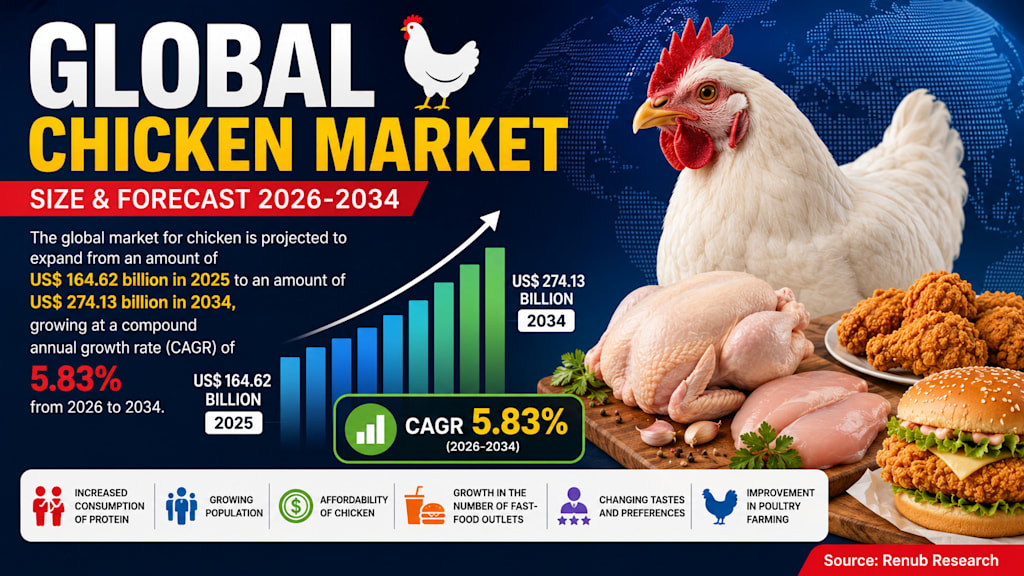
The global chicken market is on a steady long-term growth path as consumers continue to prioritize affordable, versatile, and protein-rich food options. According to the market data provided, the market is projected to rise from US$ 164.62 billion in 2025 to US$ 274.13 billion by 2034, growing at a 5.83% CAGR from 2026 to 2034. This growth is being supported by higher protein consumption, population expansion, the affordability of chicken versus other meat sources, and the continued rise of fast-food and quick-service dining.
Chicken remains one of the most consumed meats in the world because it is relatively low in fat, high in protein, and easy to prepare in many different cuisines. It can be grilled, roasted, fried, boiled, baked, or processed into value-added products, which makes it suitable for households, restaurants, and industrial food manufacturers alike.
A major advantage for chicken is that it faces fewer cultural and religious barriers than many other protein sources. It is also widely seen as a healthier alternative to red meat, which has helped it gain popularity among health-conscious consumers and fitness-focused households.
Affordable Protein Demand Is Driving Consumption
One of the strongest forces behind chicken market growth is the global demand for affordable protein. In many countries, chicken is the cheapest widely available animal protein, making it a practical choice for households, food-service operators, and institutional buyers.
The report highlights urbanization as an important demand driver, especially in Asia. The region accounts for 54% of the world’s urban population, and its urban population is expected to increase significantly by 2050. As cities expand and incomes rise, consumers often shift toward convenient, protein-rich foods, which increases chicken consumption.
Compared with beef and lamb, chicken is cheaper to produce and usually cheaper to buy. Its shorter production cycle allows producers to respond more quickly to demand changes, which also helps stabilize supply. Governments and nutrition organizations are increasingly encouraging protein-rich diets, and chicken remains one of the easiest proteins to scale at affordable prices.
Fast-Food and QSR Expansion Continues to Lift Demand
The rapid growth of quick-service restaurants and fast-food chains is another major factor supporting the chicken market. Chicken products such as fried chicken, sandwiches, nuggets, wings, and wraps have become standard menu items across global food brands.
Chicken works especially well in fast-food formats because it is adaptable, familiar, and cost-efficient. The rise of food delivery has strengthened this trend by making chicken-based meals more accessible to urban consumers who want speed and convenience.
The report notes that McDonald’s introduced the CosMc’s concept in December 2023 as part of its broader restaurant innovation strategy. While the concept is not a chicken-specific launch, it reflects how major food-service brands continue diversifying to capture changing consumer demand and traffic patterns.
As consumer lifestyles become busier, ready-to-eat and ready-to-cook chicken products are becoming more important in both retail and food-service channels. That trend is likely to continue supporting market expansion over the forecast period.
Health Perception Is Strengthening Chicken’s Position
Another reason chicken continues to outperform many other meat categories is its strong health image. Consumers increasingly associate chicken with lean protein, lower saturated fat, and balanced nutrition.
Chicken is often part of high-protein, weight-management, and fitness-focused diets. It is also widely used in meal plans that emphasize better nutritional balance and reduced red-meat intake.
The report also points out that safety and quality standards have improved thanks to better poultry farming, processing systems, and cold-chain logistics. Those improvements have strengthened consumer confidence in chicken as a regular household protein choice.
In November 2025, Maple Leaf Foods introduced Maple Leaf Mighty Protein, a new chicken protein stick range made with simple ingredients. The launch reflects the growing demand for convenient, protein-forward snack products that fit modern health and wellness trends.
Disease Outbreaks Remain a Major Industry Risk
Despite its strong growth outlook, the chicken market remains exposed to disease risk, especially avian influenza and other poultry-related outbreaks. These events can force mass culling, trade restrictions, and temporary drops in consumer confidence.
Because poultry trade is global, disease outbreaks can spread quickly through supply networks and trigger import bans from major buyers. Smaller producers are often the most vulnerable because they may lack the resources for large-scale biosecurity systems.
Maintaining disease surveillance, vaccination protocols, and strong farm-level hygiene is therefore essential for keeping the market stable. Biosecurity is no longer just an operational issue; it is a central competitive advantage.
Feed Costs and Supply Chain Pressure Remain a Challenge
Feed prices are another major pressure point for chicken producers. Since feed is one of the largest cost components in poultry production, changes in corn and soybean meal prices can quickly affect margins and retail pricing.
Weather conditions, crop yields, transportation issues, and geopolitical tensions all affect feed markets. When feed costs rise sharply, chicken producers often face margin squeeze, and some of that cost can eventually pass through to consumers.
To manage this risk, producers are investing in better feed management, efficiency improvements, and supply-chain planning. Modern poultry systems increasingly rely on technology, data, and improved breeding performance to keep unit costs under control.
The United States Remains a Global Poultry Leader
The United States remains one of the most efficient chicken production markets in the world. The country benefits from large-scale poultry farming, strong domestic demand, advanced feed systems, and a highly developed distribution network.
The report states that the U.S. had more than 514 million chickens on farms as of December 2024, while chicken consumption rebounded in 2025. Those numbers underline the scale and importance of poultry in the American food system.
Technology has improved breeding, feeding, disease control, and processing efficiency across the U.S. poultry sector. The country also remains a key exporter of chicken products to global markets.
At the same time, the U.S. industry still faces pressure from feed price volatility, sustainability expectations, and animal welfare concerns. Even so, the domestic market remains one of the strongest and most influential in global poultry.
China and Europe Are Shaping Demand Patterns
China’s chicken consumption market continues to grow as rising incomes, urbanization, and changing diets increase protein demand. Chicken remains attractive because it is relatively affordable and fits modern convenience-focused eating habits.
The report notes that chicken consumption in China increased from 4 kilograms per person in 1962 to about 70 kilograms per person in 2022, showing how dramatically demand has expanded over time.
In the European Union, chicken consumption is also stable and gradually increasing as consumers seek healthier meat options. The report says EU poultry meat consumption is expected to reach 24.6 kg per capita by 2030, reflecting the strength of poultry within the regional diet mix.
Europe’s market is also shaped by organic, free-range, and sustainability-driven purchasing patterns, which are supporting premium product growth in retail and food service.
Saudi Arabia and Brazil Are Important Trade Markets
Saudi Arabia is a major poultry importer and plays a significant role in global chicken trade. The report says it ranked as the 8th largest importer of poultry meat in 2024, driven by population growth, rising incomes, and food-service demand.
Because domestic production does not fully meet demand, Saudi Arabia depends heavily on imports from key exporting countries. Trade policy, global prices, and supply-chain disruptions can all affect import volumes.
Brazil remains one of the largest chicken exporters in the world due to its low-cost production base and strong agricultural sector. According to the report, Brazil exported 5.294 million metric tons of chicken products in 2024, a record high and a 3% increase from 2023.
Recent Reuters reporting shows how trade flows have been affected by avian influenza and diplomatic reopening. Brazil declared itself free of bird flu on commercial flocks in June 2025, China lifted its poultry import ban in November 2025, and the EU recognized Brazil as bird-flu free in September 2025, allowing exports to resume.
Recent Developments from Leading Companies
Tyson Foods raised its 2025 sales forecast in February 2025 after stronger chicken and beef demand improved first-quarter results.
Tyson Foods raised its annual revenue forecast again in August 2025 as resilient chicken demand lifted poultry margins and offset beef weakness.
Pilgrim’s Pride agreed to pay $41.5 million in January 2025 to settle a securities class action tied to competition allegations in the chicken industry.
JBS announced a $70 million investment in Paraguay in October 2025, including the acquisition and expansion of a chicken processing plant.
BRF reported record annual results in February 2025, supported by strong domestic and international chicken demand and 84 new export authorizations in 2024.
BRF posted strong Q2 2025 results in August 2025 despite bird-flu trade disruptions, helped by domestic sales and alternative export destinations.
Brazil confirmed its first bird flu outbreak on a commercial poultry farm in May 2025, triggering trade bans from major buyers and short-term disruption across the chicken trade.
Saudi Arabia resumed poultry imports from Brazil in August 2025, helping restore an important export channel after the bird-flu disruption.
Thailand’s poultry industry was expected to grow in 2025 as lower feed costs and bird-flu-related trade shifts in Brazil created export opportunities.
Rainbow Chicken in South Africa reported a sharp profit jump in March 2025 as the company recovered from earlier bird flu pressure and reinvested in infrastructure expansion.
Outlook for 2026–2034
The global chicken market should remain one of the most dependable food categories over the next decade because demand is supported by affordability, protein consumption, convenience, and changing dietary habits. The projected rise from US$ 164.62 billion in 2025 to US$ 274.13 billion by 2034 reflects a market with strong structural demand rather than short-term momentum alone.
Processed chicken, frozen products, premium poultry, and value-added ready meals are likely to be especially important growth categories as consumers continue seeking convenience and nutrition together. Food-service channels, retail expansion, and export trade will also remain key market pillars.
At the same time, producers will need to keep managing disease risk, feed costs, sustainability requirements, and trade disruptions. The strongest companies are likely to be those that combine scale with flexibility and maintain strong biosecurity and supply-chain resilience.
Final Thoughts
Chicken continues to stand out as one of the world’s most commercially important protein sources because it is affordable, widely accepted, and easy to adapt across cultures and cuisines. Its position in fast food, retail, and home cooking gives the market a broad and durable demand base.
The next phase of growth will likely come from value-added poultry products, stronger trade flows, and continued efficiency gains in farming and processing. Even with disease and feed-cost challenges, the global chicken market remains well positioned for steady expansion through 2034.
About the Creator
Enjoyed the story? Support the Creator.
Subscribe for free to receive all their stories in your feed.
Comments
There are no comments for this story
Be the first to respond and start the conversation.