
Global Cancer Immunotherapy Market Surges as Precision Oncology, Clinical Innovation, and Next-Generation Therapies Transform Cancer Care
Rapid advances in checkpoint inhibitors, monoclonal antibodies, CAR-T therapies, and personalized oncology are driving strong growth across the global cancer immunotherapy industry.

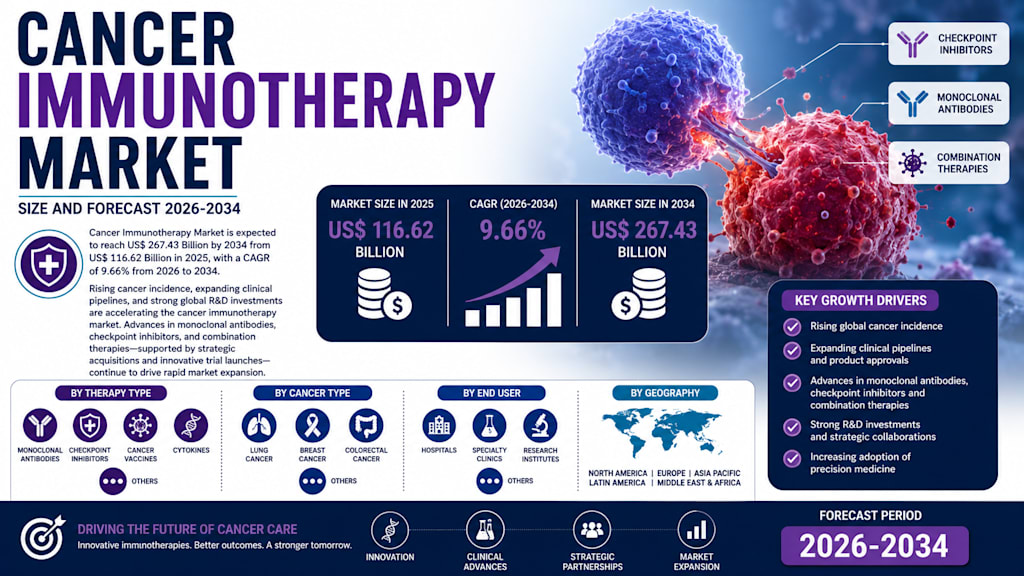
Global cancer immunotherapy market enters a transformative growth phase
The global cancer immunotherapy market is entering one of the most dynamic periods in modern oncology as biotechnology companies, pharmaceutical giants, and healthcare institutions accelerate investment in immune-based cancer treatments. According to the latest industry analysis, the Cancer Immunotherapy Market is projected to grow from US$ 116.62 billion in 2025 to US$ 267.43 billion by 2034, registering a CAGR of 9.66% from 2026 to 2034.
This expansion reflects a major shift in cancer treatment strategies worldwide. Instead of relying solely on chemotherapy, radiation, or surgery, healthcare providers are increasingly using therapies that stimulate the body’s immune system to identify and destroy cancer cells more effectively.
Advances in monoclonal antibodies, checkpoint inhibitors, cancer vaccines, immune modulators, and CAR-T cell therapies are dramatically improving long-term survival rates for many cancer patients. Combined with precision medicine tools, biomarker testing, and AI-supported drug development, immunotherapy is rapidly becoming one of the most important pillars of modern cancer care.
What makes cancer immunotherapy different from traditional treatment?
Cancer immunotherapy works by strengthening or modifying the immune system so it can better recognize and attack cancer cells. Unlike chemotherapy, which directly targets rapidly dividing cells, immunotherapy enhances the body’s natural defense mechanisms against tumors.
Several major immunotherapy categories are driving the market:
- Checkpoint inhibitors
- Monoclonal antibodies
- CAR-T cell therapies
- Cancer vaccines
- Cytokine therapies
- Immune modulators
These treatments can produce durable responses and often generate fewer side effects than conventional cancer therapies. In some cases, immune memory may even help prevent disease recurrence after treatment.
The growing effectiveness of personalized oncology and biomarker-guided therapies is also helping physicians identify which patients are most likely to respond successfully to immunotherapy.
Rising global cancer burden continues to accelerate demand
One of the strongest drivers behind market growth is the rising global incidence of cancer. Aging populations, changing lifestyles, environmental factors, and increasing diagnostic capabilities are contributing to higher cancer detection rates worldwide.
Healthcare systems are therefore under increasing pressure to provide more effective and targeted cancer therapies. Immunotherapy has emerged as a preferred option in many oncology settings because it can significantly improve survival outcomes across multiple tumor types.
Growing awareness among physicians and patients regarding the long-term benefits of immunotherapy is also accelerating adoption. As more clinical evidence demonstrates positive outcomes in lung cancer, melanoma, breast cancer, colorectal cancer, and hematologic malignancies, immunotherapy use continues expanding globally.
Precision oncology is reshaping treatment strategies
Precision oncology is becoming one of the most important forces transforming the cancer immunotherapy market. Modern cancer care increasingly relies on genomic profiling, biomarker testing, liquid biopsies, and AI-driven analytics to match therapies with individual patient characteristics.
This personalized approach improves treatment effectiveness while reducing unnecessary toxicity and failed therapies. Immunotherapy is particularly well-suited to precision medicine because patient immune responses can vary significantly depending on genetic and tumor-specific factors.
The report highlights an important January 2025 development in which Kazia Therapeutics launched the ABC-Pax trial in Australia to evaluate paxalisib combined with immunotherapy in advanced triple-negative breast cancer using liquid biopsy monitoring.
Such developments illustrate how biomarker-guided treatment models are becoming central to next-generation cancer care.
Combination therapies are becoming increasingly important
Combination immunotherapy approaches are rapidly reshaping the oncology landscape. Researchers increasingly pair immunotherapies with chemotherapy, radiation therapy, targeted drugs, and additional immune modulators to improve treatment response rates and overcome resistance mechanisms.
These strategies are particularly valuable in difficult-to-treat cancers where single-agent therapies may provide limited benefit.
The report highlights several important examples:
AstraZeneca reported strong Phase III ADRIATIC study results in July 2024 showing that Imfinzi (durvalumab) improved overall survival and progression-free survival in limited-stage small cell lung cancer after chemoradiotherapy.
Amgen announced promising Phase 1b trial findings in September 2024 for IMDELLTRA (tarlatamab-dlle) combined with PD-L1 inhibitors in extensive-stage small cell lung cancer.
These studies demonstrate how combination strategies are improving disease control and expanding treatment possibilities across oncology.
Expanding oncology pipelines are driving innovation
The immunotherapy pipeline is expanding rapidly as pharmaceutical and biotechnology companies intensify research into next-generation immune-based treatments. Companies are investing heavily in monoclonal antibodies, bispecific antibodies, engineered cell therapies, immune modulators, and novel checkpoint inhibitors.
Strategic acquisitions are also strengthening innovation capabilities throughout the industry. The report notes that Innova Therapeutics completed the acquisition of Enci Therapeutics in November 2025 to advance IVT-8086, a first-in-class humanized monoclonal antibody targeting SFRP2.
At the same time, AI-supported drug discovery and advanced translational research are helping accelerate candidate identification and clinical trial efficiency.
These developments are creating one of the most active oncology research environments in pharmaceutical history.
Regulatory approvals continue supporting global expansion
Frequent regulatory approvals are helping accelerate global immunotherapy adoption. As more therapies demonstrate meaningful survival benefits in clinical trials, regulatory agencies are approving additional indications across multiple cancer types.
In October 2024, the U.S. FDA approved Opdivo (nivolumab) for perioperative treatment of resectable non-small-cell lung cancer following the CheckMate-77T trial, which showed a 42% reduction in disease recurrence, progression, or death.
The report also highlights June 2025 developments where Glenmark Pharmaceuticals launched Tevimbra (tislelizumab) in India for non-small-cell lung cancer and esophageal cancer following regulatory approval.
These approvals are expanding patient access while strengthening physician confidence in immunotherapy-based treatment protocols.
Emerging markets are becoming increasingly important
Emerging economies are rapidly becoming key growth regions for cancer immunotherapy companies. Countries across Asia-Pacific, Latin America, and the Middle East are improving oncology infrastructure, increasing healthcare investments, and expanding access to advanced biologics.
Governments are also supporting faster approval pathways, insurance expansion, and biotechnology investment initiatives designed to improve cancer treatment accessibility.
In May 2025, ImmunityBio finalized an agreement with healthcare authorities in Saudi Arabia to introduce its IL-15 superagonist Cancer BioShield platform across the Middle East.
Such partnerships demonstrate how global pharmaceutical companies are increasingly targeting underserved oncology markets with advanced immunotherapy solutions.
Monoclonal antibodies remain foundational to the market
Monoclonal antibodies continue to represent one of the most important segments within cancer immunotherapy. Their ability to specifically target tumor-associated pathways while modulating immune responses makes them highly effective across multiple cancer types.
Pharmaceutical companies are heavily investing in next-generation monoclonal antibody technologies, including:
- Bispecific antibodies
- Antibody-drug conjugates
- Immune checkpoint modulators
- Tumor-targeting biologics
The increasing number of regulatory approvals and expanded reimbursement support is accelerating global adoption of monoclonal antibody therapies.
Lung cancer remains a dominant application area
Lung cancer continues to represent one of the largest and fastest-growing immunotherapy application segments. The widespread adoption of PD-1 and PD-L1 inhibitors is reshaping treatment guidelines for non-small-cell lung cancer worldwide.
Combination therapies, biomarker-driven patient selection, and personalized treatment approaches are significantly improving survival outcomes in advanced lung cancer settings.
As countries expand cancer screening programs and precision oncology infrastructure, demand for advanced lung cancer immunotherapies is expected to continue rising steadily.
Cancer research centers are driving scientific progress
Cancer research centers worldwide are playing an increasingly important role in advancing immunotherapy innovation. Institutions are investing heavily in genomic research platforms, translational laboratories, AI-driven analytics, and clinical trial infrastructure.
Collaborations between research institutes and biotechnology companies are accelerating development of next-generation vaccines, engineered cell therapies, and novel immune-modulating treatments.
Growing funding support from governments, private foundations, and global healthcare organizations is strengthening global immuno-oncology research ecosystems.
High treatment costs remain a major challenge
Despite remarkable therapeutic progress, immunotherapy remains among the most expensive forms of cancer treatment globally. Complex manufacturing processes, advanced biologics production, and specialized treatment infrastructure contribute to very high therapy costs.
Checkpoint inhibitors, CAR-T therapies, and monoclonal antibodies can place significant financial pressure on healthcare systems, insurers, and patients alike.
Access challenges are particularly severe in low- and middle-income countries where reimbursement systems and oncology infrastructure remain limited.
Without broader insurance support, improved pricing strategies, and expanded healthcare infrastructure, treatment accessibility disparities may continue limiting global adoption.
Biological complexity continues to affect treatment outcomes
Cancer immunotherapy also faces scientific and clinical challenges related to unpredictable patient responses. Tumor heterogeneity, immune evasion mechanisms, and genetic variability can significantly influence treatment effectiveness.
Some patients experience dramatic responses while others show minimal benefit or develop resistance over time. Immune-related side effects such as inflammation and autoimmune reactions can also complicate treatment management.
Researchers continue working to improve biomarker identification, optimize dosing strategies, and better understand tumor-immune interactions to improve consistency and expand patient eligibility.
United States remains the global market leader
The United States continues leading the global cancer immunotherapy market due to strong R&D investment, advanced oncology infrastructure, and rapid regulatory approvals.
Large-scale clinical trial activity, AI-supported drug discovery, and precision oncology initiatives are strengthening the country’s leadership position.
The FDA’s approval of Opdivo in October 2024 for perioperative treatment of resectable NSCLC further highlights the country’s strong regulatory and innovation environment.
Germany strengthens Europe’s immunotherapy innovation ecosystem
Germany remains one of Europe’s leading immunotherapy markets because of its advanced healthcare system, strong biotechnology sector, and active academic research environment.
The report highlights a December 2023 collaboration between BioMed X and Ono Pharmaceutical focused on next-generation immunotherapies leveraging neutrophil-based antitumor mechanisms.
Comprehensive insurance coverage and strong precision oncology infrastructure continue supporting rapid therapy adoption.
India emerges as a major future growth market
India’s cancer immunotherapy market is growing rapidly because of rising cancer incidence, expanding hospital infrastructure, and improving access to advanced biologics.
Regulatory support, increasing healthcare spending, and expanding insurance coverage are helping accelerate market penetration across urban and semi-urban regions.
The report notes that Dr. Reddy’s Laboratories introduced Zytrovi in November 2024 for metastatic nasopharyngeal carcinoma, strengthening India’s oncology treatment portfolio.
Key companies continue intensifying competition
The competitive landscape includes several major pharmaceutical and biotechnology companies investing heavily in oncology pipelines, precision medicine, and immune-based therapies. Key players include:
- Amgen Inc.
- AstraZeneca
- Bayer AG
- Bristol-Myers Squibb Company
- Pfizer Inc.
- Novartis AG
- Johnson & Johnson
- Eli Lilly Company
- Seattle Genetics Inc.
Ten major developments shaping the cancer immunotherapy market
- BioNTech announced progress on BNT327 and plans for approximately 20 Phase 2/3 trials by 2026.
- ImmunityBio expanded Cancer BioShield platform access across the Middle East.
- Amgen reported promising IMDELLTRA Phase 1b trial results in lung cancer.
- AstraZeneca demonstrated survival benefits for Imfinzi in small cell lung cancer.
- Oxford University Hospitals initiated an mRNA-based therapeutic cancer vaccine trial.
- Glenmark launched Tevimbra in India for NSCLC and esophageal cancer.
- Kazia Therapeutics launched the ABC-Pax precision oncology trial.
- FDA approved Opdivo for perioperative NSCLC treatment.
- BioMed X partnered with Ono Pharmaceutical on next-generation immunotherapies.
- Dr. Reddy’s introduced Zytrovi for metastatic nasopharyngeal carcinoma in India.
Final thoughts
The global cancer immunotherapy market is entering a transformative era fueled by scientific innovation, precision medicine, and rapidly expanding clinical success. Immunotherapy is no longer a niche oncology segment—it is becoming a central pillar of modern cancer treatment worldwide.
With the market projected to grow from US$ 116.62 billion in 2025 to US$ 267.43 billion by 2034, competition among pharmaceutical and biotechnology companies is expected to intensify around next-generation biologics, combination therapies, and personalized treatment strategies. The organizations capable of improving accessibility, treatment precision, and long-term patient outcomes are likely to define the future of global oncology care.
About the Creator
Enjoyed the story? Support the Creator.
Subscribe for free to receive all their stories in your feed.
Comments
There are no comments for this story
Be the first to respond and start the conversation.