
Global Biodegradable Plastic Market to Reach US$27.11 Billion by 2034 as Sustainability and Circular Economy Initiatives Accelerate Adoption
Growing environmental awareness, stringent regulations on single-use plastics, technological advancements in biopolymers, and rising demand for sustainable packaging are driving remarkable growth in the global biodegradable plastic market.

Biodegradable Plastics Are Redefining the Future of Sustainable Materials
Plastic pollution has become one of the world's most pressing environmental challenges, with billions of tons of plastic waste accumulating in landfills, rivers, and oceans every year. Growing concerns about environmental degradation, climate change, and waste management have encouraged governments, businesses, and consumers to seek more sustainable alternatives to conventional petroleum-based plastics.
Among the most promising solutions are biodegradable plastics, which are designed to naturally decompose under appropriate environmental conditions while reducing long-term ecological impact. Produced from renewable resources such as corn starch, sugarcane, cellulose, and other bio-based materials, biodegradable plastics are increasingly being adopted across packaging, agriculture, healthcare, retail, and consumer goods industries.
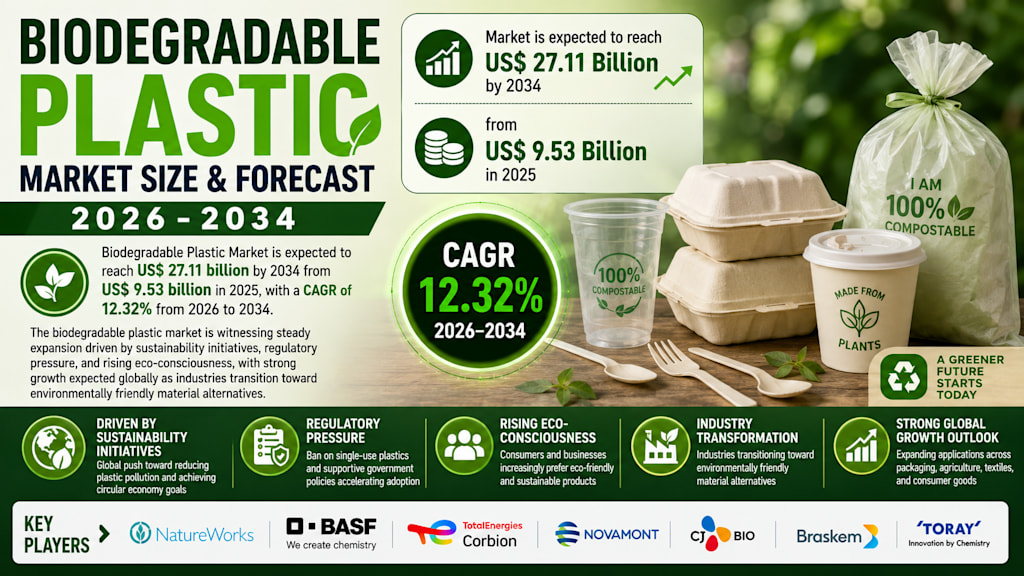
According to the latest market outlook, the Global Biodegradable Plastic Market is projected to grow from US$9.53 billion in 2025 to US$27.11 billion by 2034, registering a compound annual growth rate (CAGR) of 12.32% during 2026–2034. Sustainability initiatives, tightening environmental regulations, technological innovation, and growing consumer preference for eco-friendly products continue driving long-term market expansion.

Biodegradable Plastics Offer a Sustainable Alternative
Biodegradable plastics are specially engineered materials capable of breaking down naturally into water, carbon dioxide, biomass, and other environmentally safe substances through the action of microorganisms.
Unlike conventional plastics that may persist in the environment for centuries, biodegradable plastics significantly reduce long-term waste accumulation when disposed of under appropriate composting conditions.
These materials are commonly produced using renewable feedstocks including corn starch, sugarcane, potato starch, cellulose, and microbial fermentation products.
Today they are widely used in food packaging, agricultural films, disposable tableware, medical products, shopping bags, and consumer goods.
Environmental Regulations Continue Driving Market Growth
One of the strongest drivers of the biodegradable plastic market is the implementation of increasingly stringent environmental regulations.
Governments around the world are introducing restrictions and outright bans on single-use plastics while encouraging industries to transition toward sustainable material alternatives.
Policies promoting circular economy principles, carbon reduction, waste management, and extended producer responsibility are accelerating adoption across multiple industries.
Financial incentives, subsidies, and sustainability targets further encourage manufacturers to invest in biodegradable plastic technologies.
As environmental regulations continue tightening globally, demand for biodegradable materials is expected to increase steadily.
Consumer Awareness Is Reshaping Purchasing Decisions
Growing public awareness regarding plastic pollution has significantly influenced consumer behavior.
Modern consumers increasingly prefer products packaged using environmentally friendly materials that reduce waste and support sustainability.
Food manufacturers, retailers, cosmetics companies, and consumer goods brands are responding by replacing traditional plastic packaging with biodegradable alternatives.
Social media campaigns, environmental education, and corporate sustainability initiatives continue strengthening public support for eco-friendly packaging.
This shift in consumer preferences remains one of the industry's most powerful long-term growth drivers.
Packaging Industry Leads Market Expansion
Packaging remains the largest application segment within the biodegradable plastic market.
Food and beverage companies, e-commerce businesses, retailers, and consumer goods manufacturers increasingly adopt biodegradable packaging to reduce environmental impact while complying with evolving regulations.
Flexible packaging, shopping bags, food containers, disposable cutlery, films, and compostable packaging materials continue experiencing strong demand.
Rapid growth in online retail has further increased the need for sustainable packaging solutions capable of reducing plastic waste throughout supply chains.
Advances in Biopolymer Technology Improve Performance
Continuous research and development have significantly enhanced the quality and versatility of biodegradable plastics.
Modern biopolymers now provide improved mechanical strength, thermal stability, flexibility, and durability that allow them to compete more effectively with conventional plastics.
Innovative materials including polylactic acid (PLA), polyhydroxyalkanoates (PHA), polybutylene adipate terephthalate (PBAT), and starch-based blends continue expanding commercial applications.
Improved production technologies are also helping reduce manufacturing costs while increasing scalability.
These technological advances continue strengthening market competitiveness.
Circular Economy Initiatives Encourage Adoption
Circular economy principles have become central to global sustainability strategies.
Governments and businesses increasingly emphasize responsible resource utilization, waste reduction, recycling, composting, and renewable materials throughout product lifecycles.
Biodegradable plastics contribute directly to these objectives by reducing long-term waste accumulation while supporting environmentally responsible production systems.
Corporate sustainability commitments and environmental reporting standards further encourage adoption across numerous industries.
PLA Continues Leading Material Demand
Polylactic Acid (PLA) remains one of the most widely used biodegradable polymers.
Produced primarily from renewable agricultural resources such as corn starch and sugarcane, PLA offers excellent transparency, processability, and compostability.
It is extensively used in food packaging, disposable cups, trays, containers, films, and consumer products.
Ongoing improvements in PLA manufacturing continue expanding its application across increasingly demanding industrial sectors.
Agriculture Continues Expanding Applications
Agriculture represents another rapidly growing application for biodegradable plastics.
Biodegradable mulch films, seed coatings, plant pots, irrigation components, and compostable agricultural materials help reduce plastic waste while improving farming sustainability.
Unlike conventional agricultural plastics that require removal after use, biodegradable materials naturally decompose under appropriate environmental conditions.
Growing interest in environmentally responsible farming continues supporting expansion of this application segment.
Healthcare Creates New Opportunities
The healthcare industry is increasingly utilizing biodegradable plastics for medical devices, drug delivery systems, surgical materials, sutures, and disposable healthcare products.
Biodegradable polymers offer excellent biocompatibility while reducing long-term environmental impact associated with medical waste.
Continuous advances in biomaterials continue expanding opportunities for biodegradable plastics within medical technology and pharmaceutical applications.
High Production Costs Remain a Challenge
Despite impressive growth prospects, biodegradable plastics remain more expensive than conventional petroleum-based plastics.
Production requires renewable raw materials, specialized processing technologies, and advanced manufacturing techniques that increase overall costs.
Limited economies of scale and relatively smaller production volumes further contribute to higher prices.
Cost-sensitive industries may therefore delay adoption despite growing environmental awareness.
Continued technological progress is expected to gradually improve production efficiency and affordability.
Composting Infrastructure Limits Full Potential
Another significant challenge involves insufficient composting and waste management infrastructure.
Many biodegradable plastics require industrial composting conditions to decompose efficiently.
However, numerous regions still lack specialized composting facilities capable of processing biodegradable materials correctly.
Improper disposal alongside conventional waste may reduce environmental benefits while creating consumer confusion.
Investment in waste management infrastructure and public education remains essential for maximizing the advantages of biodegradable plastics.
Regional Markets Continue Driving Growth
The United States remains one of the world's largest biodegradable plastic markets because of growing environmental awareness, expanding sustainable packaging demand, advanced research capabilities, and increasing corporate sustainability initiatives.
The United Kingdom continues experiencing strong market growth through strict environmental regulations, bans on selected single-use plastics, expanding circular economy initiatives, and increasing consumer preference for eco-friendly packaging.
India has emerged as one of the fastest-growing markets owing to government restrictions on single-use plastics, expanding sustainable manufacturing, increasing investment in biopolymer production, and rising environmental awareness among consumers and businesses.
The United Arab Emirates continues strengthening market demand through national sustainability strategies, growing investment in green technologies, expanding hospitality and retail sectors, and increasing adoption of environmentally responsible packaging materials.
Together, these regional markets continue shaping the future of the global biodegradable plastic industry.
Innovation Will Shape the Future of Sustainable Plastics
The future of biodegradable plastics will be driven by advances in biopolymer science, production efficiency, renewable feedstocks, and circular economy innovation.
Manufacturers continue developing stronger, more durable, and more cost-effective biodegradable materials suitable for increasingly diverse industrial applications.
Research also focuses on improving compostability, reducing production costs, enhancing recycling compatibility, and expanding renewable raw material utilization.
As sustainability continues becoming a global priority, biodegradable plastics are expected to play an increasingly important role in replacing conventional plastics across multiple industries.
Final Thoughts
The global biodegradable plastic market is entering a period of rapid expansion as governments, industries, and consumers increasingly embrace environmentally responsible material solutions.
The projected growth from US$9.53 billion in 2025 to US$27.11 billion by 2034, supported by a 12.32% CAGR, reflects rising environmental awareness, stricter plastic regulations, technological innovation, and expanding applications across packaging, agriculture, healthcare, and consumer goods.
Although high production costs and limited composting infrastructure remain important challenges, continuous advances in biopolymer technology, supportive government policies, and growing corporate sustainability initiatives position the biodegradable plastic industry for exceptional long-term growth. As the global transition toward a circular economy accelerates, biodegradable plastics will remain one of the most important materials supporting a cleaner and more sustainable future.
About the Creator
Enjoyed the story? Support the Creator.
Subscribe for free to receive all their stories in your feed.
Comments
There are no comments for this story
Be the first to respond and start the conversation.