
Global Amniotic Membrane Market to Reach US$7.78 Billion by 2034 as Regenerative Medicine and Advanced Wound Care Accelerate Growth
Growing demand for regenerative therapies, expanding applications in ophthalmology and wound care, technological advances in tissue preservation, and increasing adoption of biological grafts are driving rapid growth in the global amniotic membrane market.

Amniotic Membranes Are Transforming Regenerative Medicine
Regenerative medicine is rapidly changing the future of healthcare by enabling the body to repair damaged tissues naturally. Among the most promising biological materials supporting this transformation is the human amniotic membrane. Known for its remarkable healing properties, the amniotic membrane has become an important therapeutic option across ophthalmology, wound care, orthopedics, reconstructive surgery, and tissue regeneration.
Unlike synthetic graft materials, amniotic membranes naturally contain growth factors, cytokines, collagen, and extracellular matrix proteins that promote healing while reducing inflammation, scarring, and infection. As healthcare providers increasingly adopt biologic solutions that improve patient outcomes, demand for amniotic membrane products continues to expand worldwide.
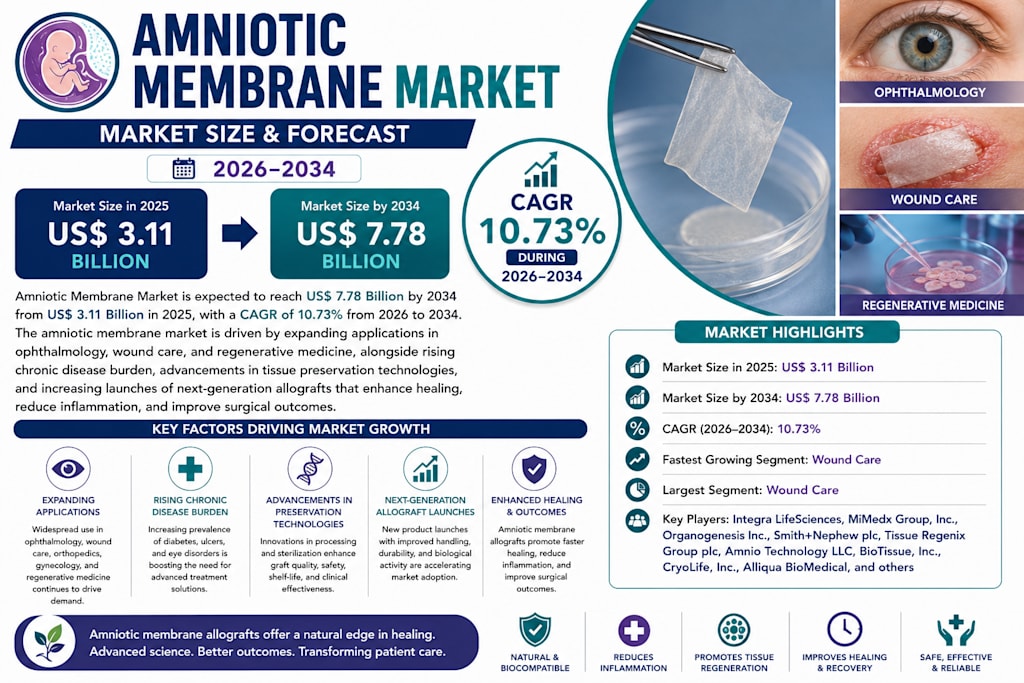
According to the latest market outlook, the Global Amniotic Membrane Market is projected to grow from US$3.11 billion in 2025 to US$7.78 billion by 2034, registering a compound annual growth rate (CAGR) of 10.73% during 2026–2034. Expanding applications in regenerative medicine, chronic wound management, ophthalmology, and advanced surgical procedures continue to support this impressive market growth.
Understanding Amniotic Membranes
The amniotic membrane is the innermost layer of the placenta and has been used in medicine for decades because of its unique biological properties.
Rich in collagen, growth factors, anti-inflammatory proteins, and extracellular matrix components, the membrane supports tissue regeneration while minimizing scar formation and reducing infection risks.
Medical-grade amniotic membranes are carefully processed and preserved using cryopreservation, dehydration, or lyophilization technologies before being used in clinical applications.
Today, these biological grafts are widely utilized for ocular surface reconstruction, chronic wound management, surgical repair, orthopedic procedures, dental treatments, and regenerative medicine.
Regenerative Medicine Continues Driving Market Growth
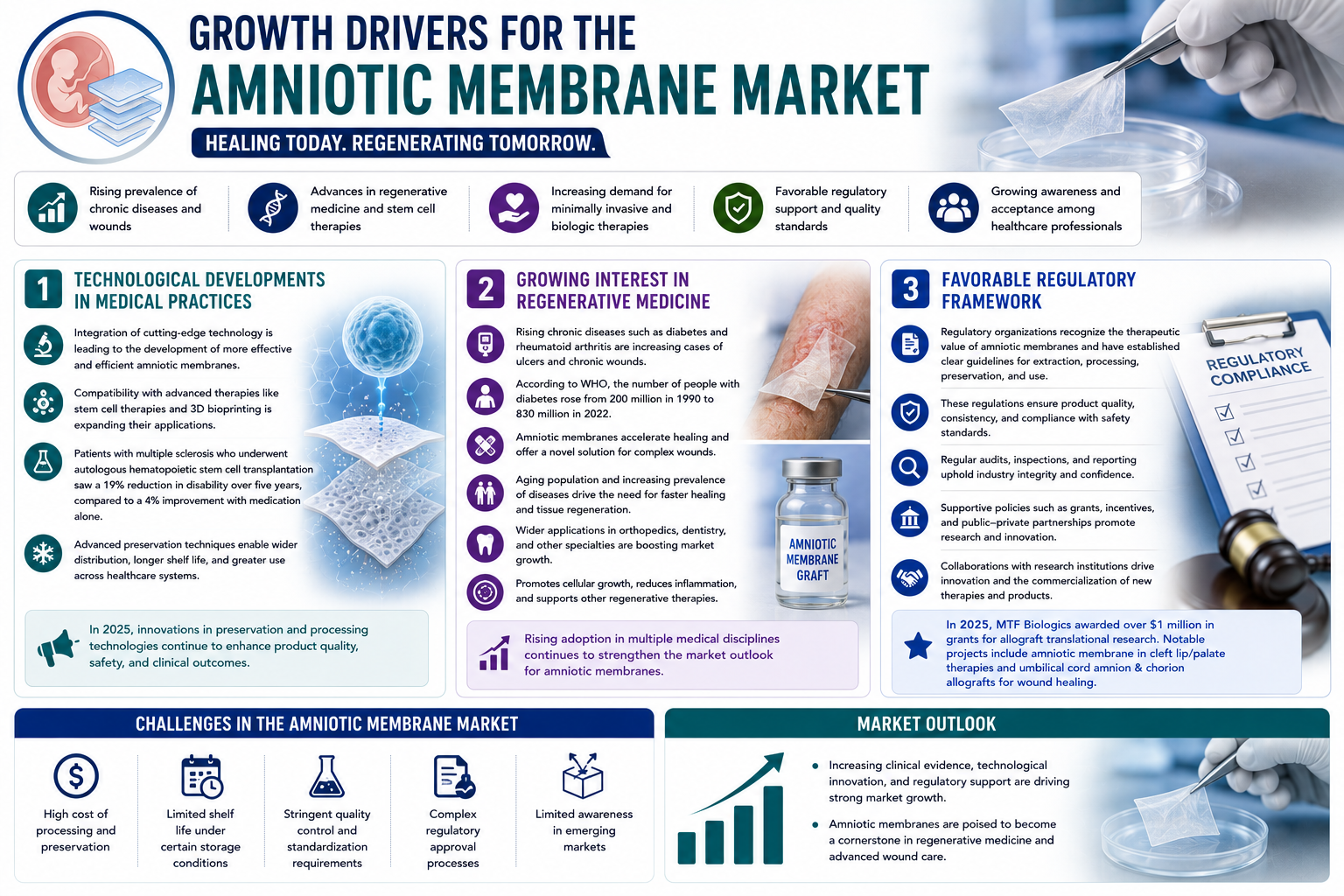
One of the strongest factors supporting market expansion is the rapid growth of regenerative medicine.
Healthcare providers increasingly seek biological materials capable of promoting natural healing rather than simply replacing damaged tissue.
Amniotic membranes provide anti-inflammatory, antimicrobial, and regenerative properties that stimulate cellular repair while improving healing outcomes.
Researchers continue exploring their use alongside stem cell therapies, tissue engineering, and three-dimensional bioprinting technologies, creating new opportunities across multiple medical specialties.
As regenerative medicine continues advancing, amniotic membrane products are expected to become increasingly important therapeutic tools.
Rising Burden of Chronic Wounds Increases Demand
The growing prevalence of chronic diseases has significantly increased demand for advanced wound care solutions.
Patients suffering from diabetes, pressure ulcers, venous leg ulcers, burns, and surgical wounds often require biological materials capable of accelerating tissue repair.
Amniotic membranes create favorable healing environments by reducing inflammation, promoting epithelial regeneration, and minimizing scar formation.
The continued rise in diabetes worldwide, together with aging populations and increasing chronic disease prevalence, continues expanding demand for advanced biological wound care products.
Healthcare providers increasingly view amniotic membranes as valuable alternatives to conventional wound management techniques.
Ophthalmology Remains a Major Application Area
Ophthalmology represents one of the largest application segments within the amniotic membrane market.
These biological grafts are widely used for treating corneal ulcers, dry eye disease, persistent epithelial defects, ocular burns, and ocular surface reconstruction.
The membrane protects damaged tissue while encouraging epithelial healing and reducing inflammation, significantly improving patient recovery.
Growing awareness of advanced ocular therapies, increasing eye disease prevalence, and improvements in preservation technologies continue strengthening adoption within ophthalmology.
Specialized eye care centers increasingly incorporate amniotic membrane transplantation into routine clinical practice.
Tissue Preservation Technology Improves Product Performance
Advances in preservation technology have significantly improved the effectiveness and availability of amniotic membrane products.
Modern cryopreservation, dehydration, and lyophilization techniques preserve biological activity while extending product shelf life and simplifying storage requirements.
Improved preservation methods maintain essential growth factors and structural proteins that contribute directly to tissue regeneration.
These innovations have expanded product accessibility while allowing healthcare providers to utilize amniotic membranes across a wider range of clinical settings.
Technological progress continues supporting broader commercial adoption.
Favorable Regulatory Support Encourages Innovation
Healthcare regulatory authorities increasingly recognize the therapeutic value of amniotic membrane products.
Clearer regulatory frameworks governing tissue donation, processing, preservation, sterilization, and clinical use have improved product quality while strengthening physician confidence.
Governments and research organizations also continue supporting regenerative medicine through grants, academic partnerships, and scientific research programs.
These initiatives encourage manufacturers to invest in innovative biological graft technologies capable of addressing complex medical challenges.
Cryopreserved Membranes Lead the Market
Cryopreserved amniotic membranes remain among the most widely utilized product types.
This preservation method retains the membrane's native biological characteristics, including growth factors, cytokines, and structural proteins essential for tissue repair.
Cryopreserved products are extensively used in ophthalmology, wound care, reconstructive surgery, and regenerative medicine because of their superior biological performance.
Growing clinician awareness regarding their therapeutic advantages continues driving strong market demand.
Surgical Wound Applications Continue Expanding
Amniotic membranes have become increasingly valuable in surgical wound management.
Their anti-inflammatory, antimicrobial, and anti-scarring properties promote faster healing while reducing postoperative complications.
Surgeons increasingly utilize these biological grafts during orthopedic, reconstructive, burn, trauma, and plastic surgery procedures where rapid tissue regeneration is essential.
The global increase in surgical procedures and growing preference for minimally invasive techniques continue supporting demand for advanced biological wound coverings.
Regulatory Challenges Remain Significant
Despite impressive growth prospects, manufacturers continue facing complex regulatory requirements.
Amniotic membrane products must comply with strict donor screening, tissue recovery, processing, sterilization, and quality control standards before receiving regulatory approval.
Differences between regulatory frameworks across countries may extend approval timelines while increasing development costs.
Maintaining consistent product quality despite natural biological variability also presents ongoing manufacturing challenges.
Reimbursement and Awareness Limit Wider Adoption
Limited reimbursement and inconsistent physician awareness remain important barriers within several healthcare systems.
Although clinical evidence supporting amniotic membrane therapies continues expanding, reimbursement policies vary considerably among countries and insurance providers.
Some healthcare professionals also remain unfamiliar with advanced regenerative therapies, slowing broader clinical adoption.
Manufacturers continue investing in physician education, clinical research, and real-world evidence to strengthen market acceptance and improve reimbursement opportunities.
Regional Markets Continue Driving Growth
The United States remains one of the world's largest amniotic membrane markets due to its advanced healthcare infrastructure, strong regenerative medicine research, increasing prevalence of chronic wounds, and widespread adoption of advanced ophthalmic therapies.
The United Kingdom continues expanding its market through growing surgical volumes, regenerative medicine research, and increasing use of biological grafts in ophthalmology and reconstructive procedures.
India has emerged as a rapidly growing market driven by rising diabetes prevalence, increasing chronic wound cases, expanding hospital infrastructure, and growing awareness of regenerative medicine.
Saudi Arabia continues strengthening demand through healthcare modernization, increasing diabetes prevalence, expanding ophthalmology services, and government investment in advanced biological therapies.
Together, these regional markets continue shaping worldwide demand for amniotic membrane technologies.
Innovation Will Shape the Future of Regenerative Medicine
The future of the amniotic membrane market will be driven by advances in regenerative medicine, tissue engineering, preservation technologies, and personalized healthcare.
Researchers continue developing multi-layer biological grafts, improved preservation methods, combination therapies with stem cells, and innovative regenerative applications capable of treating increasingly complex medical conditions.
Artificial intelligence, digital pathology, and precision medicine are also expected to enhance patient selection while improving treatment outcomes.
As regenerative medicine continues evolving, amniotic membrane products will become increasingly important across multiple medical specialties.
Final Thoughts
The global amniotic membrane market is entering a period of remarkable expansion as healthcare providers increasingly adopt biological therapies capable of promoting natural tissue regeneration and improving clinical outcomes.
The projected growth from US$3.11 billion in 2025 to US$7.78 billion by 2034, supported by a 10.73% CAGR, reflects expanding applications in ophthalmology, wound care, surgery, and regenerative medicine.
Although regulatory complexity, reimbursement limitations, and clinician awareness remain important challenges, continuous innovation in tissue preservation, regenerative science, and biologic graft development positions the amniotic membrane industry for strong long-term growth. As demand for advanced healing technologies continues rising worldwide, amniotic membranes are expected to remain a cornerstone of next-generation regenerative healthcare.
About the Creator
Enjoyed the story? Support the Creator.
Subscribe for free to receive all their stories in your feed.
Comments
There are no comments for this story
Be the first to respond and start the conversation.