
Global Ammunition Industry Navigates Modernization, Supply Chain Challenges, and Evolving Security Needs
Defense modernization programs, technological innovation, and geopolitical tensions continue to shape the future of the global ammunition industry through 2033.

The global ammunition industry remains an important component of national defense infrastructure and security planning. Governments worldwide continue to assess their defense preparedness in response to evolving geopolitical conditions, regional conflicts, and modernization initiatives. As military organizations adopt advanced technologies and seek greater operational efficiency, ammunition manufacturers are adapting to changing requirements involving precision, reliability, and supply chain resilience.
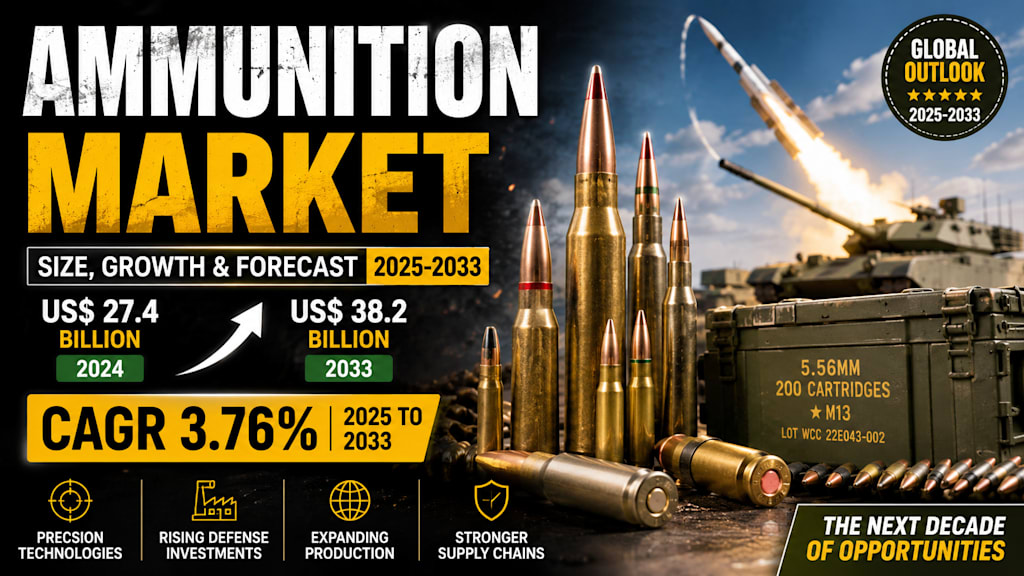
According to Renub Research, the global ammunition market is projected to grow from US$ 27.4 billion in 2024 to US$ 38.2 billion by 2033, reflecting a compound annual growth rate (CAGR) of 3.76% between 2025 and 2033. The market's evolution is influenced by defense modernization efforts, technological advancements, industrial investments, and changing procurement priorities.
The Changing Landscape of the Ammunition Industry
The ammunition sector has undergone significant transformation over the last decade. Traditional ammunition manufacturing remains essential, but governments and defense organizations increasingly emphasize precision, efficiency, and interoperability.
Modern military operations often require ammunition systems that can function effectively in complex operational environments while minimizing unintended consequences. This shift has encouraged research into advanced guidance systems, digital integration, and enhanced targeting capabilities.
Many countries are also investing in domestic production capabilities to strengthen supply chain security and reduce dependence on foreign suppliers. These initiatives are contributing to the expansion of manufacturing facilities and strategic partnerships across multiple regions.
Defense Modernization Driving Industry Activity
One of the most significant factors influencing the ammunition industry is the modernization of military forces worldwide.
Governments continue to replace aging equipment with newer systems capable of meeting contemporary operational requirements. Modern artillery systems, guided munitions, and advanced launch platforms often require specialized ammunition designed for improved performance and compatibility.
Military modernization programs extend beyond weapons platforms themselves. They also involve logistics systems, ammunition storage solutions, inventory management technologies, and production infrastructure.
As countries seek to maintain readiness and improve operational effectiveness, ammunition procurement remains an important component of broader defense spending strategies.
The Rise of Precision-Guided Munitions
Precision-guided munitions have become increasingly important in modern defense planning. These systems incorporate advanced technologies such as GPS navigation, sensors, laser guidance, and sophisticated targeting mechanisms.
Compared with conventional systems, precision-guided solutions are designed to improve accuracy and operational efficiency. Their development reflects broader trends toward technology-enabled defense capabilities.
Recent investments by governments and defense contractors indicate growing interest in enhancing targeting precision while integrating ammunition systems with digital command-and-control networks.
Research institutions and defense organizations across multiple countries continue exploring next-generation technologies that may improve range, guidance, and overall effectiveness.
Research and Development Remains a Priority
Research and development spending has become a defining characteristic of the modern ammunition industry.
Defense organizations increasingly seek solutions that address evolving operational requirements while incorporating advancements in materials science, engineering, and manufacturing technologies.
Innovation efforts focus on several key areas, including:
Enhanced accuracy
Improved range capabilities
Reduced weight
Greater reliability
Digital integration
Advanced materials
Environmental considerations
Public and private sector investments continue to support these objectives. Governments often collaborate with domestic manufacturers, universities, and technology firms to strengthen national defense capabilities and encourage innovation.
These investments also contribute to workforce development and industrial growth in regions with significant defense manufacturing activity.
Expanding Domestic Manufacturing Capacity
Many countries are prioritizing domestic ammunition production as part of broader industrial and security strategies.
Supply chain disruptions experienced in recent years highlighted vulnerabilities associated with dependence on international suppliers. As a result, governments have increasingly supported initiatives aimed at strengthening local manufacturing capabilities.
Domestic production offers several potential advantages:
Greater supply chain control
Improved responsiveness during emergencies
Enhanced national security
Reduced dependence on imports
Job creation and industrial development
Countries across North America, Europe, Asia-Pacific, and the Middle East have announced investments in manufacturing facilities designed to increase production capacity and improve long-term resilience.
Technology Transforming Ammunition Management
Technological innovation is influencing not only ammunition design but also inventory management and logistics.
Digital platforms, automation systems, and data-driven monitoring tools are becoming increasingly important in ammunition management operations.
Advanced inventory systems can help organizations monitor stock levels, track distribution, and improve accountability across large networks. These technologies may also contribute to greater operational efficiency and enhanced decision-making.
The integration of digital technologies reflects broader trends toward modernization throughout the defense sector.
Supply Chain Challenges Continue
Despite technological progress and investment, supply chain challenges remain a significant concern for the ammunition industry.
Production depends on access to various raw materials, including metals, propellants, and specialized components. Disruptions affecting these materials can influence manufacturing schedules and operational costs.
Several factors contribute to supply chain uncertainty:
Geopolitical tensions
Trade restrictions
Transportation delays
Raw material shortages
Inflationary pressures
Labor availability
Manufacturers increasingly explore strategies such as supplier diversification, strategic stockpiling, and localized sourcing to improve resilience.
While these approaches may reduce risks, they can also introduce additional costs and operational complexities.
Political Uncertainty and Procurement Volatility
The ammunition market is closely linked to government spending and defense procurement decisions.
Changes in political priorities, economic conditions, or international relations can influence military budgets and purchasing plans. These shifts may create uncertainty for manufacturers attempting to forecast future demand.
Long-term planning becomes particularly challenging when procurement cycles fluctuate due to changing security environments or budgetary constraints.
Industry participants therefore emphasize flexibility, strategic planning, and continuous monitoring of global developments.
Regional Outlook
United States
The United States remains one of the most influential participants in the global ammunition industry.
A substantial defense budget, ongoing modernization efforts, and a large defense industrial base contribute to sustained demand across multiple ammunition categories.
Military requirements, training activities, and international commitments continue to support procurement and production initiatives. The country also benefits from a robust manufacturing ecosystem capable of supporting large-scale production.
Germany
Germany has increased its focus on defense modernization in recent years.
Investments in military readiness and technological advancement have supported demand for various ammunition systems. The country is also exploring environmentally conscious manufacturing practices and innovative production technologies.
These developments contribute to Germany's growing role within the European defense landscape.
India
India's ammunition industry is evolving through a strong emphasis on self-reliance and domestic production.
Government initiatives encouraging indigenous manufacturing have increased participation from both public and private sector organizations. Investments in production facilities, research programs, and technological development continue to strengthen the country's defense industrial base.
India's long-term strategy includes reducing import dependence while enhancing domestic capabilities.
United Arab Emirates
The United Arab Emirates continues investing in defense modernization and local industrial development.
Partnerships with international organizations and investments in manufacturing infrastructure support efforts to strengthen domestic capabilities.
The UAE's approach reflects a broader regional trend toward expanding local production while adopting advanced technologies.
Environmental and Sustainability Considerations
Sustainability is becoming an increasingly important topic within the defense manufacturing sector.
Researchers and manufacturers are exploring environmentally responsible materials and production processes. Efforts include reducing hazardous substances, improving recycling initiatives, and enhancing manufacturing efficiency.
Although operational requirements remain the primary focus, environmental considerations are expected to play a larger role in future innovation strategies.
Future Outlook for the Industry
The ammunition industry is likely to remain closely tied to global security developments, technological innovation, and industrial policy decisions.
Several trends are expected to influence the sector during the coming years:
Continued military modernization
Expansion of domestic manufacturing capabilities
Increased adoption of digital technologies
Growth in precision-guided systems
Greater emphasis on supply chain resilience
Ongoing research and development investments
At the same time, manufacturers must navigate challenges related to supply chain disruptions, regulatory requirements, and geopolitical uncertainty.
The balance between technological advancement, operational readiness, and industrial sustainability will likely shape industry priorities through the next decade.
Recent Industry Developments
Hanwha and Ultra Intelligence & Communications signed a memorandum of understanding in October 2024 focused on defense interoperability initiatives.
BAE Systems secured a major contract in August 2024 involving M109A7 self-propelled howitzers and M992A3 ammunition carriers.
Saab announced plans for a new munitions facility in Michigan aimed at expanding production capacity.
Adani launched a large ammunition and missile manufacturing complex in Kanpur, India.
European institutions announced funding initiatives intended to support ammunition manufacturing capacity.
Elbit Systems received contracts related to precision-guided munitions technologies.
Munitions India collaborated with academic institutions on advanced ammunition development projects.
Several NATO member states expanded ammunition procurement and stock replenishment programs.
Defense manufacturers increased investment in digital inventory and logistics management systems.
Global defense contractors continued expanding production capabilities to address evolving security requirements.
Final Thoughts
The global ammunition industry sits at the intersection of technology, manufacturing, national security, and public policy. As governments pursue modernization strategies and strengthen industrial resilience, the sector continues adapting to changing operational and strategic requirements.
While opportunities for innovation remain significant, challenges involving supply chains, political uncertainty, and evolving regulations will continue shaping industry decisions. Ultimately, the future of the ammunition industry will depend on how effectively stakeholders balance technological advancement, operational readiness, and long-term sustainability in an increasingly complex global environment.
About the Creator
Enjoyed the story? Support the Creator.
Subscribe for free to receive all their stories in your feed.
Comments
There are no comments for this story
Be the first to respond and start the conversation.