
Global Agricultural Micronutrients Market Expected to Reach US$10.93 Billion by 2034 as Soil Nutrient Depletion Accelerates
Rising demand for higher crop yields, precision farming technologies, and balanced fertilization practices is transforming the future of global agriculture

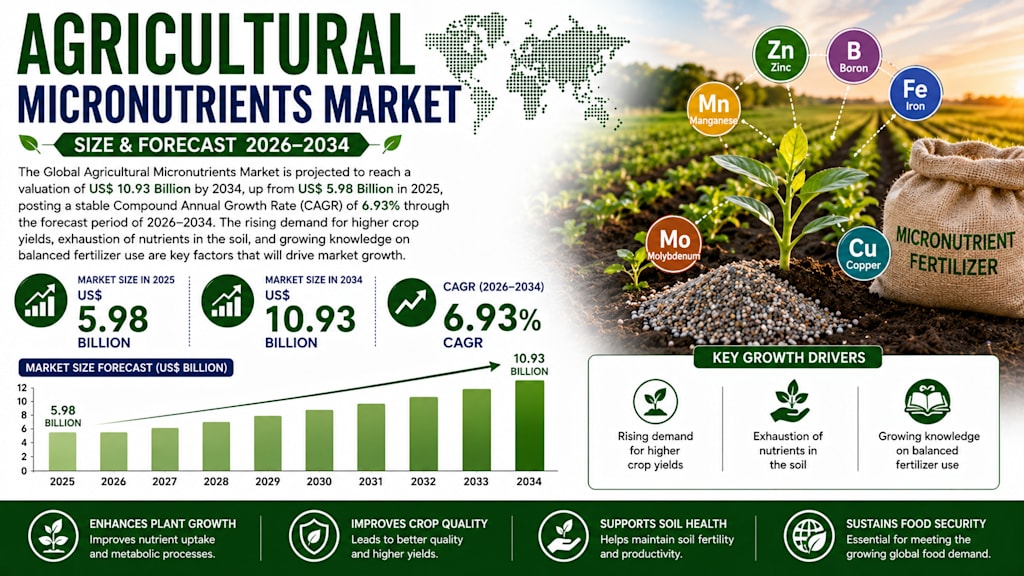
The global agricultural micronutrients market is entering a period of strong and sustained growth as farmers worldwide increasingly recognize the importance of balanced crop nutrition and soil health management. With agricultural productivity under growing pressure from population expansion, climate challenges, and soil degradation, micronutrient fertilizers are becoming essential tools for improving crop quality and maximizing yields.
According to Renub Research, the global agricultural micronutrients market is projected to grow from US$5.98 billion in 2025 to approximately US$10.93 billion by 2034, expanding at a stable compound annual growth rate (CAGR) of 6.93% between 2026 and 2034.
The market’s growth is being fueled by rising demand for higher agricultural output, increasing nutrient depletion in soils, and expanding awareness around balanced fertilization practices. As modern agriculture becomes more technology-driven and sustainability-focused, micronutrients are emerging as a critical component of global food production systems.

Agricultural Micronutrients Are Becoming Essential for Crop Health
Agricultural micronutrients are minerals required by plants in small quantities but are absolutely essential for proper growth, development, and productivity. Key micronutrients include:
- Zinc
- Boron
- Iron
- Manganese
- Copper
- Molybdenum
- Chlorine
Although plants require these nutrients in smaller amounts compared to macronutrients such as nitrogen, phosphorus, and potassium, micronutrients play a major role in:
- Enzyme activation
- Photosynthesis
- Nutrient absorption
- Protein synthesis
- Flowering and fruiting
- Plant metabolism
Deficiencies in micronutrients can significantly reduce crop quality, plant health, and overall agricultural productivity.
As farming systems become increasingly intensive, maintaining proper micronutrient balance is becoming a top priority for agricultural producers worldwide.
Soil Nutrient Depletion Is Driving Global Demand
One of the strongest factors fueling the agricultural micronutrients market is the growing depletion of soil nutrients caused by intensive farming practices.
Decades of continuous cultivation, overuse of conventional fertilizers, and insufficient soil restoration have significantly reduced the availability of essential micronutrients in agricultural soils.
Farmers have traditionally focused heavily on macronutrients like nitrogen, phosphorus, and potassium while often neglecting trace micronutrients necessary for long-term soil fertility.
According to the United Nations Food and Agriculture Organization (FAO), global demand for agricultural products is expected to rise substantially, with cereal consumption projected to increase by approximately 150 million tons over the coming years.
This increasing pressure on food production is accelerating demand for micronutrient fertilizers capable of restoring soil fertility and sustaining crop productivity.
Governments and agricultural organizations are also promoting balanced fertilization strategies to combat nutrient depletion and support sustainable farming.
Rising Demand for High-Quality Crops Is Supporting Market Expansion
The global agricultural industry is under increasing pressure to produce not only larger crop volumes but also higher-quality and nutrient-rich food products.
Consumers today are more health conscious and increasingly prefer fresh produce with stronger nutritional profiles. At the same time, food processing industries and export-oriented agricultural sectors demand crops that meet strict quality standards.
Micronutrients help improve:
- Crop yield
- Fruit size and appearance
- Nutritional value
- Disease resistance
- Plant metabolism
- Product shelf life
Farmers are therefore adopting micronutrient fertilizers to improve both productivity and crop quality.
In March 2025, Polish agricultural equipment manufacturer Krukowiak partnered with Swiss agritech firm xFarm Technologies to support precision agriculture and sustainable farming initiatives across Poland.
This reflects the growing global integration of technology and nutrient management strategies within agriculture.
Precision Farming Is Revolutionizing Nutrient Management
The increasing adoption of precision farming technologies is significantly accelerating growth within the agricultural micronutrients market.
Precision agriculture uses advanced tools such as:
- GPS systems
- Soil sensors
- Drones
- Satellite mapping
- Data analytics
- Smart irrigation systems
These technologies allow farmers to accurately identify nutrient deficiencies and apply micronutrients more efficiently.
Rather than applying fertilizers uniformly across entire fields, precision farming enables targeted nutrient application based on real-time soil and crop data. This improves crop efficiency while reducing waste and environmental impact.
Governments and private agricultural companies are increasingly promoting smart farming through subsidies, training programs, and technology partnerships.
In September 2024, Orbia Advance Corporation introduced its GrowSphere Operating System designed to enhance precision irrigation and nutrient application efficiency.
Lack of Farmer Awareness Remains a Major Challenge
Despite strong market potential, one of the biggest obstacles facing the agricultural micronutrients industry is limited awareness among farmers, particularly in developing regions.
Many farmers continue relying primarily on traditional fertilizers focused on nitrogen, phosphorus, and potassium while underestimating the importance of micronutrients.
Additional barriers include:
- Limited access to soil testing services
- Inadequate agricultural education
- Lack of technical training
- Misconceptions about micronutrient costs
As a result, adoption rates remain relatively low in some agricultural regions despite the long-term productivity benefits.
Governments, cooperatives, and agricultural organizations are increasingly investing in farmer education and awareness campaigns to address this challenge.
High Costs Continue Limiting Adoption
The relatively high cost of micronutrient fertilizers compared to traditional fertilizers also presents a major market challenge.
Small-scale farmers in developing countries often face financial constraints that limit their ability to invest in advanced nutrient management products.
Production costs associated with formulation, processing, and distribution also contribute to higher retail prices.
Although micronutrient fertilizers offer long-term benefits such as improved yields and healthier soils, the upfront cost remains a barrier for many growers.
Expanding subsidy programs and affordable fertilizer solutions may be necessary to accelerate adoption rates globally.
Chelated Micronutrients Are Gaining Significant Popularity
Chelated micronutrients are becoming increasingly important within modern agriculture because of their superior nutrient absorption capabilities.
Chelated micronutrients are combined with organic molecules that prevent chemical reactions in soil which could otherwise make nutrients unavailable to plants.
This improves:
- Nutrient stability
- Bioavailability
- Absorption efficiency
- Crop performance
Chelated fertilizers are especially valuable in high-value crops such as fruits, vegetables, and flowers where precision nutrition is critical.
As sustainable agriculture and resource efficiency become more important globally, demand for chelated micronutrient products is expected to rise steadily.
Fruits and Vegetables Are Leading Market Demand
Among crop segments, fruits and vegetables represent one of the largest consumers of agricultural micronutrients.
These crops require precise nutrient management to maintain:
- Fruit size
- Color quality
- Shelf life
- Disease resistance
- Nutritional value
Consumer demand for healthier produce and export-quality products is encouraging farmers to adopt micronutrient-rich fertilization programs.
Similarly, the oilseeds and pulses segment is also experiencing strong micronutrient demand because of increasing global consumption of plant-based protein foods.
Zinc and Iron Continue Dominating the Market
Zinc Micronutrients
Zinc remains one of the most important agricultural micronutrients because it supports enzyme activation, chlorophyll production, and protein synthesis in plants.
Zinc deficiencies can lead to poor plant growth, delayed maturity, and lower yields.
As awareness surrounding balanced fertilization increases, zinc-based fertilizers are seeing growing adoption worldwide.
Iron Micronutrients
Iron also plays a critical role in photosynthesis and energy transfer within plants. Iron deficiency often causes chlorosis, a condition where leaves become yellow due to insufficient chlorophyll production.
Chelated iron products such as Fe-EDTA and Fe-DTPA are increasingly popular because they remain stable even in alkaline soil conditions.
Soil and Fertigation Applications Are Expanding
Soil Applications
Soil application remains the dominant method for micronutrient delivery because it directly restores soil fertility and supports long-term nutrient management.
Farmers increasingly rely on soil testing to determine precise micronutrient requirements and optimize fertilizer usage.
Fertigation Systems
Fertigation — the process of delivering nutrients through irrigation systems — is rapidly growing within modern agriculture.
This technique allows:
- Precise nutrient delivery
- Reduced fertilizer waste
- Improved water efficiency
- Better nutrient absorption
- Fertigation is becoming especially important in greenhouse farming, hydroponics, and high-yield crop production systems.
United States, India, France, and Brazil Are Major Growth Markets
United States
The U.S. market benefits from advanced farming technologies, precision agriculture adoption, and strong awareness around nutrient management. In February 2024, Helena Agri-Enterprises expanded the application scope of its Zypro soil amendment technology.
France
France’s highly developed agricultural sector continues driving demand for premium micronutrient fertilizers, especially in vineyards, fruit cultivation, and grain production.
India
India is witnessing rapid growth because of widespread soil nutrient deficiencies and increasing government support for balanced fertilization. In May 2023, Aries Agro Limited launched its “100 Days Drone Yatra” project focused on drone-based micronutrient spraying.
Brazil
Brazil’s agricultural sector continues expanding micronutrient usage across soybean, coffee, and sugarcane cultivation. In September 2024, French agri-biotech company Elicit Plant introduced EliZon technology aimed at improving soybean resistance to water stress.
Major Companies Intensify Industry Competition
Competition within the global agricultural micronutrients market remains highly competitive.
Leading companies include:
- BASF
- Compass Minerals
- Coromandel International
- Deepak Fertilisers
- Nouryon
- Nufarm
- Nutrien
- The Mosaic Company
- Yara International
Manufacturers are increasingly focusing on innovation, precision nutrient solutions, and sustainable farming technologies to strengthen their competitive positions.
Final Thoughts
The global agricultural micronutrients market is becoming increasingly important as modern agriculture faces growing pressure to produce more food using fewer natural resources.
With the market projected to reach approximately US$10.93 billion by 2034, micronutrient fertilizers are expected to play a major role in improving crop productivity, restoring soil fertility, and supporting sustainable farming systems worldwide.
However, the industry must continue addressing challenges related to affordability, farmer awareness, and access to precision agriculture technologies.
As food security concerns intensify and sustainable farming practices become more essential, agricultural micronutrients are likely to remain a cornerstone of future global agricultural development.
About the Creator
Enjoyed the story? Support the Creator.
Subscribe for free to receive all their stories in your feed.
Comments
There are no comments for this story
Be the first to respond and start the conversation.