
Global Aerosol Paints Market Set to Reach USD 417.96 Million by 2033 as DIY Culture and Automotive Demand Accelerate Growth
Rising construction activities, vehicle customization trends, and eco-friendly innovations are reshaping the future of the aerosol paints industry worldwide

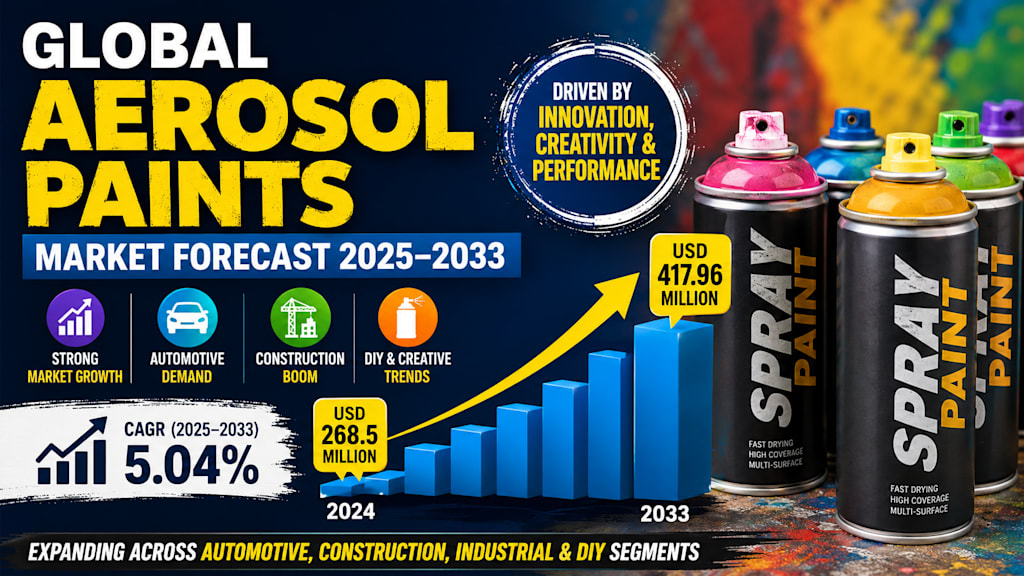
The global aerosol paints market is entering a period of sustained expansion, supported by increasing demand from automotive refinishing, construction projects, industrial maintenance, and the rapidly growing do-it-yourself (DIY) culture. According to industry projections, the market was valued at USD 268.5 million in 2024 and is expected to reach USD 417.96 million by 2033, growing at a CAGR of 5.04% during the forecast period.
Aerosol paints, commonly known as spray paints, have become indispensable across a wide range of applications due to their convenience, portability, and ability to deliver smooth, uniform finishes. Whether used by professional contractors, automotive technicians, artists, or hobbyists, aerosol paints continue to gain popularity because they eliminate the need for brushes and rollers while offering quick drying times and precise application.
As consumers increasingly seek efficient solutions for decorating, repairing, and customizing surfaces, aerosol paints are finding new opportunities across residential, commercial, and industrial sectors.
Understanding the Growing Importance of Aerosol Paints
Aerosol paints are packaged in pressurized containers that dispense paint through a spray nozzle. This technology enables even coverage on a variety of materials, including metal, wood, concrete, plastic, and glass.
Their versatility has helped them become widely adopted in automotive touch-ups, construction site markings, industrial equipment maintenance, furniture restoration, decorative artwork, and street murals. The ability to achieve professional-quality finishes without specialized equipment has broadened their appeal among both professionals and everyday consumers.
The expanding color palette, availability of specialty finishes, and improvements in durability have further strengthened market demand worldwide.
DIY Culture Creates a Powerful Growth Engine
One of the strongest drivers of market expansion is the growing popularity of DIY projects. Consumers increasingly prefer renovating furniture, decorating interiors, restoring household items, and customizing personal belongings themselves rather than hiring professionals.
Social media platforms have played a significant role in accelerating this trend. Online tutorials, home improvement influencers, and creative content creators regularly demonstrate spray-painting techniques, inspiring millions of users to undertake their own projects.
Aerosol paints are particularly attractive in DIY applications because they are easy to use, affordable, and capable of producing smooth, professional-looking results. The availability of metallic, matte, glossy, textured, and specialty finishes allows consumers to experiment creatively without significant investment.
Manufacturers are responding to this demand by introducing environmentally friendly formulations, improved spray technology, and enhanced color selections that cater specifically to hobbyists and home improvement enthusiasts.
Automotive Customization Continues to Drive Demand
The automotive industry remains one of the largest consumers of aerosol paints globally. Vehicle owners, repair shops, and customization specialists rely on spray paints for touch-ups, detailing, restoration projects, and aesthetic modifications.
Minor scratches, paint chips, and trim repairs can often be addressed efficiently using aerosol products, eliminating the need for costly body shop services. Additionally, automotive enthusiasts frequently use aerosol paints to personalize vehicle components, including wheels, engine parts, bumpers, and interior accessories.
The global rise in vehicle ownership, combined with aging vehicle fleets in many regions, is increasing the need for maintenance and refinishing products. Consumers are keeping vehicles longer, creating sustained demand for convenient repair solutions.
Vehicle personalization trends are also becoming increasingly popular among younger consumers, further supporting long-term growth in automotive aerosol paint applications.
Industrial Expansion Supports Market Growth
Industrial facilities depend heavily on aerosol paints for equipment maintenance, corrosion prevention, safety markings, and asset identification.
Manufacturing plants, refineries, warehouses, and energy facilities require durable coatings that can withstand harsh environmental conditions while providing efficient application in difficult-to-access areas.
Aerosol paints offer significant advantages in industrial settings because they reduce downtime and eliminate the need for large-scale coating equipment. Workers can quickly apply protective coatings, identification markings, and maintenance finishes with minimal disruption to operations.
As industrial activity continues to expand across Asia-Pacific, the Middle East, and Latin America, demand for industrial-grade aerosol paints is expected to remain strong throughout the forecast period.
Construction Sector Creates New Opportunities
The construction industry represents another important growth avenue for aerosol paint manufacturers. Spray paints are widely used for site markings, color coding, layout planning, safety indicators, and finishing applications.
Construction professionals value aerosol paints because they are portable, weather-resistant, and capable of delivering visible markings on various surfaces. Surveyors, engineers, and contractors frequently use fluorescent spray paints for infrastructure projects, excavation zones, and utility installations.
Global infrastructure investments, urbanization initiatives, and large-scale development projects are creating consistent demand for construction-related aerosol products. Emerging economies in Asia, the Middle East, and Africa are particularly important growth markets due to rapid urban expansion and government infrastructure spending.
Environmental Regulations Present Challenges
Despite strong market growth, aerosol paint manufacturers face increasing regulatory pressure related to environmental sustainability.
Traditional aerosol paints often contain volatile organic compounds (VOCs) and chemical propellants that contribute to air pollution and environmental concerns. Governments across North America and Europe are implementing stricter regulations aimed at reducing emissions and improving air quality.
Compliance with these standards requires manufacturers to invest in research and development, reformulate products, and adopt cleaner production technologies.
While low-VOC and water-based alternatives are gaining popularity, balancing environmental performance with product durability and application quality remains a significant challenge for the industry.
Safety Concerns Require Ongoing Attention
Health and safety considerations also present challenges for market participants. Aerosol paints can expose users to solvents, airborne particles, and flammable substances if used improperly.
Professional users generally follow established safety procedures, including ventilation requirements and protective equipment guidelines. However, DIY consumers may not always adhere to recommended practices.
Manufacturers continue to improve product labeling, safety instructions, and packaging design to promote responsible usage. Education campaigns and enhanced regulatory compliance efforts are helping reduce risks while maintaining consumer confidence.
Acrylic Aerosol Paints Gain Popularity
Among raw material categories, acrylic aerosol paints continue to experience strong demand due to their versatility and environmental advantages.
These paints offer vibrant colors, fast drying times, excellent UV resistance, and low odor characteristics. Artists, crafters, decorators, and DIY users increasingly prefer acrylic formulations because they are easy to apply and clean up.
The growing acceptance of street art, public murals, and creative design projects has expanded the customer base for acrylic aerosol paints worldwide. Their lower VOC content also aligns with increasing consumer demand for environmentally responsible products.
Epoxy Aerosol Paints Serve High-Performance Applications
Epoxy aerosol paints occupy an important niche within industrial and heavy-duty applications.
Known for exceptional durability, chemical resistance, and strong adhesion, epoxy coatings are commonly used on metal surfaces exposed to harsh operating environments. Industries such as marine, manufacturing, oil and gas, and transportation rely on epoxy aerosols for corrosion protection and long-lasting performance.
Although they are generally more expensive and require careful handling, epoxy aerosol paints remain essential where superior protection is required.
Solvent-Borne Technologies Maintain Market Presence
Solvent-borne aerosol paints continue to dominate several professional applications despite growing environmental scrutiny.
Their superior gloss retention, strong adhesion, rapid drying characteristics, and reliable weather resistance make them particularly valuable in automotive refinishing and industrial maintenance.
Manufacturers are increasingly investing in lower-emission solvent technologies to maintain performance standards while meeting evolving environmental regulations.
Regional Outlook
United States
The United States remains one of the most influential markets for aerosol paints globally. Strong DIY participation, a robust automotive aftermarket, and significant construction activity continue to drive demand.
Home improvement culture remains deeply embedded in consumer behavior, while large retail networks ensure widespread product availability. Regulatory leadership in environmental standards is also encouraging innovation in sustainable paint technologies.
Germany
Germany's aerosol paints market benefits from its advanced automotive manufacturing sector, industrial strength, and commitment to sustainability.
Demand for low-emission and environmentally compliant products is particularly strong. Continuous investment in research and development has positioned Germany as a leader in high-performance and eco-friendly coating technologies.
China
China represents one of the fastest-growing markets due to expanding industrial production, infrastructure development, and rising consumer spending.
The country's growing automotive aftermarket, construction sector, and DIY community continue to create substantial opportunities for both domestic and international manufacturers.
Saudi Arabia
Saudi Arabia's market is being supported by infrastructure investments linked to Vision 2030 initiatives. Rising automotive customization trends, industrial diversification, and large-scale development projects are generating increasing demand for durable aerosol coatings suited to harsh climatic conditions.
Competitive Landscape
The global aerosol paints industry remains highly competitive, with manufacturers focusing on innovation, sustainability, and product diversification.
Key companies are investing heavily in low-VOC formulations, water-based technologies, advanced spray systems, and specialty coatings designed for automotive, industrial, and consumer applications.
Strategic partnerships, product launches, and regional expansion initiatives are expected to intensify competition over the coming years as companies seek to capture emerging opportunities across developing markets.
Recent Industry Developments
Nippon Paint introduced its Mastercraft automotive body and paint repair service brand in 2024.
PPG launched a new range of water-based aerosol paints targeting environmentally conscious users.
AkzoNobel expanded its DIY paint portfolio through the Dulux Simply Refresh range.
Growing investment in low-VOC aerosol technologies continues across major manufacturers.
Several companies are developing improved spray nozzle systems for enhanced precision.
Water-borne aerosol paint adoption is increasing across Europe and North America.
Industrial coating producers are focusing on corrosion-resistant aerosol solutions.
Automotive refinishing brands are expanding customization-focused product offerings.
Manufacturers are increasing investments in sustainable packaging technologies.
Demand for specialty finishes such as metallic, textured, and matte coatings continues to rise.
Final Thoughts
The global aerosol paints market is positioned for healthy growth through 2033, supported by expanding DIY culture, rising automotive customization, industrial maintenance requirements, and infrastructure development. Although environmental regulations and safety concerns present challenges, innovation in sustainable formulations and advanced application technologies is creating new opportunities for manufacturers.
As consumers and industries continue to seek convenient, efficient, and high-quality coating solutions, aerosol paints are expected to remain an essential component of the global coatings industry for years to come.
About the Creator
Enjoyed the story? Support the Creator.
Subscribe for free to receive all their stories in your feed.
Comments
There are no comments for this story
Be the first to respond and start the conversation.