
Germany Watch Market: Why Are Precision Engineering and Smartwatches Driving Germany’s Watch Industry Forward?
Growing demand for premium watches, increasing smartwatch adoption, strong appreciation for engineering excellence, and rising interest in luxury accessories are fueling the expansion of Germany’s watch market through 2034.

Germany has long been recognized as a global leader in engineering, precision manufacturing, and technological innovation. From automobiles and industrial machinery to consumer electronics and luxury goods, German consumers place exceptional value on quality, reliability, and craftsmanship. These preferences have played a major role in shaping the country's watch industry, which continues to evolve as traditional timepieces coexist with advanced wearable technologies.
Today, watches in Germany serve far more than a timekeeping function. They represent personal style, professional identity, technological sophistication, and in many cases, long-term investments. While mechanical watches continue to attract enthusiasts who appreciate heritage and craftsmanship, smartwatches are rapidly gaining popularity among consumers seeking health monitoring, fitness tracking, and digital connectivity.
This combination of tradition and innovation is creating strong growth opportunities throughout the German watch market.
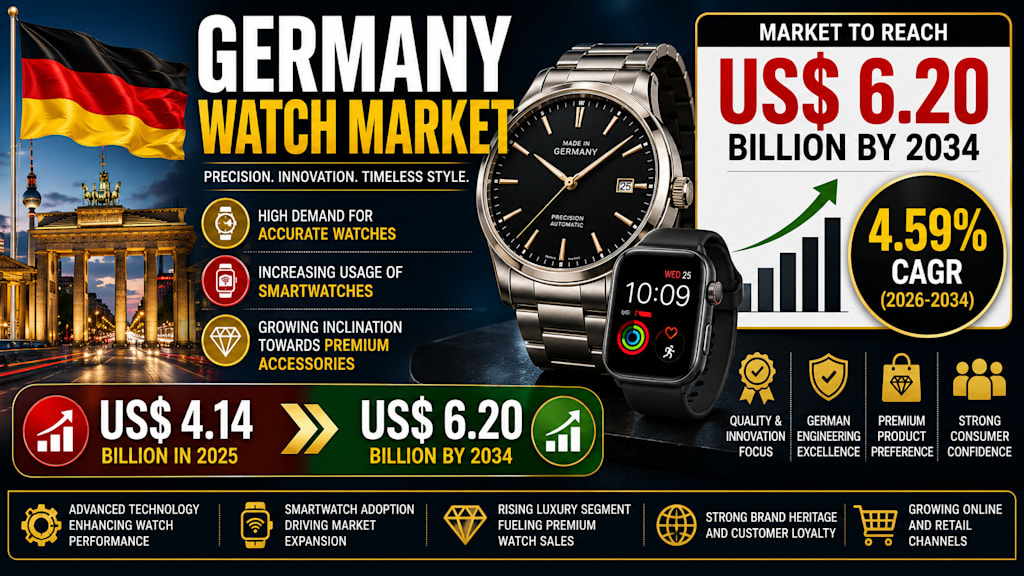
According to Renub Research, the Germany Watch Market is expected to grow from US$ 4.14 billion in 2025 to US$ 6.20 billion by 2034, registering a CAGR of 4.59% between 2026 and 2034. Rising demand for accurate and durable watches, increasing adoption of smartwatches, growing consumer preference for premium accessories, and Germany's strong emphasis on quality and innovation are expected to support market growth throughout the forecast period.
Watches Remain an Important Part of German Consumer Culture
A watch is a wearable device designed to display time while often offering additional features such as alarms, date displays, fitness tracking, GPS navigation, and smartphone connectivity.
Traditional watches utilize mechanical or quartz movements, while modern smartwatches integrate advanced digital technologies that support communication, wellness monitoring, and productivity functions.
In Germany, watches continue to enjoy widespread popularity because consumers appreciate products that combine functionality, durability, and elegant design. Whether purchased for professional use, personal expression, or technological convenience, watches remain highly relevant across multiple demographic groups.
The country's strong culture of engineering excellence and appreciation for precision manufacturing further reinforces consumer demand for high-quality timepieces.
Precision Engineering Drives Consumer Demand
One of the strongest growth drivers within the German watch market is the consumer preference for precision engineering and superior craftsmanship.
German consumers are known for their appreciation of products that deliver long-lasting performance, accuracy, and reliability. These preferences extend directly into the watch industry.
Many buyers seek watches that combine advanced engineering with practical functionality. As a result, both mechanical and electronic watches that emphasize precision and durability continue to perform strongly.
Germany's industrial heritage has created a consumer culture that values technical excellence and product quality. Manufacturers respond by developing watches that demonstrate meticulous craftsmanship, innovative technology, and dependable performance.
The appeal of precision-engineered products continues to support both domestic and international watch brands operating in Germany.
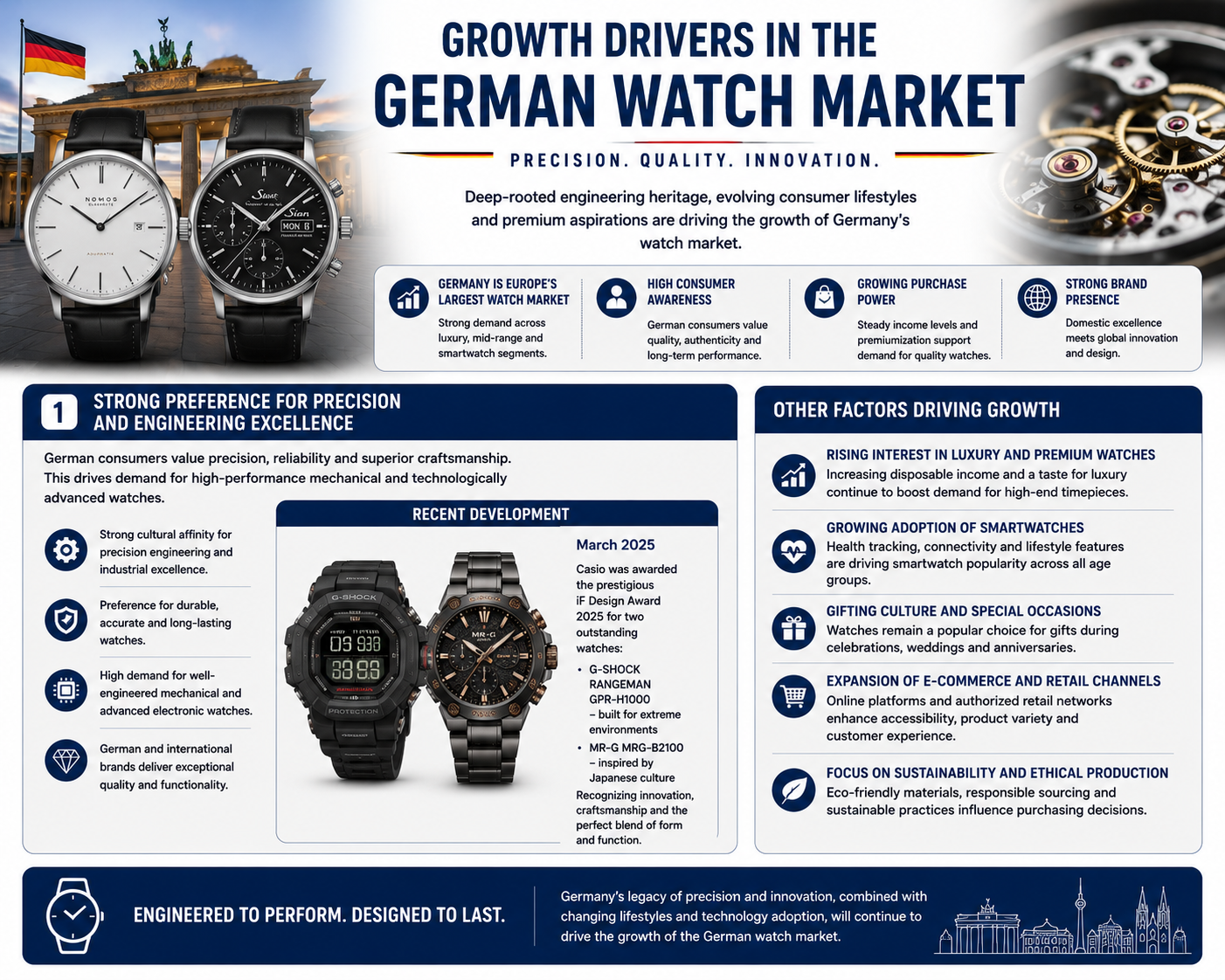
In March 2025, Casio received the prestigious iF Design Award 2025 for two watches: the rugged G-SHOCK RANGEMAN GPR-H1000, designed for harsh environments, and the MR-G MRG-B2100, inspired by traditional Japanese design aesthetics. The recognition highlighted the importance of combining innovation, engineering, and design excellence within the watch industry.
Smartwatch Adoption Continues to Accelerate
The rapid growth of wearable technology represents another major catalyst for market expansion.
German consumers are increasingly embracing smartwatches because they offer capabilities that extend far beyond traditional timekeeping. These devices enable users to monitor health metrics, track physical activity, navigate using GPS, receive notifications, and maintain smartphone connectivity throughout the day.
Growing awareness regarding health and wellness has significantly contributed to this trend. Consumers increasingly seek tools that help them manage exercise routines, monitor heart rates, and improve overall well-being.
Younger consumers and urban professionals have emerged as particularly important customer segments due to their familiarity with digital technologies and connected lifestyles.
Continuous improvements in battery efficiency, sensor accuracy, display quality, and software functionality have made smartwatches increasingly attractive to mainstream consumers.
In September 2023, Apple launched the Apple Watch Series 9 in Germany, featuring enhanced hiking and cycling applications as well as new mental wellness support functions. Such innovations continue strengthening consumer interest in wearable technology.
Health and Fitness Trends Support Wearable Growth
Germany's growing focus on health and active living continues to support demand for smartwatches and fitness-oriented wearables.
Consumers increasingly participate in gym memberships, outdoor recreation, cycling, hiking, and wellness-focused activities. Wearable devices provide valuable insights that help users track progress and achieve personal fitness goals.
Smartwatches equipped with heart-rate monitoring, sleep tracking, stress measurement, and workout analytics have become especially appealing to health-conscious individuals.
The integration of mobile applications further enhances usability by allowing consumers to analyze performance data and receive personalized recommendations.
As preventive healthcare and self-monitoring continue gaining importance, wearable devices are expected to remain among the fastest-growing categories within the German watch market.
Luxury Watches Benefit from Rising Consumer Spending
Luxury watches continue to represent a highly attractive and profitable segment within Germany.
Rising disposable incomes and increasing interest in premium products have encouraged many consumers to invest in high-end timepieces. Luxury watches are widely perceived as symbols of prestige, success, and refined taste.
Consumers are particularly attracted to limited-edition models, heritage-inspired collections, and products manufactured using precious materials.
Many buyers also view luxury watches as investment assets capable of retaining or increasing value over time.
The presence of internationally recognized luxury brands and specialized retailers further strengthens market development.
In July 2024, German luxury watch brand Aigner Watches partnered with Titan Company to expand into the Indian market, demonstrating the international appeal and growth ambitions of German luxury watchmakers.
Watches Continue to Serve as Status Symbols
Beyond functionality, watches continue to hold important symbolic value.
Many consumers view premium watches as expressions of professional success, social status, and personal achievement. This is particularly evident within luxury and mechanical watch categories.
Business professionals often regard watches as essential accessories that communicate sophistication and attention to detail.
Luxury timepieces are frequently purchased to commemorate milestones such as promotions, anniversaries, graduations, and significant personal achievements.
The emotional and symbolic significance associated with watch ownership continues supporting long-term market demand.
Electronic Watches Lead Innovation
Electronic watches represent one of the fastest-growing segments within Germany's watch market.
Consumers appreciate the convenience of accessing health metrics, notifications, navigation tools, and communication functions through a single wearable device.
Technological advancements continue improving battery life, display performance, user interfaces, and software capabilities.
Manufacturers also offer extensive customization options that allow consumers to personalize their devices according to individual preferences.
The combination of practicality, connectivity, and innovation ensures that electronic watches remain highly attractive to modern consumers.
Mechanical Watches Retain a Loyal Following
Despite the popularity of smartwatches, mechanical watches continue to enjoy strong demand among collectors, enthusiasts, and professionals.
Mechanical timepieces are admired for their craftsmanship, durability, and timeless design. Consumers often appreciate the artistry involved in creating intricate manual and automatic movements.
Many mechanical watches are viewed as heirloom-quality products capable of lasting generations.
Limited production runs, premium materials, and heritage branding further enhance their exclusivity and desirability.
The continued popularity of mechanical watches demonstrates that traditional craftsmanship remains highly valued within the German market.
Men's Watches Continue to Dominate Sales
The men's watch segment accounts for a significant portion of total market demand.
German consumers often view watches as essential components of professional attire and personal style. Product offerings range from affordable everyday models to premium luxury collections and advanced smartwatches.
Smartwatches are particularly popular among men because of their connectivity features and fitness-related capabilities.
Traditional watches remain important for business settings, formal events, and collectors seeking timeless designs.
Manufacturers continue developing products that emphasize performance, precision, durability, and sophistication—qualities that resonate strongly with German consumers.
Online Retail Expands Market Accessibility
The growth of e-commerce has transformed watch retailing across Germany.
Consumers increasingly appreciate the convenience of researching products online, comparing prices, reading reviews, and making purchases from home.
Online platforms provide access to a broad selection of domestic and international brands, improving market transparency and consumer choice.
At the same time, physical retail stores continue playing an important role, particularly for luxury products where personalized service and hands-on experiences remain valuable.
Many brands now utilize omnichannel strategies that combine digital convenience with traditional retail experiences.
Challenges Facing the German Watch Market
Competition from Smartphones and Alternative Devices
One of the primary challenges facing the watch industry is competition from smartphones and other multifunctional devices.
Many consumers rely on smartphones to access time, notifications, communication tools, and information. This reduces the necessity of traditional watches for basic timekeeping.
While smartwatches have helped address this challenge by offering expanded functionality, they also face competition from fitness bands and other wearable technologies.
Manufacturers must continually innovate to remain relevant in an increasingly digital environment.
High Competition and Price Sensitivity
Germany's watch market is highly competitive, featuring numerous domestic and international brands across all price categories.
Consumers can choose from affordable fashion watches, mid-range products, luxury timepieces, and advanced smartwatches. This diversity creates significant competitive pressure.
Economic uncertainty and inflation may also affect purchasing behavior, particularly among price-sensitive consumers.
Manufacturers face the ongoing challenge of balancing innovation, quality, and affordability while maintaining profitability.
Frankfurt Leads Professional Demand
Frankfurt's position as one of Europe's leading financial centers creates strong demand for premium watches.
Professionals frequently purchase luxury timepieces that reflect success and professionalism. Smartwatches are also popular among business users who value productivity and wellness-related features.
The city's affluent consumer base and international business environment continue supporting market growth.
Munich Supports Luxury and Lifestyle Segments
Munich's high standard of living and affluent population make it an important market for premium watches.
Consumers frequently purchase luxury timepieces, heritage collections, and branded products that emphasize quality and exclusivity.
Smartwatches also perform strongly due to the city's active lifestyle and outdoor recreation culture.
Hamburg Values Reliability and Functionality
Consumers in Hamburg often prioritize reliability, practicality, and durability when selecting watches.
The city's strong economy and relatively high incomes support demand for both premium traditional watches and technologically advanced smartwatches.
International business connections further contribute to strong demand for globally recognized brands.
Berlin Drives Innovation and Design Trends
Berlin's youthful and creative culture makes it one of Germany's most dynamic watch markets.
Consumers frequently embrace innovative products, digital technologies, and unconventional designs. Smartwatches, digital watches, and fashion-forward products are particularly popular among younger buyers.
The city's creative environment also encourages experimentation with niche brands and unique watch styles.
Future Outlook
The future of the Germany watch market remains highly promising.
Growing demand for premium accessories, increasing adoption of wearable technologies, rising health awareness, and Germany's enduring appreciation for engineering excellence will continue supporting market growth through 2034.
Manufacturers that successfully combine innovation, craftsmanship, functionality, and design will be best positioned to capitalize on emerging opportunities.
As watches continue evolving into sophisticated lifestyle products, Germany is expected to remain one of Europe's most important and influential watch markets.
Final Thoughts
The Germany watch market represents a unique blend of tradition, precision engineering, and technological innovation. Mechanical watches continue to attract consumers who value craftsmanship and heritage, while smartwatches are reshaping the industry through health monitoring, connectivity, and digital functionality.
With the market projected to grow from US$ 4.14 billion in 2025 to US$ 6.20 billion by 2034, significant opportunities exist for watchmakers, retailers, luxury brands, and technology companies. Businesses that successfully balance quality, innovation, and consumer expectations will be best positioned to thrive in Germany’s evolving watch industry.
About the Creator
Enjoyed the story? Support the Creator.
Subscribe for free to receive all their stories in your feed.
Comments
There are no comments for this story
Be the first to respond and start the conversation.