
Germany Transportation Battery Market Set for Strong Growth as EV Adoption and Energy Innovation Accelerate Through 2033
Government incentives, automotive leadership, battery innovation, and sustainability initiatives position Germany as one of Europe's most influential transportation battery markets.

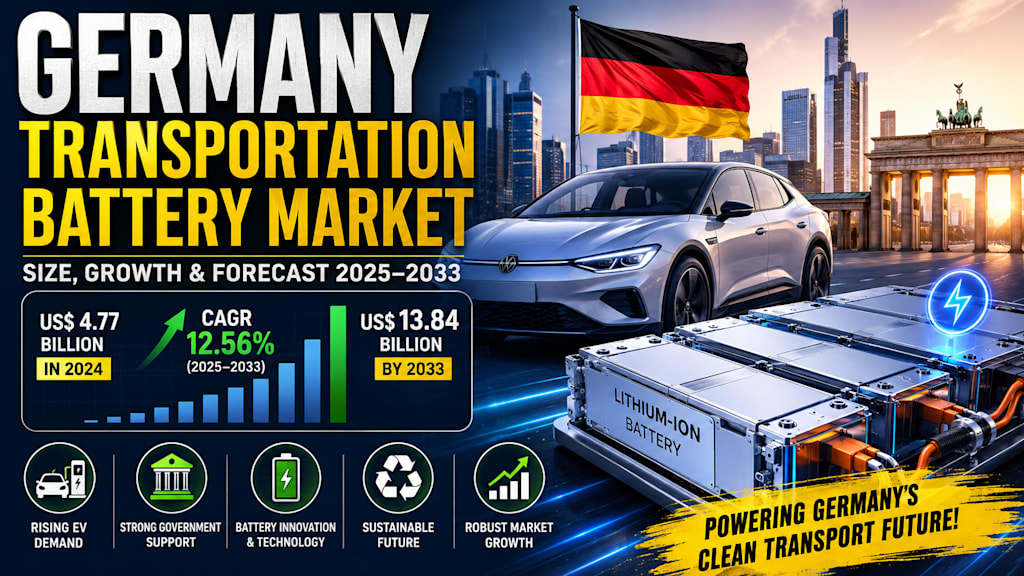
Germany Transportation Battery Market Size and Forecast 2025–2033
The Germany Transportation Battery Market is entering a transformative period driven by the rapid adoption of electric vehicles (EVs), advancements in battery technology, and the country's ambitious climate goals. According to Renub Research, the Germany Transportation Battery Market is projected to grow from US$ 4.77 billion in 2024 to US$ 13.84 billion by 2033, expanding at a CAGR of 12.56% between 2025 and 2033.
As Europe’s largest automotive market and one of the world's leading industrial economies, Germany is strategically positioned to become a powerhouse in battery production, energy storage innovation, and sustainable transportation. Increasing consumer demand for cleaner mobility solutions, strong government incentives, and substantial investments from automakers and technology companies are creating a favorable environment for long-term market expansion.
Germany's Transition Toward Sustainable Mobility
Germany has made sustainability a cornerstone of its economic and industrial development strategy. Transportation remains one of the largest contributors to greenhouse gas emissions, prompting policymakers to accelerate the transition toward electrified mobility.
Transportation batteries are at the heart of this transformation. They power electric passenger vehicles, commercial fleets, buses, and emerging mobility solutions while supporting the broader shift away from fossil fuels. As EV adoption increases nationwide, demand for high-performance batteries continues to surge.
The market is currently dominated by lithium-ion batteries due to their high energy density, reliability, and declining production costs. At the same time, research and development efforts are focused on next-generation battery technologies, including solid-state batteries, which promise improved safety, faster charging, longer life cycles, and greater efficiency.
Germany's commitment to reducing carbon emissions and achieving climate neutrality is encouraging both public and private sectors to invest heavily in battery innovation, production facilities, and charging infrastructure.
Strong Government Support Driving Market Expansion
Government policies remain one of the strongest growth catalysts for the transportation battery industry in Germany.
Federal and regional authorities have introduced a variety of incentives to encourage electric vehicle adoption and battery manufacturing. These initiatives include purchase subsidies for EV buyers, tax benefits, grants for charging infrastructure development, and financial support for battery research projects.
Germany also aligns closely with the European Union’s Green Deal objectives, which seek to reduce emissions and increase the use of renewable energy across member states. The country's climate targets have accelerated investments in clean transportation technologies and battery supply chains.
Public funding programs aimed at strengthening domestic battery production are helping reduce dependence on imports while creating new opportunities for local manufacturers. As a result, Germany is steadily building a resilient and competitive battery ecosystem capable of supporting future transportation needs.
The government's focus on energy security has further strengthened the market by encouraging domestic battery production and strategic partnerships throughout the value chain.
Germany's Automotive Leadership Fuels Battery Demand
Germany's reputation as a global automotive leader gives it a unique advantage in transportation battery development.
Major automakers are investing billions of euros into electric vehicle production, battery technology research, and manufacturing facilities. As companies transition their portfolios toward electric mobility, transportation batteries have become a critical component of future business strategies.
The country's extensive automotive supply chain provides a strong foundation for battery market growth. Component suppliers, engineering firms, software developers, and research institutions collaborate to accelerate innovation and improve manufacturing efficiency.
German manufacturers are increasingly integrating battery production into their operations to secure supply chains and reduce exposure to global market disruptions. This trend is creating significant opportunities for battery producers, material suppliers, and technology providers.
Additionally, growing exports of electric vehicles and battery-powered transportation solutions are enhancing Germany's position as a global hub for sustainable mobility innovation.
Technological Advancements Reshaping the Industry
Technology continues to play a central role in the evolution of Germany's transportation battery market.
Lithium-ion battery performance has improved significantly over the past decade, enabling longer driving ranges, faster charging times, and lower costs. Continuous improvements in battery chemistry are helping manufacturers meet rising consumer expectations while improving vehicle efficiency.
One of the most promising developments is the emergence of solid-state battery technology. These batteries offer enhanced energy density and safety compared to traditional lithium-ion systems. Although commercialization remains in progress, Germany is investing heavily in research and pilot production facilities.
Artificial intelligence and Internet of Things (IoT) technologies are also improving battery management systems. Advanced analytics help optimize charging cycles, predict maintenance needs, and extend battery lifespan.
Battery recycling technologies are receiving growing attention as manufacturers seek to recover valuable materials such as lithium, cobalt, and nickel. These innovations support circular economy objectives while reducing environmental impact and raw material dependency.
Together, these technological advancements are creating a more sustainable and efficient transportation battery ecosystem.
Challenges Limiting Market Growth
Despite strong momentum, several challenges continue to affect the Germany transportation battery market.
High Production Costs
Battery manufacturing remains capital intensive. Establishing large-scale production facilities requires substantial investments in equipment, technology, workforce development, and raw materials.
While economies of scale are gradually reducing costs, battery prices still influence vehicle affordability. Higher upfront costs can discourage some consumers from transitioning to electric mobility.
Manufacturers must continue improving production efficiency and supply chain management to maintain competitiveness in an increasingly crowded global market.
Infrastructure Gaps
Although Germany has made considerable progress in expanding charging infrastructure, disparities remain between urban and rural areas.
Major cities benefit from extensive charging networks, while less populated regions often face limited charging availability. This imbalance can create range anxiety among consumers and slow EV adoption.
Further investment in nationwide charging infrastructure will be essential to ensure equitable access and support long-term market growth.
Raw Material Supply Concerns
Transportation batteries depend on critical minerals such as lithium, nickel, cobalt, and graphite. Global competition for these resources has intensified, leading to concerns about supply security and price volatility.
Germany is actively exploring alternative sourcing strategies, recycling initiatives, and material innovations to reduce dependence on imported raw materials.
Battery Recycling and Sustainability Challenges
As EV adoption accelerates, battery recycling is becoming a critical issue for the transportation industry.
Germany's strict environmental standards require responsible handling of end-of-life batteries. However, recycling infrastructure remains insufficient compared to the anticipated volume of batteries reaching retirement over the coming decade.
Recovering valuable materials from used batteries is technically complex and often expensive. Many recycling processes require significant energy inputs and advanced technologies to achieve economic viability.
Without substantial investment in recycling facilities and innovative recovery methods, the growing volume of spent batteries could create environmental and supply chain challenges.
To address these concerns, Germany is promoting circular economy initiatives that prioritize material recovery, battery reuse, and sustainable manufacturing practices. Continued progress in this area will be vital for ensuring the long-term sustainability of the transportation battery market.
Regional Analysis: Key Growth Hubs Across Germany
North Rhine-Westphalia
North Rhine-Westphalia remains one of Germany's most important transportation battery markets. The region benefits from strong industrial infrastructure, advanced logistics networks, and a highly developed automotive supply chain.
Universities, research centers, and technology companies collaborate extensively on battery innovation, recycling technologies, and energy storage solutions. Investments in charging infrastructure and sustainable transportation projects continue to strengthen regional growth prospects.
Bavaria
Bavaria is a major contributor to Germany's transportation battery ecosystem due to its concentration of leading automotive manufacturers and engineering expertise.
The region supports advanced battery research, pilot production facilities, and large-scale manufacturing investments. Government-backed sustainability initiatives and renewable energy integration further support market expansion.
Bavaria's strong industrial base ensures its continued leadership in transportation battery innovation and commercialization.
Berlin
Berlin has emerged as a center for sustainable mobility innovation. The city hosts numerous startups, research institutions, and technology companies focused on battery development and smart transportation solutions.
Government support for EV adoption and charging infrastructure deployment has accelerated growth. Berlin's smart city initiatives are also driving demand for advanced battery technologies across public transportation and urban mobility applications.
Hamburg
Hamburg is gaining prominence through its focus on green logistics and transportation electrification.
The city's strategic position as a major logistics hub creates significant opportunities for electric commercial vehicles and battery-powered transport systems. Investments in electrified port operations and public transportation projects further contribute to regional market growth.
Strong collaboration among logistics providers, technology firms, and public authorities is helping Hamburg establish itself as a model for sustainable transportation development.
Competitive Landscape
Competition within the Germany transportation battery market is intensifying as global and regional players expand their presence.
Leading companies are investing in manufacturing capacity, battery research, strategic partnerships, and recycling capabilities. Innovation remains a key differentiator as firms seek to improve performance, reduce costs, and enhance sustainability.
Major market participants include:
Panasonic Corporation
Exide Industries
VARTA
Hitachi Group Ltd
Robert Bosch GmbH
Samsung SDI Co. Ltd
LG Chem Ltd
These companies are actively pursuing new technologies, production expansions, and collaborative ventures to strengthen their market positions.
10 Recent Developments in the Germany Transportation Battery Market
Octillion Power Systems announced at IAA Transportation 2024 in Hannover that it would introduce advanced battery systems specifically designed for the European transportation market.
Robert Bosch GmbH expanded investments in battery management systems to improve efficiency and performance for electric vehicles.
Samsung SDI continued strengthening partnerships with European automakers to support growing EV battery demand.
LG Chem Ltd increased research efforts focused on high-energy-density battery materials for next-generation electric mobility.
VARTA expanded battery innovation programs aimed at improving sustainability and manufacturing efficiency.
Panasonic Corporation accelerated development of advanced lithium-ion battery technologies to support future transportation requirements.
Hitachi Group Ltd enhanced digital battery monitoring solutions utilizing AI-based predictive maintenance capabilities.
Several German automotive manufacturers announced additional investments in local battery production facilities to reduce supply chain dependency.
New battery recycling projects were launched across Germany to improve material recovery rates and support circular economy objectives.
Public-private partnerships expanded nationwide charging infrastructure, helping increase electric vehicle adoption and transportation battery demand.
Market Segmentation
By Battery Type
Lead-Acid
Lithium-Ion
Other Battery Types
By Vehicle Type
Passenger Cars
Commercial Vehicles
By Drive Type
Internal Combustion Engine
Electric Vehicles
By States
North Rhine-Westphalia
Bavaria
Baden-Württemberg
Lower Saxony
Hesse
Berlin
Rhineland-Palatinate
Saxony
Hamburg
Rest of Germany
Future Outlook
The outlook for Germany's transportation battery market remains highly promising. Rising electric vehicle adoption, technological breakthroughs, supportive government policies, and expanding manufacturing capacity will continue to drive robust growth through 2033.
As the country strengthens its domestic battery supply chain and advances next-generation technologies, Germany is expected to maintain a leading position in Europe's transition toward sustainable mobility. Investments in recycling, infrastructure, and innovation will play a crucial role in overcoming existing challenges and ensuring long-term market resilience.
With transportation electrification becoming a national priority, the transportation battery industry is poised to become one of Germany's most important pillars of future economic and environmental progress.
About the Creator
Enjoyed the story? Support the Creator.
Subscribe for free to receive all their stories in your feed.
Comments
There are no comments for this story
Be the first to respond and start the conversation.