
GCC Liquid Biopsy Market: Precision Diagnostics Transforming Cancer Detection Across the Gulf
Rising cancer cases, rapid genomics innovation, and government healthcare investments are accelerating the growth of the GCC liquid biopsy market through 2033.

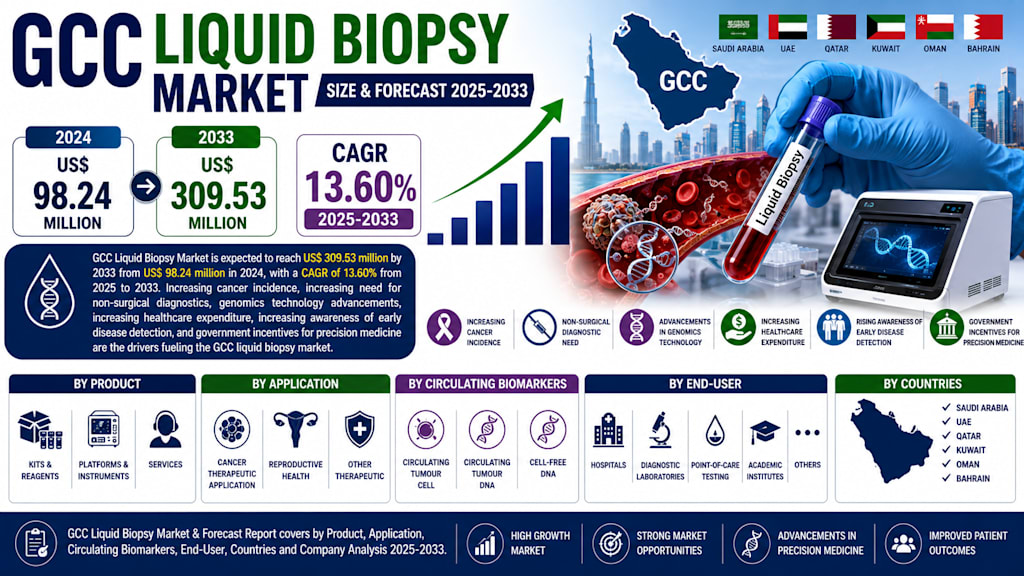
GCC Liquid Biopsy Market Overview
The GCC liquid biopsy market is entering a rapid growth phase as healthcare systems across the Gulf region increasingly focus on precision medicine, early cancer detection, and non-invasive diagnostics. According to Renub Research, the market is expected to grow from US$ 98.24 million in 2024 to US$ 309.53 million by 2033, expanding at a CAGR of 13.60% from 2025 to 2033. The market is being driven by rising cancer incidence, advancements in genomics technologies, increasing healthcare spending, growing awareness of early disease detection, and supportive government initiatives focused on modern healthcare transformation.
Liquid biopsy is a non-invasive diagnostic method used to detect and analyze biomarkers such as circulating tumor DNA (ctDNA), RNA, exosomes, and other tumor-related material from bodily fluids like blood, saliva, and urine. Unlike traditional tissue biopsies, liquid biopsies are less painful, quicker, and easier to repeat over time. These advantages are making the technology increasingly valuable for early cancer detection, treatment monitoring, recurrence tracking, and personalized therapy planning.
The healthcare industry in the GCC region is undergoing a broader transformation centered around digital healthcare, personalized medicine, and advanced diagnostics. Liquid biopsy fits directly into this trend because it provides real-time insights into tumor behavior without requiring invasive surgical procedures. As healthcare systems in Saudi Arabia, the UAE, Qatar, Oman, Kuwait, and Bahrain continue to modernize, liquid biopsy is becoming one of the most promising technologies in oncology diagnostics.
Rising Cancer Incidence Is Fueling Market Demand
One of the strongest growth drivers in the GCC liquid biopsy market is the increasing burden of cancer across the Middle East. The report states that more than 70% of cancer-related deaths occur in the Middle East, while the World Health Organization estimates that cancer cases in the region could triple by 2030. At the same time, several countries in the region still lack sufficient cancer treatment infrastructure, creating an urgent need for better diagnostic solutions.
Traditional tissue biopsy methods can be invasive, painful, expensive, and difficult to repeat regularly. Liquid biopsy offers an attractive alternative because it allows physicians to detect cancer-related biomarkers from a simple blood sample. This enables earlier diagnosis, more effective monitoring of treatment response, and improved identification of disease recurrence. As awareness grows regarding the importance of early cancer detection, healthcare providers in the GCC are increasingly adopting liquid biopsy technologies as part of broader oncology programs.
The growing incidence of breast cancer, colorectal cancer, lung cancer, and other forms of cancer in the Gulf region is expected to sustain long-term demand for advanced diagnostic platforms. Governments and private healthcare providers are also encouraging screening initiatives and early intervention strategies, further strengthening the role of liquid biopsy in modern cancer care.
Technological Advancements Are Reshaping Diagnostics
Technology advancement is another major factor accelerating the GCC liquid biopsy market. The report highlights rapid progress in next-generation sequencing (NGS), digital PCR, and microfluidics technologies, all of which are improving the sensitivity, speed, and accuracy of liquid biopsy testing.
NGS platforms are particularly important because they allow healthcare providers to identify complex genetic mutations and tumor biomarkers with greater precision. This supports personalized treatment decisions and targeted therapy selection, which are becoming increasingly important in oncology care. Digital PCR technology is also improving the detection of circulating tumor DNA, making it easier to identify cancer even at earlier stages.
Artificial intelligence and advanced analytics are further enhancing diagnostic efficiency. AI-powered interpretation tools can process large genomic datasets faster and improve clinical decision-making. As these technologies become more affordable and widely available, liquid biopsy is expected to move from specialized oncology centers into broader diagnostic use across hospitals and laboratories in the GCC region.
The combination of genomics, AI, and precision medicine is changing how cancer is diagnosed and treated. Instead of relying only on physical tissue samples, clinicians can increasingly monitor disease progression through repeat blood testing, providing more flexible and patient-friendly care pathways. This technological shift is expected to remain one of the market’s strongest growth engines through 2033.
Government Support and Healthcare Investments
Government support is playing a central role in expanding the GCC liquid biopsy market. Gulf countries are investing heavily in healthcare modernization programs, medical research infrastructure, and precision medicine initiatives. These investments are helping healthcare providers adopt advanced diagnostic technologies and improve oncology care standards across the region.
Saudi Arabia’s Vision 2030 program is one of the clearest examples of this transformation. The initiative includes major investments in healthcare infrastructure, digital medicine, and specialized cancer treatment centers. As part of this modernization effort, advanced diagnostic technologies such as liquid biopsy are gaining stronger institutional support.
The UAE is also actively promoting innovation in cancer diagnostics and treatment. Partnerships between healthcare authorities and international health insurers are supporting financing programs for cancer detection and treatment solutions, including colorectal, cervical, and breast cancer screening. These initiatives are creating favorable conditions for the adoption of liquid biopsy technologies throughout the healthcare ecosystem.
Across the GCC, public and private investments are supporting research institutes, oncology centers, and laboratory capabilities. These improvements are essential for expanding access to personalized medicine and non-invasive diagnostics. As governments continue prioritizing healthcare diversification and medical innovation, liquid biopsy is expected to become a core component of future cancer management strategies.
Market Challenges Continue to Affect Adoption
Despite strong growth prospects, the GCC liquid biopsy market still faces important challenges. High technology costs remain one of the biggest barriers to wider adoption. Advanced genomic testing platforms such as NGS and digital PCR require expensive equipment, specialized laboratory infrastructure, and highly trained professionals. These requirements can limit accessibility, especially for smaller clinics and public healthcare systems with tighter budgets.
The absence of universal insurance coverage for advanced diagnostics can also slow adoption. In some cases, patients may face significant out-of-pocket expenses for liquid biopsy testing, making affordability an ongoing concern. While healthcare spending is rising across the GCC, cost management remains an important issue for both providers and policymakers.
Regulatory complexity is another challenge. The report notes that inconsistent regulatory frameworks across GCC countries can delay market entry and create compliance difficulties for manufacturers. The absence of unified guidelines for liquid biopsy technologies may slow innovation and create uncertainty for companies seeking regional expansion.
However, as healthcare systems continue evolving and governments focus more heavily on oncology care, many of these challenges are expected to ease gradually over time. Increased investment, better training, and clearer regulatory pathways could significantly improve long-term market accessibility.
Saudi Arabia Leading Regional Expansion
Saudi Arabia represents one of the most important markets for liquid biopsy technologies in the GCC region. The country is investing heavily in advanced healthcare infrastructure, cancer research, and precision medicine as part of its Vision 2030 strategy. The report highlights how advancements in NGS and digital PCR are improving diagnostic sensitivity and supporting broader adoption of non-invasive cancer testing.
Specialized cancer care centers and research institutions are helping expand access to modern oncology diagnostics. Although challenges such as awareness and cost remain, Saudi Arabia’s healthcare modernization efforts are expected to create strong long-term opportunities for liquid biopsy providers.
UAE Strengthening Precision Medicine Adoption
The UAE liquid biopsy market is also growing rapidly due to rising healthcare expenditure and increasing adoption of precision medicine approaches. The country’s healthcare infrastructure is expanding quickly, with hospitals and research facilities integrating advanced diagnostic technologies into routine cancer care.
The UAE’s focus on innovation, medical tourism, and digital healthcare solutions is creating a supportive environment for liquid biopsy adoption. As awareness of personalized treatment options increases among physicians and patients, demand for non-invasive cancer monitoring tools is expected to remain strong.
Oman and Emerging GCC Markets
Oman is witnessing steady growth in liquid biopsy adoption as the country places greater emphasis on early cancer detection and healthcare modernization. The report notes that the increasing demand for personalized medicine and advanced diagnostics is encouraging broader use of liquid biopsy solutions.
Other GCC countries, including Kuwait, Qatar, and Bahrain, are also improving healthcare infrastructure and investing in oncology care capabilities. Although adoption levels may vary between countries, the overall regional trend points toward growing acceptance of precision diagnostics and minimally invasive cancer testing technologies.
Competitive Landscape and Major Companies
The GCC liquid biopsy market includes several leading global biotechnology and diagnostics companies. Key players mentioned in the report include F. Hoffmann-La Roche Ltd., Bio-Rad Laboratories, Thermo Fisher Scientific Inc., Johnson & Johnson, Guardant Health Inc., QIAGEN N.V., and Sysmex. These companies are investing heavily in genomic research, diagnostic innovation, and precision medicine technologies to strengthen their market positions.
Competition in the market is increasingly centered around test accuracy, genomic coverage, clinical validation, turnaround time, and AI integration. Companies are also working to expand partnerships with hospitals, laboratories, and research institutions throughout the GCC region. As adoption grows, strategic collaborations and localized healthcare initiatives are expected to become even more important.
Recent Developments by Companies
Roche expanded its oncology diagnostics portfolio in 2025 by increasing investment in precision medicine and companion diagnostics designed to support targeted cancer therapies and genomic testing.
Guardant Health continued expanding liquid biopsy applications for cancer screening and recurrence monitoring, strengthening its position in precision oncology diagnostics.
Thermo Fisher Scientific enhanced its NGS capabilities through ongoing investments in genomic sequencing technologies focused on cancer research and personalized medicine.
QIAGEN advanced biomarker testing solutions by improving molecular diagnostic workflows for oncology laboratories and research institutions.
Bio-Rad Laboratories strengthened digital PCR offerings designed to improve the sensitivity and accuracy of circulating tumor DNA detection.
Sysmex expanded partnerships in molecular diagnostics to improve cancer testing infrastructure and laboratory integration across healthcare systems.
Johnson & Johnson increased focus on oncology innovation by supporting precision medicine strategies linked to advanced biomarker detection technologies.
Roche continued developing AI-supported oncology diagnostics to accelerate genomic interpretation and improve treatment selection.
Guardant Health promoted broader clinical adoption of liquid biopsy by supporting studies focused on earlier cancer detection and therapy monitoring.
Thermo Fisher Scientific expanded collaborations with research institutes working on genomic sequencing and non-invasive cancer diagnostics in emerging healthcare markets.
Final Thoughts
The GCC liquid biopsy market is positioned for strong long-term expansion as healthcare systems across the Gulf region continue embracing precision medicine, genomics, and early cancer detection strategies. Rising cancer prevalence, improving healthcare infrastructure, and strong government investment are creating favorable conditions for market growth.
Liquid biopsy technologies are reshaping oncology care by providing faster, less invasive, and more personalized diagnostic solutions. As genomic technologies become more accessible and healthcare systems continue modernizing, liquid biopsy is expected to play an increasingly central role in cancer diagnosis, treatment monitoring, and personalized therapy across the GCC region.
About the Creator
Enjoyed the story? Support the Creator.
Subscribe for free to receive all their stories in your feed.
Comments
There are no comments for this story
Be the first to respond and start the conversation.