
GCC Hydroponics Market Set for Remarkable Growth as Food Security and Smart Farming Investments Accelerate
How Water-Efficient Agriculture Is Transforming Food Production Across the Gulf Cooperation Council

The Gulf Cooperation Council (GCC) is witnessing a significant transformation in agriculture. For decades, countries across the region have depended heavily on imported food because of desert landscapes, limited freshwater resources, and a shortage of fertile farmland. Today, however, governments and private investors are turning to hydroponics as one of the most promising solutions for achieving long-term food security while reducing pressure on natural resources.
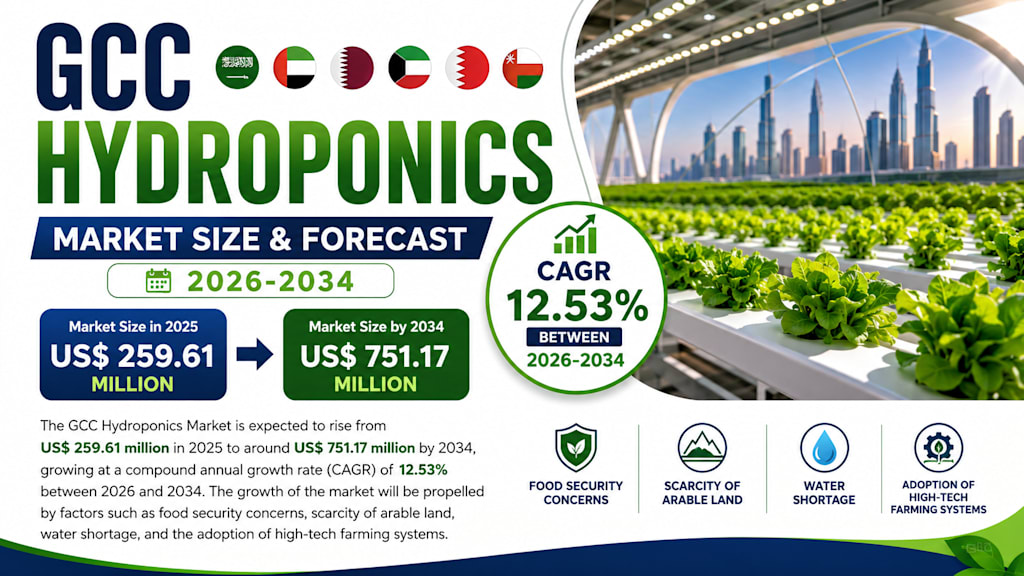
According to Renub Research, the GCC Hydroponics Market is projected to grow from US$259.61 million in 2025 to US$751.17 million by 2034, expanding at a compound annual growth rate (CAGR) of 12.53% between 2026 and 2034. This remarkable growth reflects increasing investments in smart agriculture, advanced greenhouse technologies, water-efficient farming systems, and locally produced fresh vegetables.
Hydroponics is no longer viewed as an experimental farming method. It has become a practical and commercially viable agricultural model capable of producing high-quality crops throughout the year despite the Gulf's harsh climate. As sustainability becomes a national priority across Saudi Arabia, the UAE, Qatar, Oman, Kuwait, and Bahrain, hydroponic farming is rapidly moving into the mainstream.
Understanding Hydroponic Farming
Hydroponics is a modern cultivation technique that allows plants to grow without soil. Instead of relying on traditional farmland, crops receive nutrients directly through carefully balanced water solutions. Their roots are supported by inert growing materials such as coco coir, perlite, or rockwool, while temperature, humidity, lighting, and nutrient delivery remain under precise control.
This controlled environment offers several advantages over conventional agriculture. Farmers can grow vegetables consistently throughout the year, use substantially less water, reduce pesticide usage, and produce cleaner, fresher crops with higher yields.
For GCC countries, these benefits are particularly valuable because environmental conditions often make conventional farming expensive and unpredictable.
Food Security Is Driving Agricultural Innovation
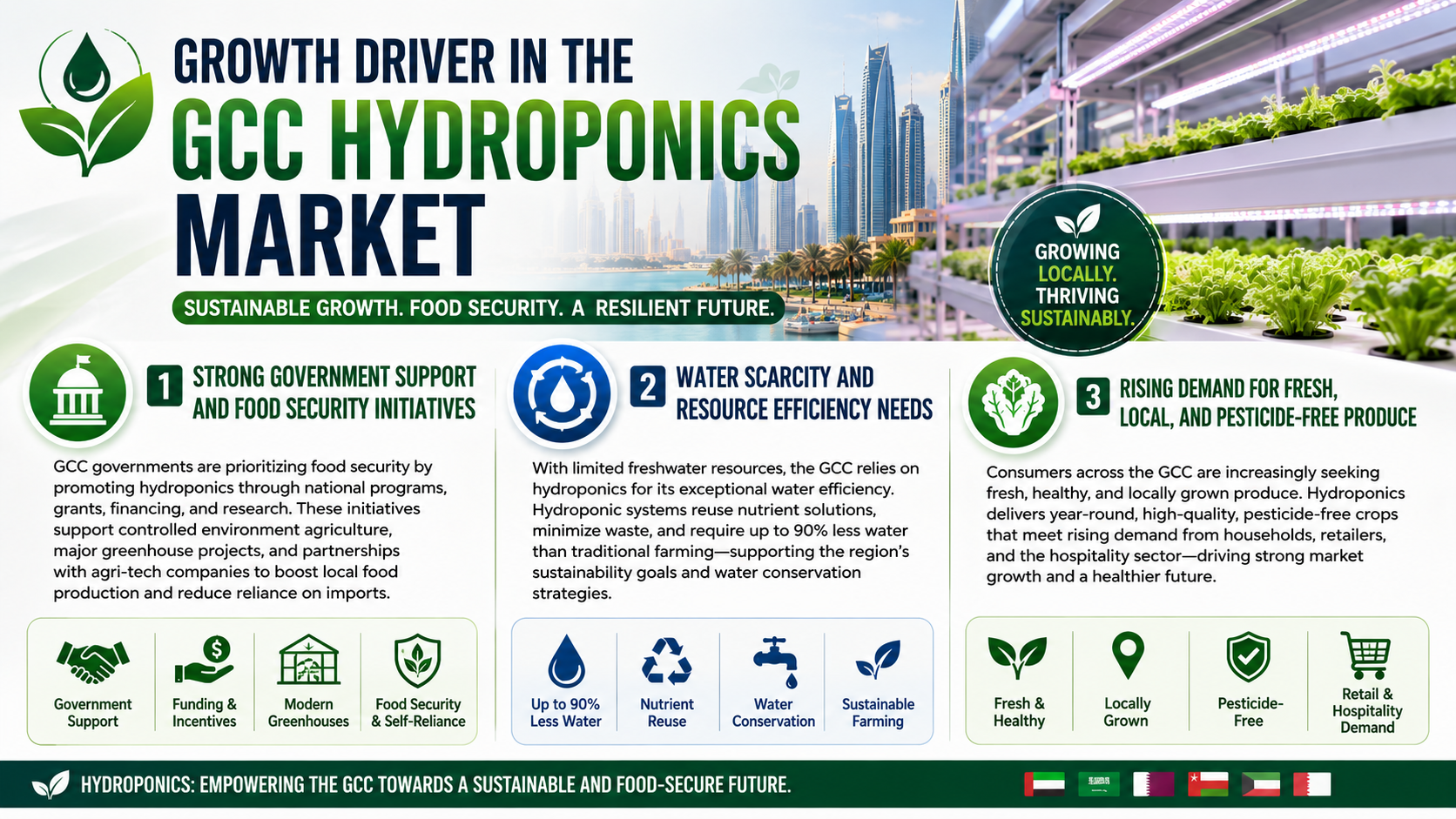
One of the strongest factors supporting hydroponic adoption is the GCC's determination to strengthen food security.
Most Gulf nations import a considerable share of their food requirements. Global supply chain disruptions over recent years have demonstrated how vulnerable import-dependent economies can become during geopolitical conflicts, pandemics, or transportation challenges.
Governments now view domestic food production as a strategic priority rather than simply an agricultural objective.
Large-scale greenhouse developments, agricultural research initiatives, public-private partnerships, and financial incentives are encouraging companies to establish advanced hydroponic farms capable of supplying fresh vegetables to local consumers.
These initiatives are helping countries reduce reliance on imported produce while improving long-term resilience.
Major Investments Are Reshaping GCC Agriculture
Investment activity throughout the GCC demonstrates the growing confidence in modern farming technologies.
Saudi Arabia continues expanding agricultural sustainability projects through billions of dollars in private investments supporting smart irrigation, regenerative agriculture, and food innovation facilities.
Qatar has committed substantial funding toward agricultural development while encouraging large-scale fertilizer production and food infrastructure projects designed to strengthen domestic production capabilities.
The United Arab Emirates continues implementing its ambitious Food Security Strategy 2051, supporting dozens of agricultural projects, smart farming businesses, and research centers dedicated to advanced cultivation technologies.
Oman has established the Future Fund Oman to diversify its economy by investing in sectors including agriculture, renewable energy, and manufacturing. International cooperation agreements are also supporting agricultural development in fertile regions of the country.
Kuwait and regional investment organizations continue signing agreements designed to expand agricultural financing and technological innovation throughout the Gulf.
These investments illustrate that hydroponics has become an important component of national economic planning rather than a niche agricultural activity.
Water Conservation Makes Hydroponics Essential
Water scarcity remains one of the GCC's greatest long-term environmental challenges.
Traditional farming consumes enormous quantities of freshwater, making it increasingly difficult to maintain sustainable agricultural production in desert climates.
Hydroponic systems address this challenge by recycling nutrient-rich water continuously throughout the growing process. Compared with conventional farming, hydroponics can reduce water consumption dramatically while maintaining excellent crop productivity.
Countries such as Qatar and Oman increasingly recognize that efficient water management is essential for future agricultural development.
Because hydroponic systems precisely deliver nutrients and moisture directly to plant roots, they minimize evaporation, runoff, and unnecessary waste.
As governments strengthen environmental sustainability goals, water-efficient agriculture will likely remain one of hydroponics' strongest competitive advantages.
Consumer Preferences Continue Changing
Consumer behavior across the GCC has evolved considerably over the past decade.
Health-conscious families increasingly seek locally grown vegetables that are fresh, nutritious, and produced with minimal pesticide use.
Restaurants, hotels, supermarkets, and premium grocery retailers also prefer dependable local suppliers capable of delivering consistent quality throughout the year.
Hydroponic farms satisfy these expectations by producing vegetables under carefully controlled conditions that reduce contamination risks while improving freshness.
Urban consumers are especially willing to pay premium prices for locally grown lettuce, tomatoes, herbs, cucumbers, peppers, and leafy greens.
This growing demand is encouraging retailers to expand partnerships with hydroponic producers throughout the region.
High Costs Remain an Important Challenge
Despite impressive growth prospects, hydroponics still faces several barriers.
Establishing commercial hydroponic facilities requires considerable capital investment. Climate-controlled greenhouses, irrigation systems, LED lighting, automated nutrient delivery, environmental monitoring equipment, and cooling infrastructure involve significant upfront expenses.
Operating costs also remain relatively high because maintaining ideal temperatures during extremely hot Gulf summers requires continuous energy consumption.
While large agricultural companies often possess sufficient financial resources, smaller farmers may struggle to invest without government support or favorable financing programs.
As technology becomes more affordable and economies of scale improve, installation costs are expected to decline gradually, making hydroponics accessible to more producers.
Skilled Professionals Are Increasingly Important
Modern hydroponic farming depends on technical knowledge as much as agricultural experience.
Successful growers must monitor nutrient concentrations, pH levels, lighting schedules, humidity, temperature, disease prevention, irrigation timing, and automated control systems.
Finding qualified professionals capable of managing these sophisticated operations remains challenging in some GCC countries.
Governments, universities, research institutions, and private companies are therefore expanding educational programs, technical workshops, and international partnerships to develop skilled agricultural professionals.
Workforce development will play an essential role in sustaining long-term market growth.
Aggregate Systems Continue Leading Adoption
Among various hydroponic methods, aggregate systems remain widely used throughout the GCC.
These systems utilize growing media such as sand, perlite, or rockwool to support plant roots while supplying nutrients through irrigation.
Farmers appreciate their relatively straightforward installation, reliable water retention, and suitability for large greenhouse operations.
Aggregate systems perform particularly well for tomatoes, cucumbers, lettuce, and several commercially important vegetables.
Their ability to conserve water while providing excellent root stability makes them highly compatible with Gulf farming conditions.
Liquid Hydroponic Systems Gain Momentum
Liquid systems including Nutrient Film Technique (NFT) and Deep Water Culture (DWC) are becoming increasingly popular, especially within urban farming projects.
These methods deliver nutrients directly through circulating water without requiring solid growing media.
Because they maximize space utilization and accelerate plant growth, liquid systems are ideal for indoor farms and vertical agriculture.
Cities across the UAE and Qatar have witnessed increasing adoption of these technologies as urban agriculture expands to meet rising demand for locally produced food.
Tomatoes and Herbs Lead Commercial Production
Tomatoes remain one of the GCC hydroponics market's most valuable crop categories.
Restaurants, supermarkets, food processors, and households consume large quantities of tomatoes throughout the year, creating strong demand for consistent domestic production.
Hydroponically grown tomatoes typically offer excellent appearance, flavor, shelf life, and production efficiency.
Fresh herbs including basil, mint, parsley, and coriander also represent an attractive market opportunity.
Their rapid growth cycles, premium pricing, and continuous consumer demand make herbs particularly profitable for hydroponic farms serving restaurants, hotels, and grocery retailers.
Climate Control Technology Supports Productivity
Environmental control systems have become essential components of successful hydroponic operations.
HVAC equipment regulates temperature, humidity, and airflow inside greenhouses, allowing plants to thrive despite the Gulf's challenging climate.
Modern irrigation technologies equipped with digital sensors, automated nutrient management, and water recycling capabilities further improve production efficiency while minimizing resource consumption.
These innovations continue improving crop quality while lowering long-term operational risks.
Saudi Arabia Emerges as a Regional Leader
Saudi Arabia continues investing aggressively in advanced agricultural technologies through Vision 2030.
Commercial hydroponic farms are expanding rapidly with support from government agencies and private investors.
Initiatives such as NEOM's Agri-FoodTech Accelerator and the establishment of Topian demonstrate the country's ambition to become a global leader in agricultural innovation.
These projects encourage international startups, technology companies, and research organizations to collaborate on next-generation farming solutions.
UAE Continues Setting the Pace
The United Arab Emirates remains one of the GCC's most advanced hydroponics markets.
Supportive government policies, sophisticated infrastructure, and strong consumer demand have encouraged widespread investment in vertical farms and climate-controlled greenhouses.
Major initiatives involving ADQ, the AgTech Park partnership, and the Agwa Center further strengthen the country's position as a regional innovation hub.
Its combination of technology, investment, and policy support provides a strong foundation for continued market expansion.
Qatar, Bahrain, Oman, and Kuwait Expand Their Presence
Qatar continues promoting hydroponics through research partnerships and food security initiatives focused on lettuce, cucumbers, herbs, and indoor farming technologies.
Bahrain is embracing hydroponics to overcome land and water limitations while increasing domestic vegetable production.
Oman continues integrating hydroponics into broader economic diversification plans through infrastructure investments and international cooperation.
Kuwait is gradually strengthening its agricultural ecosystem through investment partnerships supporting modern farming technologies.
Together, these developments demonstrate that hydroponics is becoming a regional priority rather than a country-specific initiative.
Future Outlook
The future of hydroponics in the GCC appears exceptionally promising.
Rapid urbanization, climate change concerns, increasing food demand, technological innovation, government investment, and sustainability commitments are collectively reshaping the agricultural landscape.
Artificial intelligence, automation, robotics, Internet of Things sensors, predictive analytics, renewable energy integration, and precision farming technologies are expected to make hydroponic operations even more productive and cost-efficient over the coming decade.
As production scales increase, locally grown vegetables may become increasingly competitive with imported alternatives, improving food security while supporting regional economic diversification.
Final Thoughts
Hydroponic farming has evolved from an innovative concept into one of the GCC's most important agricultural strategies. With governments investing heavily in smart farming, water conservation, climate-controlled agriculture, and food security initiatives, the sector is positioned for sustained expansion over the next decade.
Supported by strong consumer demand for fresh, locally grown produce and significant technological advancements, hydroponics is helping transform one of the world's most challenging agricultural environments into a center for sustainable food production.
As the market progresses toward an estimated US$751.17 million by 2034, hydroponics is expected to play an increasingly vital role in ensuring that GCC countries can produce more food with fewer natural resources while building resilient and sustainable agricultural systems for future generations.
About the Creator
Enjoyed the story? Support the Creator.
Subscribe for free to receive all their stories in your feed.
Comments
There are no comments for this story
Be the first to respond and start the conversation.