
GCC Hydroponics Market Expected to Reach US$751.17 Million by 2034 as Food Security and Water Conservation Drive Growth
Rising investment in sustainable agriculture, smart farming systems, and local food production is transforming hydroponic farming across the Gulf region

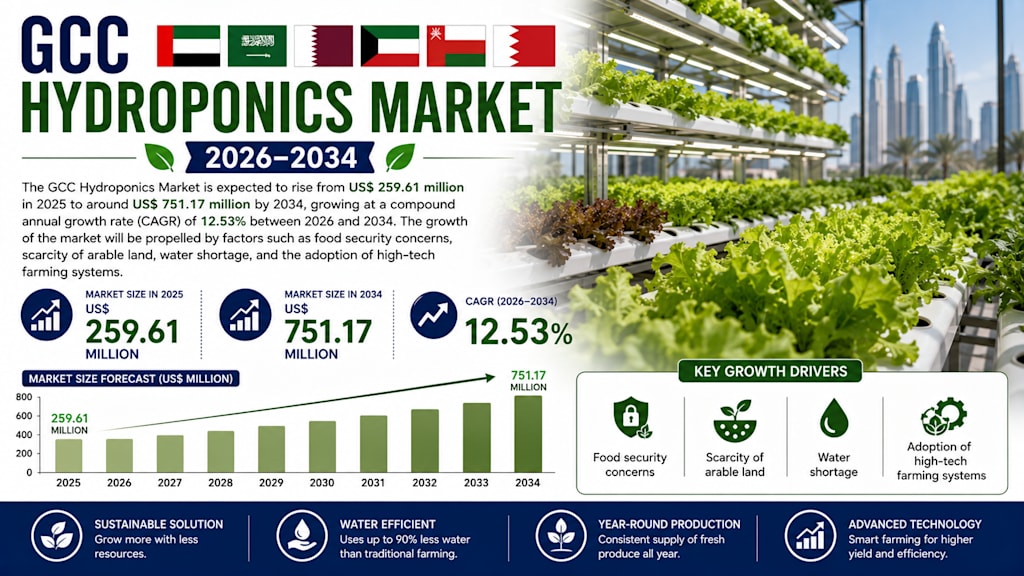
The GCC hydroponics market is rapidly emerging as one of the Middle East’s most promising agricultural sectors as Gulf nations intensify efforts to improve food security, reduce dependence on imports, and optimize water usage. Faced with harsh desert climates, limited arable land, and increasing environmental challenges, countries across the Gulf Cooperation Council are embracing hydroponic farming as a long-term solution for sustainable food production.
According to Renub Research, the GCC hydroponics market is projected to grow from US$259.61 million in 2025 to approximately US$751.17 million by 2034, expanding at an impressive compound annual growth rate (CAGR) of 12.53% between 2026 and 2034.
The market’s rapid expansion is being fueled by growing food security concerns, scarcity of fertile land, water shortages, and increasing adoption of high-tech agricultural systems. As GCC governments continue prioritizing agricultural modernization and sustainability initiatives, hydroponics is becoming a key pillar of the region’s future food strategy.
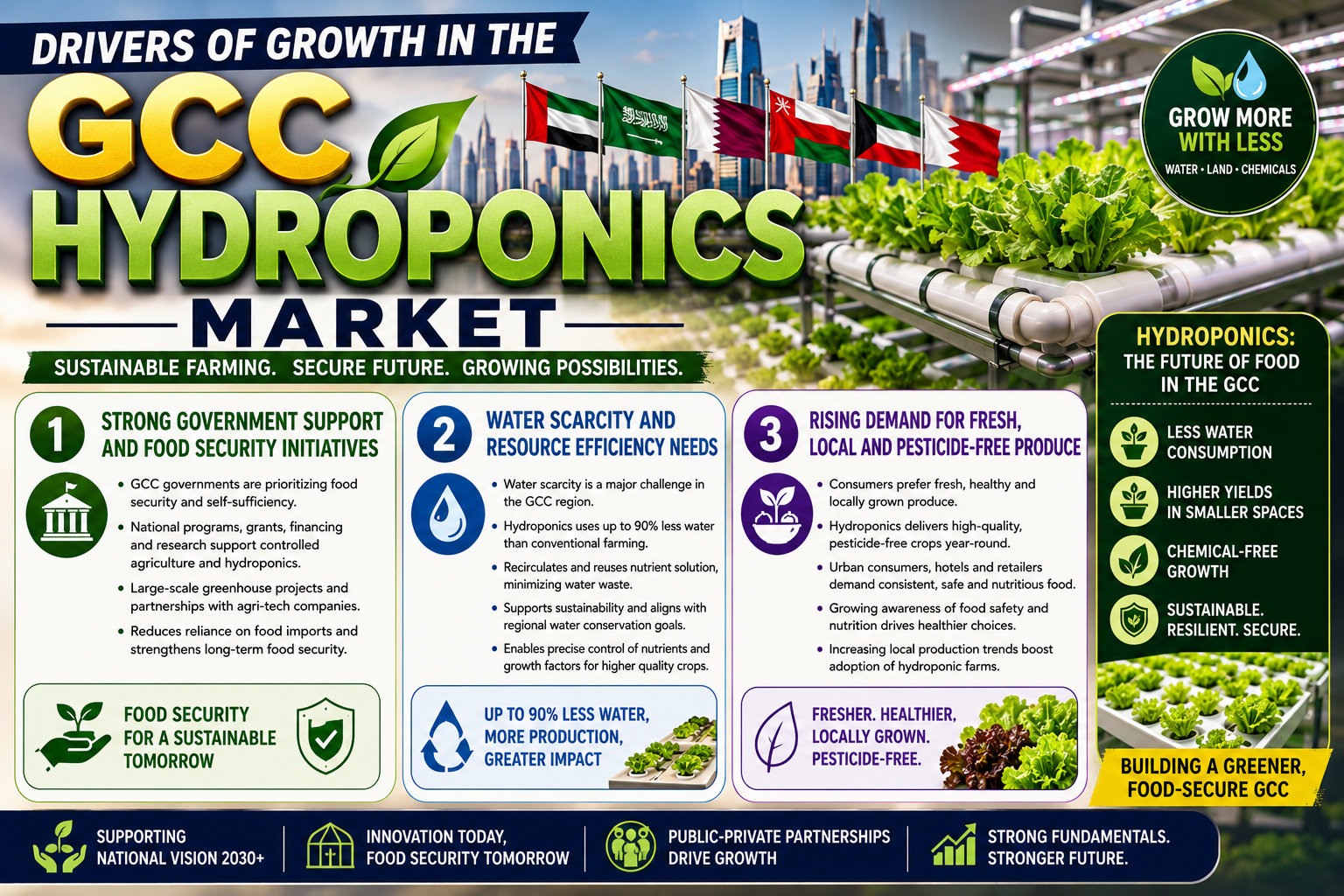
Hydroponics Is Solving Critical Agricultural Challenges in the GCC
Hydroponics is a modern agricultural technique that allows plants to grow without soil by using nutrient-rich water solutions instead. Crops are cultivated in controlled environments using non-soil growing mediums such as coco coir, perlite, and rock wool while environmental conditions are carefully regulated.
This method offers several major advantages particularly suited to the Gulf region, including:
- Significant water conservation
- Reduced land requirements
- Year-round crop production
- Lower pesticide usage
- Improved crop consistency
- Faster plant growth
Hydroponics has become increasingly popular across GCC countries such as Saudi Arabia, the UAE, Qatar, Oman, Kuwait, and Bahrain because traditional farming is heavily constrained by desert conditions and water scarcity.
The technology is now widely used for cultivating:
- Tomatoes
- Cucumbers
- Herbs
- Leafy greens
- Peppers
- Lettuce
Modern greenhouse systems and vertical farms are helping transform agricultural production in regions once considered unsuitable for large-scale farming.
Food Security Is Becoming a National Priority Across the Gulf
One of the strongest drivers behind the GCC hydroponics market is the growing urgency surrounding food security.
Many GCC nations remain heavily dependent on imported food products, making them vulnerable to global supply chain disruptions, climate-related shortages, and geopolitical instability. Governments are therefore investing aggressively in advanced agriculture technologies that can strengthen domestic food production capabilities.
Hydroponics is increasingly viewed as a strategic solution because it enables local food production despite extreme climate conditions.
Several major government investment initiatives highlighted in the report demonstrate the scale of this commitment:
- Saudi Arabia received US$9.8 billion in private investment for agricultural sustainability projects in 2025
- Qatar committed US$1.5 billion toward agricultural development through November 2025
- The UAE’s Food Security Strategy 2051 includes funding for 38 smart agriculture projects
- Oman’s Future Fund Oman was launched with an asset base of US$5.2 billion to support sectors including agriculture
These investments highlight how hydroponics is becoming deeply integrated into national economic diversification and food resilience strategies.
Water Scarcity Is Accelerating Adoption
Water scarcity remains one of the most critical environmental challenges facing GCC countries, making hydroponic farming particularly attractive.
Traditional agriculture consumes enormous amounts of water that are difficult to sustain in arid desert climates. Hydroponic systems, however, recycle nutrient-rich water solutions and use dramatically less water than conventional farming methods.
This water efficiency aligns closely with regional sustainability goals and conservation policies.
Countries such as Qatar and Oman are increasingly implementing hydroponic systems to improve agricultural water management while maintaining crop productivity. The ability to precisely control nutrients and environmental conditions further reduces resource waste and improves crop quality.
As environmental pressures and water shortages continue intensifying, hydroponics is expected to become even more important across the region.
Consumer Demand for Fresh and Local Produce Is Rising
Changing consumer preferences are also playing a major role in market growth.
Consumers across GCC nations increasingly prefer:
- Fresh produce
- Locally sourced foods
- Pesticide-free vegetables
- Organic farming methods
- Sustainable agricultural products
Urban consumers, hotels, supermarkets, and restaurants are increasingly seeking high-quality locally grown vegetables and herbs rather than imported alternatives.
Hydroponics provides year-round production capabilities that help meet these demands while reducing transportation time and improving freshness.
The growing awareness around food safety and nutrition is further strengthening consumer interest in hydroponically grown produce.
Smart Agriculture and Automation Are Transforming Farming
Technology is playing a transformative role in GCC hydroponic farming systems.
Modern hydroponic farms increasingly integrate:
- Smart irrigation systems
- Climate-controlled greenhouses
- Artificial intelligence
- Automated nutrient delivery
- LED grow lighting
- Environmental monitoring systems
These technologies improve crop productivity while reducing operational inefficiencies and resource waste.
Vertical farming systems are also becoming increasingly popular in urban environments where land availability is limited.
Governments and agritech firms are investing heavily in innovation to improve efficiency and scalability across hydroponic agriculture operations.
High Setup and Energy Costs Remain Major Challenges
Despite strong growth potential, the GCC hydroponics market still faces significant financial challenges.
Hydroponic facilities require expensive infrastructure investments, including:
- Climate-control systems
- LED grow lights
- Automated irrigation systems
- Cooling technologies
- Nutrient delivery equipment
Operating costs can also be substantial because maintaining controlled growing environments in extremely hot climates requires heavy energy consumption.
Although large agricultural companies may have the financial capacity to invest in hydroponics, smaller growers often struggle with the high initial capital requirements.
Government subsidies and support programs are helping address these barriers, but affordability remains a key industry challenge.
Skilled Workforce Limitations Continue Slowing Expansion
Hydroponic farming is highly technical and requires specialized expertise.
Managing nutrient solutions, environmental conditions, and automated systems demands skilled professionals trained in advanced agricultural technologies.
However, many GCC countries currently face shortages of local hydroponics specialists, leading to greater dependence on imported expertise and technology.
Training programs and knowledge transfer initiatives are gradually improving workforce capabilities, but skill development remains essential for long-term industry expansion.
Aggregate and Liquid Hydroponic Systems Are Expanding Rapidly
Aggregate Systems
Aggregate systems using growing mediums such as sand, perlite, and rock wool remain among the most widely adopted hydroponic methods across GCC countries.
These systems provide:
- Strong root support
- Efficient moisture retention
- Lower water wastage
- Scalability for greenhouse operations
They are especially popular for growing tomatoes, cucumbers, and lettuce in commercial greenhouses.
Liquid Systems
Liquid hydroponic systems such as Nutrient Film Technique (NFT) and Deep Water Culture (DWC) are also gaining momentum, particularly in urban vertical farms.
These systems deliver nutrients directly through water without requiring growing media, making them highly efficient for herbs and leafy vegetables.
The UAE and Qatar are particularly active in adopting liquid hydroponic technologies within smart agriculture initiatives.
Tomatoes and Herbs Lead Crop Production
Tomatoes
Tomatoes remain one of the most widely cultivated hydroponic crops in the GCC because of strong regional demand and high consumption levels.
Hydroponic cultivation enables year-round tomato production while improving flavor consistency, shelf life, and crop quality.
Consumers and restaurants increasingly prefer locally grown tomatoes due to freshness and reduced reliance on imports.
Herbs
Hydroponically grown herbs such as basil, mint, coriander, and parsley are also experiencing rising demand across the Gulf.
Hotels, restaurants, and supermarkets increasingly seek fresh herbs with consistent quality and minimal pesticide usage.
HVAC and Irrigation Technologies Are Becoming Essential
HVAC Systems
HVAC technology is critical within GCC hydroponic operations because it regulates temperature, humidity, and airflow inside greenhouses and vertical farms.
Energy-efficient climate-control systems are becoming increasingly important as operators seek to reduce high operational costs.
Irrigation Systems
Advanced hydroponic irrigation systems provide precise nutrient and water delivery while minimizing waste.
Popular technologies include:
- Drip irrigation
- Automated nutrient feeding
- Smart sensor-based water monitoring
- Water circulation systems
Governments such as Bahrain are actively supporting sustainable irrigation technologies as part of broader water conservation efforts.
Saudi Arabia and UAE Lead Regional Market Growth
Saudi Arabia
Saudi Arabia is rapidly expanding hydroponic agriculture through major investments tied to the Vision 2030 initiative. The country is aggressively promoting advanced farming technologies to strengthen food security and reduce import dependence.
The creation of the NEOM Agri-FoodTech Accelerator and the launch of Topian demonstrate Saudi Arabia’s growing focus on agricultural innovation.
United Arab Emirates
The UAE remains the regional leader in hydroponic farming because of strong government support, advanced infrastructure, and high consumer demand for premium produce.
In 2023, ADQ partnered with Italian firm ZERO to establish an AgTech Park focused on sustainable food production.
Qatar
Qatar is also investing heavily in hydroponics as part of its broader food security strategy. Hydroponic farms are increasingly being used to cultivate cucumbers, lettuces, and herbs under controlled conditions.
Bahrain
Bahrain is embracing hydroponics to address limited agricultural land and water shortages. In March 2024, Edamah partnered with Badia Farms to establish a hydroponic farm in the country.
Major Companies Intensify Industry Competition
Competition within the GCC hydroponics market continues intensifying as agritech companies expand operations and invest in controlled-environment agriculture.
Major players include:
- AeroFarms
- AmHydro
- Freight Farms
- BrightFarms
- LumiGrow
- Signify
Companies are increasingly focusing on automation, water efficiency, climate-control systems, and smart farming technologies to strengthen their market positions.
Final Thoughts
The GCC hydroponics market is entering a period of rapid transformation as governments, businesses, and consumers increasingly recognize the importance of sustainable and localized food production.
With the market projected to reach approximately US$751.17 million by 2034, hydroponics is expected to become a critical component of the Gulf region’s long-term agricultural and food security strategy.
However, future growth will depend on addressing challenges related to high operational costs, workforce training, and energy efficiency.
As climate challenges intensify and demand for fresh local produce continues rising, hydroponic farming may become one of the most important agricultural innovations shaping the future of food production across the GCC region.
About the Creator
Enjoyed the story? Support the Creator.
Subscribe for free to receive all their stories in your feed.
Comments
There are no comments for this story
Be the first to respond and start the conversation.