
GCC Foodservice Market to Reach US$ 170.47 Billion by 2034 as Tourism Growth and Digital Dining Trends Transform the Industry
Rising dining-out culture, expansion of entertainment infrastructure, and rapid adoption of delivery platforms are accelerating growth in the GCC foodservice market

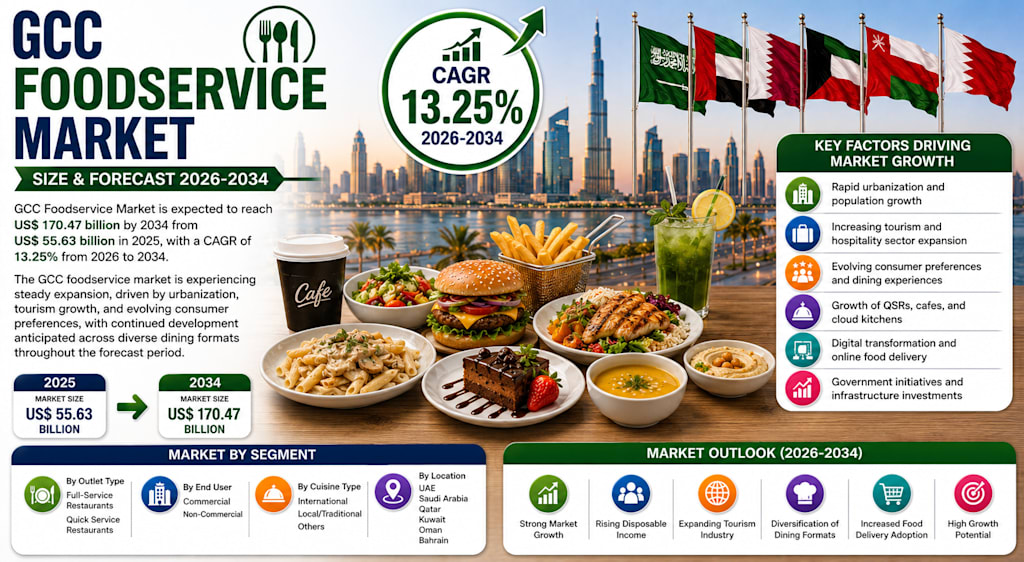
The GCC foodservice market is expected to witness remarkable growth over the coming decade as urbanization, tourism development, and changing consumer lifestyles continue reshaping the region’s dining landscape. According to Renub Research, the GCC foodservice market is projected to grow from US$ 55.63 billion in 2025 to US$ 170.47 billion by 2034, registering a CAGR of 13.25% from 2026 to 2034. Increasing demand for convenient dining experiences, expansion of retail and entertainment infrastructure, and rapid digital transformation are among the key factors driving long-term market growth across GCC countries.
The GCC foodservice industry has evolved into one of the region’s most dynamic sectors, reflecting economic diversification, rising disposable incomes, and increasingly modern consumer lifestyles. The market includes a broad range of dining formats such as fine dining restaurants, casual eateries, cafes, quick service restaurants, cloud kitchens, and large-scale catering services.
The multicultural population across GCC countries has significantly increased demand for international cuisines and innovative dining concepts. Consumers are increasingly exploring global flavors, premium food experiences, and convenient meal solutions that align with modern urban lifestyles.
At the same time, technological innovation, digital ordering systems, and food delivery applications are fundamentally transforming how foodservice businesses operate and engage with customers throughout the region.
Growing Dining-Out Culture Is Driving Market Expansion
One of the strongest growth drivers for the GCC foodservice market is the region’s rapidly expanding dining-out culture.
Social and cultural traditions across GCC countries strongly emphasize family gatherings, celebrations, and shared dining experiences. As disposable incomes continue rising, consumers increasingly spend on dining experiences ranging from casual outings to premium restaurant visits.
The report highlights that younger generations are particularly interested in exploring international cuisines, themed restaurants, and modern dining concepts, creating strong demand for innovative foodservice offerings.
Urbanization and increasingly busy lifestyles are also reducing the amount of time consumers spend preparing meals at home. This shift has significantly increased reliance on restaurants, cafes, and takeaway services.
The expansion of shopping malls, entertainment centers, and mixed-use urban developments further supports the dining-out culture by providing convenient access to a wide variety of foodservice outlets.
As consumer preferences continue evolving toward convenience and experience-driven dining, the GCC foodservice industry is expected to maintain strong long-term momentum.
Digital Transformation Is Reshaping the Competitive Landscape
Technology integration has become one of the most influential forces within the GCC foodservice industry.
Consumers increasingly rely on mobile applications and digital platforms for food ordering, table reservations, and payment processing. Businesses are rapidly adopting advanced technologies in order to improve convenience, operational efficiency, and customer engagement.
Key digital trends transforming the market include:
- Online food delivery applications
- Mobile-based ordering systems
- Contactless payments
- Loyalty applications
- AI-driven customer insights
- Cloud kitchen models
The report highlights that consumers increasingly seek speed, flexibility, and convenience, encouraging operators to strengthen digital capabilities across all service channels.
Cloud kitchens and delivery-focused restaurant concepts are becoming especially important because they allow businesses to reduce operational costs while expanding customer reach.
Foodservice operators also increasingly use data-driven analytics to understand customer behavior, optimize menus, and personalize promotional strategies.
This digital transformation continues redefining competition and creating new business opportunities across the GCC foodservice ecosystem.
Expansion of Retail and Entertainment Infrastructure Continues Supporting Growth
The rapid development of retail and entertainment infrastructure across GCC countries is significantly contributing to foodservice market expansion.
Shopping malls, mixed-use developments, entertainment complexes, and tourism destinations serve as major hubs for restaurant and cafe operations. These locations attract large consumer footfall and create strong visibility for foodservice brands.
The report highlights that foodservice integration within entertainment environments enhances consumer engagement while increasing spending across dining categories.
Key infrastructure developments supporting foodservice growth include:
- Luxury shopping malls
- Cinemas and entertainment zones
- Theme parks
- Tourism projects
- Cultural attractions
- Mixed-use urban developments
Large-scale infrastructure investments across GCC countries continue creating new opportunities for restaurant expansion and franchise development.
As urban development projects continue progressing, they are expected to further strengthen the overall ecosystem supporting foodservice businesses throughout the region.
Innovative Dining Concepts Are Transforming Consumer Experiences
Innovation in dining concepts is playing a critical role in shaping the GCC foodservice market.
Consumers increasingly seek unique and memorable dining experiences that extend beyond traditional restaurant formats. As a result, foodservice operators are introducing themed restaurants, fusion cuisine concepts, immersive dining environments, and highly personalized customer experiences.
The report highlights that businesses increasingly experiment with:
- Open-kitchen concepts
- Interactive dining experiences
- Menu customization
- Specialty cafes
- Experiential restaurant formats
- Sustainable dining concepts
Consumers also increasingly value authenticity, presentation quality, and premium ambiance.
Specialty cafes and niche foodservice segments are gaining popularity, particularly among younger consumers seeking distinctive social and lifestyle experiences.
As competition intensifies, continuous innovation will remain essential for attracting and retaining customers across the GCC foodservice industry.
Cloud Kitchens Are Emerging as a Fast-Growing Segment
Cloud kitchens are becoming one of the fastest-growing business models within the GCC foodservice market.
Delivery-focused kitchen operations allow companies to expand rapidly without the high costs associated with traditional dine-in restaurant infrastructure.
This model is particularly attractive in densely populated urban centers where commercial real estate costs remain extremely high.
Cloud kitchens provide several operational advantages including:
- Lower overhead expenses
- Faster scalability
- Delivery optimization
- Flexible menu development
- Greater operational efficiency
The growing popularity of food delivery applications throughout GCC countries continues accelerating adoption of cloud kitchen models.
This trend is expected to significantly reshape the future structure of the regional foodservice industry.
Tourism Development Continues Strengthening Market Demand
Tourism remains one of the most important long-term growth drivers for the GCC foodservice market.
Countries across the GCC continue investing heavily in tourism infrastructure, international events, luxury hospitality, and entertainment projects designed to attract global visitors.
Tourists frequently seek diverse dining experiences, increasing demand for:
- International cuisines
- Premium dining
- Quick service restaurants
- Cafes
- Luxury hospitality dining
- Experiential food concepts
The report highlights that tourism-driven commercial activity continues creating favorable conditions for restaurant expansion across airports, shopping centers, hotels, and entertainment districts.
As tourism development initiatives continue expanding across the GCC region, foodservice operators are expected to benefit from increasing visitor traffic and consumer spending.
Workforce and Talent Management Remain Significant Challenges
Despite strong market growth prospects, workforce management continues posing major operational challenges for GCC foodservice operators.
The industry depends heavily on a diverse labor force, requiring continuous recruitment, training, and retention efforts. High employee turnover rates can negatively affect operational consistency and service quality.
Managing multicultural workforces may also create communication and coordination challenges across restaurant operations.
The report highlights that maintaining consistent standards across multiple restaurant outlets requires ongoing investment in workforce development and staff training.
Labor regulations and staffing policies may further impact hiring flexibility and operational efficiency.
Foodservice companies increasingly focus on improving workplace environments, offering competitive benefits, and enhancing employee engagement in order to strengthen workforce stability.
Supply Chain Constraints Continue Affecting Operations
Supply-chain management remains another major challenge within the GCC foodservice industry.
Many GCC countries depend heavily on imported food ingredients, making the region vulnerable to global supply disruptions, logistics delays, and commodity price fluctuations.
Ensuring consistent availability of fresh and high-quality ingredients can therefore become operationally complex and expensive.
The report highlights that maintaining freshness and food quality during transportation requires highly efficient cold-chain logistics and storage infrastructure.
Foodservice operators increasingly need to strengthen supplier relationships, improve inventory management, and diversify sourcing strategies in order to reduce supply-chain risks.
The growing consumer demand for locally sourced and sustainable ingredients also introduces additional complexity for restaurant operators.
United Arab Emirates Leads the GCC Foodservice Market
The United Arab Emirates represents one of the most advanced and diverse foodservice markets within the GCC region.
The UAE offers a broad range of dining formats including luxury restaurants, casual eateries, cafes, takeaway concepts, and cloud kitchens. Its highly multicultural population creates strong demand for international cuisines and innovative dining experiences.
Urban centers such as Dubai and Abu Dhabi continue serving as major hubs for foodservice activity due to strong tourism, retail development, and consumer spending.
The report highlights that digital ordering systems and online food delivery services have significantly improved convenience and accessibility across the UAE foodservice sector.
The country’s ongoing investments in tourism, retail infrastructure, and entertainment continue positioning the UAE as a key driver of GCC foodservice growth.
Saudi Arabia Continues Expanding Through Urbanization and Youth Demand
Saudi Arabia remains one of the largest and fastest-growing foodservice markets in the GCC region.
The country benefits from a large and youthful population, rising urbanization, and increasing consumer spending on dining experiences.
Consumers increasingly prefer convenient dining options, modern restaurant concepts, and digital food-ordering services.
Major cities such as Riyadh and Jeddah continue witnessing aggressive restaurant expansion driven by urban development and changing consumer lifestyles.
Government initiatives supporting economic diversification and tourism growth further strengthen long-term market opportunities across Saudi Arabia’s foodservice industry.
Kuwait Market Benefits from Strong Dining-Out Culture
The Kuwait foodservice market is characterized by high consumer spending and a deeply established culture of dining out.
Consumers strongly value premium-quality food, international cuisines, and innovative dining experiences. Restaurants, cafes, and quick service outlets are highly concentrated within urban and retail centers.
Digital food ordering and delivery platforms continue strengthening convenience and accessibility across Kuwait’s evolving foodservice sector.
The report highlights that international brands and local operators compete aggressively through menu innovation, customer experience enhancement, and service quality improvements.
Bahrain Foodservice Market Continues Developing Steadily
Bahrain’s foodservice market reflects stable growth supported by tourism development and changing consumer preferences.
The country offers a balanced mix of traditional dining experiences and modern restaurant concepts catering to diverse tastes and demographics.
Online ordering platforms and delivery services continue strengthening market reach and customer convenience.
Operators increasingly focus on innovation, customer service, and premium dining experiences in order to remain competitive within Bahrain’s evolving foodservice landscape.
Recent Developments Highlight Rapid Industry Innovation
Several major developments reflect the rapid innovation occurring within the GCC foodservice market.
In September 2025, Brunch and Cake opened its sixth outlet at Palm Jumeirah Mall, offering all-day dining and freshly baked products including pastries, cakes, and croissants.
In July 2025, Little Caesars launched its first UAE location in Dubai as part of its global expansion strategy.
In June 2025, Papa John’s introduced a croissant pizza in the UAE featuring a flaky pastry-style crust combined with traditional pizza toppings.
Additionally, Pret A Manger opened its first Saudi Arabian location in Riyadh’s Olaya Towers during April 2025, marking a major milestone in the company’s GCC expansion plans.
These developments highlight how innovation, international expansion, and evolving consumer preferences continue shaping the GCC foodservice market.
Key Companies Operating in the GCC Foodservice Market
Major companies operating in the GCC foodservice market include Al Tazaj Fakeih, Alamar Foods Company, ALBAIK Food Systems Company, Galadari Ice Cream, Herfy Food Service Company, Kudu Company For Food And Catering, LuLu Group International, Riyadh International Catering Corporation, and Shahia Food Limited Company.
These companies compete through franchise expansion, digital ordering technologies, innovative dining concepts, customer experience enhancement, and strong retail positioning across GCC countries.
Final Thoughts
The GCC foodservice market is entering a period of accelerated expansion driven by urbanization, digital transformation, tourism development, and evolving consumer lifestyles.
Growing dining-out culture, rapid adoption of delivery platforms, expansion of entertainment infrastructure, and continuous innovation in restaurant concepts are fundamentally reshaping the regional foodservice landscape. According to Renub Research, the market is projected to reach US$ 170.47 billion by 2034, reflecting the enormous long-term growth potential of the GCC foodservice industry.
However, foodservice operators must continue navigating workforce management challenges, supply-chain complexities, and rising competitive pressure. Companies that successfully combine convenience, technological innovation, operational efficiency, and unique customer experiences are likely to lead the next phase of growth across the GCC foodservice sector.
About the Creator
Enjoyed the story? Support the Creator.
Subscribe for free to receive all their stories in your feed.
Comments
There are no comments for this story
Be the first to respond and start the conversation.