
From Kitchen Staples to Industrial Innovation: Why Potato Starch Is Becoming a Global Market Powerhouse
Growing demand for clean-label foods, sustainable industrial materials, and versatile plant-based ingredients is driving remarkable growth in the global potato starch market.

In today's rapidly evolving consumer landscape, ingredients once viewed as simple food additives are becoming strategic drivers of innovation across multiple industries. Among them, potato starch has emerged as one of the most versatile and increasingly valuable natural ingredients worldwide.
From improving the texture of processed foods and supporting gluten-free diets to enhancing paper manufacturing and enabling sustainable industrial applications, potato starch is finding new relevance in a marketplace increasingly focused on natural, renewable, and environmentally friendly solutions.
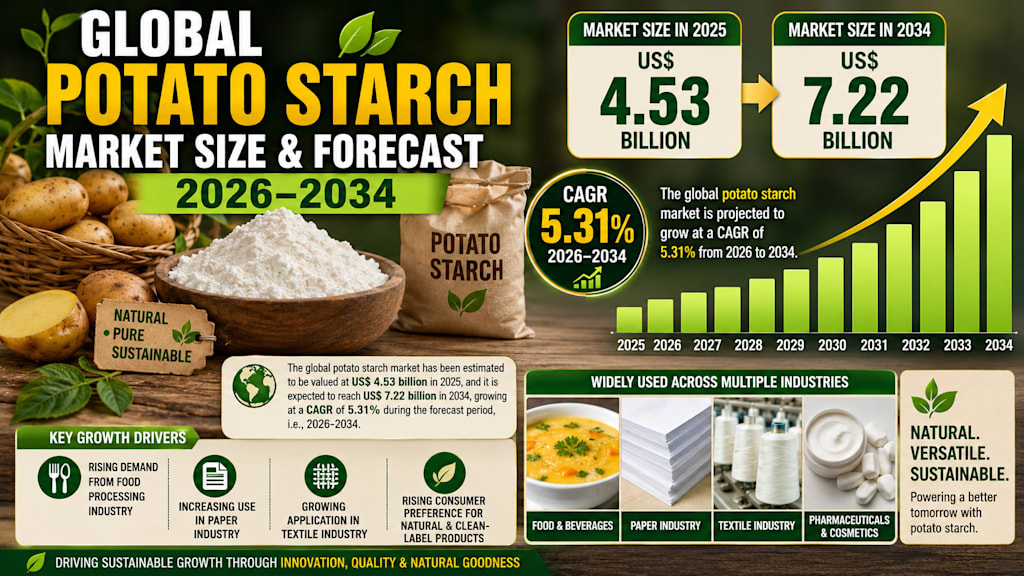
Its growing importance is reflected in strong market projections. According to Renub Research, the global Potato Starch Market was valued at US$ 4.53 billion in 2025 and is expected to reach US$ 7.22 billion by 2034, expanding at a compound annual growth rate (CAGR) of 5.31% from 2026 to 2034. Rising demand from food processing, textile, paper, pharmaceutical, and chemical industries continues to support steady market growth worldwide.
As industries seek sustainable alternatives and consumers increasingly prioritize natural ingredients, potato starch is becoming a critical component of modern manufacturing and food production.

Understanding the Importance of Potato Starch
Potato starch is a fine white powder extracted from potatoes through a process that involves crushing, washing, separating starch granules, and drying the final product.
The ingredient is widely recognized for its neutral flavor, excellent thickening properties, high viscosity, and moisture-retention capabilities. These characteristics make it particularly valuable in a wide range of food applications, including soups, sauces, bakery products, snacks, noodles, and frozen foods.
One of its greatest advantages is that it is naturally gluten-free. As consumer awareness regarding dietary restrictions and gluten sensitivity grows, potato starch has become an increasingly popular ingredient in gluten-free food formulations.
Beyond food applications, potato starch is used extensively in industries such as paper manufacturing, textiles, adhesives, pharmaceuticals, and biodegradable materials, highlighting its remarkable versatility.
Clean-Label Trends Are Transforming Consumer Preferences
One of the strongest drivers behind the potato starch market is the growing demand for clean-label and natural food products.
Today's consumers are paying closer attention to ingredient lists than ever before. Artificial additives, preservatives, and synthetic ingredients are increasingly being replaced by recognizable and naturally sourced alternatives.
Potato starch aligns perfectly with this shift.
As a plant-based, minimally processed ingredient, it serves as an effective thickener, stabilizer, and texturizer without conflicting with clean-label product positioning. Manufacturers are incorporating potato starch into numerous formulations to satisfy consumer demand for transparency and natural ingredients.
The ingredient's gluten-free nature further strengthens its appeal among health-conscious consumers and individuals following specialized diets.
As health and wellness trends continue influencing purchasing behavior, demand for natural ingredients like potato starch is expected to rise steadily.
A notable example of industry momentum occurred in June 2023 when Brenntag Specialties entered a strategic partnership with Royal Avebe to strengthen supply chain capabilities and expand access to potato starch solutions within the nutrition sector.
Food Processing Remains the Largest Market Segment
The food and beverage industry continues to represent the largest application area for potato starch globally.
Food manufacturers rely on potato starch because of its ability to improve texture, consistency, stability, and moisture retention while maintaining a neutral flavor profile.
The ingredient is widely used in soups, sauces, bakery products, processed meats, snacks, noodles, frozen foods, and ready-to-eat meals.
Modern consumers increasingly seek convenience without compromising quality. As demand for packaged and processed foods continues growing, particularly in emerging economies, potato starch has become an indispensable ingredient in industrial food production.
Its excellent heat stability and processing performance make it particularly suitable for large-scale manufacturing environments.
As global food consumption patterns continue evolving, the food and beverage sector is expected to remain the dominant force within the potato starch market.
The Processed Food Boom Is Creating New Opportunities
Changing lifestyles are contributing significantly to potato starch demand.
Busy work schedules, urbanization, and shifting dietary habits have increased reliance on convenient food products that are easy to prepare and consume.
Processed and ready-to-eat foods require ingredients capable of maintaining product quality throughout manufacturing, transportation, storage, and consumption.
Potato starch plays a crucial role in achieving these objectives by improving texture, consistency, shelf stability, and moisture retention.
The growth potential is especially evident in developing markets. According to data referenced in the market report, India's processed food industry is expected to reach approximately USD 470 billion by 2025, highlighting the significant opportunities available for functional ingredients such as potato starch.
As convenience food consumption expands globally, demand for potato starch is likely to grow alongside it.
Industrial Applications Are Expanding Rapidly
While food remains the largest application segment, industrial uses of potato starch are expanding at an impressive pace.
The paper industry utilizes potato starch as a coating and binding agent to improve paper strength, printability, and surface quality. Growing demand for packaging materials, driven partly by e-commerce expansion, continues supporting this application.
The textile industry benefits from potato starch's ability to improve fabric finishing and durability. Manufacturers use it during processing to enhance textile performance and quality.
Adhesive manufacturers also rely on potato starch because of its excellent binding characteristics, while pharmaceutical companies incorporate it into drug formulations as an excipient and stabilizing agent.
These diverse applications demonstrate why potato starch is increasingly viewed as more than a food ingredient—it has become a valuable industrial material with broad commercial relevance.
Sustainability Is Strengthening Market Demand
Environmental sustainability is becoming a major factor influencing purchasing decisions and industrial strategies worldwide.
Businesses across multiple sectors are actively seeking renewable, biodegradable alternatives to petroleum-based materials and synthetic chemicals.
Potato starch fits naturally within these sustainability goals.
Because it is derived from a renewable agricultural source, potato starch offers an environmentally friendly alternative for various industrial applications.
Researchers and manufacturers are increasingly exploring its potential in biodegradable plastics, sustainable packaging solutions, and bio-based materials.
The growing emphasis on circular economy principles and environmental responsibility is expected to further strengthen demand for potato starch-based innovations.
As governments and businesses pursue sustainability targets, renewable materials such as potato starch are likely to become even more important.
Modified Potato Starch Is Gaining Popularity
Modified potato starch represents one of the fastest-growing segments within the market.
Unlike native starch, modified starch undergoes physical, chemical, or enzymatic treatments to improve performance under demanding processing conditions.
These modifications enhance stability, texture, resistance to heat, acid tolerance, and processing durability.
As a result, modified potato starch is widely used in processed foods, industrial applications, adhesives, paper production, and advanced manufacturing environments.
Manufacturers increasingly favor modified starch because it delivers more consistent performance while meeting the requirements of modern production systems.
At the same time, ongoing innovation is helping producers develop modified starches that align with consumer demand for cleaner ingredient labels.
This balance between performance and consumer acceptance continues driving segment growth.
Conventional Potato Starch Maintains Strong Demand
While modified starch continues expanding, conventional potato starch remains an important market segment.
Native potato starch appeals to consumers seeking minimally processed ingredients and clean-label products.
Its natural composition makes it particularly attractive in food applications where simplicity and transparency are important purchasing factors.
Conventional potato starch is also widely used in traditional cooking, baking, and basic industrial applications where advanced performance characteristics are not required.
The ongoing popularity of organic and natural foods ensures continued demand for conventional starch products.
Pharmaceutical and Chemical Industries Are Increasing Adoption
The pharmaceutical sector represents another important growth area for potato starch.
Within pharmaceutical manufacturing, potato starch is frequently used as an excipient that improves tablet stability, disintegration, and drug release characteristics.
Its safety profile, natural origin, and functional performance make it highly suitable for pharmaceutical formulations.
The chemical industry is also increasing its use of potato starch in adhesives, coatings, biodegradable plastics, and environmentally friendly industrial products.
As pharmaceutical production expands globally and sustainability concerns influence industrial manufacturing, demand from these sectors is expected to increase steadily.
Challenges Facing the Potato Starch Market
Despite strong growth prospects, several challenges remain.
One of the most significant concerns involves raw material supply and price volatility.
Potato production is highly dependent on climatic conditions, including rainfall, temperature, soil quality, and weather stability. Poor harvests can reduce raw material availability and increase production costs.
Competition from alternative starches also presents challenges.
Corn starch, wheat starch, and tapioca starch are often readily available and can offer cost advantages depending on market conditions. In some applications, these alternatives may deliver comparable or superior performance.
Manufacturers must therefore continue emphasizing potato starch's unique functional benefits, sustainability advantages, and clean-label appeal to maintain competitiveness.
Regional Markets Driving Growth
The United States remains one of the most important potato starch markets globally.
A strong food processing sector, advanced manufacturing capabilities, growing demand for gluten-free products, and increasing emphasis on sustainability continue supporting market growth. In November 2024, KMC introduced CheeseMaker CF66, a potato starch-based ingredient designed to improve functionality and nutrition in plant-based cheese alternatives.
The United Kingdom benefits from strong demand for clean-label products and growing adoption of sustainable materials across food and industrial sectors.
India is emerging as an important growth market due to expanding food processing industries, rising disposable incomes, urbanization, and increasing demand for convenience foods.
Saudi Arabia is also witnessing steady growth driven by rising consumption of processed foods, expanding retail infrastructure, and increasing industrial demand.
These regional trends highlight the increasingly global nature of demand for potato starch products.
Final Thoughts
Potato starch may appear to be a simple agricultural ingredient, but its impact extends far beyond the kitchen. Its versatility, sustainability, functional performance, and compatibility with modern consumer preferences have positioned it as one of the most valuable natural ingredients across multiple industries.
From clean-label food products and gluten-free formulations to pharmaceuticals, paper manufacturing, biodegradable materials, and industrial applications, potato starch continues finding new opportunities for growth.
With the global market projected to increase from US$ 4.53 billion in 2025 to US$ 7.22 billion by 2034, the future looks highly promising. As consumers increasingly seek natural ingredients and industries pursue sustainable alternatives, potato starch is expected to remain at the center of innovation and market expansion for years to come.
What was once viewed primarily as a food thickener is rapidly becoming a strategic ingredient shaping the future of both food and industrial manufacturing worldwide.
About the Creator
Enjoyed the story? Support the Creator.
Subscribe for free to receive all their stories in your feed.
Comments
There are no comments for this story
Be the first to respond and start the conversation.