
Four Fractures, Four Timelines: What's Really Happening to Japan's Economy
Rare earths, rate hikes, a weak yen, and an aging population are all biting at once. But they don't share a single cause, and they won't share a single solution.
"You reap what you sow" is a satisfying phrase. It compresses complex causality into a moral story: what you did, you now bear. But if you look carefully at what the Japanese economy is going through in 2026, the picture is much messier than this framework suggests.
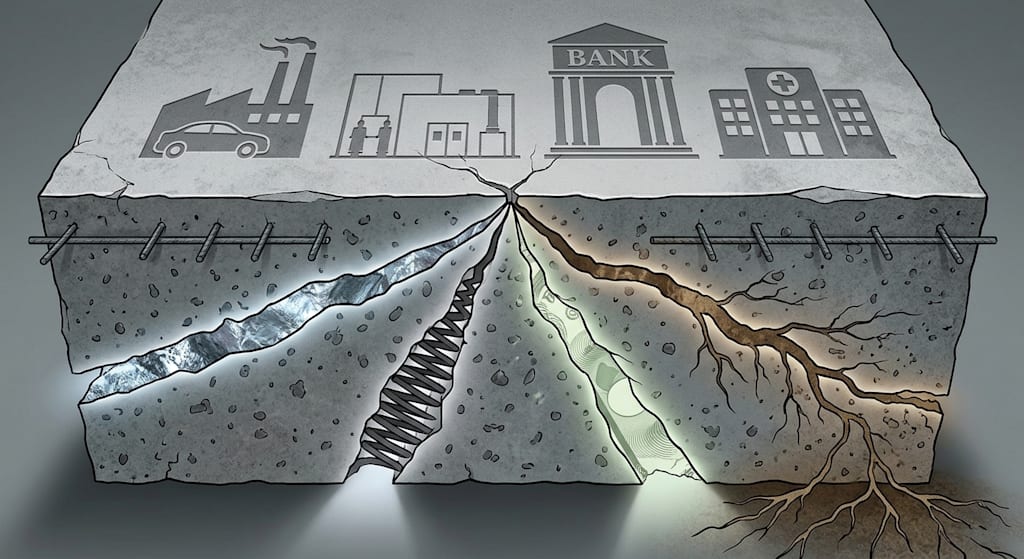
Rare-earth controls are biting. Autos and defense are under pressure. The wave of bankruptcies is accelerating. Aging is closing its net. But the logical relationships among these pressures don't all run in the same direction. Each has its own cause, its own timeline, and its own set of possible responses.
Squeezing all of them into the "you reap what you sow" narrative misses what matters. What the Japanese economy is experiencing is a structural clearing in which multiple fractures have opened at the same time. There is no single solution because there was no single cause.
The rare-earth shock: real, but not a zero-to-one cut-off
From January 2026, exports of dysprosium and terbium to Japan fell directly from about 14 tons per month to zero. By the first half of the year, Japan-bound exports of seven controlled rare earths had fallen by 51% overall. In June alone, Japan-bound rare-earth exports were down 81% year on year.
The review process didn't tighten. Specific categories were cut off completely.
Japan was not unprepared. After the brief 2010 embargo, Japan spent more than a decade building strategic reserves, and companies were required to hold safety stocks. In the early phase of the controls, Japan appeared not to have fallen into major disorder. But reserves were consumed faster than expected. By the end of May 2026, dysprosium and terbium stockpiles had been drawn down by about 60%. Signals on the auto side became concrete: Toyota cut hybrid-model production lines by about 40%; multiple Honda and Suzuki lines ran intermittently; within half a month of the controls taking effect, capacity at 12 production lines was halved.
The alternative supply gap is hard to close. Australia's Lynas produced 8 tons of dysprosium and terbium in the first quarter, while China's monthly supply to Japan alone had previously been 14 tons. Even if Australia gave all of its output to Japan, the shortfall would still be several times over.
Rare-earth controls are a trigger. They turned Japan's high concentration of dependence on China for key materials from a risk item long masked by inventories and management techniques into a constraint that had to be faced within months. Inventories can buy time, but they cannot buy an alternative supply chain. Once time runs out, pressure travels down the chain: from magnets to motors, from motors to vehicles, from vehicles to the tens of thousands of small and medium-sized suppliers with no capacity to stockpile.
Why defense had no priority
Japan's military-civilian integration model places defense projects at the bottom of the priority list when materials are short. For companies such as Mitsubishi Heavy Industries and Kawasaki Heavy Industries, civilian product lines are the main source of profit and cash flow. Defense orders in normal years are only a side business. When dysprosium, terbium, silicon carbide substrates, and high-purity gallium all become tight at the same time, the rational choice for factories is to protect the profitable large civilian orders first.
The delays in specific projects can be listed. The F-15J modernization upgrade has been delayed by at least two years because of a shortage of silicon carbide substrates. The F-2 successor has been forced to revise its design and rerun wind-tunnel testing because of supply-chain disruption. Work on the hypersonic missile project has stalled because of cut-offs in high-purity tungsten powder and samarium-cobalt magnets.
Equating project delays with defense paralysis is a stretch. Military-civilian integration is an efficiency arrangement when materials are abundant. When materials are scarce, it becomes a priority-squeezing mechanism: the logic of civilian profit automatically pushes defense to the back, without anyone having to make a decision to abandon defense.
Rate hikes and bankruptcies: a different story
One of the easiest misreadings in the viral essay is that it weaves the bankruptcy wave and rate hikes into the causal chain of "being counter-measured until it cannot hold." The deterioration in Japan's bankruptcy data in 2026 overlaps in time with rare-earth controls, but is essentially independent in causality.
In the first half of fiscal 2026, 5,373 bankruptcies involved liabilities of 10 million yen or more, the highest for the period since fiscal 2013 and the fifth consecutive year of increase. The daily average was about 29–30. But when the structure is broken down, the entities going under are mainly micro and small enterprises with fewer than 10 employees, accounting for 90%. Those with liabilities under 100 million yen account for nearly 80%.
What drove this wave was the Bank of Japan's decision in September 2026 to raise the policy rate to 1.25%, the highest since 1995. For more than a decade, near-zero financing costs, plus pandemic-era "zero-zero loans," bred a group of zombie firms with no capacity for self-generated cash flow that survived only by rolling over debt. Teikoku Databank puts the number at about 251,000, roughly 17% of all enterprises. Once the interest rate moved from "almost free" to "something that has to be paid," the conditions for these firms' continued existence disappeared.
The rate hike punctured the balloon Japan itself had inflated with three decades of zero interest rates. Rare-earth controls accelerated pressure in specific manufacturing links, but they are not the main cause of the bankruptcy wave. Writing the two as two sides of the same "you reap what you sow" story conceals a fact that is even more headache-inducing for Japanese policymakers: the bankruptcy wave is to a large extent the intended cost of monetary-policy normalization. Without rate hikes, zombie firms continue to absorb resources. With rate hikes, clearing accelerates, but the social cost of that clearing falls on the small firms and employees with the least buffer.
An exporter's identity, an importer's body
The role of yen depreciation in this round of pressure also needs its own section. In theory, currency depreciation in an export-oriented economy should help exports. But Japan's situation in 2026 is that depreciation is doing two opposite things at once: export values denominated in dollars are compressed by the exchange rate, while import costs for energy, raw materials, and food are pushed up by the exchange rate. More than 90% of Japan's energy is imported, so depreciation feeds directly into the cost side.
In the first half of 2026, 45 firms explicitly cited weak yen as the cause of bankruptcy, up more than 30% year on year, the highest for that period since the statistic began.
The identity narrative is still that of an exporting country. The body is already an importing country. Autos and semiconductor equipment remain important export pillars, but dependence on imported energy and raw materials makes the net effect of exchange-rate depreciation on the economy ambiguous or even negative. Japan has not occupied an ecological niche in the current global AI-chip boom comparable to that of China's Taiwan region or South Korea. The incremental sources of exports are themselves narrowing. Depreciation did not create this problem, but it made the problem more visible.
The photoresist reversal
The photoresist misreading in the viral essay best illustrates how the "you reap what you sow" narrative rearranges causality for the sake of completeness.
On June 22, 2026, Tokyo Ohka Kogyo, JSR, Shin-Etsu Chemical, and Fujifilm jointly announced a comprehensive tightening of supplies to China. New orders for high-end ArF/EUV photoresist were permanently suspended, new KrF orders were sharply compressed, and on-site process engineering teams in China were withdrawn.
This was a countermeasure Japan actively played in response to rare-earth pressure. The viral essay wrote that "Shin-Etsu Chemical and JSR have already stopped new orders for 3nm photoresist" and placed it in the sequence of "Japan being counter-measured until it cannot hold." The direction is the opposite.
This does not mean the photoresist card has no blowback for Japan. Japanese photoresist firms' high-end products do depend heavily on upstream materials such as Chinese rare earths, special heavy metals, and resin intermediates. The revenue loss from cutting off the Chinese market will in turn squeeze their R&D and capacity maintenance. But actively playing a card and absorbing blowback is a different causal structure from passively stopping orders because it can no longer hold. The first is a bargaining move. The second is a collapse symptom. Blurring them will lead readers to underestimate the chips Japan still holds in semiconductor materials and to overestimate the short-term "one-move checkmate" effect of rare-earth controls.
The hidden thread that decides the endgame
Among all the fractures, aging is the only line completely independent of the rhythm of external bargaining. In 2026, Japan's population aged 65 and over was 36.24 million, 29.6% of the total, a record high. Employed people aged 65 and over numbered 9.43 million, also a record.
In the bankruptcy data there is a structure easily masked by averages. 263 bankruptcies were due to "no successor," up 23.4% year on year and a record high. 240 were due to "labor shortage," also a record high. Among shops more than a century old, 112 had already gone bankrupt between January and August 2026.
These numbers describe an entire mechanism of enterprise continuity losing its carriers, not particular firms being poorly run. The owner is old. The children will not take over. The business still exists, but the person who runs it is gone. Rate hikes and rare-earth controls may accelerate or slightly delay the margins of this process, but they will not change its direction.
The most honest source in the data for the feeling that the Japanese economy "has no hope" is in these bankruptcy-cause categories. "Shut down because no one took over" says more than any monthly table of rare-earth exports falling to zero.
So where does "you reap what you sow" go wrong?
The viral essay's data mostly checks out. The daily average of 29–30 bankruptcies is accurate. The rate hike to 1.25% is accurate. The 251,000 zombie firms are the right order of magnitude. The 29.6% aging ratio is accurate. The scale of the rare-earth cut-off and the Australian replacement gap are also accurate.
The essay doesn't fabricate. Its problem is that it welds all the accurate data points into a single causal chain and reverses the direction of several links.
A picture closer to reality is the superposition of four layers of pressure, each with its own timeline and logic. Rare-earth controls are an external trigger that, within months, turns concentrated dependence on key materials from a risk into a constraint. Rate hikes are an internal policy choice that punctures the stock of zombie firms accumulated over three decades of zero interest rates. Yen depreciation is a revealing agent for a structural identity mismatch, letting an economy that is already import-based continue to understand exchange rates through an exporter's framework. Aging is a slow variable that does not join any bargaining game, but determines the social substrate on which the other three layers of pressure ultimately land.
These four layers of pressure all tightened at the same time in 2026. The result was the sensation that "everything is cracking." But attributing them to the same "hammer" makes people think that once that hammer is released, everything will return to what it was.
The Japanese economy faces a set of constraints with no single solution. Material sources require supply-chain reconstruction on a ten-year scale. The stock of debt requires a painful round of corporate clearing. What aging requires is more fundamental still. None of these three can be solved in the short term through diplomatic negotiation or inventory management.
The photoresist card shows that Japan is not a purely passive recipient. It is still playing cards, still has chips, and is still looking for space to trade in response to its structural predicament. But none of the cards in its hand can handle all four fractures at once.
About the Creator
Jin
Writer of reamstories
https://reamstories.com/jin
Enjoyed the story? Support the Creator.
Subscribe for free to receive all their stories in your feed. You could also become a paid subscriber, letting them know you appreciate their work.
Comments
There are no comments for this story
Be the first to respond and start the conversation.