
Flexible Packaging Market Growth Accelerates as Sustainable and Lightweight Packaging Becomes Essential Worldwide
Renub Research forecasts the global flexible packaging market to grow from US$ 143.72 billion in 2025 to US$ 202.79 billion by 2034, driven by rising demand from food, pharmaceutical, and personal care industries.

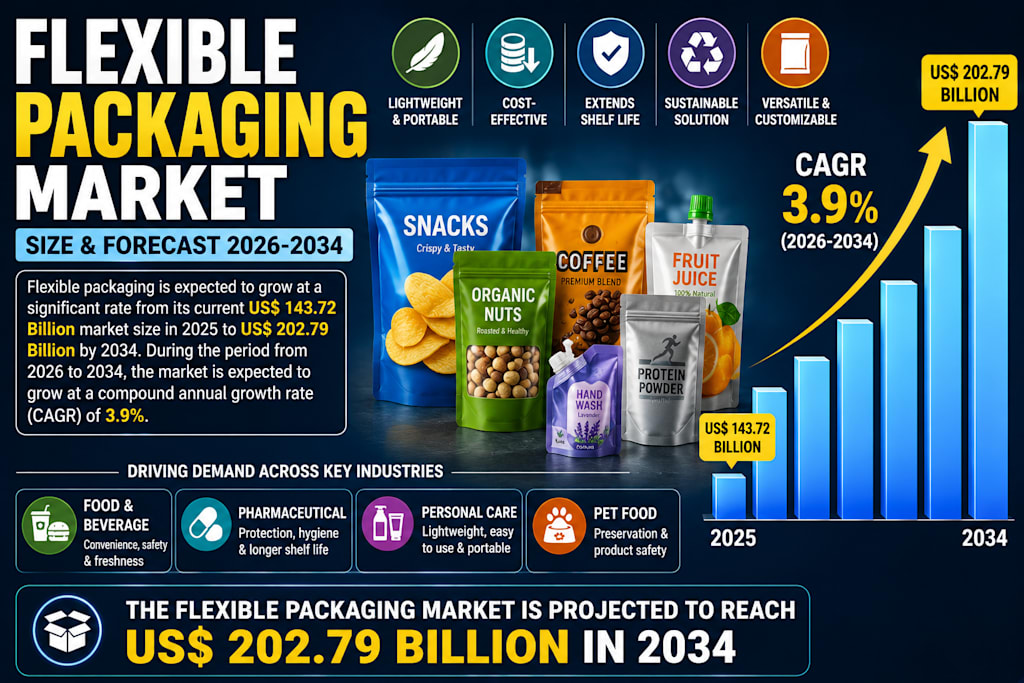
Flexible Packaging Is Transforming the Global Packaging Industry
The global packaging industry is evolving rapidly as manufacturers and consumers increasingly prioritize convenience, sustainability, cost efficiency, and product protection. Traditional rigid packaging solutions are gradually being complemented — and in many cases replaced — by more versatile alternatives that reduce material usage while improving storage and transportation efficiency. At the center of this transition is the growing flexible packaging market, which has become one of the most important segments of the modern packaging industry.
According to Renub Research, the global flexible packaging market is expected to expand from US$ 143.72 billion in 2025 to US$ 202.79 billion by 2034, registering a compound annual growth rate (CAGR) of 3.9% during 2026–2034. The market’s growth is being fueled by strong demand from food and beverage companies, pharmaceutical manufacturers, personal care brands, and the broader consumer goods industry.
Flexible packaging has become increasingly attractive because it combines functionality with efficiency. Lightweight materials, lower transportation costs, extended shelf life, attractive product presentation, and growing sustainability innovations are all helping drive adoption worldwide. As industries continue focusing on cost optimization and environmental responsibility, flexible packaging is becoming an essential part of global supply chains.
What Makes Flexible Packaging So Important?
Flexible packaging refers to packaging made from flexible materials such as plastic films, paper, aluminum foil, and composite materials. Unlike rigid packaging, flexible packaging can easily change shape and adapt to the product it contains. Common examples include pouches, bags, sachets, wraps, and flexible containers.
One of the biggest advantages of flexible packaging is its ability to protect products from moisture, oxygen, air, light, and contaminants. This protection helps preserve product quality while extending shelf life, especially for food, pharmaceuticals, and personal care products. Flexible packaging also offers practical convenience features such as resealable closures, easy-open designs, portability, and compact storage.
From snacks and frozen foods to medicines, cosmetics, detergents, and household products, flexible packaging has become deeply integrated into modern consumer lifestyles. The packaging format aligns particularly well with growing urbanization, on-the-go consumption habits, and the increasing demand for convenient packaged goods.
Food and Beverage Industry Is Driving Massive Demand
The food and beverage sector remains the largest contributor to the flexible packaging market. Modern consumers increasingly rely on packaged foods, ready-to-eat meals, snacks, frozen products, and beverages that require safe, lightweight, and convenient packaging solutions. Flexible packaging has become highly popular in this sector because it protects food freshness while improving transportation and storage efficiency.
Urbanization and busy lifestyles are major factors behind this growth. Consumers increasingly prefer portable and convenient food products that fit fast-paced daily routines. Flexible packaging supports these needs through lightweight and easy-to-carry formats that also improve shelf life and reduce food waste.
Manufacturers also benefit economically. Flexible packaging generally requires less material than rigid alternatives, reducing production costs and transportation expenses. Since packaging weight is lower, shipping becomes more efficient, helping companies reduce logistics costs while improving sustainability performance.
The file highlights innovations such as UFlex’s development of FSSAI-compliant recycled PET solutions for food and beverage packaging. Such advancements demonstrate how companies are increasingly combining sustainability with performance in food packaging solutions.
As global packaged food consumption continues rising, the food and beverage industry is expected to remain the largest growth engine for the flexible packaging market over the coming decade.
Sustainability Trends Are Reshaping Packaging Strategies
Environmental sustainability has become one of the most important forces influencing the global packaging industry. Governments, businesses, and consumers are increasingly demanding eco-friendly packaging solutions that reduce waste and lower carbon footprints. Flexible packaging is benefiting from this trend because it generally uses fewer raw materials and generates lower transportation emissions due to its lightweight structure.
Manufacturers are investing heavily in recyclable, biodegradable, and mono-material packaging technologies to address environmental concerns and comply with evolving regulations. Sustainable packaging is no longer simply a branding advantage; it is becoming a business necessity across many industries.
The file references innovations by companies such as Huhtamaki, which has developed mono-material flexible packaging technologies using paper, polyethylene, and polypropylene materials. These innovations aim to improve recyclability while maintaining product protection and packaging functionality.
Consumers are also becoming more environmentally conscious in their purchasing decisions. Brands that adopt sustainable packaging solutions increasingly gain positive attention from customers seeking eco-friendly products. This shift is encouraging more companies to redesign packaging systems around recyclable and low-impact materials.
Pharmaceutical and Personal Care Industries Are Expanding Adoption
Flexible packaging is also becoming increasingly important in the pharmaceutical and personal care sectors. In pharmaceuticals, packaging plays a critical role in ensuring product safety, hygiene, and regulatory compliance. Flexible packaging formats such as sachets, pouches, blister packs, and unit-dose packaging are widely used for medicines, capsules, powders, and healthcare products.
The rising global demand for healthcare products is directly contributing to the growth of pharmaceutical packaging solutions. Flexible packaging protects medicines from moisture, light, and contaminants while improving convenience for patients and healthcare providers.
The personal care industry is another major contributor to market expansion. Flexible packaging is commonly used for shampoos, creams, lotions, cosmetics, and travel-sized products because it combines portability with attractive product presentation. The growing popularity of single-use and travel-friendly products is further strengthening demand in this segment.
Cosmo Plastech’s expansion into pharmaceutical packaging solutions illustrates how companies are adapting flexible packaging technologies to meet the growing needs of healthcare and personal care industries.
Flexible Packaging Films Continue Dominating the Industry
Flexible packaging films remain one of the most important material categories within the market. These films are commonly made from polyethylene, polypropylene, polyester, and other materials that offer strong protective properties against moisture, oxygen, and contaminants.
Flexible films are widely used in food packaging, beverages, pharmaceuticals, and consumer goods because they combine durability with lightweight efficiency. Their ability to support high-quality printing also helps brands improve product visibility and shelf appeal.
Advancements in multi-layer film technologies have further enhanced the performance of flexible packaging by improving strength, durability, and barrier protection. At the same time, demand for recyclable and sustainable film materials continues to rise as environmental regulations become stricter globally.
Paperboard Flexible Packaging Is Growing Rapidly
Paperboard flexible packaging is gaining significant momentum because of rising environmental awareness and regulatory pressure to reduce plastic usage. Paperboard materials are renewable, recyclable, and increasingly preferred by consumers seeking environmentally responsible packaging options.
Paper-based flexible packaging is commonly used for dry food products, bakery items, snacks, and personal care goods. Technological improvements have strengthened the durability and protective performance of paperboard packaging, allowing it to compete more effectively with traditional plastic formats.
Many global brands are transitioning toward paper-based packaging to improve sustainability performance and align with consumer expectations regarding environmentally friendly products. This trend is expected to continue accelerating in the years ahead.
Plastic Flexible Packaging Still Holds the Largest Share
Despite sustainability concerns, plastic flexible packaging continues to dominate the market due to its durability, versatility, and cost efficiency. Materials such as polyethylene and polypropylene provide excellent barrier protection while remaining lightweight and affordable.
Plastic flexible packaging is widely used across food, beverages, pharmaceuticals, and household products because it offers features such as resealable closures, easy-open designs, and strong product protection. These advantages make plastic packaging highly practical for both manufacturers and consumers.
However, environmental concerns surrounding plastic waste are pushing manufacturers to invest in recyclable and biodegradable alternatives. The future of plastic flexible packaging will likely depend on how effectively the industry can improve recyclability and reduce environmental impact.
Regional Markets Continue Expanding Worldwide
The United States remains one of the most advanced flexible packaging markets globally due to strong demand from food, beverage, pharmaceutical, and personal care industries. The country also leads in packaging innovation and sustainability initiatives, with companies investing heavily in recyclable packaging technologies.
The United Kingdom market is benefiting from rising consumer demand for eco-friendly packaging solutions and strong regulatory support for sustainable materials. Companies are increasingly introducing paper-based and recyclable packaging formats to meet environmental expectations.
India’s flexible packaging market is expanding rapidly due to urbanization, rising disposable income, organized retail growth, and increasing demand for packaged foods and personal care products. The rapid expansion of e-commerce is also contributing significantly to packaging demand across the country.
Saudi Arabia is also witnessing strong market growth supported by industrial expansion, growing retail infrastructure, and increasing focus on sustainable packaging technologies. These regional trends highlight the increasingly global importance of flexible packaging solutions across industries.
Environmental and Supply Chain Challenges Still Exist
Despite strong growth prospects, the flexible packaging industry still faces several important challenges. One of the biggest concerns involves recycling complexity, particularly for multi-layer flexible packaging products that are difficult to process using traditional recycling systems.
Governments and environmental agencies are introducing stricter regulations aimed at reducing plastic waste, putting pressure on manufacturers to develop more sustainable alternatives. While innovation is progressing rapidly, achieving full recyclability without compromising product protection remains technically challenging.
Raw material price volatility is another major issue. Prices for plastic resins, aluminum, and paper fluctuate due to supply chain disruptions, geopolitical tensions, and global demand imbalances. These fluctuations can significantly impact production costs and profitability for packaging manufacturers.
Addressing sustainability and supply chain challenges will be critical for ensuring the long-term growth and resilience of the flexible packaging industry.
Final Thoughts
The flexible packaging market is becoming one of the most important components of the modern packaging industry. Its ability to combine convenience, product protection, lightweight efficiency, and sustainability makes it highly attractive across food, healthcare, personal care, and consumer goods sectors.
Renub Research’s forecast of the market growing from US$ 143.72 billion in 2025 to US$ 202.79 billion by 2034 reflects the increasing global demand for advanced and environmentally responsible packaging solutions. As consumer lifestyles evolve and sustainability expectations continue rising, flexible packaging is expected to remain at the center of the packaging industry’s future transformation.
About the Creator
Enjoyed the story? Support the Creator.
Subscribe for free to receive all their stories in your feed.
Comments
There are no comments for this story
Be the first to respond and start the conversation.