
Fiberglass Pipes Market to Reach US$ 7.97 Billion by 2033 as Infrastructure and Energy Investments Drive Demand
Corrosion-Resistant Piping Solutions Gain Global Momentum Across Oil & Gas, Water Management, and Industrial Applications

The global fiberglass pipes market is entering a new phase of expansion as industries increasingly seek durable, corrosion-resistant, and cost-effective alternatives to traditional metal piping systems. From oil and gas operations to municipal water networks and agricultural irrigation projects, fiberglass pipes are proving to be a preferred solution in environments where strength, longevity, and reliability are essential.
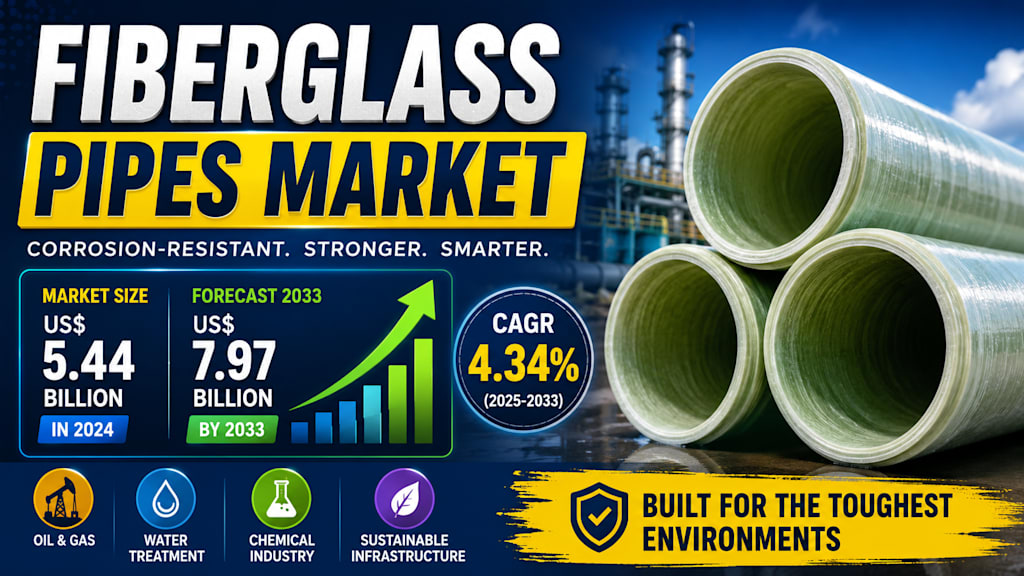
According to Renub Research, the Global Fiberglass Pipes Market was valued at US$ 5.44 Billion in 2024 and is projected to reach US$ 7.97 Billion by 2033, growing at a CAGR of 4.34% between 2025 and 2033.
The market's growth reflects broader trends in infrastructure modernization, energy sector expansion, urbanization, and sustainability initiatives worldwide. As governments and industries invest heavily in resilient infrastructure, fiberglass pipes are becoming a critical component in next-generation projects.
Understanding Fiberglass Pipes
Fiberglass pipes, commonly known as Fiberglass Reinforced Plastic (FRP) pipes, are composite structures manufactured using plastic resins reinforced with glass fibers. These pipes offer a unique combination of lightweight construction, high mechanical strength, corrosion resistance, and long service life.
Unlike traditional steel or metal pipes that may rust or deteriorate over time, fiberglass pipes maintain structural integrity even when exposed to aggressive chemicals, saline environments, and extreme temperatures.
Their superior performance has made them increasingly popular across multiple industries including:
Oil and Gas
Chemical Processing
Water Treatment
Wastewater Management
Power Generation
Marine Applications
Agricultural Irrigation
The ability to reduce maintenance costs while extending operational lifespan continues to position fiberglass pipes as a strategic investment for both public and private sector projects.
Growing Demand from the Oil & Gas Industry
One of the strongest growth drivers for the fiberglass pipes market remains the global oil and gas sector.
Energy companies are increasingly utilizing fiberglass pipes for transporting corrosive fluids, produced water, hydrocarbons, and chemical mixtures. Offshore drilling platforms and onshore exploration sites often operate in challenging environments where traditional metal pipelines are susceptible to corrosion.
Fiberglass pipes provide several advantages:
Excellent corrosion resistance
Reduced maintenance requirements
Lightweight transportation and installation
Longer operational lifespan
Improved safety performance
As global energy demand continues to rise, investments in exploration, production, and pipeline infrastructure are expected to generate sustained demand for fiberglass piping systems.
Countries such as India, Saudi Arabia, the United States, and several Middle Eastern nations are expanding their energy infrastructure, creating substantial opportunities for fiberglass pipe manufacturers.
Infrastructure Development Accelerating Market Expansion
Rapid urbanization is transforming infrastructure requirements worldwide.
Developing economies across Asia-Pacific, the Middle East, and Latin America are investing heavily in:
Water supply networks
Sewage treatment facilities
Industrial parks
Smart city projects
Irrigation systems
Governments are increasingly prioritizing durable infrastructure capable of operating efficiently for decades with minimal maintenance.
Fiberglass pipes meet these requirements by offering exceptional resistance to chemical degradation, soil corrosion, and environmental stress. Their long lifecycle significantly reduces replacement costs, making them attractive for large-scale public infrastructure projects.
India's continued investments in water distribution systems, urban development, and irrigation modernization are creating particularly favorable conditions for market growth.
Technological Advancements Reshaping the Industry
Innovation remains a major factor influencing the future of fiberglass piping systems.
Manufacturers are continuously improving materials, production methods, and product performance. Advanced fiberglass pipe variants such as Glass Reinforced Epoxy (GRE) and Glass Reinforced Plastic (GRP) pipes now offer enhanced:
Pressure resistance
Thermal stability
Structural strength
Operational longevity
Automation in manufacturing facilities is also improving consistency and reducing production costs.
Customized solutions are increasingly being developed for specific industries including:
Desalination plants
Chemical processing facilities
Power generation stations
Offshore energy projects
These innovations are helping fiberglass pipes compete more effectively against conventional materials while opening new application opportunities.
Market Challenges Remain
Despite strong growth prospects, several challenges continue to impact market expansion.
High Initial Investment
Fiberglass pipes generally require higher upfront investment compared to traditional materials such as steel, PVC, or concrete.
Although lifecycle costs are often lower due to reduced maintenance requirements, project developers operating under strict budgets may hesitate to adopt fiberglass solutions.
Installation Complexity
Specialized equipment and trained personnel are often required during installation.
In developing regions where technical expertise may be limited, installation challenges can affect adoption rates.
Environmental Concerns
The production process for fiberglass materials involves non-renewable resources and may generate emissions.
Additionally, recycling fiberglass composites remains a complex issue. As environmental regulations become stricter, manufacturers will need to invest in sustainable production and recycling technologies.
Product Segment Spotlight: GRE Pipes
Glass Reinforced Epoxy (GRE) pipes represent one of the most advanced categories within the fiberglass pipe market.
GRE pipes offer:
Exceptional corrosion resistance
High-pressure handling capabilities
Superior thermal performance
Long-term durability
These characteristics make GRE pipes especially valuable in offshore oil platforms, chemical processing facilities, and marine infrastructure projects where reliability is critical.
As industries seek high-performance piping systems for increasingly demanding applications, GRE pipe adoption is expected to continue rising.
E-Glass Fiberglass Pipes Gaining Popularity
E-glass fiberglass pipes utilize electrical-grade glass fibers that provide strong insulation and mechanical performance.
These pipes are widely used in:
Telecommunications
Electrical infrastructure
Chemical processing
Industrial manufacturing
Their non-conductive properties and corrosion resistance make them highly suitable for applications requiring both structural integrity and electrical insulation.
Growing industrial automation and infrastructure development are expected to support demand for E-glass fiberglass pipe solutions throughout the forecast period.
Water and Wastewater Applications Continue to Expand
Municipal water systems and wastewater treatment facilities are becoming major consumers of fiberglass pipes.
Benefits include:
Resistance to microbial degradation
Chemical resistance
Smooth internal surfaces
Improved flow efficiency
Reduced maintenance requirements
As urban populations continue to grow, governments are investing heavily in water infrastructure upgrades.
Fiberglass pipes provide a sustainable and cost-effective solution capable of supporting modern wastewater management systems while minimizing operational disruptions.
Irrigation Sector Driving Agricultural Adoption
Agriculture remains another important growth area for fiberglass pipes.
Modern irrigation systems require durable piping capable of withstanding exposure to:
Fertilizers
Chemicals
UV radiation
Variable weather conditions
Fiberglass pipes help reduce water losses caused by leaks and corrosion, improving overall irrigation efficiency.
With global food demand rising and precision agriculture becoming more widespread, farmers and agricultural authorities are increasingly turning toward advanced fiberglass piping systems.
Regional Market Highlights
United States
The United States remains one of the most technologically advanced fiberglass pipe markets globally.
Demand is supported by:
Water infrastructure modernization
Energy sector investments
Industrial development
Sustainability initiatives
Government-backed infrastructure programs are encouraging adoption of long-lasting corrosion-resistant materials.
France
France's emphasis on sustainable development and renewable energy infrastructure is supporting fiberglass pipe demand.
Applications are growing across:
Municipal water networks
Geothermal projects
Wastewater treatment
Hydropower facilities
The country's environmental policies continue to encourage the use of advanced composite materials.
India
India represents one of the fastest-growing markets worldwide.
Government initiatives such as:
Jal Jeevan Mission
Smart Cities Mission
Irrigation modernization programs
are creating substantial opportunities for fiberglass pipe manufacturers.
Growing urbanization and industrialization further strengthen market potential.
Saudi Arabia
Saudi Arabia's Vision 2030 strategy is driving significant infrastructure and industrial investments.
Fiberglass pipes play a crucial role in:
Desalination plants
Oil and gas facilities
Water distribution systems
Industrial projects
Harsh desert conditions make corrosion-resistant fiberglass solutions particularly attractive.
10 Recent Developments Shaping the Fiberglass Pipes Industry
1. Harrington Process Solutions Acquires Cortrol Process Systems (August 2024)
The acquisition strengthens Harrington's position in corrosion-resistant industrial flow control solutions and fiberglass systems.
2. Hobas Pipe USA Expands Manufacturing Capacity (April 2024)
The company increased production capacity by 50% to meet growing demand for large-diameter fiberglass pipes.
3. Rice University Develops GFRP Recycling Technology (February 2024)
Researchers introduced an innovative process to recycle glass fiber reinforced plastic into valuable silicon carbide materials.
4. Inpipe Sweden AB Enters Indian Market (August 2024)
The company announced a strategic partnership to introduce advanced UV-cured GRP liner technology in India.
5. Amiblu Supports UNESCO World Engineering Day 2025
The company became an official partner for UNESCO's sustainability-focused engineering initiative.
6. Future Pipe Industries Expands Dammam Facility
The Saudi Arabia plant added two new Flexstrong™ high-pressure spoolable pipe production lines.
7. Growing Investment in Desalination Projects
Fiberglass pipes are increasingly selected for large-scale desalination facilities worldwide.
8. Expansion of Smart Water Infrastructure Projects
Municipal authorities are integrating fiberglass solutions into next-generation water management systems.
9. Increased Focus on Sustainable Composite Manufacturing
Industry leaders are investing in environmentally responsible production methods.
10. Rising Adoption in Renewable Energy Projects
Fiberglass piping systems are finding new opportunities in geothermal, hydropower, and clean energy infrastructure.
Competitive Landscape
Major companies operating in the global fiberglass pipes market include:
PPG Industries
Future Pipe Industries
Chemical Process Piping Pvt. Ltd.
Saudi Arabian Amiantit Co
Russel Metals Inc.
Amiblu Holding GmbH
ANDRONACO INDUSTRIES
Gruppo Sarplast
These companies continue investing in product innovation, capacity expansion, strategic partnerships, and sustainability initiatives to strengthen their market positions.
Final Thoughts
The fiberglass pipes market is steadily evolving from a specialized industrial segment into a cornerstone of modern infrastructure development. As industries seek durable, lightweight, and corrosion-resistant alternatives to traditional materials, fiberglass pipes are becoming increasingly essential across energy, water management, chemical processing, and agriculture.
With the market expected to grow from US$ 5.44 Billion in 2024 to US$ 7.97 Billion by 2033, manufacturers that focus on innovation, sustainability, and application-specific solutions are likely to capture significant opportunities in the years ahead. As governments and businesses prioritize resilient infrastructure, fiberglass pipes are positioned to play a vital role in building the future of global industrial and municipal networks.
About the Creator
Enjoyed the story? Support the Creator.
Subscribe for free to receive all their stories in your feed.
Comments
There are no comments for this story
Be the first to respond and start the conversation.