
Evaporative Cooler Market Gains Momentum as Heatwaves and Energy Costs Rise
Climate change, growing demand for energy-efficient cooling, and the push for eco-friendly technologies are driving global adoption of evaporative coolers.

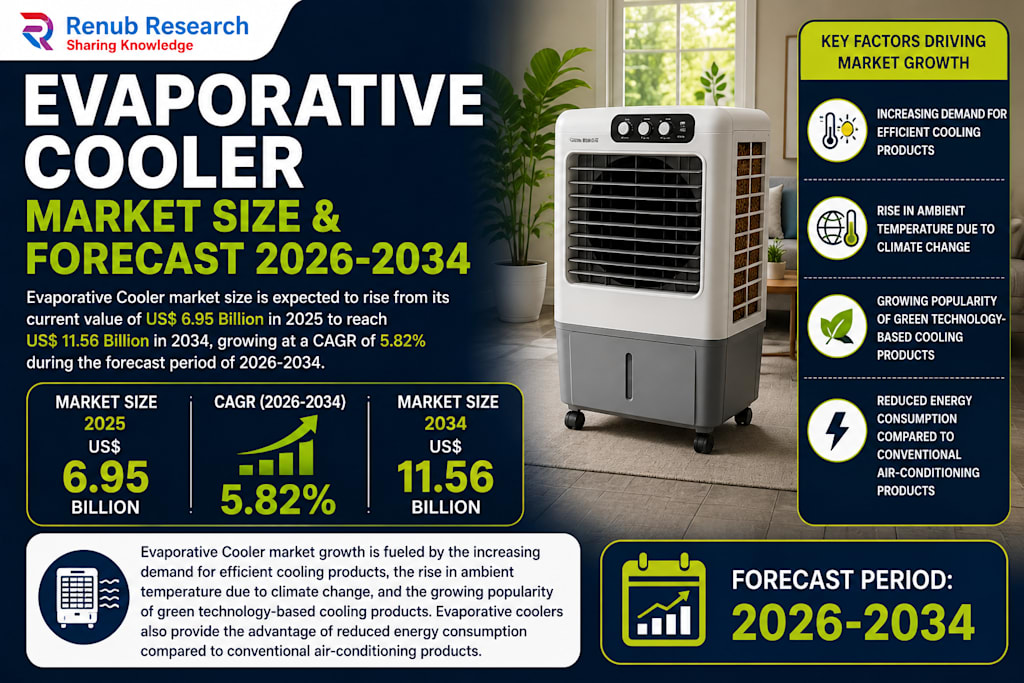
The global cooling industry is entering a period of rapid transformation as rising temperatures, increasing electricity costs, and environmental concerns reshape consumer preferences worldwide. Among the fastest-growing alternatives to traditional air conditioning systems are evaporative coolers, often known as swamp coolers, which offer energy-efficient and environmentally friendly cooling solutions. According to Renub Research, the global evaporative cooler market is expected to increase from US$ 6.95 billion in 2025 to US$ 11.56 billion by 2034, growing at a compound annual growth rate (CAGR) of 5.82% between 2026 and 2034. Increasing global temperatures, rising energy demand, and growing awareness of sustainable technologies are helping drive this expansion.
Evaporative Coolers Are Emerging as a Sustainable Cooling Alternative
An evaporative cooler is a cooling device that works by using water evaporation instead of chemical refrigerants to reduce air temperature. Unlike traditional air conditioning systems that rely on compressors and refrigerants, evaporative coolers pull warm air through water-saturated cooling pads. As water evaporates, the air cools naturally before being circulated into indoor spaces through a fan.
This process makes evaporative coolers significantly more environmentally friendly compared to conventional air conditioners. Because they use water and air rather than refrigerants, they consume far less electricity and produce lower carbon emissions. Their simple design also makes them easier to install and maintain, which has helped expand adoption across homes, offices, warehouses, workshops, factories, and outdoor spaces.
The growing popularity of evaporative coolers reflects broader global concerns surrounding energy efficiency, climate change, and rising electricity prices. In many developing countries, evaporative coolers are becoming practical alternatives to expensive air-conditioning systems for households and small businesses.
Rising Temperatures and Heatwaves Are Increasing Demand
One of the strongest drivers behind the evaporative cooler market is the growing intensity of global heatwaves and rising surface temperatures caused by climate change. According to NASA scientists, 2024 became the hottest year on record, with global average surface temperatures reaching approximately 1.28°C above the 20th-century baseline. The warming trend has been reinforced by an unprecedented streak of record-high monthly temperatures beginning in mid-2023.
As climate conditions worsen, more regions worldwide are experiencing prolonged heatwaves and dangerously high temperatures. These environmental changes are creating urgent demand for affordable cooling technologies capable of providing relief during extreme weather events.
Evaporative coolers are especially effective in hot and dry climates where low humidity allows water evaporation to cool air efficiently. This makes them highly attractive in regions where conventional air conditioning may be too expensive or energy-intensive for widespread use.
The increase in extreme temperatures is not only influencing residential demand but also commercial and industrial adoption, particularly in warehouses, factories, workshops, and semi-open spaces that require continuous airflow and cooling.
Energy Efficiency Is Becoming a Major Priority
Another major growth driver for the market is the increasing demand for energy-efficient cooling systems. Conventional air conditioners consume significant amounts of electricity because they depend on compressors and refrigerant-based cooling systems. Evaporative coolers, by contrast, use far less power because they rely mainly on fans and water evaporation.
As electricity prices continue rising globally, both households and businesses are searching for cooling technologies capable of lowering operating costs without sacrificing comfort. Governments and environmental organizations are also encouraging the use of energy-efficient appliances as part of broader sustainability initiatives.
The emphasis on energy conservation is particularly important in regions where cooling demand is growing rapidly because of rising temperatures and urbanization. Energy-efficient cooling technologies are becoming essential not only for reducing costs but also for minimizing strain on electrical infrastructure during peak summer demand periods.
The HVAC industry is responding to this trend with new investments and manufacturing expansion. In November 2025, Daikin announced the construction of a new HVAC manufacturing facility in Jeddah in partnership with Daikin Saudi Arabia, reflecting rising demand for energy-efficient climate-control technologies in the Middle East.
Eco-Friendly Cooling Solutions Are Attracting Consumers
Environmental sustainability is also becoming one of the biggest reasons consumers and businesses are considering evaporative cooling systems. Traditional air-conditioning systems often use chemical refrigerants that contribute to greenhouse gas emissions and ozone depletion. Evaporative coolers avoid these environmental concerns by relying on natural cooling processes involving only water and air.
Their lower electricity consumption also helps reduce overall carbon emissions, making them attractive to environmentally conscious consumers and organizations trying to meet sustainability targets.
As awareness of climate change and environmental responsibility grows, businesses are increasingly adopting greener cooling technologies as part of broader decarbonization strategies. Manufacturers are also introducing advanced evaporative coolers with improved efficiency, better designs, and smart features to appeal to modern consumers.
The broader sustainability movement is encouraging industries to rethink cooling infrastructure in ways that balance comfort, affordability, and environmental impact.
Humidity Remains a Major Limitation
Despite their advantages, evaporative coolers are not ideal for every environment. One of the biggest challenges affecting the market is limited performance in regions with high humidity. Evaporative cooling depends on water evaporation, and when humidity levels are already high, the cooling process becomes significantly less effective.
In humid climates, traditional air-conditioning systems generally provide better cooling performance because they can remove moisture from indoor air while reducing temperatures. As a result, evaporative coolers are most effective in dry environments rather than tropical or coastal regions with consistently high humidity levels.
This climate dependency limits market penetration in certain geographic regions and creates ongoing competition from conventional air-conditioning systems.
Water Consumption and Maintenance Concerns Continue
Another important challenge for the industry involves regular maintenance requirements and water usage. Evaporative coolers rely on water-soaked pads to cool incoming air, which means continuous access to water is necessary during operation.
Over time, dust, minerals, and impurities can accumulate within the cooling pads and water systems, reducing efficiency and requiring regular cleaning or replacement. In areas facing water scarcity or drought conditions, these water requirements may discourage adoption among some consumers.
Manufacturers continue working to improve water efficiency and simplify maintenance processes, but these issues remain important considerations for long-term market growth.
Direct Evaporative Cooling Dominates the Market
The direct evaporative cooler segment remains one of the most widely used categories within the market. These systems cool air by passing warm outside air directly through water-saturated pads, where evaporation lowers air temperature before circulation through fans.
Direct evaporative coolers are valued for their simplicity, affordability, and low electricity consumption compared to conventional air-conditioning systems. They are commonly used in homes, workshops, warehouses, and industrial facilities where fresh airflow and energy efficiency are priorities.
As global temperatures continue increasing, demand for cost-effective cooling technologies such as direct evaporative systems is expected to remain strong.
Residential Demand Is Expanding Rapidly
Residential evaporative coolers are becoming increasingly popular in regions experiencing hot and dry climates. Many households prefer evaporative cooling systems because they are affordable, energy-efficient, and easier to install than central air-conditioning systems.
Portable coolers, rooftop units, and compact residential systems are widely used in bedrooms, living rooms, and apartments. These coolers also improve indoor air circulation by continuously introducing fresh outdoor air rather than recirculating indoor air.
Growing awareness of energy-saving appliances and environmentally friendly technologies is helping support strong residential demand globally.
Commercial and Industrial Use Is Increasing
Commercial spaces are also adopting evaporative cooling systems at a faster pace. Offices, retail stores, restaurants, warehouses, event venues, factories, and workshops require cooling solutions capable of operating continuously without generating excessive electricity costs.
Evaporative coolers are particularly useful in large semi-open environments where traditional air conditioning may be impractical or too expensive. They also provide better airflow and fresh-air circulation, improving indoor comfort in industrial and commercial settings.
As businesses continue focusing on energy efficiency and sustainability, evaporative cooling systems are increasingly becoming part of green building and operational cost-reduction strategies.
HVAC Professionals Are Driving Adoption
HVAC contractors and distributors play a major role in the evaporative cooler market by helping customers select, install, and maintain suitable cooling systems. These professionals evaluate building layouts, climate conditions, ventilation requirements, and cooling demands to recommend the most efficient solutions.
As awareness of energy-efficient cooling grows, HVAC professionals are increasingly offering evaporative cooling systems as alternatives to conventional air-conditioning units. Maintenance services such as pad cleaning, airflow optimization, and water-system management are also supporting market growth within this segment.
Big-Box Retailers Are Expanding Accessibility
Large retail chains and home-improvement stores are helping broaden consumer access to evaporative coolers by offering a wide range of products including portable, window-mounted, and residential units.
Consumers benefit from the ability to compare products, pricing, and features directly within retail environments. The increasing availability of evaporative coolers through major retailers is helping expand awareness and adoption among homeowners looking for affordable cooling solutions.
Regional Markets Show Different Growth Patterns
The United States evaporative cooler market continues growing steadily, particularly across western and southwestern states where hot, dry climates make evaporative cooling highly effective. Residential and industrial users increasingly prefer evaporative systems because of lower electricity costs and environmental benefits.
In March 2024, Seeley International launched a next-generation indirect evaporative cooling solution specifically designed for industrial and data-center applications, highlighting continued innovation within the sector.
The United Kingdom market remains relatively smaller because of the country’s moderate climate, but rising summer temperatures and periodic heatwaves are gradually increasing demand for portable and energy-efficient cooling systems. Consumers are increasingly viewing evaporative coolers as environmentally friendly alternatives to air conditioners.
India represents one of the largest and fastest-growing evaporative cooler markets globally due to the country’s hot climate and high demand for affordable cooling solutions. Many households and small businesses use evaporative coolers because they consume far less electricity than air conditioners while remaining affordable for middle-income consumers. Symphony Ltd’s launch of BLDC-based energy-efficient air coolers in 2023 demonstrates ongoing innovation in the Indian market.
Saudi Arabia’s market is also growing gradually as businesses and industrial facilities adopt energy-saving cooling technologies for outdoor, warehouse, and semi-open environments. Sustainability goals and infrastructure modernization are encouraging broader interest in evaporative cooling solutions.
Competition Is Driving Product Innovation
The global evaporative cooler market includes several major manufacturers competing through innovation, energy efficiency, and product design. Key companies covered in the market analysis include Honeywell International Inc., Munters Group, Phoenix Manufacturing Inc., Bonaire Heating & Cooling, Celsius Design Limited, Colt Group Limited, and Condair Group AG.
Competition is pushing companies to improve cooling performance, water efficiency, smart functionality, and overall user convenience while reducing energy consumption.
Final Thoughts
The global evaporative cooler market is benefiting from a combination of rising temperatures, growing energy concerns, and increasing demand for environmentally responsible cooling technologies. As climate change intensifies and electricity costs continue rising, consumers and businesses are actively searching for alternatives to energy-intensive air-conditioning systems.
While limitations related to humidity, water usage, and maintenance remain important challenges, ongoing technological improvements and sustainability-focused innovation are helping strengthen the long-term outlook for the industry.
With the market expected to reach US$ 11.56 billion by 2034, evaporative coolers are becoming increasingly important within the global transition toward greener, more affordable, and energy-efficient climate-control solutions.
About the Creator
Enjoyed the story? Support the Creator.
Subscribe for free to receive all their stories in your feed.
Comments
There are no comments for this story
Be the first to respond and start the conversation.