
Europe Whey Protein Ingredients Market to Reach US$ 659.56 Million by 2034 as Sports Nutrition and Functional Foods Fuel Demand
Rising fitness culture, growing health awareness, and innovation in whey-based nutrition products are accelerating growth in the Europe whey protein ingredients industry

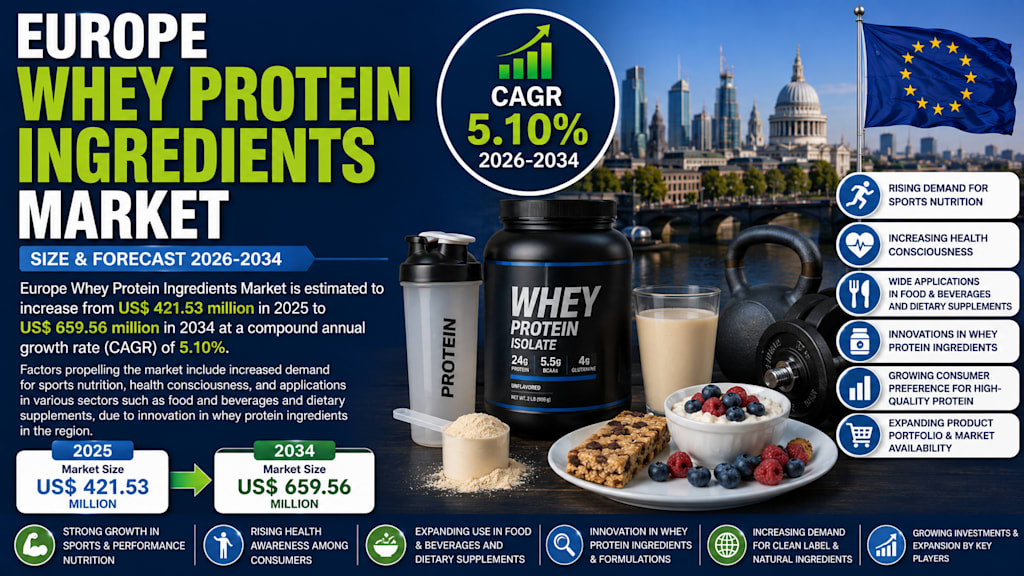
The Europe whey protein ingredients market is expected to witness stable growth over the coming decade as consumers increasingly prioritize protein-rich nutrition, active lifestyles, and functional food products. According to Renub Research, the Europe whey protein ingredients market is projected to grow from US$ 421.53 million in 2025 to US$ 659.56 million by 2034, registering a CAGR of 5.10% from 2026 to 2034. Rising demand for sports nutrition, expanding health consciousness, increasing use of whey proteins in food and beverages, and continuous product innovation are among the key factors driving market growth across Europe.
Whey protein ingredients are premium-quality proteins derived from whey, the liquid byproduct generated during cheese production. Known for their high biological value, rapid absorption rate, and rich amino acid profile, whey proteins are widely used in sports nutrition, dietary supplements, functional foods, ready-to-drink beverages, bakery products, and infant nutrition applications.
The market has evolved significantly in recent years as whey protein moves beyond gym-focused supplements into mainstream consumer diets. Today, whey proteins are increasingly incorporated into everyday food products targeting consumers focused on fitness, wellness, healthy aging, weight management, and preventive healthcare.
Rising Health Awareness Is Driving Protein-Rich Diet Trends
One of the strongest growth drivers for the Europe whey protein ingredients market is the growing awareness surrounding nutrition, preventive healthcare, and balanced diets.
Consumers across Europe increasingly understand the role protein plays in muscle development, metabolism, energy balance, immunity, and overall wellbeing. This has led to rising consumption of protein-enriched foods, beverages, snacks, and meal replacements across multiple age groups.
The report highlights that consumers are becoming more proactive about maintaining healthy lifestyles and preventing lifestyle-related conditions such as obesity and diabetes through improved nutrition choices.
Whey protein ingredients are benefiting strongly from this shift because they offer high-quality protein with excellent digestibility and fast absorption. They are widely perceived as an effective nutritional solution for active individuals, aging populations, and health-conscious consumers.
Government and institutional support for protein diversification is also helping strengthen the broader protein market in Europe. According to the report, the European Commission allocated EUR 12 million through Horizon Europe initiatives to support protein crop breeding and related agricultural studies as part of the Farm-to-Fork strategy.
These developments reflect Europe’s growing emphasis on nutrition innovation, sustainability, and long-term food security.
Sports Nutrition and Fitness Culture Are Accelerating Demand
The rapid growth of fitness culture and active lifestyle adoption across Europe continues to significantly boost demand for whey protein ingredients.
Consumers increasingly participate in gym training, sports activities, wellness programs, and fitness routines, creating stronger demand for protein powders, protein bars, ready-to-drink beverages, and recovery supplements.
Whey protein remains one of the most preferred ingredients within sports nutrition because of its fast absorption, muscle recovery capabilities, and high amino acid concentration.
Importantly, whey protein is no longer consumed exclusively by athletes and bodybuilders. Everyday consumers, including young professionals, students, and older adults, increasingly use protein products as part of healthier daily routines.
Social media fitness trends, wellness influencers, and digital health communities are also contributing to rising awareness surrounding protein consumption and performance nutrition.
The report highlights a major development from March 2025, when BioTechUSA significantly expanded its protein bar manufacturing capacity while introducing two new vitamin supplement product lines.
This expansion demonstrates how companies are investing aggressively to meet rising consumer demand for protein-based wellness products across Europe.
Europe’s Strong Dairy Industry Supports Market Expansion
Europe’s well-established dairy industry provides a major structural advantage for the whey protein ingredients market.
Since whey is a byproduct of cheese manufacturing, Europe’s large dairy production infrastructure ensures a steady and reliable supply of raw materials for whey protein processing.
Advanced dairy-processing technologies across Europe have also enabled the development of highly refined whey protein concentrates, isolates, and hydrolysates designed for different nutritional applications.
Manufacturers continue investing heavily in:
- Improved whey processing technologies
- Higher-purity protein formulations
- Better taste and texture solutions
- Clean-label product development
- Sustainable production systems
- Functional ingredient innovation
The report notes that companies are actively developing whey protein ingredients for use in functional foods, beverages, and therapeutic nutrition products.
Sustainability is also becoming increasingly important. Producers are investing in more environmentally efficient processing systems aimed at reducing waste and minimizing production footprints.
These factors continue strengthening Europe’s position as one of the world’s most advanced whey protein production regions.
Functional Foods and Convenience Nutrition Products Continue Growing
The Europe whey protein ingredients market is also benefiting from growing consumer demand for convenient and functional nutrition products.
Busy lifestyles and increasing wellness awareness are encouraging higher consumption of protein-enriched ready-to-eat foods, beverages, snacks, and meal replacements.
Consumers increasingly prefer products that deliver multiple benefits at once, including convenience, satiety, nutrition, and portability.
As a result, whey proteins are now widely incorporated into:
- Protein beverages
- Functional dairy products
- Breakfast cereals
- Bakery products
- Nutritional snacks
- Yogurts
- Meal replacements
- Clinical nutrition products
Manufacturers continue improving flavor profiles, texture quality, and clean-label positioning in order to attract broader consumer groups beyond athletes.
The report highlights growing demand for whey protein beverages due to rising consumer interest in portable nutrition products that can be consumed anytime and anywhere.
The combination of convenience and high nutritional value continues making whey protein ingredients highly attractive across mainstream food and beverage categories.
Whey Protein Concentrate Maintains Strong Market Presence
The Europe whey protein concentrate market continues experiencing strong demand because of its affordability, versatility, and broad industrial applications.
Whey protein concentrate contains moderate protein levels along with beneficial nutrients such as lactose and fats, making it suitable for multiple food-processing applications.
Its functional properties, including emulsification and texture enhancement, make it widely used across bakery products, dairy foods, nutritional supplements, and processed snacks.
The report notes that whey protein concentrate remains especially popular among beginner fitness consumers and cost-conscious buyers seeking affordable protein solutions.
Europe’s large dairy production capacity ensures stable raw material availability for continued market expansion in this segment.
Functional Foods Segment Is Expanding Rapidly
The Europe functional foods whey protein ingredients market is growing steadily as consumers increasingly seek foods offering additional health benefits.
Protein-enriched foods are becoming highly popular because consumers associate them with muscle support, weight management, energy balance, and healthy aging.
Food manufacturers are aggressively launching innovative products containing whey proteins to attract wellness-oriented consumers.
Clean-label trends are also influencing product development strategies. Consumers increasingly expect better ingredient transparency, natural formulations, and improved taste profiles.
Manufacturers are therefore investing in cleaner ingredient systems, better formulations, and enhanced product quality while maintaining strong nutritional performance.
Elderly Nutrition and Medical Nutrition Markets Are Supporting Long-Term Growth
The Europe elderly nutrition and medical nutrition market is emerging as another major growth area for whey protein ingredients.
Europe’s aging population increasingly requires protein-enriched nutritional products to maintain muscle mass, mobility, strength, and overall physical health.
Healthcare professionals often recommend whey protein products to help prevent malnutrition and support faster recovery among elderly patients.
The report highlights rising demand for protein-rich supplements, clinical nutrition beverages, and specialized dietary products designed specifically for aging consumers.
Advancements in nutritional science are also enabling manufacturers to create more digestible, palatable, and condition-specific products aimed at elderly and medically vulnerable populations.
This segment is expected to remain a strong long-term contributor to overall market growth.
Competition from Plant-Based Proteins Is Increasing
Despite strong growth prospects, the Europe whey protein ingredients market faces increasing competition from plant-based protein alternatives.
Consumers are becoming more conscious of sustainability, environmental concerns, and animal welfare issues, encouraging greater adoption of plant-based diets and flexitarian lifestyles.
Proteins derived from soy, peas, hemp, and other plant sources are gaining popularity as alternatives to dairy-based proteins.
Food manufacturers are expanding plant-protein product portfolios aggressively, increasing competitive pressure across sports nutrition and functional food categories.
The report highlights a major development from June 2025, when Roquette expanded its Nutralys range by launching new textured wheat and pea protein solutions.
Although whey protein continues maintaining strong nutritional advantages, the growth of plant-based proteins represents an important competitive challenge for the industry.
Price Volatility and Dairy Supply Dependence Remain Challenges
Another major challenge facing the Europe whey protein ingredients market is its dependence on dairy supply chains and milk-price fluctuations.
Factors such as feed costs, weather conditions, dairy demand, and international trade conditions can significantly impact whey availability and pricing.
Supply-chain disruptions and logistics challenges may also affect product availability and increase operational costs.
Smaller manufacturers often struggle more than larger companies because they have fewer resources to manage rapid raw-material price fluctuations.
Maintaining stable pricing while preserving profitability remains one of the industry’s key operational challenges.
Germany Remains a Leading Whey Protein Ingredients Market
Germany continues to represent one of Europe’s largest and most advanced whey protein ingredients markets.
The country benefits from a highly developed dairy sector, strong consumer awareness regarding health and fitness, and advanced food-processing capabilities.
German consumers increasingly purchase whey protein products to support active lifestyles, muscle recovery, and healthier eating habits.
The report highlights a notable development from October 2024, when Infinite Roots and Hamburg University of Technology received €2.6 million in government funding to research technologies capable of converting whey into cultivation media for mycelium production.
Such innovation reflects Germany’s growing role in advanced protein technologies and sustainable food production research.
United Kingdom Market Benefits from Fitness and Convenience Trends
The United Kingdom whey protein ingredients market continues expanding due to strong fitness culture and rising demand for convenient nutrition products.
Whey proteins are widely used in protein powders, protein bars, and ready-to-drink beverages targeting consumers focused on wellness and performance nutrition.
The country’s advanced retail infrastructure and strong e-commerce penetration ensure broad accessibility for protein products across urban and regional markets.
The report highlights that in April 2025, More Nutrition expanded into the British market with high-protein, low-sugar nutrition and wellness products aimed at health-conscious consumers.
Innovation in flavors, clean-label formulations, and functional nutrition continues driving strong consumer interest across the UK market.
France Maintains Strong Demand for Premium Whey Protein Products
France’s whey protein ingredients market continues benefiting from the country’s strong dairy heritage and increasing health awareness.
French consumers increasingly seek protein-rich diets for fitness, weight management, and overall wellness purposes.
The report highlights a major innovation example from December 2025, when AFI introduced several high-protein dairy and whey-based beverage concepts at Fi Europe 2025 in Paris.
These included clear high-protein yogurt drinks, hydrolyzed whey beverages containing 25 grams of protein per serving, and flavored carbonated milk-based beverages made with pure whey protein.
France’s strong focus on food quality, taste, and nutritional innovation continues supporting market growth.
Russia Market Expands Through Local Dairy Development
Russia’s whey protein ingredients market is growing steadily as awareness surrounding fitness and health continues increasing among urban consumers.
The food-processing industry increasingly incorporates whey proteins into beverages, dairy products, and nutritional snacks.
Government support for domestic dairy production is helping improve whey supply and strengthen local manufacturing capabilities.
The report highlights that in January 2023, Molvest Group expanded its Kalach facility for intensive milk processing and milk protein concentrate production through investments worth approximately 2 billion rubles.
These investments are helping support long-term development of Russia’s dairy and protein industries.
Key Companies Operating in the Europe Whey Protein Ingredients Market
Major companies operating in the Europe whey protein ingredients market include Arla Foods, Carbery Food Ingredients, Groupe Lactalis, FrieslandCampina, Lactoprot Deutschland, MEGGLE, Morinaga Milk Industry, and Sodiaal.
These companies compete through whey processing technologies, nutritional innovation, clean-label product development, dairy integration, and strong distribution capabilities across Europe.
Final Thoughts
The Europe whey protein ingredients market is steadily evolving as consumers increasingly prioritize health, fitness, convenience, and functional nutrition.
Strong sports nutrition demand, expanding wellness culture, growth in medical and elderly nutrition, and continued innovation in whey-based food products are all contributing to long-term market expansion. According to Renub Research, the market is projected to reach US$ 659.56 million by 2034, highlighting the continued importance of whey protein ingredients within Europe’s evolving nutrition landscape.
However, the industry must also navigate rising competition from plant-based proteins, volatile dairy supply conditions, and increasing sustainability expectations. Companies that successfully combine nutritional performance, innovation, affordability, and environmentally responsible production practices are likely to lead the next phase of growth in Europe’s whey protein ingredients industry.
About the Creator
Enjoyed the story? Support the Creator.
Subscribe for free to receive all their stories in your feed.
Comments
There are no comments for this story
Be the first to respond and start the conversation.