
Europe’s Online Grocery Revolution Is Reshaping How Millions of Consumers Shop for Food
Digital Adoption, Convenience-Driven Lifestyles, and Advanced Delivery Networks Are Fueling Explosive Growth Across Europe’s Online Grocery Market

The retail industry across Europe is undergoing one of the most significant transformations in its history. As consumers increasingly embrace digital lifestyles, online grocery shopping has evolved from a convenient alternative into an essential part of daily life. What was once considered a niche service used by a limited number of consumers is now becoming a mainstream shopping channel that serves millions of households across the continent.
Rapid advancements in internet technology, smartphone penetration, secure payment systems, and sophisticated logistics networks have fundamentally changed how Europeans purchase food and household essentials. Consumers can now browse thousands of products, compare prices, schedule deliveries, and complete purchases from virtually anywhere with a few clicks or taps on a mobile device.
The COVID-19 pandemic accelerated this transformation by introducing online grocery shopping to a broader audience. Many consumers who initially adopted online grocery services out of necessity have continued using them because of the convenience, flexibility, and efficiency they provide. Today, online grocery platforms have become deeply integrated into the European retail ecosystem.
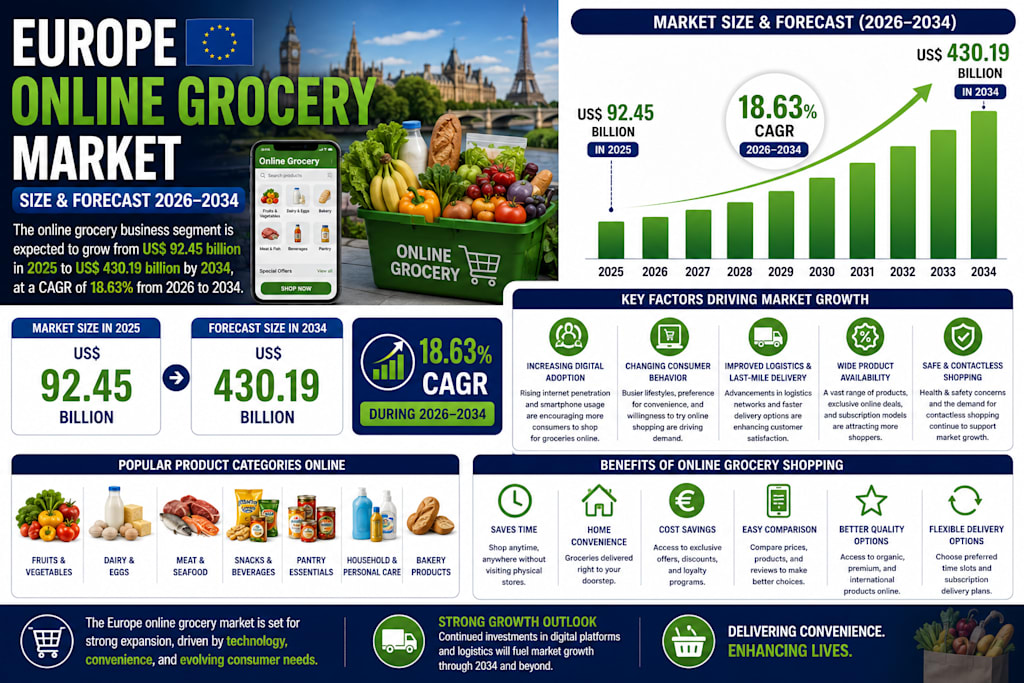
According to Renub Research, the Europe Online Grocery Market is projected to grow from US$ 92.45 billion in 2025 to US$ 430.19 billion by 2034, expanding at a remarkable CAGR of 18.63% between 2026 and 2034. This extraordinary growth reflects the increasing influence of digital commerce, evolving consumer behavior, and continuous improvements in delivery infrastructure throughout the region.
As technology continues reshaping retail experiences, the future of grocery shopping in Europe appears increasingly digital.

The Evolution of Grocery Shopping in Europe
Online grocery shopping combines traditional grocery retail with modern digital technology. Through websites and mobile applications, consumers can purchase fresh produce, dairy products, meat, seafood, snacks, cooking essentials, beverages, and household necessities without visiting physical stores.
The convenience offered by online grocery platforms has become particularly attractive in urban environments where time constraints, traffic congestion, and busy work schedules often make traditional shopping less appealing.
Unlike conventional grocery shopping, online platforms allow consumers to shop around the clock. Whether placing orders late at night, during work breaks, or while commuting, consumers enjoy unprecedented flexibility in managing their grocery needs.
Retailers have responded by creating user-friendly interfaces, personalized recommendations, subscription services, and seamless checkout processes that enhance the overall customer experience.
These improvements have helped online grocery shopping become a preferred option for many European households.
Digital Adoption Is Fueling Market Growth
One of the strongest drivers behind the expansion of Europe's online grocery market is the widespread adoption of digital technology.
Europe has one of the highest internet penetration rates globally, and smartphone ownership continues to rise across all age groups. Consumers are becoming increasingly comfortable conducting financial transactions, communicating, and shopping online.
Retailers have invested heavily in digital transformation initiatives designed to improve convenience and accessibility. Mobile applications, artificial intelligence-driven recommendations, digital loyalty programs, and secure payment systems have enhanced consumer confidence in online shopping.
Countries such as the United Kingdom, Germany, and France have emerged as leaders in digital grocery adoption. However, other European markets are rapidly catching up as internet access expands and digital literacy improves.
Innovation remains a key differentiator. Retailers continue introducing new technologies designed to simplify the customer journey and create competitive advantages.
For example, REWE announced plans to launch its Drive&Go pickup service in Germany during 2026. The service allows customers to collect online grocery orders directly from their vehicles, reducing wait times and enhancing convenience.
As digital ecosystems continue evolving, online grocery adoption is expected to accelerate further throughout Europe.
Convenience Is Changing Consumer Behavior
Consumer lifestyles have changed dramatically over the past decade.
Long working hours, increased workforce participation, urban living, and family responsibilities have created a growing demand for time-saving solutions. Online grocery shopping directly addresses these needs by eliminating many of the inconveniences associated with traditional retail.
Consumers no longer need to travel to stores, search through aisles, or wait in checkout lines. Instead, groceries can be ordered from home and delivered directly to the doorstep.
This convenience is particularly valuable for working professionals, families with children, elderly individuals, and consumers living in densely populated urban areas.
The ability to schedule deliveries according to personal preferences further enhances the appeal of online grocery services.
As modern lifestyles become increasingly busy, convenience is expected to remain one of the most influential factors driving market growth.
Health-Conscious Consumers Are Driving Demand
Health and wellness trends are also contributing significantly to the expansion of Europe's online grocery market.
Consumers are becoming increasingly aware of the importance of nutrition, food quality, and sustainable consumption. As a result, demand for fresh, organic, and locally sourced products continues to rise.
Online grocery retailers have responded by expanding product assortments and providing detailed information regarding sourcing, ingredients, nutritional content, and production methods.
Transparency has become a critical factor in building consumer trust.
Many retailers now collaborate directly with local farmers and producers, ensuring access to fresh seasonal products while supporting regional food systems.
The growing popularity of organic food products has further strengthened online grocery sales. Consumers appreciate the ability to compare products and access specialized dietary options that may not always be available in local stores.
As health-conscious purchasing behavior continues to grow, fresh and organic products are expected to remain important contributors to market expansion.
Logistics Innovation Is Enhancing Service Quality
Behind every successful online grocery order is a sophisticated logistics network designed to ensure products arrive fresh, accurate, and on time.
The development of advanced logistics infrastructure has been one of the most important factors supporting market growth.
Retailers have invested heavily in fulfillment centers, automated warehouses, cold-chain logistics, and route optimization technologies.
These investments help improve operational efficiency while maintaining product quality throughout the delivery process.
Same-day and next-day delivery services have become increasingly common across Europe, raising consumer expectations regarding speed and reliability.
Innovations such as real-time order tracking, contactless delivery, and environmentally friendly transportation methods continue enhancing customer satisfaction.
As logistics capabilities improve, online grocery retailers are becoming better equipped to serve both urban and rural populations.
Home Delivery Is Leading the Market
Home delivery remains one of the most important segments within the European online grocery market.
Consumers increasingly value the convenience of having groceries delivered directly to their homes. This service eliminates travel time and provides greater flexibility for managing busy schedules.
Retailers continue investing in delivery infrastructure to improve speed, reliability, and coverage.
Technological advancements such as route optimization software and predictive demand forecasting have helped reduce operational inefficiencies while improving delivery performance.
Environmental sustainability is also influencing delivery strategies.
Many companies are adopting electric delivery vehicles, reusable packaging solutions, and eco-friendly logistics practices to reduce environmental impact.
As home delivery services become faster and more efficient, this segment is expected to remain a major driver of market growth.
Subscription Services Are Gaining Momentum
Subscription-based grocery services have emerged as another important growth opportunity.
Consumers increasingly appreciate the convenience of receiving recurring deliveries of frequently purchased products such as milk, vegetables, beverages, and household essentials.
Subscription models provide several benefits for both consumers and retailers.
Consumers enjoy automated ordering, cost savings, and reduced shopping effort, while retailers benefit from predictable revenue streams and stronger customer retention.
Artificial intelligence and data analytics are enabling retailers to personalize subscription offerings based on purchasing habits and preferences.
As automation becomes more integrated into daily life, subscription grocery services are expected to play a larger role in shaping the future of online retail.
Product Categories Experiencing Strong Growth
Fresh fruits and vegetables represent one of the fastest-growing segments within Europe's online grocery market.
Consumers increasingly prefer receiving fresh produce directly at home rather than visiting stores. Improvements in cold-chain logistics and packaging technologies have enhanced product quality during transportation, helping build consumer trust.
The dairy segment is also experiencing substantial growth. Products such as milk, yogurt, cheese, butter, and plant-based alternatives are becoming increasingly popular online purchases.
Subscription-based dairy delivery services have further strengthened this category.
Meanwhile, the online snacks segment continues benefiting from changing lifestyles and growing demand for convenient food options. Consumers are increasingly seeking healthier snack alternatives, including gluten-free, high-protein, and low-sugar products.
The availability of international brands and personalized promotions has also contributed to growth within this segment.
Country-Level Market Developments
France remains one of Europe's most important online grocery markets.
French consumers increasingly embrace digital shopping, particularly in urban areas where convenience and time savings are highly valued. Click-and-collect services continue playing a major role in market development.
In January 2026, Instacart and Costco expanded their partnership into Europe by launching same-day delivery services for Costco customers in France and Spain, further strengthening digital grocery infrastructure.
The United Kingdom remains one of the most mature online grocery markets in Europe.
Consumers in the UK have demonstrated high acceptance of digital shopping, supported by advanced delivery networks and strong competition among retailers.
Amazon's launch of its ultra-fast Amazon Now delivery service in selected London areas illustrates the continued innovation occurring within the UK market.
Germany is also experiencing steady growth as consumers gradually embrace online grocery shopping. Urban populations are driving demand, particularly for organic products and convenience-focused services.
Spain continues benefiting from rising internet penetration, changing consumer preferences, and investments in logistics infrastructure that improve delivery capabilities.
Challenges Remain Despite Strong Growth
Despite impressive growth prospects, the European online grocery market continues facing several challenges.
One major obstacle involves logistics complexity and delivery costs. Managing cold-chain infrastructure, transporting perishable goods, and offering rapid delivery services can be expensive.
Retailers must balance consumer expectations regarding delivery speed with operational profitability.
Another challenge involves maintaining consumer trust and product quality.
Unlike traditional retail environments, online shoppers cannot physically inspect products before purchase. Ensuring consistent quality for fresh produce, dairy products, and other perishables requires significant investment in quality control and packaging.
Building and maintaining consumer confidence remains essential for long-term market success.
Final Thoughts
The European online grocery market is entering a period of extraordinary growth fueled by digital innovation, changing lifestyles, and evolving consumer expectations.
According to Renub Research, the market is expected to grow from US$ 92.45 billion in 2025 to US$ 430.19 billion by 2034, highlighting the enormous opportunities emerging across the region.
As retailers continue investing in technology, delivery infrastructure, and customer experience enhancements, online grocery shopping will become increasingly integrated into everyday life.
The future of grocery retail in Europe is no longer centered solely on physical stores. It is being shaped by digital platforms, personalized experiences, sustainable delivery solutions, and a consumer demand for convenience that continues to redefine the retail landscape.
The online grocery revolution is not simply changing how Europeans shop—it is transforming the future of retail itself.
About the Creator
Enjoyed the story? Support the Creator.
Subscribe for free to receive all their stories in your feed.
Comments
There are no comments for this story
Be the first to respond and start the conversation.